BMW i4 Range Miles: EPA Stickers vs Real-World Expectations
The 2025 BMW i4 lineup spans four trims with meaningfully different range figures. If you're researching BMW i4 range miles, here's the exact EPA data from fueleconomy.gov:
- i4 eDrive35 (70.2 kWh usable battery): 301 miles EPA (19-inch wheels) / 282 miles (18-inch)
- i4 eDrive40 (81.5 kWh usable): 307 miles EPA (19-inch) / 318 miles (18-inch)
- i4 M50 (81.5 kWh usable): 270 miles EPA (19-inch) / 245 miles (20-inch M Sport)
- i4 xDrive40 (81.5 kWh usable): 277 miles EPA
All i4 variants use NMC (nickel-manganese-cobalt) lithium-ion cells in a skateboard-style pack under the floor. BMW quotes 10-80% DC fast charging in approximately 31 minutes for the eDrive35 and 31 minutes for the eDrive40/M50, both peaking at up to 205 kW at the charger.
Charging Levels Explained: kW Speeds and Miles Added Per Hour
Understanding charging starts with distinguishing kW (kilowatts — the rate of power flow, like water pressure from a hose) from kWh (kilowatt-hours — the total energy stored, like gallons in a tank). A 200 kW charger doesn't deliver 200 kWh; it delivers energy at a rate of 200 kilojoules per second. The i4 eDrive40's 81.5 kWh battery holds 81.5 kilowatt-hours of energy.
| Level | Voltage / Amperage | Max Power (kW) | Miles of Range Per Hour | Full Charge Time (81.5 kWh) |
|---|---|---|---|---|
| Level 1 (120V household) | 120V / 12A | 1.4 kW | ~4-5 mi/hr | ~58+ hours |
| Level 2 (240V home/public) | 240V / 32-48A | 7.7-11.5 kW | ~25-37 mi/hr | 7-11 hours |
| DC Fast Charge | 400V+ DC | Up to 205 kW (peak) | ~500+ mi/hr (at peak) | 10-80% in ~31 min |
The BMW i4's onboard AC charger accepts up to 11 kW (three-phase) or 7.4 kW (single-phase, which is what nearly all US homes deliver). This means even if you install a 48-amp Level 2 charger capable of 11.5 kW, the i4 will cap AC charging at approximately 7.4 kW on a standard single-phase 240V circuit. This is a critical detail many owners discover only after overspending on charger hardware.
Home Charger Installation: Electrical Requirements, Costs & Panel Upgrades
Installing a Level 2 home charger for your BMW i4 requires a dedicated 240V circuit, typically 40A or 50A, run from your main electrical panel to the charger location. Here's what that actually involves:
Electrical requirements: A 40-amp circuit requires 8 AWG copper wire; a 50-amp circuit requires 6 AWG. The breaker must be rated at 125% of the continuous load (EV charging is classified as continuous by the NEC), so a 32A charger needs a 40A breaker, and a 40A charger needs a 50A breaker. Most modern homes with 200A service panels have sufficient spare capacity. Older homes with 100A panels may need a service upgrade — a significant added cost.
| Component | Low Estimate | High Estimate | Notes |
|---|---|---|---|
| Level 2 charger hardware | $350 | $700 | 32A-48A smart charger |
| Electrician labor (standard install) | $400 | $1,200 | Depends on run length from panel |
| Permit & inspection | $50 | $250 | Varies by municipality |
| Panel upgrade (if needed) | $1,500 | $4,000+ | 100A→200A service upgrade |
| Total (no panel upgrade) | $800 | $2,150 | Most common scenario |
| Total (with panel upgrade) | $2,300 | $6,150 | Older homes, 100A panels |
The IRS Residential Clean Energy Credit (IRC §25C) covers up to 30% of home EV charger equipment and installation costs, capped at $1,000 per year. This can offset $105-$210 of a standard install. Check eligibility with a tax professional — income caps and placement-in-service rules apply.
Connector Compatibility: CCS1, NACS, and the BMW i4
The 2025 BMW i4 uses the CCS1 (Combined Charging System) connector for both AC Level 2 and DC fast charging in North America. BMW has announced that future models will adopt the Tesla NACS (North American Charging Standard) connector, but as of the current model year, the i4 remains CCS1.
| Network / Connector | i4 Compatibility | Adapter Required? | Notes |
|---|---|---|---|
| Electrify America (CCS1) | Native — plug and charge | No | Largest US CCS network |
| EVgo (CCS1) | Native | No | Growing 350 kW stalls |
| Tesla Supercharger (NACS) | Via adapter | Yes — CCS-to-NACS (~$200-$250) | BMW-approved adapters available; not all Superchargers enabled for non-Tesla |
| ChargePoint / Blink (J1772 AC) | Via J1772-to-CCS adapter (included with i4) | Adapter included | For public Level 2 AC only |
| CHAdeMO | Not compatible | No adapter available | Legacy standard (Nissan Leaf); network declining |
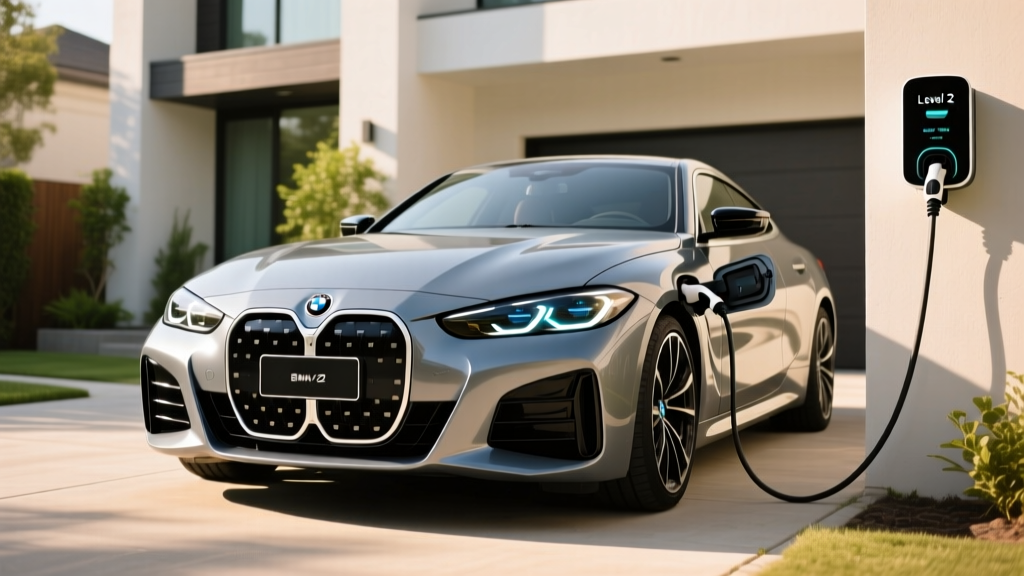
For home charging, the i4 ships with a BMW Flexible Fast Charger that includes swappable 120V (Level 1) and 240V (Level 2, NEMA 14-50 plug) adapters. This works for basic home use but is limited to 32A / 7.7 kW. For faster or smarter home charging, a dedicated wall unit is recommended.
Charging Cost Per Mile: BMW i4 vs Gasoline
The i4 eDrive40 achieves an EPA-rated 105 MPGe combined (32 kWh/100 miles). Let's translate that into actual dollars per mile across common charging scenarios:
| Scenario | Rate ($/kWh) | Cost per 100 Miles | Cost per Mile |
|---|---|---|---|
| Home off-peak (utility TOU rate) | $0.09/kWh | $2.88 | $0.029 |
| Home standard rate | $0.16/kWh | $5.12 | $0.051 |
| Public Level 2 (ChargePoint, etc.) | $0.25/kWh | $8.00 | $0.080 |
| DC Fast Charge (Electrify America) | $0.48/kWh | $15.36 | $0.154 |
| Gasoline comparison (30 MPG @ $3.50/gal) | — | $11.67 | $0.117 |
At home off-peak rates, the i4 costs roughly $0.03 per mile — about one-quarter the fuel cost of a 30 MPG gas car. Even at DC fast-charge rates, the i4 is competitive with gasoline on a per-mile basis. The savings compound: a driver covering 12,000 miles/year paying $0.16/kWh at home spends ~$614 on electricity versus ~$1,400 on gas.
Recommended Home Chargers for the BMW i4
Since the i4 caps AC charging at ~7.4 kW on single-phase power, a 32-amp charger (7.7 kW) is the sweet spot. Going to 48A won't hurt, but you won't see faster charging on the i4 specifically — though it future-proofs for a next EV.
Emporia Vue / Emporia Level 2
- Power: 48A max (11.5 kW), adjustable down to 32A
- Connector: J1772 (CCS adapter included with i4)
- Cable: 24 ft
- Smart features: Wi-Fi, app scheduling, energy monitoring, load management
- Price: ~$399
- Best for: Budget-conscious buyers who want energy tracking
ChargePoint Home Flex
- Power: Up to 50A (12 kW), configurable via dip switch
- Connector: J1772 (NACS version also available)
- Cable: 23 ft
- Smart features: Wi-Fi, Alexa, scheduling, ChargePoint network integration
- Price: ~$599
- Best for: Brand ecosystem and public-network loyalty
Wallbox Pulsar Plus
- Power: 40A (9.6 kW)
- Connector: J1772
- Cable: 25 ft
- Smart features: Wi-Fi + Bluetooth, app control, Power Sharing (daisy-chain two units on one circuit)
- Price: ~$449
- Best for: Compact form factor, two-EV households
For any of these, ensure your electrician installs a NEMA 14-50 receptacle (for plug-in units) or hardwires the charger directly. Hardwired installs are slightly cheaper, eliminate one failure point, and allow up to 48A on a 60A breaker — whereas a NEMA 14-50 outlet is limited to 40A continuous (50A breaker) per NEC code.
Safety, Electrical Code & Key Installation Considerations
EV charging is a continuous, high-draw electrical load — essentially running a clothes dryer for 8 hours straight. Code compliance isn't optional:
- Dedicated circuit: The charger must be on its own dedicated breaker — no sharing with other outlets or appliances.
- GFCI protection: NEC 2020 and later require GFCI protection for all 125V/250V receptacles used for EV charging in garages. Hardwired units are exempt from this specific requirement, which is one reason many electricians prefer hardwiring.
- Outdoor rating: If installing outside, the charger must carry a NEMA 4 or NEMA 4X rating. All three chargers above are outdoor-rated.
- Wire gauge: Undersized wire causes overheating and fire risk. Your electrician will size wire per NEC Table 310.16 based on circuit amperage and run length.
- Permit & inspection: Most jurisdictions require an electrical permit for EV charger installation. Skipping this can void homeowner's insurance coverage in the event of an electrical fire.
BMW i4 DC Fast Charging: The Charge Curve Reality
The i4's advertised 205 kW peak DC fast-charge rate is exactly that — a peak, not a sustained rate. Like all EVs, the i4's charge curve tapers significantly as the battery fills:
- 10-30% SoC: Near peak rate (~180-205 kW), adding ~100 miles in ~10 minutes
- 30-60% SoC: Moderate taper (~120-150 kW), still adding range quickly
- 60-80% SoC: Significant taper (~60-90 kW) — the final 20% to 80 takes longer than the first 20%
- 80-100% SoC: Dramatic taper (~20-40 kW) — charging above 80% on DC is time-inefficient
This is why manufacturers quote 10-80% times (~31 minutes for the i4) rather than 0-100%. On a road trip, plan your stops around the 10-80% window for maximum time efficiency. Charging from 80-100% on DC can add 20+ minutes for relatively few miles.
Preconditioning the battery before arriving at a DC fast charger is essential for achieving peak rates. The i4's navigation system will automatically precondition the battery when a DC fast charger is set as your destination — always use this feature, especially in cold weather. Arriving at a charger with a cold battery can cut your peak charge rate in half.
Frequently Asked Questions
How much does it cost to install a home EV charger for the BMW i4?
Expect $800-$2,150 for a standard installation (charger hardware + electrician labor + permit) if your electrical panel has sufficient capacity. If your home has an older 100A panel that needs upgrading to 200A, add $1,500-$4,000+. Get at least three quotes from licensed electricians — prices vary significantly by region and run complexity.
How fast will each charging level add range to my i4?
Level 1 (120V) adds about 4-5 miles of range per hour — sufficient only for emergency top-ups or very low-mileage drivers. Level 2 (240V, 32A) adds roughly 25-30 miles per hour, fully replenishing the i4 eDrive40 overnight. DC fast charging at peak rates can add 100+ miles in 10 minutes, tapering as the battery fills.
Which connector and charger is compatible with the BMW i4?
The i4 uses CCS1 for DC fast charging and J1772 for AC Level 2 (the CCS1 connector includes J1772 pins). Most public Level 2 stations use J1772 plugs, which connect to the i4's CCS port via the adapter BMW includes. For Tesla Superchargers, you'll need a BMW-approved CCS-to-NACS adapter (~$200-$250).
How much does charging the BMW i4 cost per mile versus a gas car?
At home on a standard $0.16/kWh rate, the i4 costs roughly $0.05/mile. A comparable 30 MPG gas car at $3.50/gallon costs about $0.12/mile — more than double. Off-peak home charging drops the i4 to ~$0.03/mile. DC fast charging at $0.48/kWh costs ~$0.15/mile, slightly more than gas, which is why home charging is the economic sweet spot.
What electrical upgrades might I need before installing a charger?
If your home has a 200A electrical panel with spare breaker slots, you likely need only a new dedicated 40A or 50A circuit. If your panel is 100A, fully loaded, or uses an obsolete brand (e.g., Federal Pacific, Zinsco), you'll need a panel upgrade ($1,500-$4,000+). Some utilities offer load-management devices that let you add a charger without a panel upgrade by throttling charger draw when other appliances are running — ask your electrician about this option.