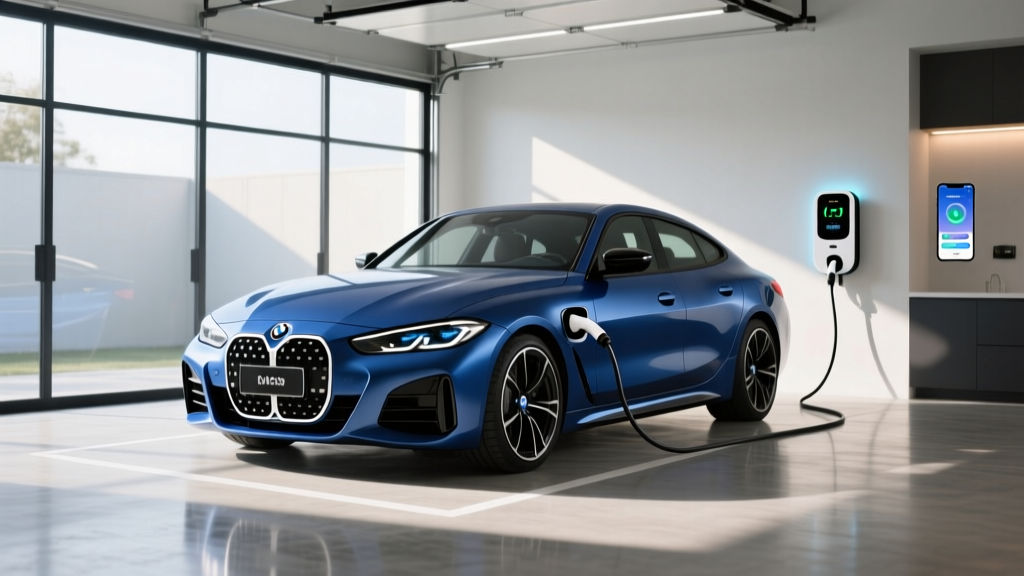
If you own a BMW i4—or are shopping for one—the vehicle's EPA-estimated range is only half the equation. The other half is how quickly and cheaply you can replenish that battery at home. The 2026 BMW i4 lineup spans from the eDrive35 to the M50, with EPA range estimates stretching from roughly 269 miles (M50 xDrive) to 307 miles (eDrive40), depending on trim and wheel size. But realizing that range day-to-day depends entirely on your charging setup.
This guide breaks down exactly how to charge a BMW i4 at home and on the road: what each charging level adds in real miles per hour, what your electrical panel can handle, what installation actually costs, and which Level 2 chargers pair best with the i4's 81.5 kWh (usable) battery pack. We'll also run the cost-per-mile math against a gas equivalent so you can see where the savings land.
BMW i4 Range and Battery Specs at a Glance
Before sizing a charger, you need to know what you're filling. The BMW i4 uses an 81.5 kWh usable lithium-ion NMC battery pack across all trims. The vehicle's onboard charger accepts up to 11 kW on Level 2 AC, and up to 200 kW on DC fast charge (eDrive40/M50; the eDrive35 peaks at 180 kW).
| Trim | EPA Range | Battery (usable) | Max AC Charge | Max DC Charge | 10–80% DC | 0–60 mph | Base MSRP |
|---|---|---|---|---|---|---|---|
| eDrive35 | 269 mi | 81.5 kWh (NMC) | 11 kW | 180 kW | ~31 min | 5.8s | $52,800 |
| eDrive40 | 307 mi | 81.5 kWh (NMC) | 11 kW | 200 kW | ~28 min | 5.5s | $57,900 |
| M50 xDrive | 269 mi | 81.5 kWh (NMC) | 11 kW | 200 kW | ~28 min | 3.7s | $69,900 |
Charging Levels Explained: kW, Speed, and What They Mean for Your i4
The single most common EV mistake is confusing kW (kilowatts, a measure of power or charge rate) with kWh (kilowatt-hours, a measure of energy or battery capacity). Think of kW as the diameter of the pipe filling a water tank measured in gallons (kWh). A bigger pipe fills the tank faster, but the tank size stays the same.
| Level | Voltage / Amps | Power (kW) | Miles of Range per Hour | Full 0–100% Time (81.5 kWh) | Typical Use |
|---|---|---|---|---|---|
| Level 1 | 120V / 12A | 1.4 kW | ~4–5 mi/hr | ~58 hours | Emergency / trickle |
| Level 2 (basic) | 240V / 32A | 7.7 kW | ~25–28 mi/hr | ~10.5 hours | Home (older installs) |
| Level 2 (optimal) | 240V / 48A | 11.5 kW | ~37–40 mi/hr | ~7.5 hours | Home (recommended) |
| DC Fast | 400V+ DC | 180–200 kW | ~550–650 mi/hr (peak) | 10–80% in ~28 min | Road trips |
Because the BMW i4's onboard AC charger maxes out at 11 kW, installing a 48-amp Level 2 circuit (which delivers up to 11.5 kW) lets you capture the car's full AC charging capability. A 32-amp charger will work, but you'll leave ~30% of available charging speed on the table—meaning an overnight charge adds roughly 220 miles instead of 310.
Home Charger Installation: Electrical Requirements and Costs
A Level 2 home charger requires a dedicated 240-volt circuit, similar to what an electric dryer or oven uses. For a 48-amp charger, electrical code (NEC 2023/2026) requires the circuit breaker to be rated at 125% of the continuous load, meaning you need a 60-amp breaker. A 32-amp charger needs a 40-amp breaker.
What Your Electrical Panel Can (and Can't) Handle
Most modern homes with a 200-amp main panel can accommodate a 60-amp EV circuit without a panel upgrade. However, older homes with 100-amp service, or homes already running multiple large loads (electric heat, tankless water heater, double oven), may need a panel upgrade to 200 amps—or a smart load-management device that throttles the charger when other circuits are drawing heavily.
A licensed electrician will perform a load calculation (per NEC Article 220) before recommending a circuit size. Do not skip this step: an overloaded panel is a fire hazard and will fail inspection.
Installation Cost Breakdown
| Item | Low End | High End | Notes |
|---|---|---|---|
| Level 2 charger (hardware) | $400 | $750 | 48A smart charger, 25-ft cable |
| Electrician labor (run + mount) | $500 | $1,500 | Depends on panel-to-garage distance |
| Electrical materials (wire, conduit, breaker) | $150 | $400 | 6 AWG copper for 60A circuit |
| Permit and inspection | $50 | $250 | Varies by municipality |
| Panel upgrade (if needed) | $1,500 | $3,500 | 100A → 200A service upgrade |
| Total (no panel upgrade) | $1,100 | $2,900 | Most typical installs |
| Total (with panel upgrade) | $2,600 | $6,400 | Older homes |
Many utility companies offer rebates of $200–$500 for Level 2 charger installation, and some states provide additional incentives. The federal Alternative Fuel Vehicle Refueling Property Credit (§30C) can cover up to 30% of installation costs (max $1,000 for residential), subject to census-tract eligibility. Check current rules at irs.gov.
Which Connector Does the BMW i4 Use? Compatibility and Adapters
As of the 2026 model year, the BMW i4 comes equipped with a CCS1 (Combined Charging System) port for both AC Level 2 and DC fast charging in North America. BMW has announced that future models will transition to the NACS (North American Charging Standard, i.e., Tesla's connector), but the current i4 generation retains CCS1.
| Charging Scenario | Connector Needed | Adapter Required? |
|---|---|---|
| Home Level 2 (J1772) | CCS1 (top section) | No — J1772 plugs into CCS1 natively |
| Public CCS DC fast charger | CCS1 | No |
| Tesla Supercharger (NACS) | NACS | Yes — BMW-approved CCS-to-NACS adapter (~$200–$250) |
| CHAdeMO station | CHAdeMO | No — CHAdeMO-to-CCS adapters are rare/expensive; avoid |
Key takeaway: For home charging, any J1772 Level 2 charger works natively with the i4's CCS1 port. For road trips, a CCS-to-NACS adapter unlocks Tesla's Supercharger network (now open to non-Tesla vehicles via adapter), dramatically expanding your DC fast-charging options. BMW has confirmed compatibility with Tesla Superchargers using a certified adapter; check BMW's official charging page for the latest approved adapter list.
Recommended Level 2 Chargers for the BMW i4
Since the i4 accepts up to 11 kW on AC, you want a 48-amp charger on a 60-amp circuit to capture its full charging speed. Here are three proven options that match the i4's capabilities:
ChargePoint Home Flex
Power: Up to 12 kW (50A) — i4 will draw 11 kW
Connector: J1772 (fits CCS1 natively)
Cable: 23 ft
Smart features: Wi-Fi, app scheduling, Alexa, load sharing
Price: ~$550–$650
Why it works: Amperage is adjustable via DIP switches, so you can set it to 48A on a 60-amp circuit. Excellent app with charge-cost tracking.
Emporia Level 2 EV Charger
Power: Up to 11.5 kW (48A)
Connector: J1772
Cable: 24 ft
Smart features: Wi-Fi, app, energy monitoring, solar integration
Price: ~$400–$450
Why it works: Best value for a full 48A charger. Built-in energy monitoring pairs well with solar owners. NEMA 4 outdoor rated.
BMW Wallbox (OEM)
Power: Up to 11 kW (48A)
Connector: J1772
Cable: 25 ft
Smart features: Wi-Fi, BMW app integration, scheduled charging
Price: ~$600–$700
Why it works: Seamless integration with BMW's My BMW app and vehicle preconditioning. Aesthetic match for BMW owners willing to pay a slight premium.
Charging Cost: Home vs. Public vs. Gas Equivalent
The BMW i4 eDrive40 achieves an EPA-rated 99 MPGe combined (roughly 34 kWh per 100 miles). Let's translate that into real dollars per mile across different charging scenarios and compare it to a gas equivalent—a BMW 330i sedan rated at 30 MPG combined.
| Scenario | Rate | Cost per 100 Miles | Cost per Mile |
|---|---|---|---|
| Home (off-peak, $0.12/kWh) | $0.12/kWh | $4.08 | $0.041 |
| Home (standard, $0.18/kWh) | $0.18/kWh | $6.12 | $0.061 |
| Public Level 2 ($0.30/kWh) | $0.30/kWh | $10.20 | $0.102 |
| DC Fast Charging ($0.45/kWh) | $0.45/kWh | $15.30 | $0.153 |
| BMW 330i Gas ($3.60/gal, 30 MPG) | $3.60/gal | $12.00 | $0.120 |
The math is clear: Charging at home during off-peak hours costs roughly one-third what gasoline costs per mile. Even public DC fast charging at premium rates is only slightly more expensive than gas. An i4 owner who charges 80% at home and 20% on DC fast chargers will spend approximately $7.15 per 100 miles—saving roughly $4.85 per 100 miles versus the 330i. Over 15,000 annual miles, that's about $727 in annual fuel savings.
Safety, Code, and Smart Installation Practices
A Level 2 charger is a continuous high-amperage load that runs for hours—often overnight while you sleep. Proper installation is non-negotiable.
- Dedicated circuit: Your EV charger must be on its own dedicated breaker. Never share the circuit with other appliances.
- GFCI protection: NEC 2023 and 2026 editions require GFCI protection for all EV receptacles (if using a plug-in charger on a NEMA 14-50 outlet). Hardwired chargers are exempt from GFCI requirements in most jurisdictions, and hardwiring eliminates a common nuisance-trip failure point.
- Outdoor rating: If your charger is mounted outside or in an unenclosed carport, it must carry a NEMA 4 (or IP65+) weather rating. All three chargers recommended above meet this standard.
- Cable management: A 25-foot cable is heavy. Use a cable organizer or holster to prevent tripping hazards and connector strain.
- Permit and inspection: Most jurisdictions require an electrical permit for a new 240V circuit. The inspection ensures the wire gauge, breaker size, and grounding meet code. Skipping the permit can void homeowner's insurance coverage for electrical fires.
Frequently Asked Questions
How much does it cost to install a home EV charger for the BMW i4?
A typical 48-amp Level 2 installation runs $1,100 to $2,900 all-in (charger, electrician, materials, permit) if your panel has capacity. Homes needing a 100A-to-200A panel upgrade should budget $2,600 to $6,400 total. Utility rebates and the federal §30C credit can offset $300–$1,000 of that cost.
How fast will each charging level add range to the i4?
Level 1 (120V) adds about 4–5 miles of range per hour—only useful for overnight top-offs of 40–50 miles. Level 2 at 48 amps adds roughly 37–40 miles per hour, enough to fully recharge the i4's 81.5 kWh battery in about 7.5 hours. DC fast charging at 200 kW can add 180+ miles in 15 minutes during the peak portion of the charge curve.
Which connector and charger are compatible with my BMW i4?
The i4 uses a CCS1 port. Any J1772 Level 2 charger plugs directly into the top portion of the CCS1 inlet—no adapter needed. For Tesla Superchargers, you'll need a BMW-approved CCS-to-NACS adapter. Avoid CHAdeMO stations; adapters are impractical and expensive.
How much does charging cost per mile compared to gas?
At home on off-peak electricity ($0.12/kWh), the i4 costs about $0.04 per mile. A comparable BMW 330i at $3.60/gallon and 30 MPG costs $0.12 per mile. That's a three-fold savings for home charging. Even the most expensive DC fast charging ($0.45/kWh) at $0.15/mile is competitive with gasoline.
What electrical upgrades might I need for a Level 2 charger?
You need a dedicated 240V circuit with a 60-amp breaker (for a 48A charger). If your home has a 200-amp panel with available capacity, no upgrade is needed. If you have 100-amp service or a heavily loaded panel, expect a $1,500–$3,500 panel upgrade. A smart load-management device ($200–$400) can sometimes avoid a panel upgrade by dynamically reducing charger draw when other circuits are active.