BMW i4 M50 Range: EPA Sticker vs Real-World Expectations
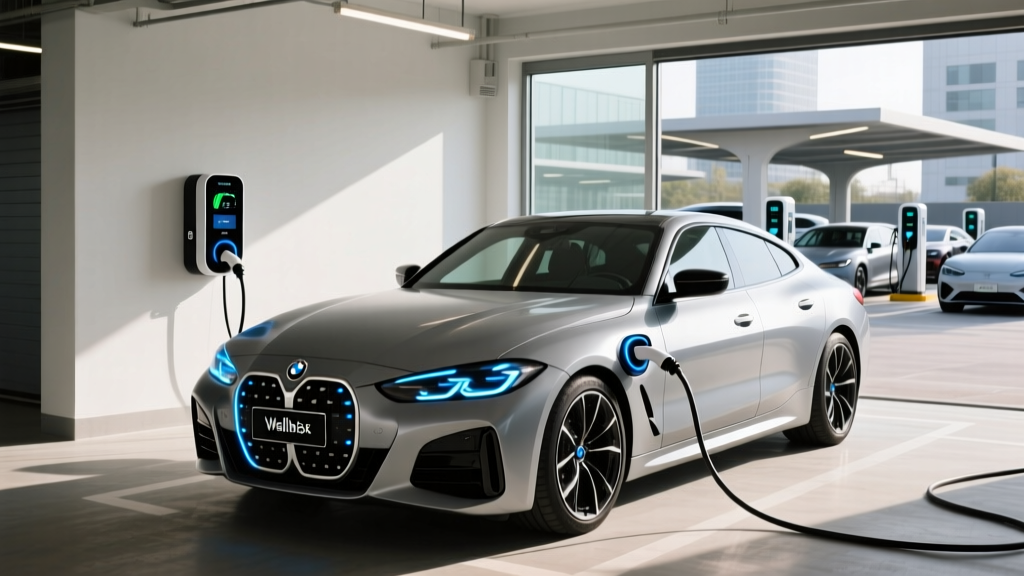
The BMW i4 M50 is the performance-oriented dual-motor variant of BMW's electric Gran Coupe, producing 536 horsepower (400 kW) and rocketing from 0-60 mph in approximately 3.7 seconds. But buyers shopping the i4 M50 want to know one thing first: how far can it actually go?
The EPA rates the 2025/2026 BMW i4 M50 at 245 miles of combined range on its 81.5 kWh usable battery pack (NMC chemistry, total pack ~83.9 kWh). Efficiency lands at approximately 31 kWh/100 mi (or roughly 109 MPGe combined), per fueleconomy.gov.
- EPA combined: 245 miles
- Highway (70 mph sustained): ~210–225 miles
- Cold weather (below 32°F): ~175–200 miles (expect 20–30% loss)
- City/regen-heavy driving: ~250–260 miles
The M50's dual-motor AWD, heavier curb weight (~4,900 lbs), and stickier performance tires all work against highway efficiency compared to the single-motor i4 eDrive40 (EPA 301 mi).
| Spec | Value |
|---|---|
| EPA Range | 245 mi |
| Battery (usable) | 81.5 kWh, NMC |
| Max DC Fast Charge | 200 kW (peak) |
| 10–80% DCFC Time | ~31 minutes |
| Level 2 (AC) Max | 11 kW (onboard charger) |
| Horsepower | 536 hp (400 kW) |
| 0–60 mph | 3.7 sec |
| Efficiency | 31 kWh/100 mi (109 MPGe) |
| Base MSRP (2025) | ~$69,700 |
| Battery Warranty | 8 yr / 100,000 mi |
Charging the BMW i4 M50: Level 1, Level 2, and DC Fast Charging
The i4 M50 supports three charging tiers. Understanding the difference between kW (power, or how fast energy flows) and kWh (energy, or how much the battery holds) is essential. Think of kW as the speed of water from a hose and kWh as the size of the bucket.
| Level | Power (kW) | Miles Added/Hour | 0–100% Time | Use Case |
|---|---|---|---|---|
| Level 1 (120V) | ~1.4 kW | ~3–4 mi/hr | ~58 hours | Emergency / overnight trickle |
| Level 2 (240V, 48A) | 11 kW (max) | ~30–35 mi/hr | ~7.5 hours | Daily home charging |
| DC Fast (CCS/NACS) | Up to 200 kW | ~600+ mi/hr (peak) | 10–80% in ~31 min | Road trips, quick top-ups |
The i4 M50's onboard AC charger caps at 11 kW, meaning even if your home wallbox is rated for 48 amps (11.5 kW), the car will only accept about 11 kW (roughly 46 amps). A 40-amp circuit / 32-amp continuous charger still delivers roughly 7.7 kW — adequate for overnight replenishment but slower than the car's maximum.
DC Fast Charging Curve Reality
BMW advertises a 200 kW peak DC fast charge rate. In practice, the i4 M50 sustains roughly 175–200 kW from 10–40% State of Charge, then tapers progressively. By 60% SoC, power drops to ~120 kW; above 80%, it falls below 50 kW. This is why the 10–80% time of ~31 minutes is the meaningful metric — charging from 80–100% can add another 30+ minutes. For road trips, plan stops around the 10–80% window for maximum efficiency.
Home Charger Installation: Electrical Requirements & Costs
To unlock the i4 M50's full 11 kW Level 2 charging capability, you need a 240V circuit with at least a 60-amp breaker (to support continuous 48-amp charging under NEC 80% rule). Here is what a typical installation involves.
Electrical Requirements
- Voltage: 240V (split-phase, standard US residential)
- Amperage: 48A continuous draw requires a 60A breaker
- Wire gauge: 6 AWG copper (or 4 AWG aluminum for longer runs)
- Dedicated circuit: Required — cannot share with other appliances
- GFCI protection: Required by NEC 2020+ for EV receptacles (hardwired units may exempt in some jurisdictions)
| Component | Simple Install (panel nearby) | Complex Install (long run / panel upgrade) |
|---|---|---|
| Level 2 Charger (48A, hardwired) | $500–$750 | $500–$750 |
| Electrician labor (2–4 hrs @ $100–$150/hr) | $300–$600 | $800–$2,000 |
| Electrical permit | $50–$150 | $50–$200 |
| Conduit, wire, misc materials | $50–$150 | $200–$500 |
| Electrical panel upgrade (100A → 200A) | $0 (not needed) | $1,500–$3,500 |
| Total Estimated Cost | $900–$1,650 | $3,050–$6,950 |
Panel upgrade reality check: Homes built before the 1990s often have 100-amp or even 60-amp electrical panels. Adding a 60-amp EV circuit to an already-loaded 100A panel may require a service upgrade to 200A. Budget $1,500–$3,500 for this work, and factor in utility coordination time (2–6 weeks in some areas). Always have a licensed electrician perform a load calculation before committing to a charger amperage.
Connector Compatibility: CCS, NACS, and the BMW i4
The BMW i4 M50 sold in North America through 2025 ships with a CCS1 (Combined Charging System) port. BMW has announced that future models will transition to the NACS (North American Charging Standard / Tesla) connector, and BMW now provides or supports NACS adapters for access to Tesla Supercharger stations.
| Connector | Native? | Adapter Needed? | Networks |
|---|---|---|---|
| CCS1 | Yes (native port) | No | Electrify America, EVgo, ChargePoint, Ionity |
| NACS (Tesla) | No (CCS vehicle) | Yes — CCS-to-NACS adapter (~$200–$300) | Tesla Supercharger (V3/V4) |
| J1772 (Level 2 AC) | Yes (upper portion of CCS) | No | All public Level 2 stations |
| CHAdeMO | No | Not available | Legacy Nissan Leaf network (declining) |
Adapter tip: BMW has been rolling out CCS-to-NACS adapters to enable Supercharger access. Confirm with your dealer whether one is included with your i4 M50 or available for purchase. Third-party adapters from brands like Lectron are also available, but verify they are rated for the full 200 kW DC fast charge rate to avoid throttling your charge speed.
Level 2 Home Charger Recommendations for the BMW i4 M50
Since the i4 M50 accepts up to 11 kW AC, a 48-amp (hardwired) or 40-amp (NEMA 14-50 plug) Level 2 charger is the sweet spot. Here are top picks that match the car's capabilities:
ChargePoint Home Flex
- Power: Up to 12 kW (50A), adjustable down
- Connector: J1772 (CCS-compatible)
- Cable: 23 ft
- Smart features: Wi-Fi, app scheduling, load sharing, Alexa
- Install: Hardwired or NEMA 14-50
- Price: ~$550–$650
Tesla Wall Connector (Universal)
- Power: Up to 11.5 kW (48A)
- Connector: NACS + J1772 adapter included
- Cable: 24 ft
- Smart features: Wi-Fi, OTA updates, power sharing
- Install: Hardwired only
- Price: ~$600
Emporia Level 2 EV Charger
- Power: Up to 11.5 kW (48A)
- Connector: J1772
- Cable: 24 ft
- Smart features: Energy monitoring, solar integration, app control
- Install: Hardwired or NEMA 14-50
- Price: ~$350–$400 (budget pick)
Any of these chargers will fully replenish the i4 M50's 81.5 kWh battery overnight. The ChargePoint Home Flex is a strong all-rounder; the Emporia is the value pick with excellent energy-monitoring for solar owners.
Charging Cost: Home vs Public vs Gas — Cost Per Mile
The i4 M50 consumes approximately 31 kWh per 100 miles. Using that figure, here is what charging costs look like across scenarios — and how it compares to a gas equivalent like the BMW M440i xDrive Gran Coupe (EPA ~28 MPG combined).
| Scenario | Rate | i4 M50 Cost/Mile | M440i Gas Cost/Mile |
|---|---|---|---|
| Home (off-peak utility rate) | $0.10/kWh | $0.031 | $0.13 (at $3.70/gal, 28 MPG) |
| Home (national avg residential) | $0.17/kWh | $0.053 | $0.13 |
| Public Level 2 (network pricing) | $0.30/kWh | $0.093 | $0.13 |
| DC Fast Charging (Electrify America) | $0.48/kWh | $0.149 | $0.13 |
| Tesla Supercharger (V3, avg) | $0.35/kWh | $0.109 | $0.13 |
The takeaway: Home charging at off-peak rates makes the i4 M50 roughly 75% cheaper per mile than its gas counterpart. Even public DC fast charging is competitive with gasoline. However, if you rely exclusively on expensive public DCFC, your per-mile cost can exceed gas — home charging access is the economic linchpin of EV ownership.
Charging time examples for the i4 M50's 81.5 kWh battery:
- 10–80% at 200 kW DCFC: ~31 minutes (~57 kWh added)
- 10–80% at 150 kW DCFC: ~38 minutes
- 10–80% at 50 kW DCFC: ~90 minutes
- 0–100% at 11 kW Level 2: ~7.5 hours
- 0–100% at 7.7 kW Level 2 (40A circuit): ~10.5 hours
Safety, Code Compliance & Installation Best Practices
EV charging installation is not a DIY project. Here is what the National Electrical Code (NEC) and common best practices require:
- Dedicated circuit: Your Level 2 charger must have its own breaker — no shared circuits with dryers, ovens, or HVAC.
- GFCI protection: NEC 2020 Article 625.54 requires GFCI protection for all EV receptacles (NEMA 14-50 outlets). Hardwired chargers may be exempt in some jurisdictions but are generally safer.
- Outdoor rating: If installing outside, ensure the charger carries a NEMA 4 or IP65 rating for weather resistance. All recommended chargers above qualify.
- Permit & inspection: Most jurisdictions require an electrical permit ($50–$200) and a post-install inspection. Skipping this risks insurance claim denials and code violations.
- Wire sizing: Undersized wire is a fire hazard. A 48A continuous load requires 6 AWG copper minimum; longer runs (>50 ft) may need 4 AWG to limit voltage drop.
- Load calculation: A licensed electrician will perform a NEC Article 220 load calculation to verify your panel can handle the additional 60A circuit. If it cannot, a panel upgrade or a lower-amperage charger (e.g., 32A / 40A breaker) may be necessary.
Frequently Asked Questions
How much does it cost to install a home EV charger for the BMW i4 M50?
A straightforward Level 2 installation (panel nearby, short wire run, no panel upgrade) typically costs $900–$1,650 including the charger, electrician labor, materials, and permit. If your home needs a panel upgrade from 100A to 200A, total costs can reach $3,000–$7,000. Get at least two quotes from licensed electricians.
How fast will each charging level add range to the i4 M50?
Level 1 (120V) adds roughly 3–4 miles per hour — essentially unusable for daily driving. Level 2 (240V, 48A) adds about 30–35 miles per hour and can fully charge overnight. DC fast charging at up to 200 kW can add ~180 miles in 15 minutes (10–50% SoC) or reach 80% in about 31 minutes.
Which connector and charger are compatible with my BMW i4 M50?
The i4 M50 uses a CCS1 connector natively for DC fast charging and J1772 for Level 2 AC. To access Tesla Superchargers, you will need a CCS-to-NACS adapter. Any J1772 or CCS-compatible Level 2 home charger will work — choose one rated for 48A to maximize the car's 11 kW onboard charger.
How much does charging cost per mile compared to gas?
At home on off-peak electricity ($0.10/kWh), the i4 M50 costs about $0.031/mile — roughly 75% less than a comparable gas BMW. On the national average residential rate ($0.17/kWh), it is about $0.053/mile. Public DC fast charging at $0.48/kWh pushes cost to ~$0.15/mile, which is comparable to or slightly above gasoline.
What electrical upgrades might I need for a home charger?
Homes with 100-amp electrical panels or limited breaker spaces may need a panel upgrade to 200 amps ($1,500–$3,500). Older wiring may require replacement. If your garage is far from the panel, longer conduit and wire runs add cost. Some homeowners opt for a lower-amperage charger (32A on a 40A breaker) to avoid a panel upgrade — this still adds ~22 miles per hour of charging, sufficient for most daily needs.
Does the BMW i4 M50 qualify for the federal EV tax credit?
Under current IRS §30D rules, the i4 M50's MSRP (~$69,700) exceeds the $55,000 sedan cap, making it ineligible for the $7,500 federal clean vehicle credit. Some state-level incentives may still apply — check your state's energy office or fueleconomy.gov for details. Tax rules change; always confirm with a tax professional.