BMW i4 eDrive40 Range: What the EPA Number Doesn't Tell You
The 2025 BMW i4 eDrive40 carries an EPA-estimated 301 miles of range on its 81.5 kWh (usable) battery pack. That figure applies to the eDrive40 trim with 18-inch wheels; stepping up to 19-inch or 20-inch alloys drops the EPA estimate to roughly 270–282 miles. The single rear motor produces 335 horsepower and 317 lb-ft of torque, launching the gran coupe to 60 mph in about 5.5 seconds.
EPA: 301 mi (18" wheels) | Highway (70 mph sustained): ~255–270 mi | Cold weather (below 32°F): ~220–245 mi | Combined mixed driving: ~275–290 mi. The i4's heat pump helps mitigate winter losses compared to resistive heating, but any EV loses 15–30% range in freezing temps.
The battery uses NMC (nickel manganese cobalt) chemistry, which offers higher energy density than LFP but benefits from keeping state of charge between 20–80% for daily driving to minimize long-term degradation. BMW warranties the high-voltage pack for 8 years or 100,000 miles against capacity loss below 70% of original, per BMW USA's battery and charging documentation.
But extracting maximum value from those 301 EPA miles means charging smartly — and that starts with understanding how the i4 actually accepts electrons.
Charging Levels Explained: kW, Miles Per Hour, and Your i4
The single most common confusion for new EV owners is the difference between kW (power — how fast energy flows) and kWh (energy — how much the battery holds). Think of kW as the width of a hose and kWh as the size of the bucket. Your i4's battery is an 81.5 kWh bucket; the charging level determines how wide the hose is.
| Charging Level | Voltage / Amperage | Power (kW) | Miles Added Per Hour | Best For |
|---|---|---|---|---|
| Level 1 (Standard Outlet) | 120V / 12A | ~1.4 kW | ~4–5 mi/hr | Emergency top-up, PHEVs |
| Level 2 (Home / Workplace) | 240V / 32–48A | 7.7–11.5 kW | ~25–38 mi/hr | Daily home charging |
| DC Fast Charging | 400–800V DC | 50–205 kW peak | ~150–600 mi/hr (peak) | Road trips, rapid top-up |
The BMW i4 eDrive40 has an onboard AC charger rated at 11 kW (three-phase capable, but in US residential single-phase 240V service, expect about 7.7–9.6 kW depending on the circuit). On DC fast charging, the i4 peaks at approximately 205 kW, which BMW rates at a 10–80% charge in about 31 minutes under ideal thermal conditions.
That 205 kW is a peak, not a sustained rate. The actual charge curve tapers significantly above 50% SoC. Expect roughly 180–205 kW between 10–30%, dropping to ~150 kW by 50%, ~100 kW by 65%, and below 50 kW once you cross 80%. This is why most EV owners charge to 80% on road trips and move on rather than waiting for a full battery.
Home Charger Installation: Costs, Electrical Requirements, and Gotchas
For the BMW i4 eDrive40, a properly installed Level 2 home charger is the backbone of ownership. Here's what's involved.
Electrical Requirements
To deliver the i4's maximum AC charge rate, you need a 240V dedicated circuit rated for 48–50 amps. Per National Electrical Code (NEC), continuous loads (which EV charging qualifies as) must not exceed 80% of the circuit rating. That means:
- A 50-amp breaker delivers up to 40A continuous (9.6 kW at 240V)
- A 60-amp breaker delivers up to 48A continuous (11.5 kW at 240V)
- Wire gauge: 6 AWG copper for 50A circuits; 4 AWG for 60A
The i4's 11 kW onboard charger maxes out around 48A, so a 60-amp circuit is the optimal home setup to extract full Level 2 speed.
Panel Upgrade Reality
Most modern homes have a 200-amp main panel, which typically supports a 50–60A EV circuit without issue. However, if your panel is already near capacity (large HVAC, electric oven, dryer, pool heater), you may need a panel upgrade to 200A or even 400A, or a load-management device like the Emporia Smart Load Management system that dynamically throttles the charger when other high-draw appliances kick on.
| Item | Typical Cost Range | Notes |
|---|---|---|
| Level 2 Charger (Equipment) | $350–$750 | Smart Wi-Fi chargers; basic units from ~$250 |
| Electrician Labor (standard install) | $500–$1,500 | Short run from panel to garage; longer runs cost more |
| Electrical Permit | $50–$250 | Varies by municipality; some waive for EV installs |
| Panel Upgrade (if needed) | $1,500–$4,000 | 200A to 400A upgrade; not required for most homes |
| Conduit & Wiring (long runs) | $200–$800 | Adds ~$5–$15/ft for runs over 50 ft from panel |
| Total (no panel upgrade) | $900–$2,500 | Most common scenario for 200A-panel homes |
| Total (with panel upgrade) | $2,500–$6,000+ | Older homes with 100A or 150A panels |
The IRS and many utilities offer incentives that can offset installation. The federal Alternative Fuel Vehicle Refueling Property Credit (§30C) covers up to 30% of home charging equipment and installation costs, capped at $1,000, per IRS guidelines. Check your utility as well — many offer $250–$500 rebates for smart charger installations.
Connector Compatibility: CCS, NACS, and the i4's Transition
The BMW i4 eDrive40 sold for model years 2022–2024 came equipped with a CCS1 (Combined Charging System) port, which handles both AC Level 2 and DC fast charging through a single inlet. For the 2025–2026 model years, BMW has transitioned to the NACS (North American Charging Standard / Tesla) connector on new-production i4 models, aligning with the broader industry shift.
| Connector Type | Used By | i4 Compatibility | Adapter Needed? |
|---|---|---|---|
| NACS (Tesla) | Tesla, BMW (2025+), Ford, GM, Rivian, Hyundai, others | Native on 2025+ i4; adapter for 2022–2024 | CCS-to-NACS adapter (~$150–$200) for older i4 at NACS chargers |
| CCS1 | Legacy: VW, BMW (pre-2025), most non-Tesla EVs 2018–2024 | Native on 2022–2024 i4 | NACS-to-CCS adapter for older CCS cars at NACS-only stations |
| CHAdeMO | Nissan Leaf, Mitsubishi (legacy) | Not compatible | No widely available adapter; network is being phased out |
| J1772 (AC only) | All EVs (AC Level 1/2) | Native via included cable or charger | NACS vehicles use J1772-to-NACS adapter (usually included) |
If you own a 2022–2024 i4 with CCS1, you can still access Tesla Superchargers using a BMW-approved or third-party CCS-to-NACS adapter. BMW has been issuing adapters to existing owners; check with your dealer. The Supercharger network now numbers over 25,000 stalls in North America, making adapter access a significant practical advantage for road trips.
Cost to Charge: Home vs. Public vs. Gas Comparison
One of the strongest ownership arguments for the i4 eDrive40 is fuel cost savings, but the math depends heavily on where and when you charge.
| Charging Scenario | Rate ($/kWh) | Cost for Full 81.5 kWh | Cost Per Mile (301 mi range) |
|---|---|---|---|
| Home (off-peak utility rate) | $0.08–$0.12 | $6.52–$9.78 | $0.022–$0.033 |
| Home (average US rate) | $0.16 | $13.04 | $0.043 |
| Public Level 2 (workplace/mall) | $0.20–$0.35 | $16.30–$28.53 | $0.054–$0.095 |
| DC Fast (Electrify America, EVgo) | $0.35–$0.55 | $28.53–$44.83 | $0.095–$0.149 |
| Tesla Supercharger (average) | $0.28–$0.40 | $22.82–$32.60 | $0.076–$0.108 |
| Gasoline comparison (30 MPG, $3.50/gal) | — | $35.12 (equiv.) | $0.117 |
The i4 eDrive40 achieves an EPA-rated 97 MPGe combined (roughly 34 kWh/100 mi). At the national average electricity rate of ~$0.16/kWh, that works out to about 4.3 cents per mile. Compare that to a BMW 430i Gran Coupe (which averages ~28 MPG combined) at $3.50/gallon gas: roughly 12.5 cents per mile. Home charging delivers a 65–70% per-mile fuel savings over gas.
However, exclusive reliance on DC fast charging at $0.45+/kWh narrows that gap considerably, sometimes matching gas costs per mile. The economics of EV ownership overwhelmingly favor those who can charge at home.
Best Level 2 Home Chargers for the BMW i4 eDrive40
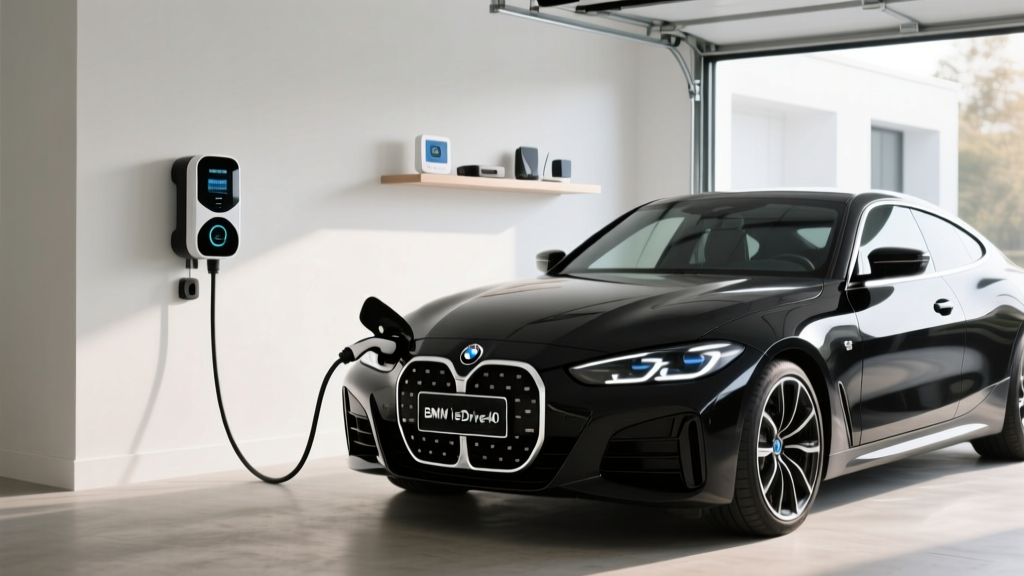
To take full advantage of the i4's 11 kW onboard charger, you want a hardwired Level 2 unit capable of delivering at least 40A (9.6 kW) and ideally 48A (11.5 kW). Here are three proven picks, each with distinct strengths.
ChargePoint Home Flex
- Power: Up to 12 kW (50A) — adjustable via DIP switch
- Connector: NACS (2025+ version) or J1772 with adapter
- Cable Length: 23 ft
- Smart Features: Wi-Fi, scheduling, Alexa, energy tracking
- Price: ~$549–$649
- Verdict: Best all-around smart charger; amperage flexibility works for 50A or 60A circuits
Emporia Vue EV Charger
- Power: Up to 11.5 kW (48A)
- Connector: NACS or J1772
- Cable Length: 24 ft
- Smart Features: Solar integration, whole-home energy monitoring, load management
- Price: ~$399–$499
- Verdict: Best value with solar pairing; load management avoids panel upgrades
Grizzl-E Smart
- Power: Up to 9.6 kW (40A)
- Connector: J1772 (NACS adapter included with newer versions)
- Cable Length: 24 ft
- Smart Features: OCPP-compatible, adjustable amperage, built in Canada
- Price: ~$399–$449
- Verdict: Rugged outdoor-rated pick; ideal for cold climates and uncovered parking
For the i4 eDrive40, the ChargePoint Home Flex on a 60A circuit extracts near-maximum Level 2 speed. A full overnight charge from 20% to 80% takes roughly 5–6 hours at 9.6–11 kW — more than sufficient for daily replenishment.
Safety, Code, and Installation Best Practices
A Level 2 charger installation is a significant electrical project. Cutting corners here creates fire risk and may void your home insurance. Key requirements per NEC Article 625:
- Dedicated circuit: The charger must be on its own breaker — not shared with other outlets or appliances
- GFCI protection: Required for outdoor installations and increasingly for indoor garage outlets (2023 NEC update)
- Outdoor rating: If mounted outside, the charger must carry a NEMA 4 or NEMA 4X rating for weather resistance
- Permit and inspection: Most jurisdictions require an electrical permit and post-install inspection; skipping this can cause problems at home sale time
- Hardwired vs. plug: Hardwired units (no plug) are preferred for 48A+ circuits; NEMA 14-50 receptacles are acceptable for 40A circuits but must be properly torqued and inspected — loose 14-50 outlets are a documented fire risk
Always use a licensed electrician familiar with EV charger installs. Ask whether they'll pull a permit (they should), and get at least two quotes. Prices vary enormously based on run length from the panel to the charger location.
BMW i4 eDrive40 Charging FAQ
How much does it cost to install a home EV charger for the BMW i4?
A typical Level 2 installation with a 50–60A circuit runs $900–$2,500 including equipment, electrician labor, and permit — assuming your home has a 200A panel with available capacity. If a panel upgrade is needed, add $1,500–$4,000. The federal §30C credit covers 30% of installation cost up to $1,000.
How fast will each charging level add range to my i4 eDrive40?
Level 1 (120V): roughly 4–5 miles per hour. Level 2 (240V, 48A): roughly 32–38 miles per hour. DC fast charging at peak 205 kW: up to 190+ miles in 10 minutes, but the rate tapers significantly above 50% SoC, so 10–80% takes about 31 minutes total.
Which connector does my BMW i4 use, and do I need an adapter?
Model years 2022–2024 use CCS1 natively; 2025–2026 models use NACS natively. If you have a CCS1-equipped i4 and want to access Tesla Superchargers, you'll need a CCS-to-NACS adapter (~$150–$200). For home Level 2 charging, any J1772 or NACS charger will work with the appropriate cable or adapter.
How much does charging the i4 cost per mile compared to gas?
At the US average home electricity rate of $0.16/kWh, the i4 eDrive40 costs about $0.043 per mile to drive. A comparable gas-powered BMW 430i at 28 MPG with $3.50/gallon fuel costs about $0.125 per mile — roughly a 65% savings for the EV when charging at home. DC fast charging at $0.45/kWh narrows the gap to about 20–30% savings.
What electrical upgrades might my home need for an i4 charger?
If your home has a 200A main panel with available breaker slots, you likely need nothing beyond the dedicated 50–60A circuit. Homes with 100A or 150A panels, or panels already near capacity from HVAC, electric range, and dryer loads, may require a panel upgrade to 200A or 400A ($1,500–$4,000), or a smart load-management device that dynamically shares capacity between the charger and other appliances.
Should I charge my i4 eDrive40 to 100% every night?
For daily driving, BMW recommends setting the charge limit to 80–90% to reduce long-term degradation on the NMC battery. Charge to 100% only when you need the full 301 miles for a road trip, and try to begin driving shortly after reaching full charge rather than letting it sit at 100% for extended periods.
The BMW i4 eDrive40's 301-mile EPA range and 205 kW DC fast-charging capability make it one of the most practical luxury electric sedans on the market — provided you pair it with a proper home charging setup. A $1,000–$2,000 Level 2 installation pays for itself within the first year of fuel savings for most drivers, and it transforms the ownership experience from "planning around charging" to "waking up full every morning."