Why BMW i4 Owners Need a Charging Strategy (Not Just a Plug)
The BMW i4 eDrive40 and i4 M50 remain two of the most compelling electric gran coupes on the market in 2026. With an EPA-estimated range of up to 307 miles (eDrive40) and a usable battery capacity of approximately 81.5 kWh (NMC chemistry), the i4 delivers genuine daily usability. But owning an EV means owning a charging routine — and for BMW i4 drivers, that routine intersects with home electrical upgrades, public network quirks, connector compatibility shifts, and yes, the occasional BMW i4 charging station ticket from municipal enforcement or private lot operators who enforce idle fees and time limits.
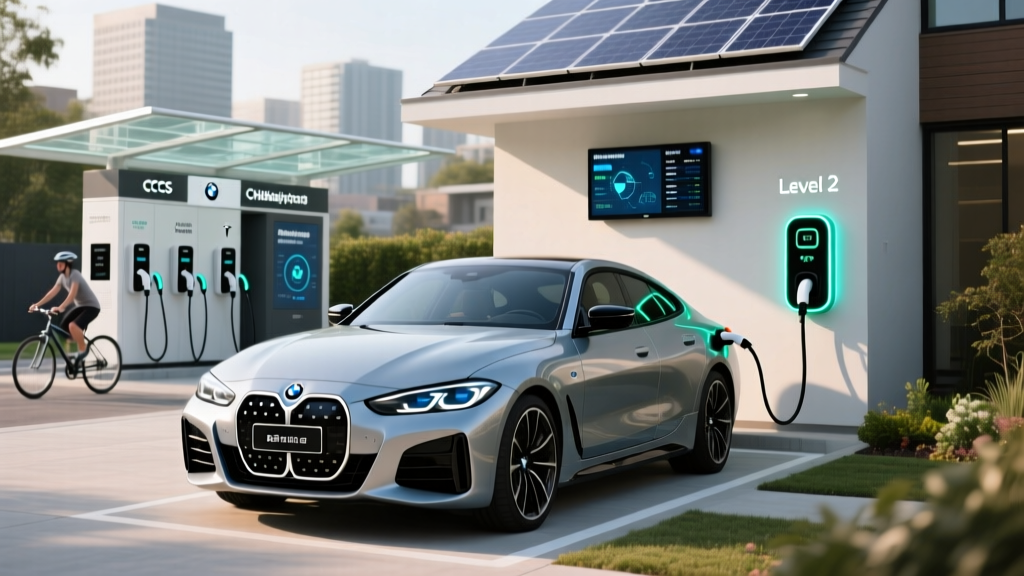
This guide covers every charging scenario an i4 owner will encounter: Level 1 trickle charging from a standard outlet, Level 2 home installation with real cost breakdowns, DC fast charging on road trips, and the parking-enforcement pitfalls that catch new EV owners off guard. We'll use exact numbers — kW charge rates, kWh battery capacity, dollars per mile, and minutes to 80% — because vague promises don't help you plan.
Charging Levels Explained: kW, Speeds, and Miles Per Hour
The single most important distinction in EV charging is between kW (kilowatts), which measures power — the rate at which energy flows — and kWh (kilowatt-hours), which measures energy — the total capacity of your battery. Think of kW as the width of a pipe and kWh as the size of the tank you're filling. Your BMW i4's battery holds approximately 81.5 kWh of usable energy. How fast you fill it depends on the kW rating of your charging source.
| Charging Level | Voltage | Max Power (kW) | Miles of Range Added Per Hour | Typical Use Case |
|---|---|---|---|---|
| Level 1 (120V AC) | 120V | 1.4–1.9 kW | 3–5 miles/hr | Emergency top-up, overnight trickle |
| Level 2 (240V AC) | 240V | 7.2–11.5 kW | 20–40 miles/hr | Home daily charging, workplace |
| DC Fast Charging | 400V+ DC | Up to 205 kW (i4 peak) | 180–500+ miles/hr (at peak) | Road trips, highway corridors |
The BMW i4 supports AC charging at up to 11 kW (three-phase in Europe; in the US, single-phase at up to ~11.5 kW on a 48A circuit). For DC fast charging, the i4 peaks at approximately 205 kW on a compatible CCS1 station, though sustained rates taper significantly above 80% state of charge (SoC). A realistic 10–80% DC fast charge takes about 31 minutes under ideal thermal conditions — but plan for 35–40 minutes in cold weather or at stations delivering less than peak power.
Home Level 2 Installation: Electrical Requirements and Real Costs
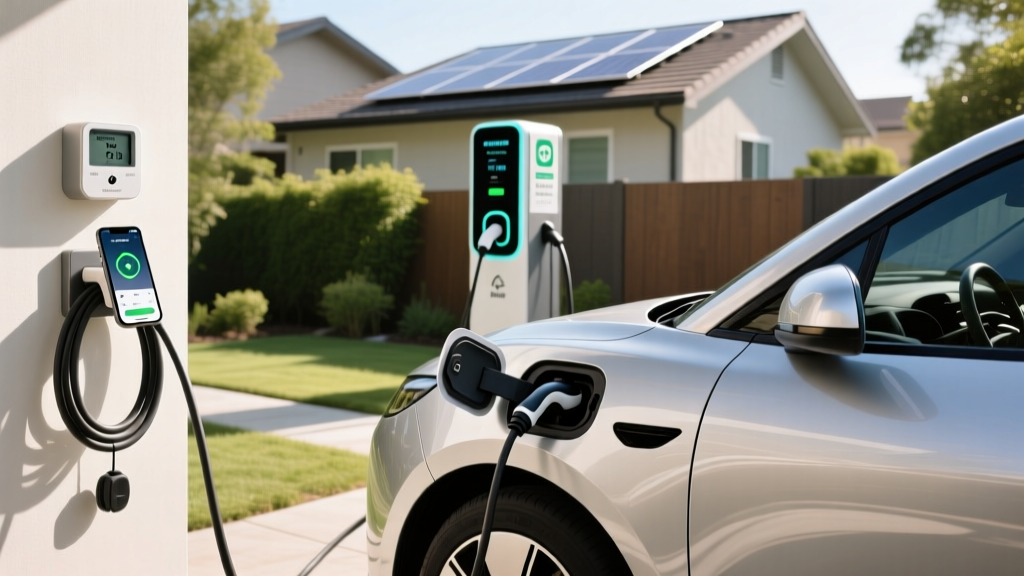
Most BMW i4 owners will install a Level 2 home charger, and this is where costs vary dramatically based on your home's electrical infrastructure. A Level 2 charger requires a 240V circuit — the same voltage as an electric dryer or oven. The most common setup for the i4 is a 48-amp charger on a dedicated 60-amp circuit (the National Electrical Code requires the circuit to be rated 125% of the continuous load).
What Your Electrician Will Evaluate
- Panel capacity: Most modern homes have a 200-amp main panel. Adding a 60-amp EV circuit is usually feasible. Older homes with 100-amp service may require a panel upgrade ($1,500–$3,500) or a load-management device that throttles the charger when other high-draw appliances are running.
- Wiring run distance: A charger mounted 10 feet from the panel costs far less to wire than one 80 feet away in a detached garage. Expect $8–$15 per linear foot for 6 AWG copper wire in conduit.
- Permit requirements: Most jurisdictions require an electrical permit ($50–$250) and a post-installation inspection. Skipping the permit risks insurance claim denials and code violations.
- Outdoor rating: If your charger is outdoors, it needs a NEMA 4 (weatherproof) enclosure. Most quality Level 2 chargers ship rated for outdoor use, but the junction box and receptacle (if hardwired vs. plug-in) must also be rated.
| Cost Component | Typical Range | Notes |
|---|---|---|
| Level 2 Charger (Equipment) | $400–$750 | 48A smart charger, 25-ft cable |
| Electrician Labor (standard install) | $600–$1,800 | Depends on wire run distance |
| Electrical Permit | $50–$250 | Varies by municipality |
| Panel Upgrade (if needed) | $1,500–$3,500 | 100A → 200A service upgrade |
| Total (standard, no panel upgrade) | $1,050–$2,800 | Most common scenario |
| Total (with panel upgrade) | $2,550–$6,300 | Older homes with 100A service |
The federal government does not currently offer a direct tax credit for home EV charger equipment for individual taxpayers — the §30C alternative fuel infrastructure credit expired for most residential installations. However, some utilities and state programs offer rebates of $250–$500 for Level 2 equipment. Check your local utility's EV program page for current offers.
Connector Compatibility: CCS1, NACS, and the Adapter Question
The BMW i4 sold in North America through the 2025 model year ships with a CCS1 (Combined Charging System) port, which handles both Level 2 AC (via the J1772 upper portion) and DC fast charging (via the two additional DC pins below). BMW has announced a transition to the NACS (North American Charging Standard) connector — the Tesla-designed plug — beginning with certain 2026 model-year vehicles, though availability varies by production batch and trim.
| Connector Type | AC Charging | DC Fast Charging | BMW i4 Compatibility |
|---|---|---|---|
| J1772 | Yes (Level 1 & 2) | No | Native (via CCS1 upper port) |
| CCS1 | Yes | Yes | Native on 2022–2025 models |
| NACS (Tesla) | Yes | Yes | Adapter required for pre-2026 i4; may be native on late 2026 builds |
| CHAdeMO | No | Yes (legacy) | No adapter available; avoid these stations |
If your i4 has a CCS1 port and you want to access Tesla Supercharger stations — which now welcome non-Tesla EVs at many locations via the NACS standard — you'll need a CCS-to-NACS adapter. BMW has offered an official adapter, and reputable third-party options from brands like Lectron are available for $150–$250. Confirm your specific i4's software supports NACS adapter communication before purchasing, as early firmware versions required a dealer update.
Equipment Recommendations: Best Level 2 Chargers for the BMW i4
Not all Level 2 chargers are equal. The i4 can accept up to ~11.5 kW on a 48-amp circuit, so buying a charger that maxes out at 32 amps (7.7 kW) leaves performance on the table. Here are three chargers that match the i4's onboard charger capability, with specifics:
ChargePoint Home Flex
- Power Output: Up to 12 kW (50A adjustable)
- Connector: J1772 (CCS1 compatible)
- Cable Length: 23 feet
- Smart Features: Wi-Fi, app scheduling, Alexa integration, energy tracking
- Price: ~$550
- Best For: Most i4 owners wanting app control and flexible amperage
Wallbox Pulsar Plus
- Power Output: Up to 11.5 kW (48A)
- Connector: J1772 (CCS1 compatible)
- Cable Length: 25 feet
- Smart Features: Wi-Fi + Bluetooth, load balancing, compact form factor
- Price: ~$500
- Best For: Tight garage spaces and panel load-management pairing
Emporia Level 2 EV Charger
- Power Output: Up to 11.5 kW (48A)
- Connector: J1772 (CCS1 compatible)
- Cable Length: 24 feet
- Smart Features: Wi-Fi, real-time energy monitoring, integrates with Emporia whole-home energy monitor
- Price: ~$400
- Best For: Budget-conscious owners who still want full 48A and energy tracking
All three chargers above require a dedicated 60-amp circuit for maximum output. They are NEMA 4 rated for outdoor installation and include GFCI protection as required by NEC 2023 (and carried forward in 2026 code cycles). Hardwired installation is preferred for maximum reliability and to avoid the 240V receptacle requirement, though plug-in versions using a NEMA 14-50 outlet are available if you want portability.
Cost to Charge: Home vs. Public vs. DC Fast (and vs. Gas)
The BMW i4 eDrive40 achieves an EPA-rated combined efficiency of approximately 3.0–3.3 kWh per mile (roughly 100–110 MPGe). The M50, with its dual motors and higher performance tuning, consumes closer to 3.5–3.8 kWh per mile. These figures determine your real cost per mile at different charging scenarios.
| Charging Scenario | Avg Cost per kWh | Cost to Fill 81.5 kWh (10–100%) | Cost per Mile (eDrive40) | Cost per Mile (M50) |
|---|---|---|---|---|
| Home (off-peak utility rate) | $0.09–$0.13 | $7.34–$10.60 | $0.027–$0.043 | $0.032–$0.050 |
| Home (standard rate, no TOU) | $0.14–$0.18 | $11.41–$14.67 | $0.042–$0.060 | $0.049–$0.068 |
| Public Level 2 (network) | $0.25–$0.39 | $20.38–$31.79 | $0.075–$0.129 | $0.088–$0.148 |
| DC Fast Charger (Electrify America, EVgo) | $0.35–$0.55 | $28.53–$44.83 | $0.105–$0.182 | $0.123–$0.209 |
| Gas Equivalent (30 MPG at $3.40/gal) | — | $28.33 (equivalent energy) | $0.113 | $0.113 |
The takeaway is clear: home charging on an off-peak rate makes the i4 dramatically cheaper to fuel than any comparable gas-powered 3 Series or 4 Series. Even public DC fast charging is roughly cost-competitive with premium gasoline. But habitual reliance on expensive public DC chargers erodes the savings advantage — which is why a home Level 2 setup pays for itself within 12–18 months for most drivers covering 10,000+ miles annually.
Avoiding the BMW i4 Charging Station Ticket: Idle Fees, Time Limits, and Enforcement
Here's where the keyword becomes practical. A BMW i4 charging station ticket isn't a traffic citation — it's typically one of three things:
- Idle fees from charging networks: Tesla Superchargers charge up to $1.00/minute in idle fees if your vehicle remains plugged in after reaching its charge limit and the station is at least 50% occupied. Electrify America and EVgo have similar policies, typically $0.20–$0.50/minute. Set your i4's charge limit to 80% (which you should do anyway for battery longevity on NMC chemistry) and monitor the app.
- Municipal parking enforcement: Many city-installed public chargers are in metered or time-limited parking spots. Your i4 may be charging fine, but if the parking meter expires or the 2-hour limit passes, you'll get a standard parking ticket — $25–$75 depending on the city. Always check signage for both the charger and the parking space.
- Private lot towing or booting: Shopping centers and garages with EV chargers increasingly enforce "EV charging only while actively charging" rules. If your i4 has finished charging and you're still in the grocery store, a private enforcement company may ticket or boot the vehicle. Apps like PlugShare often note enforcement policies in station reviews — check before you park.
The BMW i4's My BMW app will notify you when charging is complete, but push notifications can be delayed by 5–10 minutes. If you're at a public station with known idle fees, set a manual timer on your phone as a backup.
Safety, Code Compliance, and the Panel-Upgrade Reality
EV charging is a continuous high-draw electrical load — your Level 2 charger may run at full amperage for 6–8 hours straight. This is fundamentally different from an oven or dryer that cycles on and off. The NEC treats EV charging as a continuous load, which is why a 48A charger requires a 60A breaker and circuit rated for 125% of the load.
Key Safety Requirements
- Dedicated circuit: Your EV charger must be on its own breaker — not shared with other outlets or appliances.
- GFCI protection: Required for all EV receptacles and hardwired installations under current NEC. Quality chargers include built-in GFCI.
- Outdoor rating: NEMA 4 minimum for outdoor installations. Verify the entire assembly — charger, cable, connector holster — is rated.
- Load management: If your panel is near capacity (common in homes with electric heat, AC, and an EV charger), a load-management device like the Wallbox Power Meter or Sense energy monitor can dynamically reduce charger amperage to prevent tripping the main breaker.
If your home has a 100-amp panel, take the panel-upgrade cost seriously. A licensed electrician can perform a load calculation to determine whether you need a full service upgrade or whether a load-management solution will suffice. Never skip this step — an overloaded panel is a fire hazard and will fail inspection.
Frequently Asked Questions
How much does it cost to install a home EV charger for my BMW i4?
A standard Level 2 installation (48A charger on a 60A circuit) typically costs $1,050–$2,800 including equipment, electrician labor, and permit — assuming your electrical panel has sufficient capacity. If you need a 100A-to-200A panel upgrade, add $1,500–$3,500. Always get a load calculation from a licensed electrician before committing.
How fast will each charging level add range to my i4?
Level 1 (120V) adds roughly 3–5 miles per hour — about 30–40 miles overnight. Level 2 (240V, 48A) adds approximately 35–40 miles per hour, fully replenishing the i4's 81.5 kWh battery in about 8–9 hours. DC fast charging at peak 205 kW adds 10–80% in approximately 31 minutes under ideal conditions, though cold weather and station congestion can extend this to 35–45 minutes.
Which connector is compatible with my BMW i4?
Model-year 2022–2025 BMW i4 vehicles use a CCS1 connector natively. This accepts J1772 for AC charging and CCS1 for DC fast charging. To use Tesla Superchargers (NACS), you'll need a CCS-to-NACS adapter ($150–$250). Some late 2026-production i4 models may ship with NACS natively — verify with your dealer based on your VIN.
How much does charging cost per mile compared to gas?
Charging at home on off-peak rates costs approximately $0.03–$0.04 per mile in the i4 eDrive40 — roughly one-third the cost of a 30 MPG gas car burning premium at $3.40/gallon ($0.11/mile). Public DC fast charging at $0.45/kWh brings the cost to roughly $0.14–$0.17 per mile, which is slightly more than gas. Home charging is where the economics overwhelmingly favor EVs.
What electrical upgrades might I need for a home charger?
If your home has a 200-amp panel with available capacity, you likely need only a new 60-amp breaker and a wire run to the charger location. Homes with 100-amp service, older wiring, or panels already near capacity (electric HVAC, water heater, dryer, range) may require a full panel upgrade to 200A or a load-management device. An electrician's load calculation — typically $100–$200 as a standalone service — will give you a definitive answer.
How do I avoid a charging station parking ticket or idle fee?
Set your i4's charge limit to 80% to reduce idle time and protect NMC battery health. Enable push notifications in the My BMW app, but also set a manual phone timer as backup. Always check parking signage at public chargers for time limits separate from the charging session. Read PlugShare station reviews for notes on enforcement policies, idle fees, and towing risk before relying on an unfamiliar station.