BMW i4 Charging Speed: What You Need to Know Up Front
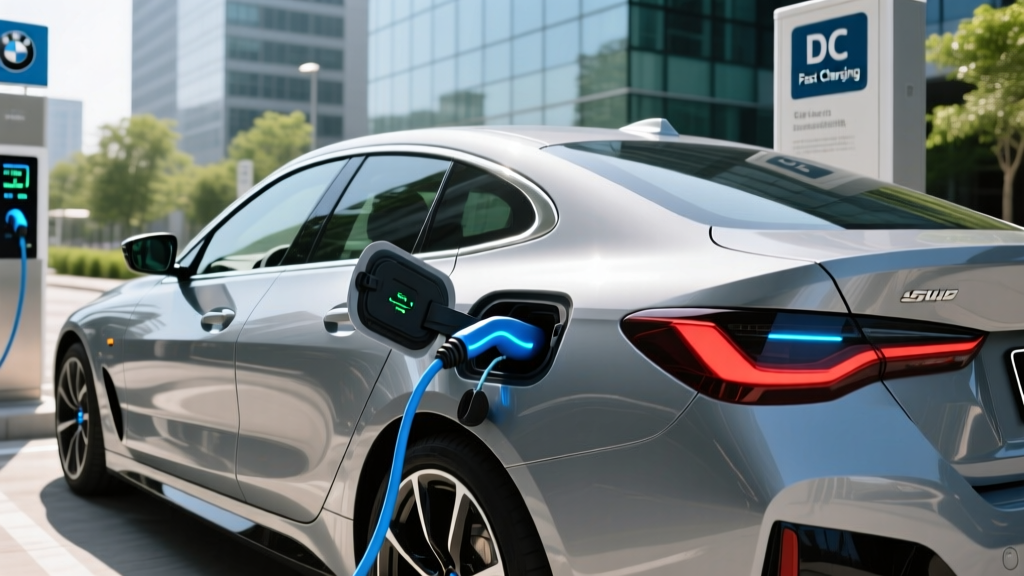
The BMW i4 charges at a peak DC fast-charging rate of 205 kW (eDrive40 and M50 trims) on its 81.5 kWh usable battery pack (NMC chemistry). In real-world conditions, that translates to a 10–80% charge in approximately 31 minutes at a compatible 350 kW DC fast charger, with the charge curve tapering significantly above 80% State of Charge (SoC). On Level 2 AC power, the i4 accepts up to 11 kW, adding roughly 35 miles of range per hour.
But peak kW ratings only tell part of the story. Charging speed depends on the charger type, battery temperature, state of charge, and whether you've preconditioned the pack. This guide breaks down every charging scenario for the BMW i4 — from a standard 120V wall outlet to the fastest public chargers — and covers the real costs of installing a home Level 2 setup.
Charging Levels Explained: Speeds, Times, and Range Added
Every BMW i4 owner will encounter three charging levels. Here's exactly what each delivers in terms of power, time, and practical range recovery.
| Level | Power (kW) | Miles of Range/Hour | 0–100% Full Charge | Best For |
|---|---|---|---|---|
| Level 1 (120V AC) | ~1.4 kW | ~4–5 mi/hr | ~55–65 hours | Overnight top-up, emergencies |
| Level 2 (240V AC) | Up to 11 kW | ~32–37 mi/hr | ~8–9 hours | Daily home charging |
| DC Fast Charging | Peak 205 kW | ~160+ mi in 10 min | 10–80% in ~31 min | Road trips, quick top-ups |
The DC Fast-Charging Curve: Why Peak kW Is Misleading
BMW advertises 205 kW peak charging for the i4, but that number only holds in a narrow SoC window — roughly between 10% and 35%. After that, the battery management system (BMS) progressively reduces charge rate to protect cell health. Here's what a typical session on a 350 kW charger looks like:
- 10–35% SoC: ~180–205 kW (peak zone)
- 35–60% SoC: ~120–150 kW
- 60–80% SoC: ~70–90 kW
- 80–100% SoC: ~20–40 kW (significant taper)
This taper is why charging from 80% to 100% on DC fast charging can take nearly as long as the 10–80% portion. For road trips, plan to charge to 80% and drive on — you'll save significant time. The i4's EPA-rated range is up to 301 miles (eDrive40 with 18-inch wheels), though expect ~250–270 miles at sustained highway speeds and ~220–240 miles in freezing temperatures. Per fueleconomy.gov, the eDrive40 achieves 97 MPGe combined.
Home Level 2 Charger Installation: Costs, Electrical Requirements, and Upgrades
A Level 2 home charger is the practical backbone of i4 ownership. The i4's onboard charger accepts up to 11 kW on AC power, which means you need a 240V circuit capable of delivering at least 48 amps to max it out (since EV chargers are continuous loads, NEC code requires the circuit to be rated at 125% of the charger's draw — so a 48A charger needs a 60A circuit).
How Much Does It Cost to Install a Home EV Charger?
Total installation costs vary widely based on your home's electrical panel capacity, the distance from panel to charger location, and local permit fees. Here's a realistic breakdown:
| Component | Basic Install | Complex Install |
|---|---|---|
| Level 2 charger (hardware) | $350–$650 | $350–$650 |
| Electrician labor | $300–$600 | $800–$2,000 |
| Electrical permit | $50–$150 | $50–$200 |
| Conduit/wiring (long runs) | $50–$100 | $300–$800 |
| Panel upgrade (if needed) | $0 | $1,500–$3,500 |
| Total | $750–$1,500 | $3,000–$7,150 |
What Electrical Upgrades Might I Need?
Homes built before 2000 often have 100A or 150A electrical panels. Adding a 60A dedicated circuit for EV charging may exceed your panel's capacity, especially if you already run electric dryers, ovens, or HVAC on the same panel. A licensed electrician will perform a load calculation (per NEC Article 220) to determine whether your panel can handle the additional draw.
If a panel upgrade from 100A to 200A is required, expect to pay $1,500–$3,500 including the new panel, labor, and utility coordination. This is the single biggest variable in home charging costs and one that surprises many new EV buyers. Some utilities offer rebates for panel upgrades tied to EV adoption — check with your local provider.
Safety and Code Considerations
NEC Article 625 governs EV charging installations. Key requirements include:
- Dedicated circuit: Your Level 2 charger must have its own dedicated breaker — no sharing with other outlets or appliances.
- GFCI protection: NEC 2020 and later require GFCI protection for EV receptacles (though hardwired chargers may be exempt in some jurisdictions — confirm with your local inspector).
- Outdoor rating: If your charger is installed outdoors or in an unenclosed carport, it must carry a NEMA 4 (weather-resistant) rating.
- Cable management: The charging cable should not cross walkways. Use a cable holster or retractor rated for outdoor use.
- Permit and inspection: Most jurisdictions require an electrical permit and post-installation inspection. Skipping this can void home insurance coverage and create issues at resale.
Which Connector Is Compatible with the BMW i4?
The BMW i4 uses a CCS1 (Combined Charging System) connector for both AC Level 2 and DC fast charging in North America. As of 2025, BMW has adopted the NACS (North American Charging Standard / Tesla) port on new models, and the 2026 i4 lineup is expected to ship with NACS. However, most i4s on the road today still carry CCS1.
| Model Year | Built-in Port | Tesla Supercharger Access | Adapter Needed? |
|---|---|---|---|
| 2022–2024 i4 | CCS1 | Yes, with BMW-approved CCS-to-NACS adapter | CCS-to-NACS adapter (~$200–$250) |
| 2025 i4 (late production) | CCS1 / NACS (transition) | Yes, native or with adapter | Check build date / window sticker |
| 2026 i4 | NACS (expected) | Yes, native | NACS-to-CCS adapter for non-Tesla DC chargers |
For home Level 2 charging, any J1772-equipped charger will work with the i4 (J1772 is the AC portion of the CCS1 connector). If you install a Tesla Wall Connector (NACS plug), you'll need a J1772-to-NACS adapter for current CCS1 i4 models.
Charging Cost: BMW i4 Cost Per Mile vs. Gas
One of the strongest ownership arguments for the i4 is fuel cost savings — but the exact savings depend heavily on where and when you charge. The i4 eDrive40 consumes approximately 34 kWh per 100 miles (or about 2.94 miles/kWh) in mixed driving, per EPA data.
| Scenario | Rate | Cost per 100 Miles | Cost per Mile |
|---|---|---|---|
| Home (off-peak utility rate) | $0.09/kWh | $3.06 | $0.031 |
| Home (average US rate) | $0.17/kWh | $5.78 | $0.058 |
| Public Level 2 (network rate) | $0.30/kWh | $10.20 | $0.102 |
| DC Fast Charging (EA/EVgo) | $0.48/kWh | $16.32 | $0.163 |
| Gas car (30 MPG, $3.40/gal) | — | $11.33 | $0.113 |
Home charging at off-peak rates is dramatically cheaper than gas — roughly one-third the per-mile cost. However, exclusive reliance on DC fast charging at current public rates can actually exceed gas costs. The economic case for the i4 is strongest when you charge at home 80%+ of the time.
Best Home Chargers for the BMW i4: Equipment Picks
Since the i4 accepts up to 11 kW on AC, you'll want a Level 2 charger capable of at least 48 amps to capture the full charging speed. Here are three proven options:
ChargePoint Home Flex
- Power: Up to 12 kW (50A), adjustable down to 16A
- Connector: J1772 (compatible with all CCS1 i4s)
- Cable: 23 ft
- Smart features: Wi-Fi, app scheduling, Alexa, energy tracking
- NEMA rating: NEMA 4 (indoor/outdoor)
- Price: ~$550
Best for: Flexible amperage if your panel is tight on capacity.
Tesla Wall Connector (Gen 3)
- Power: Up to 11.5 kW (48A)
- Connector: NACS (requires J1772 adapter for CCS1 i4)
- Cable: 24 ft
- Smart features: Wi-Fi, OTA updates, power sharing between units
- NEMA rating: NEMA 3R (outdoor rated)
- Price: ~$475
Best for: Homes with both a Tesla and a BMW, or future-proofing for NACS.
Emporia Level 2 EV Charger
- Power: Up to 11.5 kW (48A)
- Connector: J1772
- Cable: 24 ft
- Smart features: Wi-Fi, app control, solar integration, energy monitoring
- NEMA rating: NEMA 4
- Price: ~$400
Best for: Budget-conscious buyers who want smart features and solar pairing.
All three support hardwired installation (preferred for 48A+ circuits, as NEMA 14-50 receptacles are rated for 50A maximum and NEC continuous-load rules limit you to 40A on a plug-in setup). Hardwiring unlocks the full 48A output.
BMW i4 Charging FAQ
How fast will each charging level add range to my BMW i4?
Level 1 (120V) adds roughly 4–5 miles of range per hour — enough only for overnight recovery of 40–50 miles. Level 2 (240V, 48A) adds about 35 miles per hour, fully replenishing the i4's ~301-mile EPA range overnight. DC fast charging at a 350 kW station can add approximately 160 miles in the first 10 minutes, with the rate tapering as the battery fills.
Can I use Tesla Superchargers with my BMW i4?
Yes, with conditions. BMW has enabled Supercharger access for CCS1-equipped i4 models via an approved CCS-to-NACS adapter (sold separately, ~$200–$250). You'll also need to add your i4 to the BMW app linked to Tesla's network. The 2026 i4 is expected to ship with a native NACS port, eliminating the adapter requirement.
Does the BMW i4 support preconditioning for faster charging?
Yes. When you set a DC fast-charging station as your navigation destination in the iDrive system, the i4 automatically begins preconditioning the battery to its optimal charging temperature (~25–35°C). This can reduce 10–80% charge times by 5–10 minutes, especially in cold weather when an un-preconditioned battery may limit charge rate to under 100 kW initially.
What happens to charging speed in cold weather?
Lithium-ion batteries charge slower at low temperatures. Without preconditioning, DC fast charging at 20°F can start as low as 50–75 kW and take 45+ minutes for 10–80%. Always navigate to your charger using the iDrive system to trigger preconditioning, and expect real-world range to drop to ~220–240 miles in sustained freezing conditions due to cabin heating and battery resistance.
Is a 200A electrical panel required for home Level 2 charging?
Not always, but it helps. A 200A panel typically has enough spare capacity for a 60A dedicated EV circuit (48A continuous). Homes with 100A panels often require an upgrade. A licensed electrician will calculate your existing load per NEC Article 220 to determine if your current panel can support the charger. Never assume open breaker slots equal available capacity.
Sources: EPA fuel economy data via fueleconomy.gov; BMW USA i4 specifications; NEC Article 625 and Article 220 electrical code requirements.