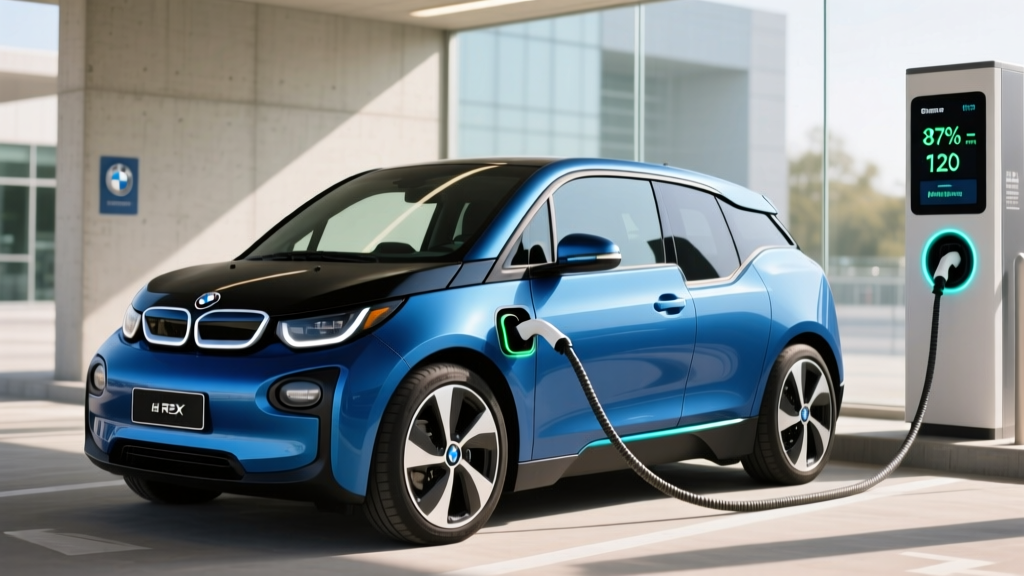
The BMW i3 with Range Extender (REx) occupies a unique space in the EV landscape — a plug-in electric vehicle that pairs a usable battery with a small gasoline generator to eliminate range anxiety. Whether you own a 2014-2021 i3 REx or are considering one on the used market, understanding its real-world range, charging capabilities, and optimal home setup is essential for maximizing efficiency and minimizing fuel costs.
This guide covers the BMW i3 REx's range expectations across model years, walks through every charging level with concrete speeds, details home installation requirements and costs, and breaks down the economics of charging versus gasoline. We'll also address connector compatibility, equipment recommendations, and the electrical upgrades your home might need.
BMW i3 REx Range: EPA vs Real-World Expectations
The BMW i3 REx was produced from 2014 through 2021, with significant battery upgrades in 2017 and 2019. The electric-only range varies considerably by model year:
| Model Year | Battery Capacity | EPA Electric Range | Total Range (with REx) | MPGe (Electric) |
|---|---|---|---|---|
| 2014-2016 | 22 kWh (18.8 usable) | 72 miles | ~150 miles | 117 MPGe |
| 2017-2018 | 33 kWh (27.2 usable) | 97 miles | ~180 miles | 111 MPGe |
| 2019-2021 | 42.2 kWh (37.9 usable) | 126 miles | ~200 miles | 113 MPGe |
Real-World Range Reality: EPA estimates assume mixed driving at moderate temperatures. In actual use, expect 15-25% less electric range during highway driving (70+ mph), and 20-40% reduction in freezing weather due to battery chemistry and cabin heating demands. A 2019-2021 i3 REx rated at 126 miles EPA may deliver 95-105 miles on the highway in winter, or 115-120 miles in ideal conditions.
The Range Extender — a 647cc two-cylinder gasoline engine — generates electricity to maintain battery state of charge rather than driving the wheels directly. It activates when the battery reaches approximately 6-7% state of charge, adding roughly 70-80 miles of additional range from its 1.9-gallon fuel tank.
Charging Levels Explained: Speeds and Range Added
Understanding charging speed requires distinguishing between kW (kilowatts), which measures power delivery rate, and kWh (kilowatt-hours), which measures total energy capacity. Think of kW as the flow rate of water through a hose, and kWh as the total volume in the bucket.
| Charging Level | Power (kW) | Voltage/Amps | Miles of Range per Hour | 0-80% Time (42 kWh) |
|---|---|---|---|---|
| Level 1 (120V) | 1.4-1.9 kW | 120V / 12-16A | 4-6 miles | 20-24 hours |
| Level 2 (240V) | 7.4 kW (max) | 240V / 32A | 22-25 miles | 4-5 hours |
| DC Fast Charging | 50 kW (max) | 400V DC | ~150 miles | 45-60 minutes |
The BMW i3 accepts a maximum of 7.4 kW on Level 2 AC charging and 50 kW on DC fast charging (via CCS1 connector on 2015+ models). Earlier 2014 models used CHAdeMO for DC fast charging before BMW switched to the CCS standard.
Charging Curve Reality
DC fast charging doesn't maintain peak speed throughout the session. The i3's 50 kW peak rate applies only between roughly 10-60% state of charge. Above 80%, charging slows significantly to protect battery health — expect 20-25 kW from 80-100%. This is why 10-80% charging times are more practical benchmarks than full 0-100% figures.
Home Charging Installation: Requirements and Costs
Installing a Level 2 home charger is the single most impactful upgrade for i3 REx ownership, transforming daily convenience and enabling you to wake up with a full battery every morning.
Electrical Requirements
A Level 2 charger for the BMW i3 requires:
- Voltage: 240V (same as an electric dryer or oven)
- Amperage: 40A dedicated circuit for a 32A charger (NEC code requires 125% overhead)
- Panel capacity: Minimum 100A service, though 200A is preferred for homes with multiple high-draw appliances
Installation Cost Breakdown
| Component | Cost Range | Notes |
|---|---|---|
| Level 2 Charger (Equipment) | $400-$800 | 32-40A smart charger with 25ft cable |
| Electrician Labor | $500-$2,000 | Varies by run length, wall type, local rates |
| Permit | $50-$200 | Required in most jurisdictions |
| Panel Upgrade (if needed) | $1,500-$3,500 | Only if existing panel lacks capacity |
| Total (no panel upgrade) | $950-$3,000 | Average installation: ~$1,800 |
| Total (with panel upgrade) | $2,450-$6,500 | Older homes with 100A service |
Factors that increase installation cost:
- Long cable runs from panel to garage (over 50 feet)
- Conduit requirements through concrete walls or underground
- Panel located far from charging location
- Need to upgrade from 100A to 200A service
- Local code requiring GFCI breakers ($50-$100 additional)
Panel Upgrade Considerations
Homes built before 1990 often have 100A electrical service, which may be insufficient for Level 2 charging plus existing loads (electric range, dryer, HVAC). An electrician will perform a load calculation per NEC Article 220 to determine if your panel can handle the additional 40A circuit. If you're already planning solar installation or heat pump upgrades, coordinating these projects can reduce overall costs.
Connector Compatibility: What Plugs Into Your i3
The BMW i3 uses different connectors depending on model year and charging level:
| Model Year | Level 1/2 Connector | DC Fast Connector | Notes |
|---|---|---|---|
| 2014 | J1772 | CHAdeMO (optional) | Some 2014 models lack DC fast charge option |
| 2015-2021 | J1772 | CCS1 (Combo) | Standard CCS connector used by most US networks |
Public Charging Network Access
With a CCS1 connector (2015+ models), your i3 REx can access:
- Electrify America: Largest US network, CCS standard
- EVgo: CCS chargers in metro areas
- ChargePoint: Mixed Level 2 and DC fast
- Tesla Superchargers: Requires Magic Dock adapter (limited locations as of 2026)
For 2014 i3 models with CHAdeMO, DC fast charging options are extremely limited in 2026, as most networks have standardized on CCS. CHAdeMO chargers remain primarily at Nissan dealerships and select older installations.
Adapter Options
As Tesla opens Supercharger access to non-Tesla EVs, adapter solutions have emerged:
- Tesla Magic Dock: Built-in CCS adapter at select Supercharger stations (no separate adapter needed)
- Aftermarket CCS-to-NACS adapters: $200-$400, but verify compatibility and warranty coverage before purchasing
For Level 2 charging, all public J1772 stations work directly with your i3 — no adapter required.
Cost to Charge: BMW i3 REx Economics
One of the strongest arguments for the i3 REx is the dramatic cost difference between electric and gasoline operation.
| Charging Scenario | Cost per kWh | Full Charge Cost | Cost per Mile |
|---|---|---|---|
| Home (off-peak utility rate) | $0.12 | $5.04 | $0.04 |
| Home (standard residential) | $0.18 | $7.56 | $0.06 |
| Public Level 2 | $0.25-$0.35 | $10.50-$14.70 | $0.08-$0.12 |
| DC Fast Charging | $0.35-$0.50 | $14.70-$21.00 | $0.12-$0.17 |
| Gasoline (REx, 39 MPG) | $3.50/gallon | $66.50 (equivalent) | $0.09 |
The bottom line: Home charging at off-peak rates delivers fuel costs roughly 60-70% lower than gasoline. Even public DC fast charging can be cost-competitive with gas, though convenience and time costs differ significantly.
Maximizing Home Charging Savings
Many utilities offer time-of-use (TOU) rates that provide substantially cheaper electricity during overnight hours (typically 10 PM - 6 AM). Programming your i3 or Level 2 charger to charge during these windows can reduce fuel costs to $0.03-$0.04 per mile. Some utilities even offer dedicated EV rates with super-off-peak pricing as low as $0.07-$0.09 per kWh.
Recommended Level 2 Chargers for BMW i3 REx
Given the i3's 7.4 kW maximum charge rate, a 32A Level 2 charger (7.7 kW output) is optimal. Higher-amperage chargers won't damage the vehicle but won't charge it faster either.
Emporia Vue Smart Charger
- Power: 32A / 7.7 kW (240V)
- Connector: J1772
- Cable Length: 24 feet
- Smart Features: Wi-Fi, app scheduling, energy monitoring, load balancing
- Price: $399
- Best For: Budget-conscious owners wanting smart features
ChargePoint Home Flex
- Power: Adjustable 16-50A (32A recommended for i3)
- Connector: J1772
- Cable Length: 23 feet
- Smart Features: Wi-Fi, app control, Alexa integration, detailed charging stats
- Price: $699
- Best For: Future-proofing if you upgrade to a faster-charging EV later
Wallbox Pulsar Plus
- Power: 32A / 7.7 kW (240V)
- Connector: J1772
- Cable Length: 25 feet
- Smart Features: Wi-Fi/Bluetooth, app scheduling, power sharing between multiple units
- Price: $649
- Best For: Multi-EV households needing coordinated charging
Grizzl-E Smart
- Power: 40A / 9.6 kW (i3 will draw max 32A)
- Connector: J1772
- Cable Length: 24 feet
- Smart Features: Wi-Fi, OCPP compatibility, extreme cold rating (-40°F)
- Price: $549
- Best For: Cold climates and outdoor installations
Safety and Code Considerations
Proper installation isn't just about convenience — it's about protecting your home and vehicle from electrical hazards.
Required Safety Features
- Dedicated Circuit: Your Level 2 charger must have its own dedicated 40A breaker — never share a circuit with other appliances
- GFCI Protection: National Electrical Code (NEC) 2020 and later requires Ground Fault Circuit Interrupter protection for EV charging circuits, especially outdoor installations
- Outdoor Rating: If installing outside, ensure both the charger and outlet (if using a receptacle) are rated for wet locations (NEMA 4 or 4X rating)
- Proper Wire Gauge: 8 AWG copper wire minimum for 40A circuits; 6 AWG for runs over 50 feet to prevent voltage drop
Permit and Inspection Requirements
Most jurisdictions require an electrical permit for Level 2 charger installation, with costs typically $50-$200. The inspection ensures:
- Correct wire gauge and breaker sizing
- Proper grounding and bonding
- GFCI protection where required
- Adequate panel capacity
Skipping permits may void home insurance coverage if an electrical fire occurs, and can cause issues during home sale inspections.
Frequently Asked Questions
How much does it cost to install a home EV charger for my BMW i3?
Expect $950-$3,000 for a standard installation (equipment, electrician, and permit) if your electrical panel has sufficient capacity. Homes needing a panel upgrade (100A to 200A service) can see total costs of $2,450-$6,500. The average installation runs around $1,800.
How fast will each charging level add range to my i3 REx?
Level 1 (120V) adds 4-6 miles per hour. Level 2 (240V, 32A) adds 22-25 miles per hour, fully charging a 42 kWh battery in 4-5 hours. DC fast charging (50 kW) can add roughly 150 miles per hour at peak rate, though charging slows significantly above 80% state of charge.
Which connector is compatible with my BMW i3?
All i3 models use J1772 for Level 1 and Level 2 charging. For DC fast charging, 2014 models use CHAdeMO (if equipped), while 2015-2021 models use CCS1. Check your vehicle's charge port — CCS1 has two additional DC pins below the standard J1772 connector.
How much does charging cost per mile compared to gasoline?
Home charging at off-peak rates costs roughly $0.04 per mile, compared to $0.09 per mile for gasoline in the REx (at $3.50/gallon and 39 MPG). Even public DC fast charging at $0.40/kWh costs about $0.13-$0.17 per mile. Home charging delivers 60-70% fuel cost savings.
What electrical upgrades might I need for Level 2 charging?
Homes with 100A electrical service may need a panel upgrade to 200A, especially if you have electric heat, a dryer, and range. An electrician will perform a load calculation to determine if your existing panel can handle a 40A dedicated circuit. Older homes (pre-1990) are most likely to need upgrades.
Can I use a Tesla Supercharger with my BMW i3?
Limited access is available in 2026 through Tesla's Magic Dock system, which has a built-in CCS adapter at select Supercharger locations. However, Magic Dock availability remains sparse. Aftermarket CCS-to-NACS adapters exist ($200-$400) but verify compatibility and warranty implications before purchasing.
Does the Range Extender engine charge the battery fully?
No. The REx maintains battery state of charge at roughly 6-7% to provide continued electric driving. It doesn't recharge the battery to full capacity. Think of it as extending your range rather than recharging — you still need to plug in for a full battery.
For official EPA range and efficiency data, consult fueleconomy.gov. For home electrical work, always hire a licensed electrician familiar with NEC Article 625 (Electric Vehicle Charging System Equipment) and obtain required permits.