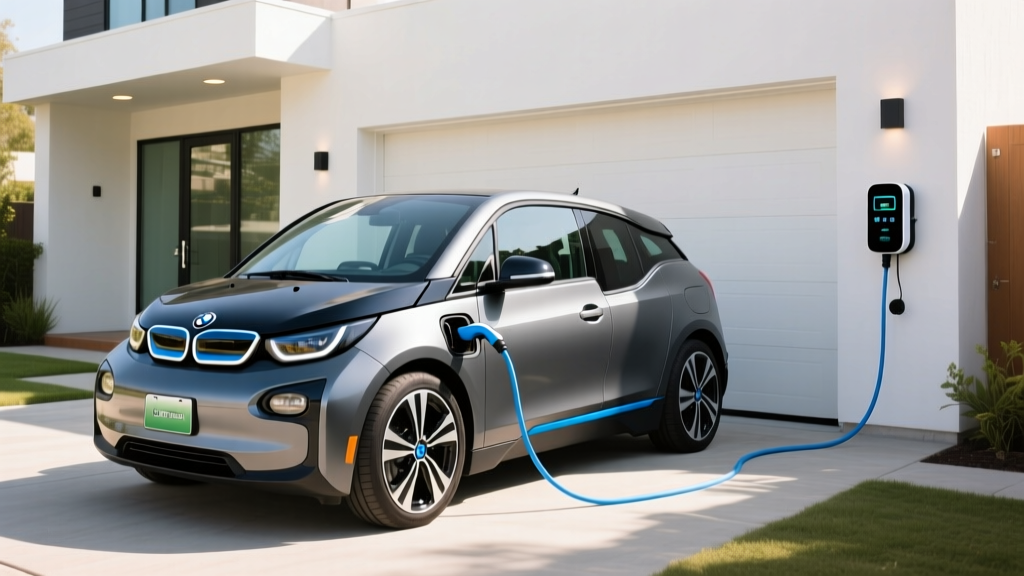
The BMW i3 with Range Extender (REx) remains one of the most distinctive plug-in vehicles on the used market. Originally produced through 2021, the final-generation i3 REx pairs a 42.2 kWh battery pack (120 Ah cells, NMC chemistry) with a 647cc two-cylinder gasoline generator. For owners and prospective buyers, understanding what the BMW i3 range extender range actually looks like in real-world driving — and how to set up charging for this unique PHEV-adjacent platform — is essential.
This guide covers the i3 REx's real-world electric and total range, charging speeds across all levels, home Level 2 installation requirements and costs, connector compatibility, and what you'll pay per mile compared to a gasoline vehicle.
BMW i3 Range Extender Range: EPA vs Real-World Numbers
The final-model-year BMW i3 REx (2019–2021) carries an EPA-rated 126 miles of all-electric range and a combined electric-plus-gasoline range of approximately 200 miles. The range-extender engine doesn't drive the wheels directly — it acts as a generator to maintain battery state of charge once the EV range is depleted.
Real-World Expectation: 95–110 mi electric in mixed driving; 75–90 mi at sustained highway speeds (70+ mph); 70–85 mi in cold weather (below 32°F) due to cabin heating load and reduced battery efficiency.
Total with REx: Expect ~160–180 mi combined real-world before needing a fuel stop or charge.
The i3's 114 MPGe combined rating (per fueleconomy.gov) reflects its efficiency on electric power. Once the REx engages, fuel economy drops to roughly 31 MPG combined — respectable for a generator-fed series hybrid, but the i3's true advantage is maximizing electric miles.
| Spec | Value |
|---|---|
| Battery (usable) | 42.2 kWh (NMC) |
| EPA Electric Range | 126 miles |
| EPA Combined Range (REx) | ~200 miles |
| MPGe (electric) | 114 combined |
| MPG (REx mode) | ~31 combined |
| Motor Output | 170 hp / 184 lb-ft |
| 0–60 mph | 6.9 seconds |
| DC Fast Charge (peak) | 50 kW (CCS) |
| Level 2 Charge Rate | 7.4 kW |
| Fuel Tank | 2.4 gallons |
Charging Levels Explained: How Fast Will Each Add Range?
The BMW i3 REx supports three charging levels. Understanding the distinction between kW (power — the rate of energy delivery) and kWh (energy — the battery's total capacity) is critical. Think of kW as the flow rate of a hose and kWh as the size of the tank being filled.
| Level | Voltage | Max Power (kW) | Miles of Range Added/Hour | Full Charge Time (0–100%) |
|---|---|---|---|---|
| Level 1 (120V outlet) | 120V / 12A | ~1.4 kW | ~4–5 mi/hr | ~30+ hours |
| Level 2 (240V home/public) | 240V / 32A | 7.4 kW | ~22–25 mi/hr | ~5.5–6 hours |
| DC Fast Charge (CCS) | 400V DC | 50 kW peak | ~100+ mi/hr (to 80%) | 10–80% in ~45 min |
Real-world charging note: The i3 REx's 50 kW DC fast-charge peak is modest by 2026 standards (many new EVs accept 150–350 kW), but for a 42.2 kWh battery, it's adequate. The charge curve holds near 45–50 kW up to roughly 60% state of charge, then tapers to ~25 kW above 80%. Plan DC fast stops around the 10–80% window for efficiency.
For daily use, Level 2 is the sweet spot. A full overnight charge from near-empty takes about 5.5 hours — easily covering any daily commute within the i3's electric envelope.
Home Level 2 Installation: Requirements, Costs & Electrical Upgrades
Installing a dedicated Level 2 charger at home is the single biggest ownership upgrade for any i3 REx driver. Here's what's involved electrically and financially.
Electrical Requirements
The i3 REx accepts up to 7.4 kW on Level 2, which requires a 240V circuit rated at 40 amps (the charger itself will be a 32A continuous-draw unit; NEC code requires circuits rated at 125% of continuous load, hence 40A). This is typically a NEMA 14-50 outlet or a hardwired connection.
- Panel capacity: Your home's main panel must have sufficient spare amperage. A 200A panel with existing headroom can usually accommodate a 40A breaker. Older 100A panels often cannot.
- Panel upgrade: If your panel is maxed out or is a legacy 100A service, upgrading to 200A typically costs $1,500–$3,000 before charger installation.
- Permit: Most jurisdictions require an electrical permit for EV charger installation ($50–$200 depending on locality).
- Dedicated circuit: The charger must be on its own dedicated breaker — never shared with other appliances.
| Component | Typical Cost Range |
|---|---|
| Level 2 charger unit (32–48A) | $350–$750 |
| Electrician labor (standard install, panel adjacent) | $500–$1,200 |
| Electrician labor (long conduit run, 50+ ft) | $1,200–$2,500 |
| Electrical permit | $50–$200 |
| Panel upgrade (if needed, 100A → 200A) | $1,500–$3,000 |
| Total (no panel upgrade) | $900–$2,150 |
| Total (with panel upgrade) | $2,400–$5,150 |
Pro tip: Since the i3 REx maxes out at 7.4 kW (32A), you don't need a 48A charger. However, installing a 48A unit on a 60A circuit future-proofs your setup for a next EV that may accept 11.5 kW. The incremental hardware cost is $100–$200, and the electrician's rough-in is identical.
Connector Compatibility: What Plug Does the BMW i3 REx Use?
The BMW i3 REx uses different connectors depending on charging level and model year:
| Connector | Use Case | i3 REx Compatible? | Notes |
|---|---|---|---|
| J1772 (Type 1) | Level 1 & Level 2 AC | Yes — native | All i3 REx models use J1772 for AC charging |
| CCS1 (Combo) | DC Fast Charge | Yes — DC-equipped models | Not all i3s have DC fast-charge option; verify before purchase |
| NACS (Tesla) | Level 2 & DC (Supercharger) | Adapter required | Tesla's J1772-to-NACS adapter works for AC; CCS-to-NACS adapters needed for DC — verify i3 compatibility with specific adapter |
| CHAdeMO | DC Fast Charge | No | Never offered on i3; CHAdeMO is largely discontinued in the US |
Critical buyer note: The DC fast-charge port (CCS1) was an optional extra on the i3 REx. Some base-trim i3s were sold without it. Always physically inspect the charge port area — if there's a second, smaller flap below the main J1772 port, the car has DC capability. Without it, you're limited to Level 1 and Level 2 AC charging only.
For home Level 2 charging, any J1772 charger works natively. If you own a Tesla Wall Connector (NACS), you'll need a NACS-to-J1772 adapter (~$150–$250 from brands like Lectron or Teslogy).
Equipment Recommendations: Best Level 2 Chargers for the i3 REx
Since the i3 REx tops out at 7.4 kW, any quality 32A (or higher) Level 2 charger will fully utilize its onboard charger. Here are proven picks based on reliability, cable management, and smart features:
Emporia Vue Level 2 Charger
- Power Output: 48A max (11.5 kW) — i3 will draw 32A (7.4 kW)
- Connector: J1772 (native for i3)
- Cable Length: 24 ft
- Smart Features: Wi-Fi, app scheduling, energy monitoring, load management
- Price: ~$399
- Why for i3: Best value smart charger; load-management feature protects older panels
ChargePoint Home Flex
- Power Output: Configurable 16–50A (up to 12 kW)
- Connector: J1772
- Cable Length: 23 ft
- Smart Features: Wi-Fi, Alexa integration, app scheduling, detailed session history
- Price: ~$549
- Why for i3: Amperage flexibility lets you match your circuit exactly; excellent app
Grizzl-E Smart
- Power Output: 40A max (9.6 kW)
- Connector: J1772
- Cable Length: 24 ft
- Smart Features: Wi-Fi, OCPP-compatible, outdoor-rated (NEMA 4)
- Price: ~$499
- Why for i3: Built for outdoor/garage installs in extreme climates; rugged aluminum case
Cost to Charge: Per-Mile Cost vs Gasoline
One of the strongest arguments for maximizing electric miles in the i3 REx is the cost advantage. Here's how charging costs break down across scenarios:
| Scenario | Rate | Cost for Full 42.2 kWh Charge | Cost Per Mile (electric) |
|---|---|---|---|
| Home — off-peak utility rate | $0.09/kWh | $3.80 | $0.030/mi |
| Home — average US residential | $0.16/kWh | $6.75 | $0.054/mi |
| Public Level 2 (ChargePoint, etc.) | $0.25–$0.39/kWh | $10.55–$16.46 | $0.084–$0.131/mi |
| DC Fast Charge (Electrify America) | $0.35–$0.55/kWh | $14.77–$23.21 | $0.117–$0.184/mi |
| Gasoline (REx mode, 31 MPG, $3.40/gal) | $3.40/gal | $8.16 (2.4 gal tank) | $0.110/mi |
Bottom line: Charging at home on an average residential rate costs roughly half what gasoline costs per mile in the REx. Off-peak home charging drops that to roughly one-quarter the cost. Public DC fast charging, however, can actually exceed gasoline cost per mile — a strong incentive to prioritize home and workplace Level 2 charging.
For context, a comparable 30 MPG gasoline compact car at $3.40/gal costs about $0.113/mile in fuel. The i3 REx on home electricity at the US average rate ($0.16/kWh) costs $0.054/mile — less than half.
Safety, Code & Installation Best Practices
EV charger installation involves significant continuous electrical load. Here are the non-negotiable safety and code considerations:
- Dedicated circuit: NEC Article 625 requires EV charging equipment be on a dedicated branch circuit. Never share the circuit with dryers, HVAC, or other high-draw appliances.
- GFCI protection: NEC 2020 and later require GFCI protection for all 125V and 250V receptacles used for EV charging in garages and outdoor locations. Hardwired units may be exempt depending on jurisdiction — your electrician will confirm.
- Outdoor rating: If installing outdoors, the charger must carry a NEMA 3R or NEMA 4 rating. The Grizzl-E Smart (NEMA 4) and ChargePoint Home Flex (NEMA 4) both qualify.
- Wire gauge: A 40A circuit requires minimum 8 AWG copper wire (THHN in conduit or NM-B). A 60A circuit (for 48A chargers) requires 6 AWG. Your electrician will size appropriately.
- Permit and inspection: Skipping the permit risks insurance complications if an electrical fire occurs and voids some charger warranties. Always permit and inspect.
The National Electrical Code (NEC) is updated every three years, and local amendments vary. Always hire a licensed electrician familiar with your jurisdiction's current EV-charging requirements.
Frequently Asked Questions
How much does it cost to install a home EV charger for the BMW i3 REx?
A standard Level 2 installation with a nearby panel and short conduit run costs $900–$2,150 including the charger unit, electrician labor, and permit. If your home needs a panel upgrade from 100A to 200A service, add $1,500–$3,000, bringing the total to $2,400–$5,150.
How fast will each charging level add range to the i3 REx?
Level 1 (120V) adds roughly 4–5 miles per hour. Level 2 (240V, 32A) adds about 22–25 miles per hour — enough to fully recharge the 126-mile electric range overnight in ~5.5 hours. DC fast charging at 50 kW adds 100+ miles per hour up to 80%, taking about 45 minutes for a 10–80% session.
Which connector and charger is compatible with my BMW i3 REx?
For Level 1 and Level 2 AC charging, the i3 REx uses the standard J1772 connector — any J1772 charger works natively. For DC fast charging, CCS1-equipped i3 models accept CCS plugs. If you want to use a Tesla Wall Connector at home, you'll need a NACS-to-J1772 adapter. Confirm whether your specific i3 has the DC fast-charge option before relying on public CCS stations.
How much does charging cost per mile compared to gas?
At the US average residential electricity rate ($0.16/kWh), the i3 REx costs about $0.054 per mile on electricity — roughly half the $0.110/mile it costs in REx gasoline mode at 31 MPG and $3.40/gallon. Off-peak home rates ($0.09/kWh) drop electric cost to $0.030/mile. Public DC fast charging at $0.45/kWh can push costs above gasoline.
What electrical upgrades might I need for a Level 2 charger?
If your home has a 200A electrical panel with available breaker slots and load headroom, you likely need only a new 40A double-pole breaker and conduit run. Homes with 100A panels, Federal Pacific or Zinsco panels (insurance red flags), or panels already near capacity will need a full panel upgrade ($1,500–$3,000). A licensed electrician should perform a load calculation before quoting.
Does the BMW i3 REx qualify for any federal tax credits in 2026?
The i3 REx was discontinued after the 2021 model year, so it does not qualify for the new-vehicle §30D Clean Vehicle Credit. However, purchasing a used i3 REx may qualify for the Used Clean Vehicle Credit (up to $4,000 or 30% of sale price, whichever is lower) under IRS §25E, subject to income caps ($75,000 single / $150,000 joint), a $25,000 maximum sale price, and purchasing from a licensed dealer. Confirm eligibility with a tax professional.
Should I charge the i3 REx to 100% daily or limit to 80%?
BMW's battery management system includes a substantial top and bottom buffer, so the usable 42.2 kWh is already less than the gross pack capacity. For daily use, charging to 100% is acceptable and many i3 owners do so to maximize the limited electric range. For long-term storage or if you don't need full range daily, setting an 80–90% limit via the iDrive charging settings will reduce calendar degradation on the NMC cells.