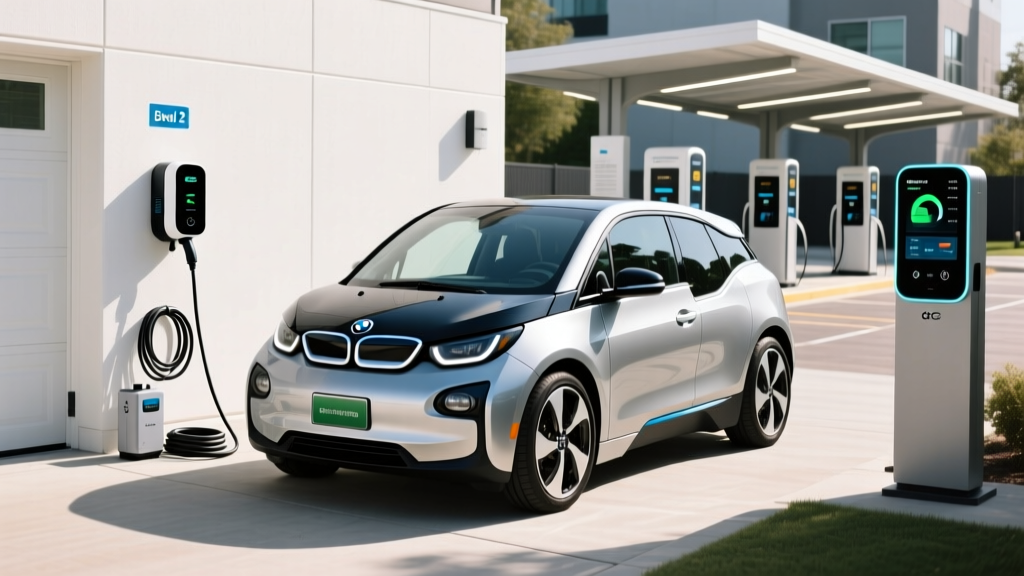
The BMW i3 remains one of the most distinctive electric vehicles ever produced, and its unique approach to range and charging continues to influence how owners plan their daily driving. Whether you're evaluating a used i3's real-world usability or comparing its charging architecture against newer EVs, understanding its range evolution and charging ecosystem is essential. This guide breaks down the BMW i3 new range expectations across model years, then provides a complete home and public charging setup playbook — from electrical requirements to equipment recommendations.
BMW i3 Range by Model Year: What the Numbers Actually Mean
The BMW i3 launched in the US for the 2014 model year with a modest 22 kWh battery (18.8 kWh usable) delivering an EPA-rated 81 miles of range. BMW progressively upgraded the pack chemistry and capacity across three major revisions:
| Model Years | Battery (Usable kWh) | Chemistry | EPA Range | Real-World Expectation |
|---|---|---|---|---|
| 2014–2016 | 18.8 kWh | NMC (Samsung SDI) | 81 mi | 60–70 mi highway; 50–60 mi cold |
| 2017–2018 | 27.2 kWh | NMC (Samsung SDI) | 114 mi | 90–100 mi highway; 75–85 mi cold |
| 2019–2021 (final) | 37.9 kWh | NMC (Samsung SDI) | 153 mi | 125–135 mi highway; 105–115 mi cold |
BMW discontinued the i3 after the 2021 model year in the US market, so "new range" discussions refer to the final 120 Ah (37.9 kWh usable) pack or the real-world range you'll experience from a used example. According to fueleconomy.gov, the 2021 i3 BEV achieves 113 MPGe combined — competitive with larger modern EVs on an efficiency-per-mile basis.
Charging Levels Explained: Speeds in kW and Miles Per Hour
Before selecting equipment or scheduling charges, you need to understand the three charging tiers and how they translate to actual range recovery. Remember: kW (kilowatts) measures power — the rate of energy delivery, while kWh (kilowatt-hours) measures energy — the total capacity of the battery. A higher kW charger fills your kWh battery faster.
| Level | Voltage | Power (kW) | i3 Miles Added/Hour | Typical Use Case |
|---|---|---|---|---|
| Level 1 | 120V AC | 1.0–1.4 kW | 3–5 mi/hr | Overnight trickle; emergency top-up |
| Level 2 | 240V AC | 3.3–11.5 kW | 12–42 mi/hr | Home/workplace daily charging |
| DC Fast Charge | 300–500V DC | Up to 50 kW | ~120–160 mi/hr (peak) | Road trips; rapid top-ups |
The BMW i3's onboard AC charger maxes out at 11 kW (for 2019+ models; earlier models were limited to 7.4 kW). On DC fast charging, the i3 uses the CCS1 connector and accepts up to 50 kW. Because the i3's battery is relatively small (37.9 kWh usable in the final generation), even 50 kW DC charging produces a 10–80% charge in approximately 35–40 minutes — longer than modern 800V-architecture EVs but practical for the battery size.
Home Charger Installation: Electrical Requirements, Costs & Panel Upgrades
Installing a Level 2 home charger is the single most impactful upgrade for daily EV ownership. For the BMW i3, an 11 kW (48A) Level 2 charger will replenish the full 37.9 kWh battery in approximately 4 hours — ideal for overnight charging.
Electrical Requirements
- Circuit: A dedicated 60A breaker (for a 48A continuous-load charger) or 50A breaker (for a 40A charger) on a 240V circuit
- Wire gauge: 6 AWG copper for 60A; 8 AWG for 50A
- Outlet vs. hardwired: Hardwired is preferred for outdoor installs and circuits above 40A; a NEMA 14-50 outlet works for portable chargers at up to 40A (50A breaker)
- GFCI protection: Required by NEC 2020+ for EV receptacles in garages; hardwired units with integrated ground-fault protection satisfy code in most jurisdictions
Installation Cost Breakdown
| Component | Low Estimate | High Estimate | Notes |
|---|---|---|---|
| Level 2 Charger (Equipment) | $350 | $700 | 40A–48A smart charger |
| Electrician Labor | $500 | $1,500 | Depends on run length, wall type |
| Electrical Panel Upgrade | $0 | $3,000 | Needed if panel lacks capacity (older homes with 100A service) |
| Permit & Inspection | $50 | $250 | Varies by municipality |
| Total (No Panel Upgrade) | $900 | $2,450 | Typical scenario for modern homes |
| Total (With Panel Upgrade) | $1,900 | $5,450 | Common in pre-2000 homes |
Panel upgrade gotcha: Homes with 100A main service often cannot support a 60A EV circuit alongside existing loads (HVAC, electric oven, dryer). A licensed electrician will perform a load calculation per NEC Article 220. If your panel is maxed, a 200A service upgrade costs $1,500–$3,000 but adds long-term home value. Some utilities offer rebates that offset panel upgrade costs — check with your provider before committing.
Safety and Code Considerations
- Always use a dedicated circuit — never share an EV charger circuit with other appliances
- Outdoor installations require a charger rated NEMA 4 (weatherproof) and a GFCI-protected circuit or hardwired connection with integrated ground fault protection
- Cable management: wall-mount a holster or use a retractable reel to prevent trip hazards and cable damage
- Check whether your jurisdiction requires a load-management device if total connected load approaches panel capacity
Connector Compatibility: NACS, CCS1, CHAdeMO & the i3
The BMW i3 sold in the US uses the CCS1 (Combined Charging System) connector for DC fast charging and the J1772 connector for Level 1 and Level 2 AC charging. This matters significantly in 2026, as the industry shifts toward NACS (the Tesla-designed connector now adopted by most major automakers).
| Connector | Used By | i3 Compatible? | Adapter Required? |
|---|---|---|---|
| J1772 (AC Level 1/2) | Most pre-2025 EVs, public Level 2 stations | Yes — native | No |
| CCS1 (DC Fast) | BMW, VW, GM, Hyundai (pre-2025) | Yes — native | No |
| NACS (Tesla / new standard) | Tesla; Ford, GM, Rivian (2025+), most 2026+ EVs | DC: via adapter; AC: via adapter | Yes — CCS1-to-NACS adapter (~$200–$300) |
| CHAdeMO | Nissan Leaf (legacy) | No | N/A — i3 cannot use CHAdeMO stations |
Practical adapter guidance: If you plan to use Tesla Superchargers (now open to non-Tesla CCS vehicles via the Magic Dock adapter at select stalls, or with your own CCS1-to-NACS adapter), invest in a reputable adapter from Lectron, A2Z, or Tesla's official CCS adapter. Confirm your adapter is rated for at least 50 kW DC and 48A AC. The i3 will never exceed 50 kW DC, so ultra-high-power 350 kW adapters are unnecessary but backward-compatible.
Charging Cost Per Mile: Home vs. Public vs. Gas Comparison
One of the strongest ownership arguments for the i3 is its low per-mile energy cost — especially when charging at home on off-peak rates.
| Scenario | Rate ($/kWh) | Cost for Full 37.9 kWh Charge | Cost Per Mile (153 mi) |
|---|---|---|---|
| Home Off-Peak (utility TOU) | $0.08–$0.12 | $3.03–$4.55 | $0.02–$0.03 |
| Home Standard Rate | $0.14–$0.18 | $5.31–$6.82 | $0.03–$0.04 |
| Public Level 2 (ChargePoint, etc.) | $0.25–$0.40 | $9.48–$15.16 | $0.06–$0.10 |
| DC Fast Charge (Electrify America, EVgo) | $0.35–$0.55 | $13.27–$20.85 | $0.09–$0.14 |
| Gas Equivalent (30 MPG @ $3.50/gal) | — | $17.89 (per 153 mi) | $0.12 |
At home off-peak rates, the i3 costs roughly 2–3 cents per mile to drive — about one-quarter the per-mile cost of a 30 MPG gas car at $3.50/gallon. Even on DC fast chargers at premium rates, the i3 remains competitive with gasoline on a per-mile basis, though the savings gap narrows. The i3's efficiency (roughly 25–27 kWh/100 miles in real-world driving) is among the best of any EV sold, thanks to its lightweight CFRP structure and regenerative braking system.
Recommended Level 2 Chargers for the BMW i3
Because the i3's onboard charger accepts up to 11 kW (48A at 240V) on 2019+ models, you want a charger that can deliver at least 48A to maximize charging speed. Earlier i3 models (2014–2018) accept 7.4 kW (32A), so a 40A charger is sufficient for those.
Emporia Level 2 Smart Charger
- Power: 48A (11.5 kW)
- Connector: J1772 (CCS adapter available)
- Cable: 24 ft
- Smart Features: Wi-Fi, scheduling, solar integration, energy monitoring via app
- Price: ~$399
- Best For: Budget-conscious owners wanting smart features and full 48A output
ChargePoint Home Flex
- Power: Configurable 16A–50A (up to 12 kW)
- Connector: J1772
- Cable: 23 ft
- Smart Features: Wi-Fi, Alexa integration, ChargePoint network access, scheduling
- Price: ~$549
- Best For: Owners who want a proven brand with flexible amperage settings
Wallbox Pulsar Plus
- Power: 40A (9.6 kW) or 48A (11.5 kW) models
- Connector: J1772
- Cable: 25 ft
- Smart Features: Wi-Fi + Bluetooth, load sharing (two chargers on one circuit), app scheduling
- Price: ~$449–$649
- Best For: Two-EV households needing load-balanced dual charging
Tesla Wall Connector (with J1772 adapter)
- Power: 48A (11.5 kW)
- Connector: NACS native; use Tesla J1772 adapter (~$50) for i3
- Cable: 24 ft
- Smart Features: Wi-Fi, firmware updates, power sharing between units
- Price: ~$475 + adapter
- Best For: Households with both a Tesla and a CCS/J1772 vehicle
For the 2019–2021 i3 with 11 kW AC capability, the Emporia Level 2 or Wallbox Pulsar Plus 48A deliver the best value-to-performance ratio. Both provide the full 48A needed to max out the i3's onboard charger, include robust app features, and come in under $650.
Public Charging Tips for the i3 in 2026
The i3's 50 kW DC fast charging cap and CCS1 connector shape your public charging strategy:
- Electrify America, EVgo, and ChargePoint DC stations with CCS1 cables are your primary network options. Most 150–350 kW stalls will still deliver only 50 kW to the i3 — that's normal and not a fault.
- Tesla Superchargers with Magic Dock (CCS1 adapter built into the stall) are accessible without a personal adapter, but verify stall availability in your area via the Tesla app.
- Preconditioning: The i3 does not offer automatic battery preconditioning for DC charging (unlike Tesla or Hyundai's 800V platforms). In cold weather, drive the car for 15–20 minutes before arriving at a DC charger to warm the battery and improve charge acceptance.
- Plan around the small battery: With 153 miles EPA, you'll DC fast charge more often on road trips than drivers of 300+ mile EVs. Use PlugShare or A Better Routeplanner to map stops every 90–110 real-world miles.
Frequently Asked Questions
How much does it cost to install a home EV charger for a BMW i3?
Expect $900–$2,450 for a standard Level 2 installation (48A charger, dedicated 60A circuit, 240V) in a home with adequate panel capacity. If your home needs a 200A service upgrade, total costs can reach $3,500–$5,450. Always get a load calculation from a licensed electrician before purchasing equipment.
How fast will each charging level add range to the i3?
Level 1 (120V) adds approximately 3–5 miles per hour. Level 2 at 11 kW (240V/48A) adds roughly 42 miles per hour — fully replenishing the 153-mile battery in about 4 hours. DC fast charging at 50 kW adds roughly 120–160 miles per hour at peak, with a 10–80% charge taking approximately 35–40 minutes.
Which connector and charger is compatible with my BMW i3?
The US-market BMW i3 uses J1772 for AC charging (Level 1 and Level 2) and CCS1 for DC fast charging. Any J1772 Level 2 home charger works natively. For Tesla Supercharger access, you'll need a CCS1-to-NACS adapter or must find a Supercharger stall with Tesla's Magic Dock CCS adapter built in. The i3 is not compatible with CHAdeMO stations.
How much does charging cost per mile compared to gas?
Charging at home on off-peak rates costs roughly $0.02–$0.03 per mile — about one-quarter the cost of a 30 MPG gas car at $3.50/gallon ($0.12/mile). Public DC fast charging at $0.35–$0.55/kWh costs $0.09–$0.14 per mile, still competitive with gasoline but with less savings margin. The i3's exceptional efficiency (~25–27 kWh/100 mi) keeps per-mile costs low across all scenarios.
What electrical upgrades might I need for a home charger?
Homes with 200A electrical service typically accommodate a 60A EV circuit without upgrades. Homes with 100A service — common in builds before 2000 — often require a panel upgrade to 200A, costing $1,500–$3,000. Your electrician will perform an NEC Article 220 load calculation to determine if your panel can handle the additional continuous load. Some utilities offer rebates for panel upgrades tied to EV adoption.
Is the BMW i3 still a practical EV in 2026?
For urban commuting and daily driving under 100 miles round-trip, the 2019–2021 i3 (153 mi EPA) remains highly practical, especially given its exceptional efficiency, tight turning radius, and premium interior materials. Its limitations are road-trip range (requiring more frequent DC stops) and a 50 kW DC charge cap that's slow by 2026 standards. If your driving is primarily local, the i3's low operating costs and unique design make it a compelling used-EV option.