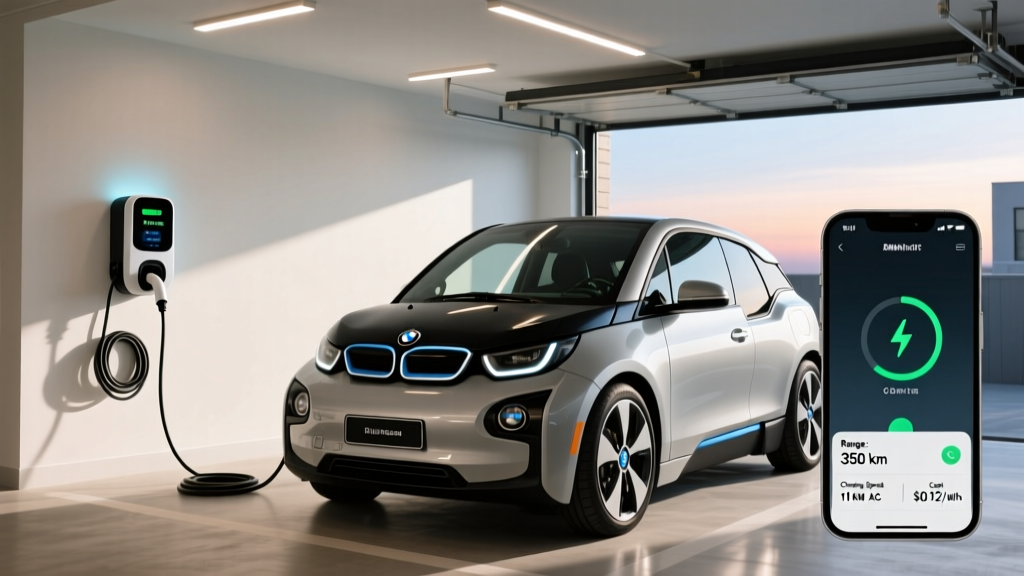
The original BMW i3 was discontinued in 2021, but BMW has revived the nameplate for a next-generation compact EV built on the Neue Klasse platform. The new BMW i3 (i3 sedan for global markets, related to the iX3 SUV) features an estimated usable battery capacity of roughly 58–60 kWh (NMC chemistry) with an EPA-estimated range projected around 270–300 miles, depending on final trim and wheel configuration. If you're researching the new BMW i3 range and how to keep it charged efficiently at home, this guide breaks down every number you need: charging speeds, home installation costs, connector compatibility, and real-world cost-per-mile versus gasoline.
Understanding the New BMW i3 Battery and Charging Architecture
Before selecting a home charger, it's essential to understand the vehicle's electrical architecture. The new-generation BMW i3 is built on BMW's 800-volt-capable Neue Klasse platform, which enables significantly faster DC charging than the legacy 400V i3. BMW has announced peak DC fast-charging capability of up to 200 kW, with a 10–80% charge time target of approximately 20–25 minutes at a compatible station. The onboard AC charger is rated at 11 kW (three-phase) or approximately 7.4–11 kW on single-phase 240V North American circuits.
A critical distinction every EV owner must internalize: kW (kilowatts) measures power — the rate at which energy flows into the battery. kWh (kilowatt-hours) measures energy — the total capacity of the battery itself. Think of kW as the width of a hose and kWh as the size of the bucket. A 60 kWh battery charged at 7.4 kW takes roughly 8 hours from empty; at 11 kW, roughly 5.5 hours.
Charging Levels Explained: Speeds, kW Ratings, and Miles Per Hour
There are three charging levels available to EV owners. Each delivers energy at a different rate, and understanding these rates is the foundation of any home charging plan.
| Level | Voltage / Amps | Power (kW) | Miles of Range / Hour | 0–100% Time (~60 kWh) |
|---|---|---|---|---|
| Level 1 | 120V / 12A | ~1.4 kW | 3–5 mi/hr | 40+ hours |
| Level 2 | 240V / 32–48A | 7.7–11.5 kW | 22–35 mi/hr | 5.5–8 hours |
| DC Fast | 400–800V DC | 50–200 kW | 150–500+ mi/hr | 10–80% in ~22 min |
Level 1 uses a standard 120V household outlet and the portable cordset that ships with the vehicle. It adds roughly 3–5 miles of range per hour — sufficient only for plug-in hybrids or EVs driven fewer than 30 miles daily. For the new i3's ~60 kWh battery, a full Level 1 charge would take over 40 hours. It's an emergency backup, not a primary strategy.
Level 2 is the standard for daily home charging. A 240V circuit (the same voltage as your electric dryer or oven) delivers 7.7 to 11.5 kW depending on amperage. At 48 amps (11.5 kW), you'll add roughly 32–35 miles of range per hour — enough to fully replenish the i3 overnight in 5–6 hours. This is the sweet spot for most owners.
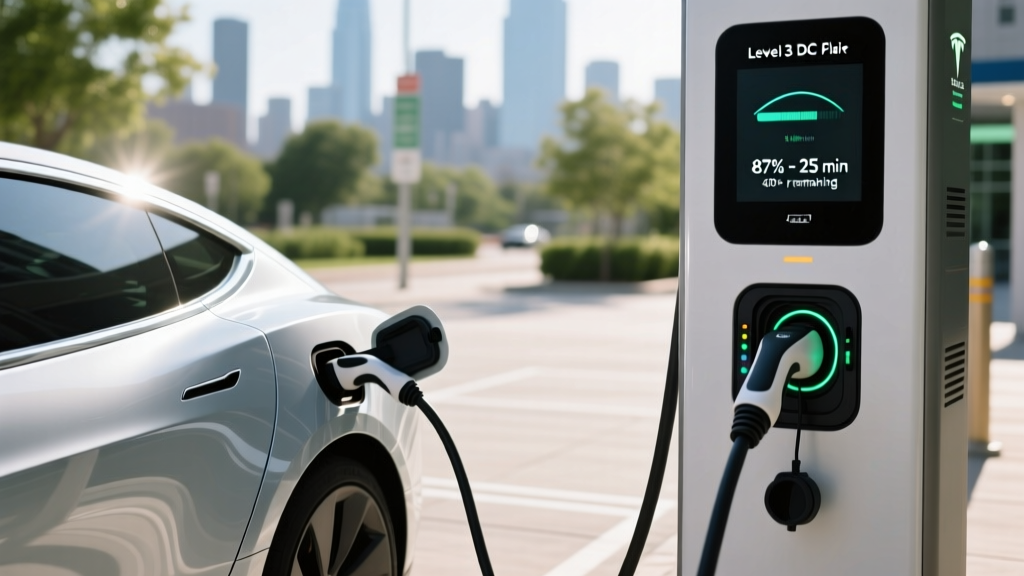
DC Fast Charging bypasses the onboard charger and delivers direct current straight to the battery at high power. The new i3's 800V architecture supports up to 200 kW at compatible chargers. Note that peak kW is not sustained: charging curves taper significantly above 80% state of charge to protect battery health. Expect the i3 to charge from 10–80% in roughly 22 minutes at a 200+ kW station, but the final 80–100% could take an additional 15–20 minutes.
Home Charger Installation: Electrical Requirements and Costs
Installing a dedicated Level 2 home charger involves electrical work that must be performed by a licensed electrician and permitted through your local building department. Here's what's involved for a typical new BMW i3 owner:
Electrical requirements: A Level 2 charger running at 48 amps requires a dedicated 60-amp, 240V circuit (the National Electrical Code requires circuits to be rated at 125% of the continuous load, so 48A continuous draw needs a 60A breaker). Lower-amperage chargers at 32A require a 40A breaker and can use 8 AWG wire; 48A units require 6 AWG copper wire.
Panel capacity: Your home's electrical panel must have sufficient spare capacity. Most modern homes with 200-amp service can accommodate a 60A EV circuit without issue. Older homes with 100-amp service may require a panel upgrade to 200A — a significant added cost. A load calculation performed by your electrician will determine this.
| Item | Low Estimate | High Estimate | Notes |
|---|---|---|---|
| Level 2 Charger (Equipment) | $350 | $700 | Smart Wi-Fi chargers, 32–48A |
| Electrician Labor | $400 | $1,200 | Depends on run length from panel |
| Permit & Inspection | $50 | $200 | Varies by municipality |
| Conduit, Wire, Breaker | $100 | $400 | 6 AWG copper, longer runs cost more |
| Panel Upgrade (if needed) | $1,500 | $3,500 | 100A to 200A service upgrade |
| TOTAL (no panel upgrade) | $900 | $2,500 | Most homes fall in this range |
| TOTAL (with panel upgrade) | $2,400 | $6,000 | Older homes with 100A service |
The IRS §30D tax credit does not currently cover home charging equipment for most taxpayers — the Alternative Fuel Vehicle Refueling Property Credit (§30C) for residential charging expired for most installations, though some commercial and census-tract-qualified installations may still qualify. Check with a tax professional for your specific situation.
Connector Compatibility: NACS, CCS1, and the BMW i3
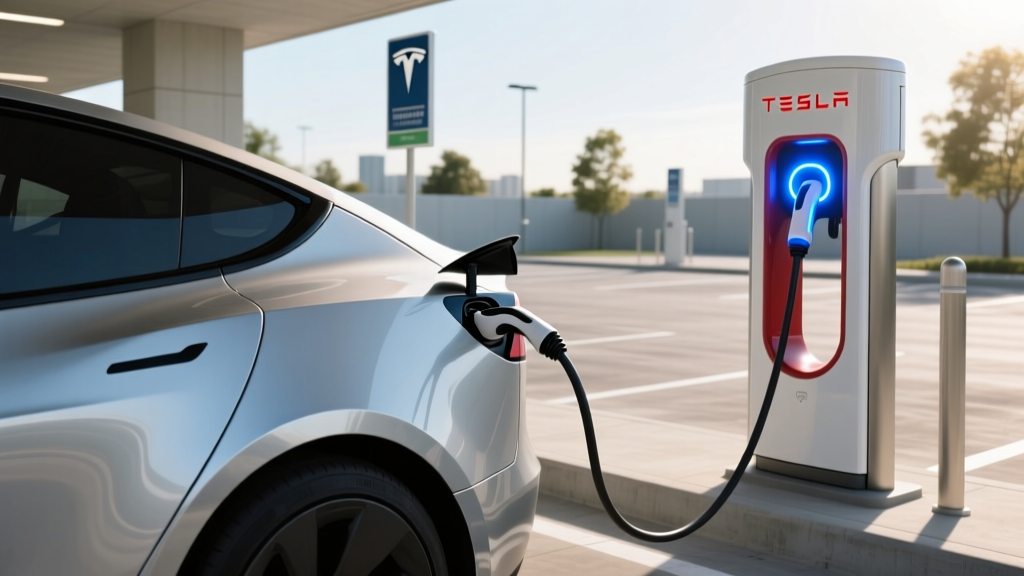
As of the 2025–2026 model years, BMW has committed to adopting the North American Charging Standard (NACS) connector — the Tesla-designed plug now standardized as SAE J3400 — on new vehicles sold in North America. The new BMW i3 is expected to ship with a native NACS charge port, giving it direct access to Tesla's Supercharger network (now open to non-Tesla EVs via the NACS standard) without an adapter.
| Connector | Type | Compatibility | Notes |
|---|---|---|---|
| NACS (J3400) | AC + DC | Native on new i3 | Direct Tesla Supercharger access; becoming industry standard |
| CCS1 | DC Fast | Adapter required (NACS-to-CCS1) | Needed for Electrify America, EVgo CCS stations |
| CHAdeMO | DC Fast | Not supported | Legacy standard; largely discontinued in the US |
| J1772 | AC Level 1/2 | Adapter required (NACS-to-J1772) | Needed for older public Level 2 stations |
Practical advice: If you're installing a home Level 2 charger, purchase a NACS-connector wallbox — this is now the dominant standard and ensures future compatibility. Budget $150–$250 for a quality CCS1 adapter for use at non-Tesla DC fast-charging networks, and a J1772-to-NACS adapter (~$100–$180) for older public Level 2 chargers you may encounter.
Recommended Home Chargers for the New BMW i3
The following Level 2 wallboxes are well-suited to the new i3's 11 kW onboard AC charger and NACS connector. All recommendations are hardwired units (hardwired installations avoid the NEC 2023 25-foot cord-length restriction on plug-in EVSE and provide a cleaner, more reliable connection).
Tesla Wall Connector (NACS)
- Power: Up to 11.5 kW (48A)
- Connector: Native NACS
- Cable: 24 ft
- Smart features: Wi-Fi, OTA updates, load sharing, Powerwall integration
- Price: ~$475
- Best for: NACS-native vehicles like the new i3; proven reliability
ChargePoint Home Flex (NACS version)
- Power: Up to 12 kW (50A, adjustable)
- Connector: NACS (2025+ models)
- Cable: 23 ft
- Smart features: Wi-Fi, app scheduling, Alexa, utility demand-response
- Price: ~$550
- Best for: Utility integration and smart scheduling for off-peak rates
Emporia Vue Level 2 Charger
- Power: Up to 11.5 kW (48A)
- Connector: NACS (2025+ models)
- Cable: 24 ft
- Smart features: Energy monitoring, solar integration, load management
- Price: ~$400
- Best for: Budget-conscious buyers; solar-home integration
Key selection note: The new BMW i3's onboard charger maxes out at approximately 11 kW on AC. Installing a 48A (11.5 kW) charger matches this ceiling. A 50A or higher charger won't charge the i3 any faster on AC, but it won't hurt — the vehicle draws only what it can accept.
Cost to Charge: Per-Mile Economics vs. Gasoline
One of the most compelling arguments for the new BMW i3 — or any EV — is the per-mile fuel cost advantage. Here's how charging costs compare across scenarios, benchmarked against a gasoline compact car averaging 30 MPG combined at $3.50/gallon:
| Charging Scenario | Rate ($/kWh) | Cost Per Mile* | Annual Cost (12,000 mi) |
|---|---|---|---|
| Home Off-Peak (utility TOU rate) | $0.08–$0.12 | $0.02–$0.03 | $240–$360 |
| Home Standard Rate (national avg) | $0.16 | $0.04–$0.05 | $480–$600 |
| Public Level 2 (ChargePoint, etc.) | $0.25–$0.39 | $0.07–$0.11 | $840–$1,320 |
| DC Fast Charging (public) | $0.35–$0.55 | $0.10–$0.16 | $1,200–$1,920 |
| Gasoline (30 MPG, $3.50/gal) | — | $0.12 | $1,400 |
*Assumes the new BMW i3 achieves approximately 3.2–3.5 miles per kWh (roughly 110–115 MPGe combined), consistent with fueleconomy.gov data for comparable Neue Klasse-class vehicles.
The takeaway is clear: home charging on an off-peak rate delivers per-mile costs roughly 75–80% lower than gasoline. Even at standard residential rates, the i3 costs less than half per mile to "fuel" compared to a 30 MPG gas car. However, exclusive reliance on public DC fast charging can approach or exceed gasoline costs — which is why home Level 2 installation is the economic foundation of EV ownership.
Charging Time Examples: Realistic Timelines for the New i3
Here are practical charging timelines for the new BMW i3's estimated 60 kWh usable battery across common scenarios:
- Overnight home charge (Level 2, 48A / 11.5 kW): 10–80% in approximately 3.5–4 hours; full 0–100% in roughly 5.5 hours. Plug in at 10 PM, wake up to a full battery by 6 AM.
- Apartment/condo shared Level 2 (32A / 7.7 kW): 10–80% in approximately 5.5 hours. Sufficient for overnight charging if you have dedicated access.
- DC fast charge (200 kW station): 10–80% in approximately 22 minutes. Ideal for road trips; the 800V architecture keeps the charge curve relatively flat through 60% SoC before tapering.
- DC fast charge (50 kW older station): 10–80% in approximately 55–65 minutes. Slower stations common at older installations; plan accordingly.
- Level 1 emergency top-up (120V / 12A): Adds roughly 4 miles per hour. Useful only for recovering enough range to reach a faster charger.
Charging curve reality: At a 200 kW DC fast charger, the i3 will sustain peak power from approximately 10–40% SoC, then gradually taper. Expect average power of roughly 130–150 kW across the full 10–80% session. BMW's thermal management system (liquid-cooled battery with preconditioning) helps maintain charging speed — always enable navigation-guided preconditioning when heading to a fast charger for optimal results.
Safety, Code Compliance, and Installation Best Practices
Home EV charger installation must comply with the National Electrical Code (NEC) and local amendments. Key safety requirements include:
- Dedicated circuit: Your Level 2 charger must be on its own dedicated breaker — never shared with other appliances.
- GFCI protection: NEC 2020 and later require ground-fault circuit interrupter (GFCI) protection for all EV charging circuits. Many modern EVSE units have built-in GFCI, but your electrician may also install a GFCI breaker.
- Outdoor rating: If your charger is installed outdoors or in an unenclosed carport, it must carry a NEMA 4 (weatherproof) rating. All chargers recommended above meet this standard.
- Permit and inspection: A permitted installation protects your home insurance coverage and ensures the work meets code. Unpermitted work can void insurance claims in the event of an electrical fire.
- Cord management: NEC restricts plug-in EVSE cord length to 25 feet for cord-and-plug-connected units. Hardwired installations have no such restriction and are preferred for permanent setups.
Frequently Asked Questions
How much does it cost to install a home EV charger for the BMW i3?
Most homeowners pay between $900 and $2,500 for a complete Level 2 installation (charger, electrician labor, permit, and materials) assuming no panel upgrade is needed. Homes requiring a 100A-to-200A panel upgrade should budget $2,400–$6,000 total. Get at least three quotes from licensed electricians and verify they have EV charger installation experience.
How fast will each charging level add range to the new i3?
Level 1 (120V) adds approximately 3–5 miles per hour. Level 2 (240V, 48A) adds approximately 32–35 miles per hour. DC fast charging at 200 kW can add up to 150–200 miles of range in a 15–20 minute session (10–80%). These figures assume the i3's projected efficiency of ~3.2–3.5 miles per kWh.
Which connector and charger are compatible with the new BMW i3?
The new BMW i3 is expected to feature a native NACS (J3400) charge port for both AC and DC charging. This provides direct access to Tesla Superchargers and all NACS-equipped stations. For CCS1-based public chargers (Electrify America, EVgo), a NACS-to-CCS1 adapter (~$150–$250) is required. For home charging, install a NACS-connector Level 2 wallbox.
How much does charging the BMW i3 cost per mile versus a gas car?
At home on off-peak electricity rates ($0.10/kWh), the i3 costs approximately $0.02–$0.03 per mile — roughly 75–80% less than a 30 MPG gas car at $3.50/gallon ($0.12/mile). Even at the national average residential rate of $0.16/kWh, the i3 costs about $0.04–$0.05 per mile. Only exclusive reliance on expensive public DC fast charging ($0.35–$0.55/kWh) narrows the gap significantly.
What electrical upgrades might I need for a Level 2 charger?
The most common upgrade is ensuring your electrical panel has sufficient spare capacity for a new 60-amp breaker (for a 48A charger). Homes with 200A service typically have adequate headroom. Homes with 100A service often require a panel upgrade to 200A, costing $1,500–$3,500. Your electrician will perform a load calculation per NEC Article 220 to determine this. Additionally, older homes may need wire upgrades if the run from panel to garage exceeds standard lengths, as voltage drop becomes a concern on long runs with 6 AWG wire.