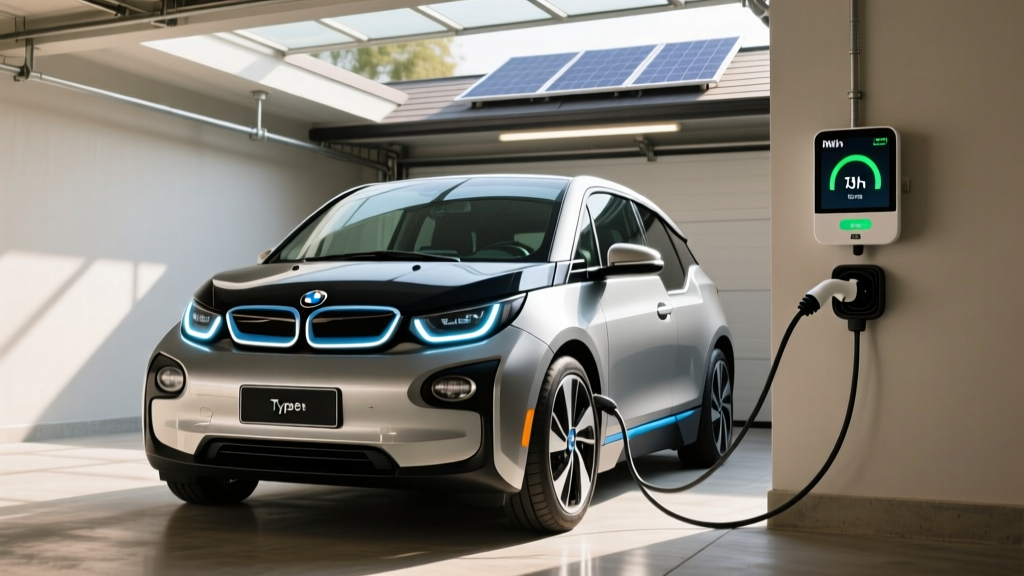
The BMW i3 extended range (REx) occupies a unique space in the EV landscape. Originally produced through the 2021 model year, its 42.2 kWh battery pack and range-extending two-cylinder gas engine gave it a practical footprint for urban drivers who wanted electric commuting with a gasoline safety net. If you own or are shopping for a pre-owned i3 REx in 2026, understanding its specific charging behavior — from its modest DC fast-charge ceiling to the Type 1/CCS adapter realities — is essential for daily usability and long-term battery health.
This guide covers every charging scenario the i3 extended range will encounter: home Level 1 and Level 2, public DC fast charging, connector compatibility, home installation costs, and the real cost-per-mile compared to a gas car. We also recommend specific Level 2 equipment that pairs well with the i3's 11 kW onboard charger.
BMW i3 Extended Range: Battery, Range, and Charging Specs at a Glance
Before we discuss charging infrastructure, let's ground the conversation in the i3 REx's hard numbers. The 2021 final-model-year specs (representative of the 120 Ah / 42.2 kWh generation sold from 2019–2021) are below:
| Spec | Value |
|---|---|
| Battery (gross / usable) | 42.2 kWh / ~37.9 kWh |
| Chemistry | NMC (Nickel Manganese Cobalt) |
| EPA electric-only range | 126 miles |
| Real-world electric range (mixed) | ~100–115 mi (highway/cold: ~80–95 mi) |
| Total range (electric + REx gas tank) | ~200 miles combined |
| EPA MPGe (electric) | 111 MPGe combined |
| EPA MPG (REx gas mode) | 39 MPG combined |
| Onboard AC charger | 11 kW (single-phase, 48A capable on 240V) |
| DC fast charge (CCS) | 50 kW peak |
| 10–80% DC fast charge | ~35–40 minutes |
| Connector (AC) | J1772 (Type 1) |
| Connector (DC) | CCS1 |
| 0–60 mph | 7.6 seconds |
| Horsepower (electric motor) | 170 hp / 184 lb-ft torque |
| Battery warranty (original) | 8 years / 80,000 miles |
Charging Levels Explained: How Fast Will Each Add Range to the i3 REx?
The BMW i3 extended range can accept power at three distinct charging levels. Understanding the difference between kW (power, or the rate of energy delivery) and kWh (energy, or the battery's total capacity) is critical here. Think of kW as the flow rate of a hose and kWh as the size of the bucket.
| Level | Voltage / Amps | Max Power (kW) | i3 REx Range Added per Hour | Full Charge Time (0–100%) | Best Use Case |
|---|---|---|---|---|---|
| Level 1 (120V) | 120V / 12A | ~1.4 kW | ~4–5 miles | ~27–30 hours | Overnight top-up, emergency |
| Level 2 (240V) | 240V / 48A | 11 kW (i3 max) | ~35–40 miles | ~3.5–4 hours | Daily home charging |
| DC Fast (CCS) | 400V DC | 50 kW peak | ~120–150 miles (10–80%) | ~35–40 min (10–80%) | Road trips, quick top-ups |
The i3's 11 kW onboard AC charger is a standout feature. Many EVs from the same era cap at 6.6 or 7.2 kW, meaning the i3 extracts more from a properly provisioned Level 2 circuit than most of its contemporaries. To take full advantage, you need a Level 2 station delivering at least 48 amps on a dedicated 60-amp circuit.
On DC fast charging, the i3's 50 kW peak is modest by 2026 standards (where 150–350 kW is common). The battery's relatively small 42.2 kWh capacity means 50 kW still represents a charge rate above 1C, so the 10–80% session completes in a reasonable 35–40 minutes. Expect the charge curve to taper noticeably above 80% SoC — this is a battery-management-system protection strategy, not a malfunction.
Home Charger Installation: Electrical Requirements, Costs, and Panel Upgrades
Installing a Level 2 home charger for your BMW i3 extended range requires a dedicated 240V circuit. Here is what a typical installation involves and what it costs.
Electrical Requirements for the i3 REx
- Voltage: 240V (split-phase, standard US residential)
- Amperage: 48A continuous draw requires a 60A breaker (NEC 80% rule: continuous loads must not exceed 80% of circuit rating)
- Wire gauge: 6 AWG copper (or 4 AWG aluminum) for runs up to ~50 feet; larger gauge for longer runs to minimize voltage drop
- Circuit: Dedicated — no sharing with other appliances
- GFCI protection: Required by NEC 2020 and later for EV charging outlets (625.41); hardwired units may have internal GFCI
Do You Need a Panel Upgrade?
This is the variable that most often catches homeowners off guard. A Level 2 charger drawing 48A adds a significant continuous load to your electrical panel. If your home has a 100A service panel (common in homes built before the 1990s) that is already near capacity, you may need a panel upgrade to 200A — or alternatively, install a lower-amperage charger (e.g., 32A on a 40A breaker) that still delivers ~25 miles of range per hour to the i3.
A licensed electrician will perform a load calculation (per NEC Article 220) to determine whether your existing panel can accommodate a 60A circuit. Some utilities and jurisdictions now accept automated load-management devices (like the Span panel or similar smart-load controllers) as an alternative to a full panel upgrade.
Installation Cost Breakdown
| Component | Low Estimate | High Estimate | Notes |
|---|---|---|---|
| Level 2 EV charger (hardware) | $350 | $700 | 11.5 kW smart charger, 25ft cable |
| Electrician labor (standard install) | $500 | $1,500 | Short run, accessible panel, drywall |
| Electrical permit | $50 | $200 | Varies by municipality |
| Conduit, wire, breaker | $100 | $400 | Depends on run length and gauge |
| Total (no panel upgrade) | $1,000 | $2,800 | Most typical installations |
| Panel upgrade (100A → 200A) | $1,500 | $4,000 | If required by load calculation |
| Total (with panel upgrade) | $2,500 | $6,800 | Older homes with 100A service |
The IRS Residential Clean Energy Credit (§25C) covers 30% of home EV charger equipment and installation costs, up to $1,000 — verify current-year eligibility with a tax professional, as rules and caps can change.
Connector Compatibility: NACS, CCS1, and the i3's Adapter Situation
The BMW i3 extended range was built before the industry's shift toward the North American Charging Standard (NACS). As a result, it uses the legacy connector ecosystem:
| Connector | Used For | i3 REx Native? | Adapter Available? | Notes |
|---|---|---|---|---|
| J1772 (Type 1) | Level 1 & Level 2 AC | Yes (native) | N/A | All public L2 stations in North America |
| CCS1 (Combo) | DC fast charging | Yes (native) | N/A | Electrify America, EVgo, most networks |
| NACS (Tesla) | AC & DC (Tesla Supercharger) | No | Yes — CCS-to-NACS adapter | Required for Tesla Supercharger access |
| CHAdeMO | DC fast (legacy) | No | Rare/expensive | Declining network; not recommended |
The NACS adapter question: As of 2026, Tesla has opened its Supercharger network to non-Tesla EVs via NACS-equipped stalls with built-in CCS adapters at select locations, or via aftermarket CCS1-to-NACS adapters. For the i3 REx, a quality CCS-to-NACS adapter (such as the Lectron or A2Z adapter, typically $150–$250) unlocks access to Tesla Superchargers — a significant practical advantage given the Supercharger network's reliability. Confirm that any adapter you purchase supports DC fast charging at up to 50 kW and is UL-listed or independently safety-tested.
Cost to Charge the BMW i3 REx: Home, Public, and Per-Mile vs. Gas
The i3 REx's small battery makes it one of the cheapest EVs to charge. Here's what you'll actually spend across common scenarios, using the usable battery capacity of ~37.9 kWh:
| Scenario | Rate ($/kWh) | Cost for Full Electric Charge | Cost per Electric Mile | Equivalent Gas Cost per Mile (30 MPG car) |
|---|---|---|---|---|
| Home (off-peak utility rate) | $0.10–$0.14 | $3.79–$5.31 | $0.03–$0.04 | $0.11 (at $3.30/gal) |
| Home (average US residential) | $0.16–$0.18 | $6.06–$6.82 | $0.05–$0.06 | $0.11 (at $3.30/gal) |
| Public Level 2 (ChargePoint, etc.) | $0.25–$0.49 | $9.48–$18.57 | $0.08–$0.15 | $0.11 (at $3.30/gal) |
| DC Fast Charge (EA, EVgo) | $0.35–$0.55 | $13.27–$20.85 | $0.11–$0.17 | $0.11 (at $3.30/gal) |
Key takeaway: Home charging at off-peak or average residential rates delivers the i3's electric miles at roughly one-third to one-half the cost of gasoline. Public DC fast charging, however, can push cost-per-mile above gas-equivalent pricing — use it for road-trip convenience, not as your primary fueling strategy. The i3's REx engine (requiring premium fuel in most model years) further tilts the economics toward home electric charging.
Best Level 2 Chargers for the BMW i3 Extended Range (2026 Equipment Picks)
The i3's 11 kW onboard charger means you want a Level 2 station that can deliver at least 48A / 11.5 kW to capture its full charging potential. Here are three proven options:
ChargePoint Home Flex
- Power output: Up to 11.5 kW (48A) on a 60A circuit; configurable down to 16A for lower-capacity panels
- Connector: J1772 (native fit for i3 AC charging)
- Cable length: 23 feet
- Smart features: Wi-Fi, app scheduling, utility demand-response integration, Alexa
- Price: ~$550–$650
- Why for i3: Amperage flexibility makes it ideal if your panel can't support a full 60A circuit today but may be upgraded later
Emporia Vue Level 2 Charger
- Power output: Up to 11.5 kW (48A)
- Connector: J1772
- Cable length: 24 feet
- Smart features: Energy monitoring via Emporia Vue panel integration, solar-aware charging, app control
- Price: ~$400–$500
- Why for i3: Best value option; solar integration is useful if you have rooftop panels and want to charge on excess generation
Grizzl-E Smart
- Power output: Up to 10 kW (40A) on a 50A circuit
- Connector: J1772
- Cable length: 24 feet
- Smart features: OCPP-compatible, app scheduling, firmware updates
- Price: ~$400–$450
- Why for i3: Slightly below the i3's 11 kW max but still adds ~30 miles/hour; rugged outdoor-rated enclosure built for Canadian winters
All three chargers are hardwired or NEMA 14-50 plug compatible. A hardwired install avoids the NEC 2020 GFCI breaker requirement for receptacles (the charger's internal ground-fault protection suffices), reducing nuisance trips and saving ~$50–$80 on a GFCI breaker.
Safety, Code, and Installation Best Practices
EV charging is a high-draw, continuous electrical load. Cutting corners here creates fire risk. Follow these non-negotiables:
- Dedicated circuit: Never share the EV charger circuit with other loads (outlets, lights, appliances).
- Permit and inspection: Every jurisdiction requires a permit for new 240V circuits. The inspection ensures wire gauge, breaker sizing, and grounding meet NEC standards. Unpermitted work can void homeowner's insurance claims.
- Outdoor rating: If mounting outdoors, ensure the charger carries a NEMA 4 or IP65 rating. The ChargePoint Home Flex and Grizzl-E both qualify.
- GFCI protection: NEC 625.41 requires ground-fault protection for EVSE. Hardwired units integrate this internally; plug-in units on a 14-50 receptacle require a GFCI breaker (which can be sensitive to nuisance tripping in older panels).
- Cable management: Use a wall-mounted cable holster to prevent the charging cord from resting on the ground where it can be damaged or create a trip hazard.
- Utility notification: Some utilities require you to notify them before adding an EV load. Many offer time-of-use (TOU) rate plans that significantly reduce off-peak charging costs — often $0.08–$0.12/kWh overnight.
Charging Time Examples for the i3 REx Battery
Here's how long common charging scenarios take with the i3's ~37.9 kWh usable battery:
| Scenario | Starting SoC | Target SoC | Energy Needed | Level 1 (1.4 kW) | Level 2 (11 kW) | DC Fast (50 kW) |
|---|---|---|---|---|---|---|
| Daily commute top-up | 50% | 80% | ~11.4 kWh | ~8 hours | ~1 hour | ~15 min |
| Overnight full charge | 10% | 100% | ~34.1 kWh | ~24 hours | ~3.5 hours | Not recommended* |
| Road-trip quick stop | 15% | 80% | ~24.6 kWh | ~18 hours | ~2.5 hours | ~35 min |
*DC fast charging to 100% is not recommended because the charge rate tapers dramatically above 80% SoC, and frequent 100% charges accelerate NMC battery degradation. For daily use, set the i3's charge limit to 80–90% and reserve 100% for trips where you need maximum range.
Frequently Asked Questions
How much does it cost to install a home EV charger for the BMW i3?
A typical Level 2 home charger installation for the i3 REx costs between $1,000 and $2,800 when no panel upgrade is needed. This includes the charger hardware ($350–$700), electrician labor ($500–$1,500), permit ($50–$200), and materials ($100–$400). If your home requires a 100A-to-200A panel upgrade, add $1,500–$4,000.
How fast will each charging level add range to my i3 extended range?
Level 1 (120V) adds roughly 4–5 miles of electric range per hour. Level 2 (240V at 48A) adds approximately 35–40 miles per hour — enough to fully recharge the i3's battery in about 3.5 hours. DC fast charging at 50 kW adds the equivalent of 120–150 miles in a 35–40 minute session (10–80% SoC).
Which connector and charger is compatible with the BMW i3 REx?
The i3 uses a J1772 connector for Level 1 and Level 2 AC charging, and a CCS1 connector for DC fast charging. To access Tesla Superchargers, you'll need an aftermarket CCS1-to-NACS adapter ($150–$250). CHAdeMO is not supported and is increasingly rare on public networks.
How much does charging cost per mile compared to gasoline?
At average US residential electricity rates ($0.16–$0.18/kWh), the i3 REx costs roughly $0.05–$0.06 per electric mile — about half the $0.11 per mile of a 30 MPG gas car burning $3.30/gallon fuel. Off-peak home rates can drop this to $0.03–$0.04 per mile. Public DC fast charging ($0.35–$0.55/kWh) pushes costs to $0.11–$0.17 per mile, roughly equal to or slightly above gasoline.
What electrical upgrades might I need for a Level 2 charger?
The most common upgrade is ensuring your panel has capacity for a dedicated 60A breaker. Homes with 100A service panels that are already heavily loaded may need a panel upgrade to 200A ($1,500–$4,000). An alternative is installing a lower-amperage charger (32A on a 40A breaker), which still adds ~25 miles of range per hour — adequate for the i3's daily needs. A licensed electrician's load calculation will determine your specific requirements.