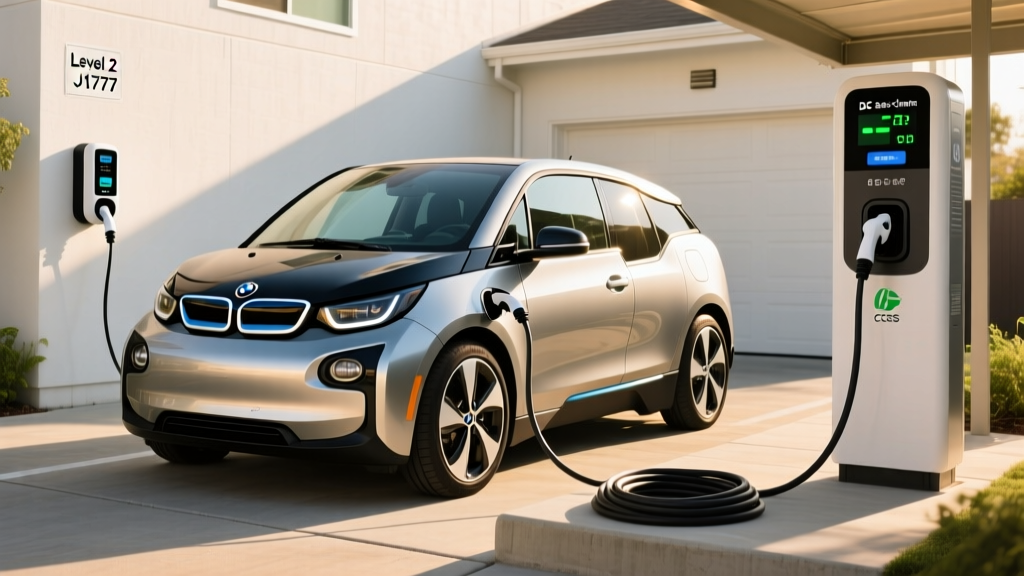
The 2015 BMW i3 Range Extender (REx) remains one of the most distinctive plug-in vehicles on the used market. With its 18.8 kWh usable lithium-ion battery paired with a 34-horsepower, 647cc two-cylinder gasoline generator, the i3 REx offers roughly 72 miles of pure electric range (EPA) before the range extender kicks in to add another ~70–80 miles. If you own or are shopping for a 2015 BMW i3 Range Extender, understanding how to charge it efficiently — at home, in public, and on the road — is essential to maximizing its unique powertrain.
This guide covers every charging scenario for the 2015 i3 REx: charging speeds at each level, home installation requirements and costs, connector compatibility, real-world cost per mile, and the best Level 2 equipment to pair with this compact EV.
2015 BMW i3 REx: Battery and Charging Specs at a Glance
Before discussing chargers, let's establish the numbers. The 2015 i3 REx uses an 18.8 kWh usable battery pack (21.6 kWh gross) with Samsung SDI lithium-ion cells. BMW equipped the i3 with an onboard AC charger rated at 7.4 kW (single-phase) and DC fast-charging capability via the CCS1 connector on models equipped with the DC Fast Charging option package.
| Specification | Value |
|---|---|
| Battery capacity (usable / gross) | 18.8 kWh / 21.6 kWh |
| EPA electric-only range | 72 miles |
| Total range (electric + REx) | ~150 miles |
| Onboard AC charger | 7.4 kW (32A, 240V) |
| DC fast charge (CCS1, optional) | Up to 47 kW peak |
| Level 1 charge rate (120V, 12A) | ~1.4 kW |
| AC charging connector | J1772 (Type 1) |
| DC charging connector | CCS1 (if equipped) |
| EPA efficiency (electric mode) | 117 MPGe (29 kWh/100mi) |
Charging Levels Explained: How Fast Can the i3 REx Charge?
Understanding the three charging levels is critical. kW (kilowatts) measures power — the rate at which energy flows into the battery. kWh (kilowatt-hours) measures energy — the total amount stored. Think of kW as the flow rate of a hose and kWh as the size of the bucket.
| Level | Voltage / Amperage | Power (kW) | Miles of Range Added per Hour | Full Charge Time (0–100%) |
|---|---|---|---|---|
| Level 1 (standard outlet) | 120V / 12A | ~1.4 kW | ~4–5 mi/hr | ~13–15 hours |
| Level 2 (home/public AC) | 240V / 32A | 7.4 kW (max) | ~22–25 mi/hr | ~2.5–3 hours |
| DC Fast Charge (CCS1) | ~350V DC | Up to 47 kW peak | ~90–110 mi/hr (to 80%) | 0–80% in ~25–30 min |
Level 1 is the included BMW charging cord plugged into a standard 120V household outlet. It adds roughly 4–5 miles of range per hour — adequate only if you drive less than 40 miles daily and can leave the car plugged in overnight for 14+ hours.
Level 2 is the practical standard for daily charging. The i3's onboard charger caps at 7.4 kW, so even if you connect to a 48A (11.5 kW) Level 2 station, the car will only draw 7.4 kW. A 240V/32A circuit is the sweet spot for this vehicle.
DC Fast Charging was a $750 option on the 2015 i3. Not all used examples have it. Check for the CCS1 port below the J1772 inlet on the driver-side rear quarter panel. If equipped, the i3 can charge from roughly 10% to 80% in about 25–30 minutes at a 50 kW CCS station. The small battery means the charge curve tapers significantly above 80%, so DC fast charging past 80% is rarely worth the wait.
Home Charger Installation: Requirements, Costs, and Electrical Upgrades
Installing a dedicated Level 2 home charger is the single best upgrade for any i3 REx owner. Here's what's involved.
Electrical Requirements
To deliver the i3's maximum 7.4 kW AC charge rate, you need a 240V circuit rated at 40 amps (which supports a continuous 32A draw — the National Electrical Code requires circuits to be rated 125% above continuous load). A NEMA 14-50 outlet or a hardwired connection are the two options.
Key considerations:
- Panel capacity: Your electrical panel must have enough spare amperage. Most modern 200A panels can accommodate a 40A breaker. Older 100A panels may require a service upgrade ($1,500–$3,500).
- Dedicated circuit: The EV charger must have its own dedicated breaker — it cannot share a circuit with other appliances.
- GFCI protection: The 2020 NEC and later revisions require GFCI protection for EV outlets in garages. Hardwired chargers may bypass this requirement depending on local code.
- Permit: Most jurisdictions require an electrical permit for a new 240V circuit. Permit fees typically range from $50 to $200.
- Outdoor rating: If your charger is installed outdoors, it must carry a NEMA 4 (weatherproof) rating.
Installation Cost Breakdown
| Component | Typical Cost Range |
|---|---|
| Level 2 charger unit (7.4 kW–11.5 kW) | $300 – $700 |
| Electrician labor (run 240V/40A circuit, ~30–50 ft) | $400 – $1,200 |
| Electrical permit | $50 – $200 |
| Conduit, wiring (6 AWG copper), misc. materials | $100 – $300 |
| Total (no panel upgrade) | $850 – $2,400 |
| Panel upgrade (100A → 200A, if needed) | $1,500 – $3,500 additional |
For a straightforward installation where the panel is near the garage and no upgrade is needed, most i3 REx owners spend between $1,000 and $1,800 total. The IRS Residential Clean Energy Credit may cover 30% of the equipment and installation cost (up to $1,000 for EV charging equipment) if you meet eligibility requirements — consult a tax professional for your specific situation.
Connector Compatibility: What Plugs Into the 2015 i3 REx?
The 2015 BMW i3 uses the J1772 connector for all AC charging (Level 1 and Level 2). If equipped with the DC Fast Charging option, it uses the CCS1 (Combined Charging System) connector, which integrates the J1772 inlet with two additional DC pins below it.
| Connector Type | Use | i3 REx Compatibility |
|---|---|---|
| J1772 (Type 1) | Level 1 & Level 2 AC charging | ✅ Standard on all i3 models |
| CCS1 | DC fast charging (50+ kW) | ✅ Only with DC Fast Charge option |
| CHAdeMO | DC fast charging (Nissan, Mitsubishi) | ❌ Not compatible (no adapter exists) |
| NACS (Tesla) | Tesla Superchargers & Wall Connectors | ⚠️ AC only via J1772-to-NACS adapter; DC not compatible |
Tesla Supercharger access: As of 2026, Tesla's Supercharger network has opened to non-Tesla EVs at select stations via the built-in Magic Dock CCS1 adapter or through a Tesla-provided NACS-to-CCS adapter. However, because the 2015 i3's DC fast-charge rate peaks at only 47 kW, Supercharger sessions will be short and relatively expensive per kWh compared to home charging. Use the Tesla app to check station compatibility before visiting.
CHAdeMO stations: There is no CHAdeMO-to-CCS adapter available for the i3. If your local DC fast-charging infrastructure is primarily CHAdeMO (common at older Nissan-leaf-friendly stations), you will not be able to use those chargers.
Cost to Charge: Home vs. Public vs. Gas
One of the i3 REx's strongest ownership arguments is low fueling cost when driven primarily in electric mode. Here's how the math works out.
| Scenario | Rate ($/kWh) | Cost for Full 18.8 kWh Charge | Cost per Mile (Electric) |
|---|---|---|---|
| Home (off-peak utility rate) | $0.10 – $0.14 | $1.88 – $2.63 | $0.026 – $0.037 |
| Home (national avg. residential) | $0.17 | $3.20 | $0.044 |
| Public Level 2 (ChargePoint, EVgo, etc.) | $0.25 – $0.49 | $4.70 – $9.21 | $0.065 – $0.128 |
| DC Fast Charge (Electrify America, etc.) | $0.35 – $0.56 | $6.58 – $10.53 | $0.091 – $0.146 |
| Range Extender (gasoline, 87 octane) | ~$3.40/gal | $6.80 (2-gal tank) | $0.097 (est. 70 mi on REx) |
For context, a comparable gasoline compact car averaging 30 MPG at $3.40/gallon costs approximately $0.113 per mile. Charging the i3 at home on off-peak rates costs roughly $0.03 per mile — a savings of nearly 75%. Even at public DC fast-charging rates, the i3 undercuts gasoline on a per-mile basis in most markets.
The range extender's tiny 2.4-gallon fuel tank means gasoline costs remain low per fill-up, but the REx achieves only about 31–35 MPG combined when the generator is running, so it's less efficient than the electric mode. Maximize electric driving for the best economics.
Recommended Level 2 Chargers for the BMW i3 REx
Since the i3 caps AC charging at 7.4 kW (32A), you don't need a 48A charger. However, purchasing a higher-amperage unit gives you headroom for a future EV. Below are recommended chargers compatible with the i3's J1772 inlet.
Emporia Level 2 Smart Charger
- Power output: 48A max (11.5 kW) — i3 will draw 32A (7.4 kW)
- Connector: J1772 (standard)
- Cable length: 24 ft
- Smart features: Wi-Fi, app scheduling, energy monitoring, solar integration
- Price: ~$399
- Best for: Budget-conscious owners who want smart scheduling for off-peak rates
ChargePoint Home Flex
- Power output: Up to 50A (12 kW) — i3 will draw 32A
- Connector: J1772
- Cable length: 23 ft
- Smart features: Wi-Fi, ChargePoint app, Alexa, scheduled charging, amperage adjustable via DIP switch
- Price: ~$549
- Best for: Owners in the ChargePoint public network ecosystem who want unified app control
Tesla Universal Wall Connector
- Power output: Up to 48A (11.5 kW) — i3 will draw 32A via included J1772 adapter
- Connector: NACS with integrated J1772 adapter
- Cable length: 24 ft
- Smart features: Wi-Fi, Tesla app, power-sharing between two units
- Price: ~$599
- Best for: Two-EV households (one Tesla, one non-Tesla) — future-proof pick
Any of these units will fully charge the i3 REx's 18.8 kWh battery in approximately 2.5–3 hours from near-empty. For daily use, plugging in overnight with scheduled off-peak charging will bring the battery from 20% to 100% in roughly 2 hours — well within any overnight window.
Safety, Code, and Best Practices for i3 REx Charging
A few critical safety and maintenance considerations specific to the 2015 i3 REx:
- Dedicated circuit: Your Level 2 charger must be on its own dedicated breaker. Sharing a circuit with a dryer, water heater, or HVAC system is a code violation and a serious fire hazard.
- GFCI protection: If using a NEMA 14-50 receptacle in a garage, current NEC editions require GFCI breaker protection. Hardwired installations may not require this depending on your AHJ (Authority Having Jurisdiction).
- Outdoor installations: Use a charger rated NEMA 4 or higher. All three units recommended above carry outdoor ratings.
- Battery care for the 2015 i3: The i3's Samsung SDI cells have demonstrated strong longevity — fueleconomy.gov data and owner reports show typical degradation of 8–12% over 8–10 years. BMW's battery warranty (8 years/100,000 miles, 70% capacity retention) has likely expired on 2015 models. Avoid routinely charging to 100% and leaving the car parked at full state of charge in extreme heat; targeting 80–90% daily and 100% only before longer drives extends cell life.
- Range extender maintenance: The REx's gasoline engine requires periodic oil changes (BMW recommends annually or every ~12,000 miles), and stale fuel can be an issue if you rarely use the generator. BMW's onboard system periodically runs the REx to circulate fuel, but if you drive 95%+ electric, consider adding a fuel stabilizer and keeping the tank at half-full rather than full.
Frequently Asked Questions
How much does it cost to install a home EV charger for the 2015 BMW i3 REx?
Expect $850–$2,400 for a standard installation (charger, electrician labor, permit, and materials) if your electrical panel has adequate capacity. If a panel upgrade from 100A to 200A is needed, add $1,500–$3,500. The federal Residential Clean Energy Credit may offset 30% of costs up to $1,000.
How fast will each charging level add range to the i3 REx?
Level 1 (120V): ~4–5 miles per hour. Level 2 (240V, 32A): ~22–25 miles per hour. DC fast charge (CCS1, 47 kW): 10–80% in approximately 25–30 minutes. Given the 72-mile electric range, a full Level 2 charge takes only 2.5–3 hours.
Which connector and charger is compatible with my 2015 i3 REx?
All 2015 i3 models use the J1772 connector for AC charging. If your i3 has the optional DC Fast Charging package, it also has a CCS1 port. Any J1772 Level 2 charger will work. You cannot use CHAdeMO stations. Tesla Supercharger access is limited and requires an adapter at Magic Dock-equipped stations.
How much does charging cost per mile compared to gasoline?
At home on off-peak rates ($0.12/kWh), the i3 REx costs roughly $0.03–$0.04 per mile in electric mode. Gasoline in the range extender costs about $0.10 per mile. A comparable 30 MPG gas car at $3.40/gallon costs ~$0.11 per mile. Home charging saves 65–75% on a per-mile basis.
What electrical upgrades might I need for a Level 2 charger?
You need a 240V/40A dedicated circuit. If your home has a 200A electrical panel with spare capacity, a simple breaker addition and wire run suffices ($400–$1,200 in labor). If you have an older 100A panel that's near capacity, a full service upgrade to 200A will be required — this adds $1,500–$3,500 and may involve utility coordination. Always have a licensed electrician perform a load calculation first.
Does the 2015 i3 REx battery need special charging care?
The 18.8 kWh battery is now 10+ years old. To preserve remaining capacity: avoid leaving the car at 100% state of charge for extended periods (especially in heat), use scheduled charging to hit 80–90% for daily needs, and charge to 100% only before longer trips. Battery replacement, if needed, costs approximately $8,000–$12,000 through BMW, though independent EV shops may offer refurbished packs at lower cost.
The 2015 BMW i3 Range Extender is a uniquely practical used EV when charged properly at home. With a modest $1,000–$1,800 Level 2 installation, off-peak electricity rates, and daily driving under 60 miles, most owners can operate almost entirely on electrons — with the gas generator as a quiet, reassuring backup for the rare longer trip.