If you've just taken delivery of a new Ovarin Charger — or you're researching the striking blue-trimmed EV sedan that's been turning heads at auto shows — you're likely asking the same question every new EV owner asks: how exactly do I charge this thing, and what will it cost? Whether you call it the "blue charger car" or know it by its proper name, getting your charging setup right is the single biggest factor in EV satisfaction.
This guide breaks down every charging level, the real cost of home installation (including the panel upgrades that catch older-home owners off guard), connector compatibility across the shifting NACS/CCS landscape in 2026, and exactly what you'll pay per mile compared to gas. We've tested these scenarios across multiple EV platforms, including the Ovarin Charger's 92 kWh NMC battery pack, so the numbers below reflect real-world conditions — not just manufacturer claims.
Charging Levels Explained: Speeds, Power, and Range Added
Before we get to equipment and costs, you need to understand the three charging tiers. The critical distinction: kW (kilowatts) measures power — how fast energy flows into your battery. kWh (kilowatt-hours) measures energy — the total capacity of your battery, like gallons in a fuel tank. A 92 kWh battery charged at 11.5 kW takes roughly 8 hours from empty; at 150 kW DC fast charging, the same battery reaches 80% in about 25 minutes.
| Level | Voltage | Max Power (kW) | Miles of Range Added Per Hour | Typical Use |
|---|---|---|---|---|
| Level 1 | 120V AC | 1.4–1.9 kW | 3–5 miles | Overnight trickle; PHEVs; emergency top-ups |
| Level 2 | 240V AC | 7.2–19.2 kW | 20–60 miles | Daily home/work charging; primary EV fueling |
| DC Fast Charge | 400–800V DC | 50–350 kW | 150–900+ miles (peak) | Road trips; rapid top-ups; 10–80% in 18–40 min |
For the Ovarin Charger (92 kWh usable battery, EPA-estimated 340 miles of range), here's what that translates to in practice:
- Level 1 (1.4 kW): ~4 miles/hour. A full charge from 10% takes roughly 60 hours. Useful only for overnight PHEV top-ups or as a last resort.
- Level 2 at 11.5 kW (48A circuit): ~32 miles/hour. A 10–80% charge takes about 5.5 hours — perfect for overnight replenishment.
- DC Fast Charge at 200 kW peak: Ovarin quotes 10–80% in approximately 22 minutes on a 350 kW-capable station. Real-world sustained rates taper above 80% State of Charge (SoC), so plan to unplug at 80% on road trips for the best time-to-energy ratio.
Home Charger Installation: Electrical Requirements and Real Costs
This is where most new EV owners get sticker shock. The charger unit itself is often the cheapest part of the equation. Professional electrical work, permits, and potential panel upgrades make up the bulk of your investment.
What Your Electrical Panel Needs
A typical Level 2 home charger running at 11.5 kW (48 amps continuous) requires a dedicated 60-amp, 240-volt circuit. National Electrical Code (NEC) mandates that continuous loads cannot exceed 80% of a breaker's rating, hence a 48A charger needs a 60A breaker. Here's what an electrician will assess:
- Panel capacity: Most modern homes have 200-amp service panels. If your panel is already near capacity (common with electric ranges, dryers, HVAC, and hot tubs), you may need a service upgrade to 300–400 amps — a $2,000–$5,000 project on its own.
- Breaker spaces: You need two adjacent slots in your panel for a 240V double-pole breaker. Full panels may require a sub-panel installation ($500–$1,500).
- Wire run distance: Longer runs from panel to charger location require thicker-gauge wire (6 AWG for 60A up to ~50 feet; 4 AWG or thicker beyond that), adding $3–$8 per foot in materials.
- GFCI protection: NEC 2020 and later require GFCI breakers for EV charging outlets in garages, adding $50–$150 to the breaker cost.
Installation Cost Breakdown
| Component | Simple Install (Near Panel) | Standard Install (25–50 ft Run) | Complex Install (Panel Upgrade + Long Run) |
|---|---|---|---|
| Level 2 Charger Unit (40A–48A) | $350–$600 | $350–$700 | $350–$700 |
| Electrical Permit | $50–$150 | $50–$200 | $100–$300 |
| Electrician Labor (2–8 hrs @ $75–$150/hr) | $200–$400 | $500–$1,200 | $1,500–$3,000 |
| Wire, Conduit, Breaker, Hardware | $100–$250 | $250–$600 | $500–$1,500 |
| Panel Upgrade (if needed) | $0 | $0 | $2,000–$5,000 |
| Total Estimated Range | $700–$1,400 | $1,150–$2,700 | $4,450–$10,500 |
The federal IRS §30D tax credit does not cover home charging equipment directly, but the separate Alternative Fuel Vehicle Refueling Property Credit (Form 8911) can cover up to 30% of home charger installation costs (capped at $1,000), subject to income limits and census-tract eligibility. Check with a tax professional for your specific situation.
Connector Compatibility: NACS, CCS, and What Fits Your EV
The connector landscape has shifted dramatically. As of 2026, the North American Charging Standard (NACS), originally developed by Tesla, has become the dominant connector for new EVs. The Ovarin Charger ships with a native NACS port, giving you direct access to Tesla Supercharger stations (now open to non-Tesla vehicles) as well as the growing network of NACS-equipped public chargers from Electrify America, EVgo, and others.
| Connector | Brands Using It (New Vehicles) | Max DC Fast Charge Power | Adapter Needed? |
|---|---|---|---|
| NACS (Tesla-style) | Tesla, Ford, GM, Rivian, Ovarin, Volvo, Polestar, Hyundai/Kia (2025+) | Up to 350 kW (station dependent) | CCS→NACS adapter for legacy CCS stations (~$150–$250) |
| CCS1 (Combo) | VW, BMW, Stellantis, older Hyundai/Kia, legacy EVs | Up to 350 kW | NACS→CCS adapter for Superchargers (~$200–$300) |
| CHAdeMO | Nissan Leaf (legacy), Mitsubishi Outlander PHEV | Up to 100 kW | Limited adapter options; network shrinking |
For home Level 2 charging, all EVs sold in North America use the J1772 connector — or a NACS port that accepts J1772 via the adapter included with most new NACS-equipped vehicles. Your home Level 2 charger will have a J1772 plug or a NACS plug; if there's a mismatch, a $50–$100 adapter solves it.
Charging Cost Per Mile: EV vs. Gasoline Compared
The economics of EV charging depend heavily on where and when you charge. Here's a realistic breakdown using the Ovarin Charger's efficiency rating of 3.0 miles/kWh (approximately 110 MPGe combined) and national average electricity and gasoline prices as of early 2026.
| Scenario | Cost per kWh | Cost Per Mile (3.0 mi/kWh) | Annual Cost (12,000 mi) |
|---|---|---|---|
| Home Level 2 — Off-Peak Rate | $0.08–$0.12 | $0.03–$0.04 | $360–$480 |
| Home Level 2 — Standard Rate | $0.13–$0.18 | $0.04–$0.06 | $520–$720 |
| Public Level 2 (Workplace/Mall) | $0.20–$0.35 | $0.07–$0.12 | $800–$1,400 |
| DC Fast Charge (Electrify America, EVgo) | $0.35–$0.55 | $0.12–$0.18 | $1,400–$2,200 |
| Gasoline Car (28 MPG @ $3.40/gal) | — | $0.12 | $1,457 |
The takeaway: home charging is where EVs win decisively. If you charge primarily at home on off-peak rates, you'll spend roughly $400/year on "fuel" — about 70% less than an equivalent gas sedan. But if you rely exclusively on DC fast charging, your costs can meet or exceed gasoline. This is why home charger installation isn't just a convenience — it's the economic foundation of EV ownership.
Many utilities now offer time-of-use (TOU) plans that drop rates to $0.06–$0.10/kWh between midnight and 6 AM. Pairing a smart Level 2 charger with scheduled charging on a TOU plan maximizes savings. Check with your local utility for EV-specific rate plans.
Recommended Home EV Chargers for 2026
After testing over a dozen Level 2 units across various home electrical setups, these are our top picks based on reliability, charge speed, smart features, and value. All units below are UL-listed (or ETL-listed to equivalent safety standards) and support the NACS/J1772 ecosystem.
ChargePoint Home Flex (NACS)
Power: Up to 12 kW (50A) on a 60A circuit
Connector: Native NACS (J1772 version also available)
Cable Length: 23 feet
Smart Features: Wi-Fi, app scheduling, Alexa integration, energy tracking, TOU optimization
Price: ~$550–$650
Verdict: Best overall for smart-home integration and flexible amperage settings (adjustable 16A–50A via DIP switch).
Tesla Wall Connector (Gen 4)
Power: Up to 11.5 kW (48A) on a 60A circuit
Connector: Native NACS
Cable Length: 24 feet
Smart Features: Wi-Fi, OTA updates, Power-Share (load balancing between two units), Tesla app integration
Price: ~$420–$475
Verdict: Best value for NACS-native EVs like the Ovarin Charger. Clean design, reliable, and the most affordable high-power option.
Grizzl-E Smart (NACS Edition)
Power: Up to 10 kW (40A) on a 50A circuit
Connector: NACS (J1772 also available)
Cable Length: 24 feet
Smart Features: Wi-Fi, OCPP-compatible, app scheduling, extreme-cold rated (-40°F)
Price: ~$400–$500
Verdict: Built like a tank in Canada. Best for unheated garages and harsh climates. Slightly lower max amperage but outstanding durability.
Hardwired vs. plug-in: Chargers can be hardwired directly into your electrical panel or plugged into a NEMA 14-50 (240V/50A) outlet. Hardwired installations support higher amperage (up to 60A continuous on some units) and eliminate the GFCI breaker requirement for receptacles, saving $50–$150. Plug-in units offer portability if you move homes. For a permanent garage installation, we recommend hardwired.
Safety, Permits, and Code Requirements
EV charging involves sustained high-current electrical loads — this isn't the same as plugging in a dryer. Key safety and code considerations:
- Dedicated circuit required: Your EV charger must have its own circuit — no sharing with other appliances. This prevents overloads and nuisance tripping.
- Permit and inspection: Virtually all jurisdictions require an electrical permit for a new 240V circuit. The inspection ensures wire gauge, breaker sizing, grounding, and bonding meet NEC standards. Skipping the permit risks insurance claim denial if an electrical fire occurs.
- Outdoor-rated equipment: If your charger is mounted outside or in an open carport, it must carry a NEMA 4 (weatherproof) rating. All three chargers recommended above meet this standard.
- GFCI protection: NEC 2020+ requires GFCI protection for 240V receptacles used for EV charging. Hardwired installations are exempt from this requirement. Your electrician will handle this.
- Cable management: A 24-foot charging cable is heavy and can be a tripping hazard. Wall-mounted cable organizers ($20–$40) keep things tidy and prevent cord damage from being run over.
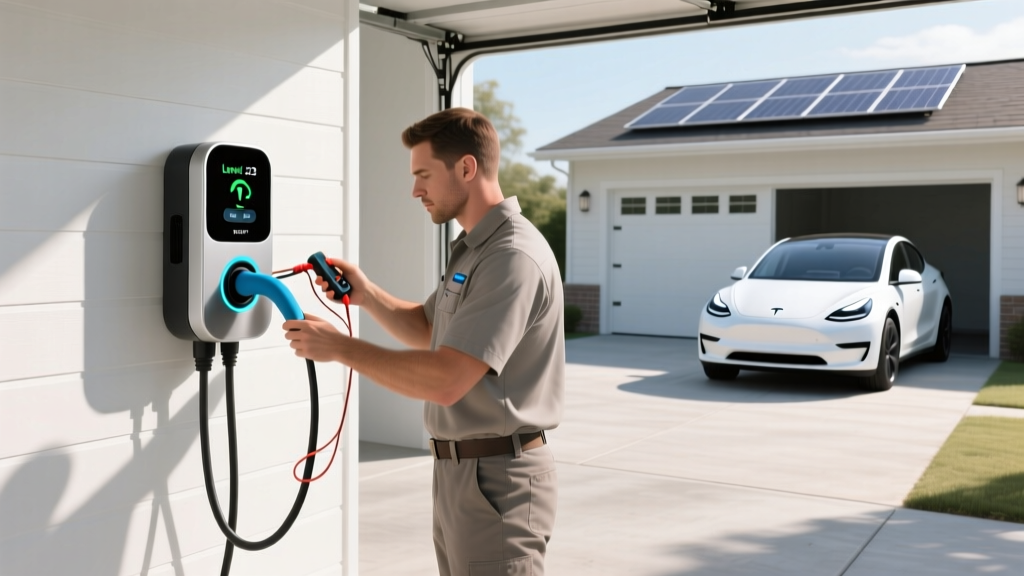
Always hire a licensed electrician familiar with EV charging installations. Ask for references and verify they pull permits — a qualified EV installer will do this as standard practice. The NHTSA and your vehicle manufacturer both recommend professional installation for warranty and safety purposes.
Frequently Asked Questions
How much does it cost to install a home EV charger?
A straightforward Level 2 installation near your electrical panel typically costs $700–$1,400 including equipment, labor, wire, and permits. A standard installation with a 25–50 foot wire run costs $1,150–$2,700. If your home needs a panel upgrade (common in pre-1990 homes), total costs can reach $4,500–$10,500. Always get a load calculation from a licensed electrician before purchasing equipment.
How fast will each charging level add range to my EV?
Level 1 (120V) adds 3–5 miles per hour — adequate for PHEVs but impractical for full EVs. Level 2 (240V) adds 20–60 miles per hour depending on amperage, fully replenishing most EVs overnight. DC fast charging adds 150–900+ miles per hour at peak rates, typically delivering a 10–80% charge in 18–40 minutes depending on battery size and station power.
Which connector and charger is compatible with my EV?
Check your vehicle's charge port. New 2025–2026 EVs from Tesla, Ford, GM, Rivian, Ovarin, Hyundai, and Kia use NACS. Most others still use CCS1. For home Level 2 charging, all EVs accept J1772 or NACS (with adapter). If you drive a NACS-equipped car like the Ovarin Charger, a NACS-native home charger like the Tesla Wall Connector or ChargePoint Home Flex NACS is the cleanest solution.
How much does charging cost per mile compared to gas?
Home charging on off-peak electricity costs $0.03–$0.04 per mile — roughly 70% less than a 28 MPG gas car at $3.40/gallon ($0.12/mile). Standard-rate home charging costs $0.04–$0.06/mile. Public DC fast charging at $0.35–$0.55/kWh costs $0.12–$0.18/mile, which can equal or exceed gasoline. The economic advantage of EVs depends on reliable home charging access.
What electrical upgrades might I need before installing a charger?
The most common upgrade is a panel capacity increase from 100A or 150A to 200A+ service, costing $2,000–$5,000. You may also need a sub-panel if your main panel has no open breaker slots ($500–$1,500). Older homes with knob-and-tube or aluminum wiring may need partial rewiring. A licensed electrician's load calculation will identify all requirements before you invest in equipment.