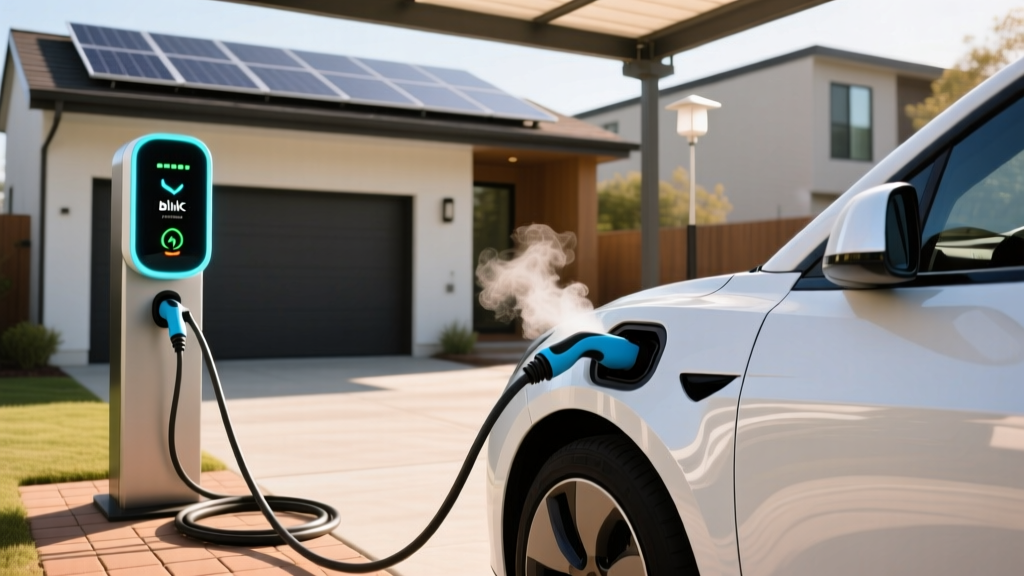
If you have seen a Blink charging station in a parking garage, grocery lot, or workplace and wondered what you would actually pay to plug in, you are not alone. Blink operates one of the largest public and semi-public charging networks in North America, but its pricing structure — guest rates, member rates, subscription tiers, and site-specific overrides — can be confusing. This guide breaks down Blink charging rates across Level 2 and DC fast charging, compares them to home charging and other networks, and shows you exactly what each session costs per mile.
How Blink Charging Rates Work: Guest vs. Member Pricing
Blink uses a variable pricing model. The rate you pay depends on three factors: whether you are a Blink member, which specific station owner set the price, and whether you are using Level 2 AC or DC fast charging. Unlike Tesla Superchargers, where pricing is mostly uniform, Blink station hosts (businesses, municipalities, parking operators) can set their own per-kWh rates within Blink's framework.
Here is the general rate structure as of early 2026:
- Guest (non-member) Level 2: $0.49–$0.69 per kWh at most locations
- Blink Member Level 2: $0.39–$0.59 per kWh (membership is free to create)
- Guest DC Fast Charging: $0.59–$0.79 per kWh
- Member DC Fast Charging: $0.49–$0.69 per kWh
- Blink Membership+ (paid tier): Discounted rates at select locations, typically 10–15% below standard member pricing
Some stations charge by the minute rather than per kWh, particularly older installations. At a time-based station, expect rates of $0.04–$0.08 per minute for Level 2 and $0.25–$0.45 per minute for DC fast. Time-based pricing penalizes vehicles with slower onboard chargers, so always check the Blink app before initiating a session.
Charging Levels Explained: Speeds, Power, and Range Added
Before comparing costs, you need to understand what each charging level delivers. Power is measured in kilowatts (kW) — that is the rate of energy flow. Energy is measured in kilowatt-hours (kWh) — that is the total amount of electricity delivered. A 50 kW charger running for one hour delivers 50 kWh of energy. This distinction is critical when calculating costs.
| Level | Voltage | Power (kW) | Miles of Range Per Hour | Typical Use Case |
|---|---|---|---|---|
| Level 1 | 120V AC | 1.0–1.4 kW | 3–5 miles | Overnight home trickle |
| Level 2 | 240V AC | 3.3–19.2 kW | 12–75 miles | Home, workplace, public (Blink L2) |
| DC Fast | 200–500V DC | 50–350 kW | 150–1,000+ miles (peak) | Highway travel, quick top-ups |
Blink's public Level 2 stations typically deliver 6.6 kW or 7.2 kW (some newer units push 19.2 kW). Their DC fast stations range from 50 kW older units to 180 kW newer cabinets. The actual charge speed your vehicle receives depends on its onboard charger capacity (for Level 2) or its peak DC charge acceptance rate.
Charging Time Examples: How Long at Blink Stations?
Charge times depend on battery size, starting state of charge (SoC), and the vehicle's charge curve — the rate tapers significantly above 80% SoC to protect battery health. Here are realistic 10–80% times for common EV battery sizes at Blink stations:
| Battery Size | Example Vehicles | Blink Level 2 (7.2 kW) | Blink DC Fast (50 kW) | Blink DC Fast (180 kW)* |
|---|---|---|---|---|
| 58 kWh usable | VW ID.4, base Hyundai Ioniq 5 | ~5.5 hours | ~62 min | ~24 min |
| 77 kWh usable | Ford Mustang Mach-E ER, Tesla Model Y | ~7.5 hours | ~82 min | ~30 min |
| 91 kWh usable | Rivian R1S, F-150 Lightning ER | ~9 hours | ~97 min | ~38 min |
*Peak rate applies only during the 10–40% SoC window. Above 60% SoC, even a 180 kW-capable station may deliver only 40–60 kW depending on the vehicle's thermal management and battery chemistry. This charge-curve taper means the last 20% of a session takes disproportionately longer — a key reason most EV owners charge to 80% on road trips.
Blink Charging Rates vs. Home Charging and Competitors
To put Blink's pricing in context, here is how per-kWh costs compare across common charging scenarios:
| Charging Source | Typical $/kWh | Notes |
|---|---|---|
| Home (national avg. residential) | $0.16 | Varies by state; EIA data |
| Home (off-peak TOU rate) | $0.08–$0.12 | Utility time-of-use plans |
| Blink Level 2 (member) | $0.39–$0.59 | Site-specific |
| Blink DC Fast (member) | $0.49–$0.69 | Site-specific |
| Electrify America DC Fast | $0.48–$0.64 | Pass+ membership reduces rate |
| Tesla Supercharger | $0.25–$0.45 | Varies by location and time |
| EVgo DC Fast | $0.43–$0.62 | Plus plan reduces rate |
Home charging remains dramatically cheaper than any public network. At the national average residential rate of $0.16/kWh, fully charging a 77 kWh battery costs roughly $12.32. At Blink's average member Level 2 rate of $0.47/kWh, that same session costs $36.19 — nearly three times more. This is why installing a home Level 2 charger is the single highest-impact investment an EV owner can make.
Cost Per Mile: Blink vs. Gas at Current Prices
The cost-per-mile comparison depends on vehicle efficiency and local fuel prices. Here is a realistic breakdown for a midsize electric SUV averaging 3.0 miles/kWh (roughly 112 MPGe) and a comparable gas SUV averaging 26 MPG combined:
| Scenario | Energy Cost | Cost Per Mile | Annual (12,000 mi) |
|---|---|---|---|
| Home charging ($0.16/kWh) | $0.053/mi | $0.053 | $640 |
| Home off-peak ($0.10/kWh) | $0.033/mi | $0.033 | $400 |
| Blink Level 2 member ($0.47/kWh) | $0.157/mi | $0.157 | $1,880 |
| Blink DC Fast member ($0.59/kWh) | $0.197/mi | $0.197 | $2,360 |
| Gas SUV (26 MPG, $3.40/gal) | $0.131/mi | $0.131 | $1,570 |
Key takeaway: EV charging at home is far cheaper than gas. But exclusive reliance on public DC fast charging — whether Blink or another network — can actually exceed the fuel cost of a comparable gas vehicle. The economics of EV ownership depend heavily on home or workplace charging access. According to fueleconomy.gov, the average EV driver who charges primarily at home saves $800–$1,200 annually versus gas.
Home Level 2 Charger Installation: Costs, Electrical Requirements, and Upgrades
Given the cost advantage of home charging, most EV owners install a dedicated Level 2 station. Here is what that involves electrically and financially.
Electrical Requirements
A typical home Level 2 charger requires a 240-volt circuit, similar to what an electric dryer or oven uses. Common configurations:
- 32A circuit (7.7 kW): Requires a 40A breaker (NEC requires 125% headroom for continuous loads). Adequate for most overnight charging of 60–80 kWh batteries.
- 40A circuit (9.6 kW): Requires a 50A breaker. Charges larger batteries faster; recommended for vehicles with 80+ kWh packs.
- 48A circuit (11.5 kW): Requires a 60A breaker. Maximum for most residential installations; only useful if the vehicle's onboard charger accepts 11.5 kW or more.
Installation Cost Breakdown
| Component | Simple Install (Near Panel) | Complex Install (Far Run / Upgrade) |
|---|---|---|
| Level 2 Charger (hardware) | $350–$700 | $350–$700 |
| Electrician labor | $300–$600 | $800–$2,000 |
| Wiring, conduit, breaker | $100–$250 | $300–$800 |
| Permit and inspection | $50–$200 | $100–$300 |
| Panel upgrade (if needed) | $0 | $1,500–$3,500 |
| Total | $800–$1,750 | $3,050–$7,300 |
The wide cost range reflects a critical variable: your home's electrical panel. Homes built after 2000 typically have 200A service with spare breaker slots, making installation straightforward. Older homes with 100A panels may need a service upgrade to accommodate a 40A or 50A EV circuit — this is the single largest cost driver and something to verify with a licensed electrician before purchasing equipment.
The federal Alternative Fuel Vehicle Refueling Property Credit (IRS Form 8911) covers 30% of home charging equipment and installation costs, up to $1,000, subject to income and census-tract eligibility. Check current-year IRS guidance before claiming.
Which Connector Is Compatible With Your EV?
Connector standards have consolidated significantly since 2024, when Ford, GM, Rivian, and most other automakers adopted the North American Charging Standard (NACS), originally developed by Tesla. Here is the current connector landscape:
| Connector | Brands Using It (2026) | Blink Station Availability |
|---|---|---|
| NACS (Tesla) | Tesla, Ford, GM, Rivian, Hyundai, Kia, BMW, most 2025+ models | Newer Blink DC stations; adapters available |
| CCS1 | VW, older Ford/GM models, Stellantis, some 2024 and earlier | Most Blink DC stations have CCS1 cables |
| CHAdeMO | Nissan Leaf (legacy only; discontinued for new models) | Limited; older Blink stations only |
| J1772 (AC Level 2) | All non-Tesla EVs (universal for AC charging) | All Blink Level 2 stations |
For Blink Level 2 stations, the connector is almost always J1772 — universal for all non-Tesla EVs. Tesla owners need a J1772-to-NACS adapter (included with most Tesla vehicles) to use Blink Level 2 stations. For DC fast charging, newer Blink stations increasingly offer NACS cables, but many still use CCS1. If your 2025+ vehicle has NACS and you encounter a CCS1-only Blink DC station, you will need a CCS1-to-NACS adapter. Check the Blink app for connector availability at your destination before driving there.
Recommended Home Level 2 Chargers
If you decide (correctly) that home charging is the most economical path, here are proven Level 2 units suited to different needs and budgets:
Emporia Level 2 Smart Charger
- Power: 48A / 11.5 kW (hardwired) or 40A / 9.6 kW (plug-in NEMA 14-50)
- Connector: J1772 (NACS adapter included)
- Cable length: 24 ft
- Smart features: Wi-Fi, energy monitoring, solar integration, scheduling
- Price: ~$400
- Best for: Budget-conscious buyers wanting full smart features
ChargePoint Home Flex
- Power: Up to 50A / 12 kW (configurable 16A–50A)
- Connector: J1772 (NACS version available)
- Cable length: 23 ft
- Smart features: Wi-Fi, Alexa, scheduling, detailed app analytics
- Price: ~$550–$650
- Best for: Flexible amperage for older electrical panels
Tesla Wall Connector
- Power: 48A / 11.5 kW
- Connector: NACS native (J1772 adapter available)
- Cable length: 24 ft
- Smart features: Wi-Fi, OTA updates, power sharing (multiple units on one circuit)
- Price: ~$475
- Best for: Tesla and NACS-equipped vehicle owners
Grizzl-E Smart
- Power: 40A / 9.6 kW
- Connector: J1772 (NACS version available)
- Cable length: 24 ft
- Smart features: OCPP-compatible, adjustable amperage, extreme cold rating (-40°F)
- Price: ~$450
- Best for: Cold-climate durability and outdoor installs
Safety and Electrical Code Considerations
EV charging is a continuous high-draw electrical load — your installation must meet National Electrical Code (NEC) requirements and local building codes:
- Dedicated circuit: Your EV charger must be on its own dedicated breaker — it cannot share a circuit with other appliances.
- NEC 125% rule: Because EV charging is a continuous load (3+ hours), the circuit breaker must be rated at 125% of the charger's maximum draw. A 40A charger requires a 50A breaker.
- GFCI protection: The 2023 NEC update requires GFCI protection for all EV charging outlets (not hardwired units). Hardwiring avoids this requirement and is often recommended.
- Outdoor rating: If installing outdoors, the charger must carry a NEMA 4 or NEMA 4X rating for weather resistance. All units listed above meet this standard.
- Permit and inspection: Most jurisdictions require an electrical permit and post-installation inspection. Skipping this step may void homeowner's insurance coverage for electrical fires.
Always hire a licensed electrician familiar with EV charger installations. The National Fire Protection Association maintains the NEC standards that govern these installations, and local amendments may add further requirements.
Frequently Asked Questions
How much does it cost to install a home EV charger?
A straightforward installation near your electrical panel typically costs $800–$1,750 including equipment, labor, and permit. If your home requires a long wire run, conduit work, or a panel upgrade from 100A to 200A service, costs can reach $3,000–$7,300. The federal Alternative Fuel Vehicle Refueling Property Credit may offset 30% (up to $1,000) for eligible taxpayers.
How fast will each charging level add range?
Level 1 (120V) adds 3–5 miles per hour. Level 2 (240V, 7.2 kW) adds roughly 25–30 miles per hour. DC fast charging at 150 kW can add 150–250 miles in 20–30 minutes depending on battery size and charge curve. Exact rates depend on your vehicle's efficiency in miles per kWh.
Which connector or charger is compatible with my EV?
For AC Level 2 charging, all non-Tesla EVs use J1772, and Tesla provides a J1772 adapter. For DC fast charging, most 2025+ models use NACS, while older vehicles use CCS1 or (rarely) CHAdeMO. Check your vehicle's charge port and the station's connector type in the Blink app before visiting.
How much does charging cost per mile compared to gas?
Home charging at $0.16/kWh costs about $0.05 per mile — roughly 60% less than a 26 MPG gas vehicle at $3.40/gallon. However, public DC fast charging at $0.59/kWh costs about $0.20 per mile, which is more expensive than gas. The EV cost advantage depends heavily on home or workplace charging access.
What electrical upgrades might I need for a home charger?
The most common upgrade is a panel replacement from 100A to 200A service, which costs $1,500–$3,500. You may also need additional breaker slots, a new conduit run from the panel to the garage or driveway, or a sub-panel if your charger is far from the main service. A licensed electrician can assess your panel capacity during a site visit, typically for $100–$200.