If you have searched for public charging options or home Level 2 equipment, you have likely encountered the name Blink. Headquartered in Miami, Florida, Blink Charging operates one of the largest public and semi-public charging networks in the United States while also manufacturing residential and commercial charging hardware. Understanding what the Blink Charging headquarters operation actually delivers — both as a public network and as a home equipment provider — helps you make smarter decisions about where you plug in and what you install in your garage.
This guide breaks down Blink's place in the broader EV charging ecosystem, explains every charging level with exact kW speeds and miles-per-hour figures, walks through real home installation costs including panel upgrades, and gives you the connector and cost-per-mile data you need to budget accurately in 2026.
Charging Levels Explained: kW Speeds and Miles Added Per Hour
The single most important distinction in EV charging literacy is the difference between kW (kilowatts) and kWh (kilowatt-hours). A kilowatt measures power — the rate at which energy flows into your battery. A kilowatt-hour measures energy — the actual amount stored. Think of kW as the width of a hose and kWh as the size of the bucket. A wider hose (higher kW) fills the bucket (battery kWh) faster.
Here is exactly what each charging level delivers in real-world terms:
| Level | Voltage | Power (kW) | Miles of Range Per Hour | Best Use Case |
|---|---|---|---|---|
| Level 1 | 120V AC | 1.2–1.9 kW | 3–5 mi/hr | Overnight top-ups, PHEVs, low-mileage drivers |
| Level 2 | 240V AC | 3.3–19.2 kW | 12–70 mi/hr | Daily home charging, workplace, destinations |
| DC Fast | 200–900V DC | 50–350+ kW | 150–1,200+ mi/hr (peak) | Road trips, rapid top-ups, fleet operations |
Most Blink public locations offer Level 2 (typically 7.2 kW or 19.2 kW AC) and a growing number of DC fast-charging stations at 60 kW to 180 kW. Blink's home product line centers on Level 2 equipment, which is what the vast majority of EV owners need for daily charging.
Home Charger Installation: Electrical Requirements and Real Costs
Installing a Level 2 home charger is not a simple plug-and-play affair. It requires a dedicated 240V circuit, proper wire gauge, and in many cases, a panel capacity evaluation. Here is what the installation actually involves and what it costs.
Electrical Requirements
- Voltage: 240V AC (same as a clothes dryer or electric oven)
- Amperage: Typically 40A or 50A circuit for a 32A or 40A charger (NEC requires circuits rated 125% above continuous load)
- Wire gauge: 6 AWG copper for 40A circuits; 4 AWG for 50A circuits (varies by run length)
- Dedicated circuit: The charger must have its own breaker — no sharing with other appliances
- GFCI protection: Required for outdoor installations and in many jurisdictions for indoor garage installations per NEC 2023/2026 updates
Panel Upgrade Reality
If your home has a 100A main electrical panel — common in homes built before 2000 — adding a 40A or 50A dedicated circuit may exceed available capacity, especially if you already run electric heat, an electric oven, and a dryer. A licensed electrician will perform a load calculation to determine whether your panel can handle the additional draw. If not, a panel upgrade from 100A to 200A typically costs $1,500–$3,500 before the charger installation even begins.
Installation Cost Breakdown
| Component | Cost Range | Notes |
|---|---|---|
| Level 2 charger hardware | $300–$700 | Blink HQ 200: ~$599; ChargePoint Home Flex: ~$699; Emporia Vue: ~$399 |
| Electrician labor (standard install) | $400–$1,200 | Short run from panel to garage: lower end. Long run or conduit required: higher end |
| Electrical permit | $50–$250 | Varies by municipality; required in most jurisdictions |
| Panel upgrade (if needed) | $1,500–$3,500 | 100A to 200A upgrade; not always required |
| Additional materials | $50–$300 | Conduit, wire, junction boxes, mounting hardware |
| Total (no panel upgrade) | $800–$2,450 | Most common scenario for modern homes |
| Total (with panel upgrade) | $2,300–$5,950 | Older homes with 100A service |
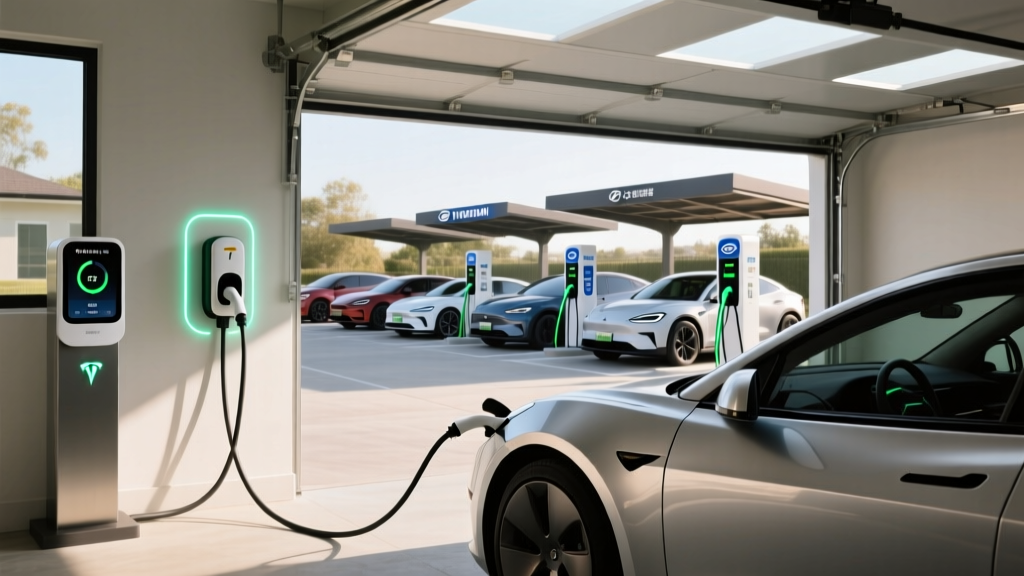
The Blink HQ 200 smart charger is one option in the $500–$600 range, offering up to 32A (7.7 kW) output on a 40A circuit with Wi-Fi connectivity and app-based scheduling. We detail equipment picks below.
Connector Compatibility: NACS, CCS1, and CHAdeMO in 2026
The connector landscape has shifted dramatically since 2023, when Ford, GM, Rivian, and most major automakers committed to adopting the North American Charging Standard (NACS), originally developed by Tesla. By 2026, NACS is the dominant connector for new EVs sold in North America, while CCS1 remains on many 2021–2024 models still on the road.
| Connector | Brands Using It (2026 Models) | Public Network Support | Adapter Needed? |
|---|---|---|---|
| NACS (J3400) | Tesla (all), Ford, GM, Rivian, Hyundai/Kia, BMW, Mercedes, Volvo/Polestar | Tesla Supercharger, Electrify America (new stalls), Blink (select), EVgo | No for new NACS vehicles; CCS→NACS adapters available |
| CCS1 | Legacy 2021–2024 models (VW ID.4 early, Audi e-tron, Porsche Taycan pre-2025) | Electrify America, EVgo, ChargePoint, Blink (DC stations) | NACS→CCS adapter if vehicle has NACS port |
| CHAdeMO | Nissan Leaf (discontinued), Mitsubishi Outlander PHEV (older) | Limited and declining | No widely available adapter to NACS/CCS |
Blink's DC fast-charging stations typically offer both CCS1 and NACS connectors at newer installations, with CHAdeMO available only at legacy locations. For home Level 2 charging, Blink's HQ 200 ships with a J1772 connector (the universal Level 2 standard). If your 2026 EV has a NACS port, you will need a J1772-to-NACS adapter (approximately $50–$100) — or choose a charger that ships with a NACS plug natively, such as the Tesla Wall Connector or the ChargePoint Home Flex with NACS cable.
Charging Time Examples: 10–80% by Battery Size
Most EV owners charge between 10% and 80% state of charge for daily use — this preserves battery health and avoids the steep charge-curve taper that occurs above 80%. Here is how long that takes at different power levels for common battery sizes:
| Battery Size (usable kWh) | Example Vehicle | Level 2 at 7.7 kW (Blink HQ 200) | Level 2 at 11.5 kW (48A charger) | DC Fast at 150 kW (peak) | |
|---|---|---|---|---|---|
| 58 kWh | VW ID.4 Standard | ~5 hr 15 min | ~3 hr 30 min | ~28 min (10–80%) | |
| 75 kWh | Tesla Model Y / Ford Mustang Mach-E | ~6 hr 50 min | ~4 hr 30 min | ~32 min (10–80%) | |
| 85 kWh | Hyundai Ioniq 5 Long Range | ~7 hr 45 min | ~5 hr 10 min | ~18 min (10–80%, 800V architecture) | |
| 100 kWh | GMC Sierra EV / Chevy Silverado EV | ~9 hr 10 min | ~6 hr 05 min | ~40 min (10–80%) | |
| 131 kWh | Ford F-150 Lightning Extended | ~11 hr 55 min | ~7 hr 55 min | ~45 min (10–80%) |
Cost to Charge: Home vs. Public vs. Gas Per Mile
One of the strongest economic arguments for EVs is the per-mile fuel cost — but only if you charge strategically. Electricity pricing varies enormously depending on where and when you plug in.
| Scenario | Rate ($/kWh) | Vehicle Efficiency (mi/kWh) | Cost Per Mile |
|---|---|---|---|
| Home, off-peak utility rate | $0.08–$0.12 | 3.0 mi/kWh | $0.027–$0.040 |
| Home, standard rate | $0.14–$0.18 | 3.0 mi/kWh | $0.047–$0.060 |
| Blink public Level 2 | $0.39–$0.59 | 3.0 mi/kWh | $0.130–$0.197 |
| DC fast charging (Blink/EA/EVgo) | $0.40–$0.65 | 3.0 mi/kWh | $0.133–$0.217 |
| Gas vehicle (28 MPG, $3.40/gal) | — | — | $0.121 |
| Gas vehicle (22 MPG, $3.40/gal) | — | — | $0.155 |
The math is clear: home charging at off-peak rates is 3–5× cheaper per mile than gasoline. Public DC fast charging, however, can equal or exceed the per-mile cost of a fuel-efficient gas car. The financial advantage of EV ownership is maximized when 80%+ of your charging happens at home on a Level 2 circuit. According to fueleconomy.gov, the average US electricity rate for EV charging is approximately $0.16/kWh, yielding roughly $0.053/mile for a typical EV.
Blink's public pricing varies by location and is set by the site host (property owner, business, or municipality) rather than by Blink Charging headquarters directly. Always check the Blink app or your vehicle's built-in charging navigation for real-time pricing before plugging in.
Equipment Recommendations: Home Level 2 Chargers Compared
Below are four well-regarded Level 2 home chargers available in 2026, including Blink's own offering. All require a dedicated 240V circuit installed by a licensed electrician.
Blink HQ 200
- Max output: 32A / 7.7 kW
- Connector: J1772 (NACS adapter needed for 2025+ vehicles)
- Cable length: 25 ft
- Smart features: Wi-Fi, Blink app scheduling, energy tracking
- Price: ~$599
- Best for: Blink ecosystem users, commercial fleet operators already on Blink network
ChargePoint Home Flex
- Max output: Up to 50A / 12 kW (configurable 16A–50A)
- Connector: J1772 or NACS (choose at purchase)
- Cable length: 23 ft
- Smart features: Wi-Fi, app scheduling, Alexa integration, flexible amperage
- Price: ~$699
- Best for: Most homeowners — adjustable amperage fits any panel capacity
Tesla Wall Connector
- Max output: 48A / 11.5 kW
- Connector: NACS native (J1772 adapter included for non-Tesla EVs)
- Cable length: 24 ft
- Smart features: Wi-Fi, OTA updates, power sharing (link multiple units)
- Price: ~$475
- Best for: Tesla owners or households with NACS-port vehicles
Emporia Vue Level 2
- Max output: 48A / 11.5 kW
- Connector: J1772 (NACS adapter sold separately)
- Cable length: 24 ft
- Smart features: Wi-Fi, whole-home energy monitoring integration, solar-aware scheduling
- Price: ~$399
- Best for: Budget-conscious buyers, homes with Emporia Vue energy monitor or solar panels
For most EV owners in 2026, the ChargePoint Home Flex or Tesla Wall Connector offers the best combination of power output, connector flexibility, and smart features. The Blink HQ 200 is a competent charger at 32A/7.7 kW but is outpaced on raw output by the 48A options, meaning overnight sessions take roughly 30% longer for larger batteries.
Safety, Code, and Installation Best Practices
EV charging places a sustained, high-amperage load on your home's electrical system — unlike a dryer that cycles on and off, a charger may draw maximum current continuously for 6–10 hours. This makes code compliance non-negotiable.
- Dedicated circuit: Your Level 2 charger must be on its own breaker, sized at 125% of the charger's rated amperage (e.g., a 40A charger needs a 50A breaker).
- GFCI protection: NEC 2023 and updated 2026 codes require Ground Fault Circuit Interrupter protection for EV charging outlets in many jurisdictions, particularly for outdoor installations. Hardwired units may have different GFCI requirements than plug-in (NEMA 14-50) units — confirm with your electrician.
- Outdoor rating: If mounting outside, ensure the charger carries a NEMA 4 or IP65 rating for weather resistance. The Blink HQ 200, ChargePoint Home Flex, and Tesla Wall Connector all carry outdoor ratings.
- Permit and inspection: Most municipalities require an electrical permit for a new 240V circuit. Your electrician will pull this, and a city inspector will verify the work. Do not skip this step — unpermitted work can void homeowner's insurance claims.
- Load management: If your panel is near capacity, consider a smart charger with built-in load management (like the Emporia Vue or Wallbox Pulsar Plus with Power Meter) that dynamically reduces charge rate when other appliances draw power, potentially avoiding a costly panel upgrade.
Blink's Role: Public Network vs. Home Hardware
Blink Charging, operating from its Miami headquarters, runs a network of over 60,000 public and semi-public charging ports across the US as of early 2026. The network skews heavily toward Level 2 destination charging — parking garages, shopping centers, workplaces, hotels, and apartment complexes — with a smaller but growing footprint of DC fast chargers.
For home use, Blink's hardware competes in a crowded market. The HQ 200 is reliable and well-integrated if you already use the Blink app frequently for public charging, but it does not lead on power output (32A vs. the 48A offered by Tesla and ChargePoint) or on connector flexibility (J1772 only, no native NACS option).
If your primary goal is home charging convenience and speed, we recommend selecting your charger based on your vehicle's connector type and your panel's amperage capacity rather than brand loyalty to a public network. The public network you use on road trips and the charger you install at home do not need to be the same brand.
Frequently Asked Questions
How much does it cost to install a home EV charger?
A typical Level 2 home charger installation costs $800–$2,450 when no panel upgrade is needed, covering hardware ($300–$700), electrician labor ($400–$1,200), and permits ($50–$250). If your home has a 100A electrical panel that needs upgrading to 200A, add $1,500–$3,500, bringing the total to $2,300–$5,950. Get a load calculation from a licensed electrician before committing.
How fast will each charging level add range?
Level 1 (120V) adds 3–5 miles per hour. Level 2 (240V) adds 12–70 miles per hour depending on amperage (7.7 kW adds ~23 mi/hr; 11.5 kW adds ~35 mi/hr). DC fast charging at 150 kW can add 200+ miles in 20 minutes at peak rate, though sustained speed tapers above 80% SoC.
Which connector and charger is compatible with my EV?
For 2025–2026 model-year EVs, most now use NACS. Older EVs (2021–2024) may use CCS1 or CHAdeMO. For home Level 2 charging, J1772 is the universal standard with adapters available for NACS ports. Check your vehicle's charge port or owner's manual, then select a charger with the matching connector — or buy the appropriate adapter.
How much does EV charging cost per mile vs. gas?
Home charging at off-peak rates ($0.10/kWh) costs approximately $0.033/mile — roughly 3–4× cheaper than gasoline at $3.40/gallon in a 28 MPG vehicle ($0.121/mile). Public DC fast charging at $0.50/kWh costs ~$0.167/mile, which is more expensive than a fuel-efficient gas car. The savings case for EVs depends heavily on home charging access.
What electrical upgrades might I need for a home charger?
The most common upgrade is a panel capacity increase from 100A to 200A ($1,500–$3,500), needed in older homes with limited spare capacity. You may also need new conduit runs if the panel is far from the garage, a sub-panel installation, or a smart load management device if you want to avoid a full panel upgrade. A licensed electrician's load calculation will determine exactly what is required.
Is Blink's public charging network reliable?
Blink's Level 2 destination chargers are generally adequate for opportunistic top-ups while parked, but public network uptime varies by location. According to NHTSA and independent EV surveys, the most reliable public networks for DC fast charging remain Tesla Supercharger (now open to non-Tesla NACS vehicles) and Electrify America. For road trips, plan your DC fast stops using your vehicle's built-in navigation or apps like PlugShare, and always have a backup station in mind.
For additional information on EV charging infrastructure standards and safety, consult the National Fire Protection Association's NEC resources and your local building department before scheduling an installation.