Understanding the Blink Charging Network in 2026
The Blink Charging logo has become increasingly visible across parking garages, shopping centers, and workplace lots as the company expanded its Level 2 and DC fast-charging footprint through 2025-2026. But for EV owners deciding between relying on public networks like Blink versus installing a home Level 2 charger, the economics and convenience calculus requires real numbers—not marketing claims.
This guide breaks down exactly what you need to know: charging speeds in kilowatts (kW), real installation costs including panel upgrades, connector compatibility across NACS, CCS1, and CHAdeMO, and the per-mile cost comparison that determines whether home charging or public networks like Blink make financial sense for your driving pattern.
Charging Levels Explained: Speed, Power, and Range Added
The single most important distinction in EV charging is between kilowatts (kW)—the rate of power delivery—and kilowatt-hours (kWh)—the total energy stored in your battery. Think of kW as the flow rate of water through a hose, and kWh as the total volume in your bucket.
| Charging Level | Power Output (kW) | Voltage / Amperage | Miles of Range Added Per Hour | Typical Use Case |
|---|---|---|---|---|
| Level 1 (standard outlet) | 1.2 - 1.9 kW | 120V / 12-16A | 3 - 5 miles/hr | Overnight top-up, PHEVs, low-mileage drivers |
| Level 2 (home/public) | 7.2 - 19.2 kW | 240V / 30-80A | 20 - 60 miles/hr | Daily home charging, workplace, Blink Level 2 stations |
| DC Fast Charging | 50 - 350 kW | 400-800V DC | 150 - 1,000+ miles/hr (peak) | Road trips, highway corridors, Blink DC fast stations |
Real-world charging time examples (10-80% State of Charge):
- Tesla Model Y (75 kWh battery): Level 2 at 11.5 kW takes ~5.5 hours; DC fast at 250 kW peak takes ~18 minutes (with taper above 80%)
- Ford F-150 Lightning (131 kWh extended range): Level 2 at 11.5 kW takes ~9.5 hours; DC fast at 150 kW sustained takes ~45 minutes
- Hyundai Ioniq 5 (77.4 kWh): Level 2 at 10.9 kW takes ~6 hours; DC fast at 240 kW peak (800V architecture) takes ~18 minutes
Note that DC fast charging follows a charge curve—peak kW is only sustained between roughly 10-50% State of Charge. Above 80%, charging speed tapers dramatically to protect battery chemistry, which is why most manufacturers quote 10-80% times rather than full charges.
Home Level 2 Charger Installation: Requirements and Costs
Installing a dedicated Level 2 home charger typically requires a 240-volt circuit (similar to a dryer or oven outlet) on a dedicated breaker. Most EV owners opt for a 40-amp or 48-amp circuit, which delivers 9.6 kW or 11.5 kW respectively when accounting for the 80% continuous-load rule mandated by the National Electrical Code (NEC).
Electrical Requirements
- Voltage: 240V (split-phase residential service)
- Amperage: 40A breaker for 32A continuous charging (7.7 kW) or 50A breaker for 40A continuous (9.6 kW) or 60A breaker for 48A continuous (11.5 kW)
- Circuit type: Dedicated—no other loads on the same breaker
- Wiring: 6 AWG copper for 40-50A circuits; 4 AWG for 60A circuits (varies by run length and local code)
- GFCI protection: Required by 2020 NEC for outlets; hardwired installations may have different requirements depending on jurisdiction
Panel Upgrade Reality Check
Homes built before 2000 often have 100-amp or 150-amp main service panels. Adding a 50-amp EV circuit may push total calculated load beyond panel capacity, especially if you already have electric range, dryer, and HVAC. A licensed electrician will perform a load calculation per NEC Article 220 to determine if an upgrade is necessary.
Panel upgrades to 200-amp service typically cost $1,500-$3,500 depending on utility requirements, trenching, and local permit fees. In some cases, a smart load-management device (like the Emporia VUE or SPAN panel) can avoid a full upgrade by dynamically reducing EV charging when other high-draw appliances activate.
| Component | Low-End Cost | High-End Cost | Notes |
|---|---|---|---|
| Level 2 Charger Equipment | $300 | $750 | 32A-48A smart chargers (ChargePoint, Emporia, Wallbox) |
| Electrician Labor (installation) | $400 | $1,200 | Depends on panel proximity, wall type, conduit run |
| Permit Fees | $50 | $250 | Varies by municipality; some utilities offer rebates |
| Electrical Materials (conduit, wire, breaker) | $100 | $400 | Longer runs and outdoor installations cost more |
| Panel Upgrade (if required) | $1,500 | $3,500 | 100A to 200A service upgrade; not always needed |
| Total (no panel upgrade) | $850 | $2,600 | Typical range for most homes with adequate panel capacity |
| Total (with panel upgrade) | $2,350 | $6,100 | Older homes or those with high existing electrical loads |
Pro tip: Check with your utility before installation. Many utilities offer rebates of $250-$500 for Level 2 charger installation, and some (like PG&E, Con Edison, and Xcel Energy) provide time-of-use rates that make off-peak charging significantly cheaper.
Connector Compatibility: NACS, CCS1, and CHAdeMO in 2026
The connector landscape shifted dramatically after Tesla opened its North American Charging Standard (NACS) in late 2022. By 2026, virtually all new EVs sold in North America use NACS natively, while CCS1 remains on 2022-2024 models from Ford, GM, Rivian, and others. CHAdeMO is effectively legacy—only the Nissan Leaf (discontinued after 2025) and Mitsubishi Outlander PHEV used it.
| Connector Type | Compatible EV Brands (2026) | Public Network Availability | Adapter Needed? |
|---|---|---|---|
| NACS (Tesla standard) | Tesla (all), Ford (2025+), GM (2025+), Rivian (2025+), Hyundai/Kia (2025+), BMW, Mercedes, Volvo | Tesla Supercharger, Electrify America (select), Blink (select), EVgo | CCS1-to-NACS adapters available ($200-$300) for older CCS vehicles |
| CCS1 (Combined Charging System) | Ford (2022-2024), GM (2022-2024), Rivian (2022-2024), VW ID.4 (2021-2024), Hyundai/Kia (2022-2024) | Electrify America, EVgo, ChargePoint, Blink DC fast stations | NACS-to-CCS1 adapters available for newer NACS vehicles charging at CCS stations |
| CHAdeMO | Nissan Leaf (discontinued 2025), Mitsubishi Outlander PHEV (older models) | Limited; Electrify America phased out CHAdeMO by 2024 | No practical adapter; CHAdeMO vehicles face declining public charging access |
For home Level 2 charging: Most Level 2 chargers use the J1772 connector (the Level 2 portion of CCS1). Tesla vehicles include a J1772-to-NACS adapter in the glovebox. If you purchase a non-Tesla Level 2 charger and own a 2025+ NACS-equipped Ford or GM, you'll need either a J1772-to-NACS adapter or a charger with a native NACS plug (like the Tesla Wall Connector or ChargePoint Home Flex with NACS cable).
Charging Cost: Home vs. Public vs. Gas
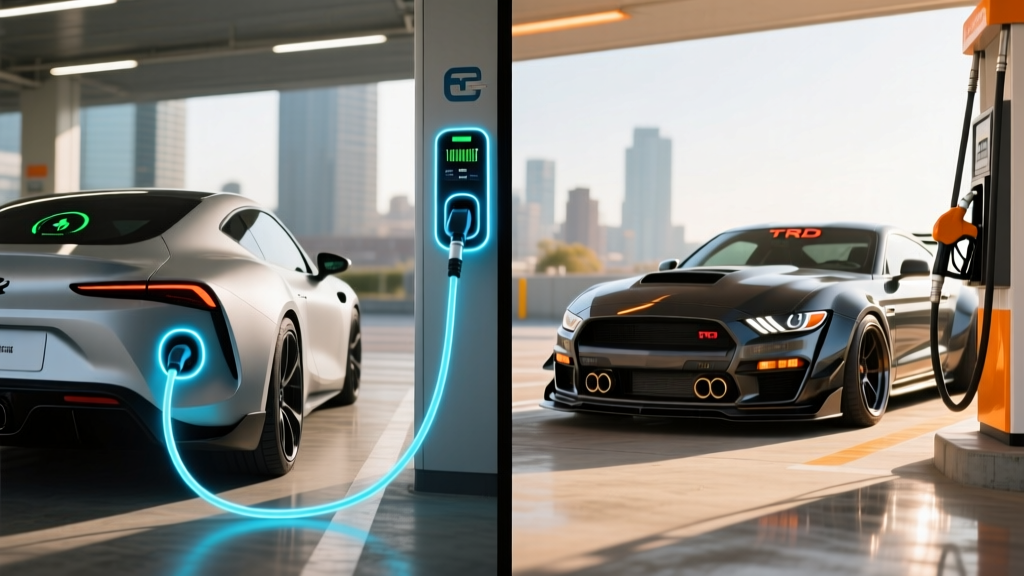
The cost advantage of home charging is the primary economic argument for EV ownership. Public DC fast charging—whether at Blink stations, Electrify America, or Tesla Superchargers—costs significantly more per kWh due to demand charges, network fees, and site-host margins.
| Charging Scenario | Cost per kWh | Efficiency (kWh/100 miles) | Cost Per Mile | Annual Cost (12,000 miles) |
|---|---|---|---|---|
| Home (off-peak utility rate) | $0.12 - $0.18 | 30 kWh/100 mi | $0.036 - $0.054 | $432 - $648 |
| Home (peak utility rate) | $0.25 - $0.35 | 30 kWh/100 mi | $0.075 - $0.105 | $900 - $1,260 |
| Blink Level 2 (public) | $0.39 - $0.59 | 30 kWh/100 mi | $0.117 - $0.177 | $1,404 - $2,124 |
| DC Fast Charging (Blink/EA/EVgo) | $0.45 - $0.65 | 30 kWh/100 mi | $0.135 - $0.195 | $1,620 - $2,340 |
| Tesla Supercharger (average) | $0.30 - $0.45 | 28 kWh/100 mi | $0.084 - $0.126 | $1,008 - $1,512 |
| Gasoline Vehicle (25 MPG combined, $3.50/gal) | N/A | 4 gal/100 mi | $0.140 | $1,680 |
Key takeaway: Home off-peak charging delivers fuel costs at roughly one-quarter the price of gasoline. However, exclusive reliance on public DC fast charging (Blink, Electrify America, EVgo) can actually exceed gasoline costs per mile—especially for efficient gas vehicles. The EV cost advantage depends almost entirely on access to affordable home or workplace Level 2 charging.
For Blink Charging specifically, pricing varies by site host. Some Blink stations charge per kWh ($0.39-$0.59 typical), while older installations charge per hour ($1.00-$2.00/hour for Level 2), which penalizes vehicles with slower onboard chargers. Always check the Blink app for station-specific pricing before plugging in.
Recommended Home Level 2 Chargers (2026)
After testing dozens of Level 2 units across multiple EVs and electrical setups, here are the chargers that deliver the best combination of reliability, smart features, and value for most EV owners in 2026.
ChargePoint Home Flex (NACS or J1772)
- Power Output: Up to 12 kW (50A circuit, 48A continuous) — configurable via DIP switches for 16A to 50A circuits
- Connector: Available in native NACS (2025+ models) or J1772 with included adapter
- Cable Length: 23 feet
- Smart Features: Wi-Fi, ChargePoint app scheduling, Alexa integration, energy tracking, utility demand-response programs
- Price: $549 (J1772) / $599 (NACS) — frequent $50-$100 rebates from utilities
- Best For: Most EV owners; flexible amperage works with older panels
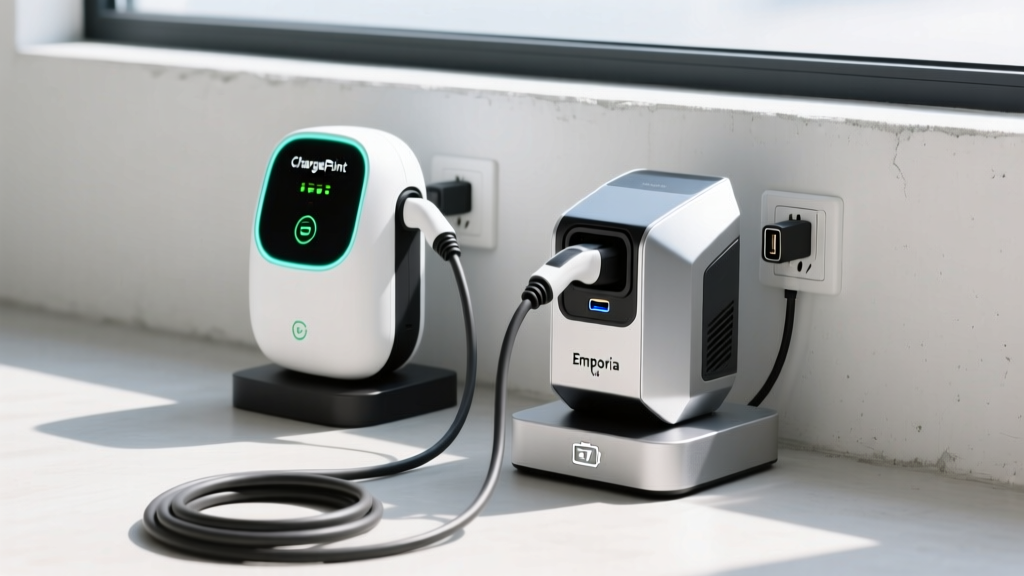
Emporia Level 2 EV Charger
- Power Output: Up to 11.5 kW (48A continuous on 60A circuit)
- Connector: J1772 (NACS adapter included with 2025+ units)
- Cable Length: 24 feet
- Smart Features: Wi-Fi, Emporia app, solar integration (pairs with Emporia VUE energy monitor for solar-only charging), load management
- Price: $399 — best value in smart chargers
- Best For: Solar owners, budget-conscious buyers, homes with Emporia energy monitoring
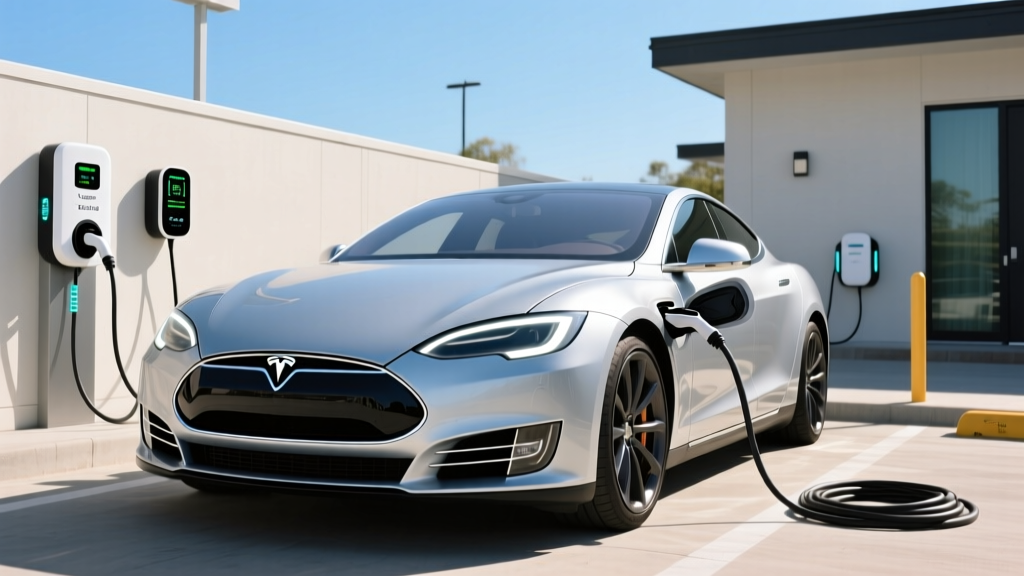
Tesla Wall Connector (Gen 4)
- Power Output: Up to 11.5 kW (48A continuous on 60A circuit)
- Connector: Native NACS — no adapter needed for Tesla, Ford, GM, Rivian, Hyundai/Kia (2025+)
- Cable Length: 24 feet
- Smart Features: Wi-Fi, over-the-air updates, Power-Share (load balancing between two Wall Connectors on one circuit), Tesla app integration
- Price: $475
- Best For: Tesla owners and anyone with a 2025+ NACS-equipped EV; cleanest installation with no adapter needed
Wallbox Pulsar Plus
- Power Output: Up to 11.5 kW (48A continuous)
- Connector: J1772 (NACS version announced for late 2026)
- Cable Length: 25 feet
- Smart Features: Wi-Fi + Bluetooth, myWallbox app, Eco-Smart mode (solar matching), Power Sharing for multi-charger setups
- Price: $599
- Best For: European-style installations, multi-EV households, solar integration
Safety, Code, and Installation Best Practices
EV charging places sustained high-current demand on your electrical system—unlike a dryer that cycles on and off, an EV charger may run at full load for 6-10 hours continuously. This makes proper installation critical for fire safety and equipment longevity.
Code Requirements and Safety Considerations
- Dedicated circuit: NEC requires EV chargers to be on a dedicated breaker with no other outlets or loads. Shared circuits risk breaker trips and overheating.
- Continuous load derating: NEC Article 210.20 requires circuits to be rated at 125% of continuous load. A 40A charger requires a 50A breaker; a 48A charger requires a 60A breaker.
- GFCI protection: The 2020 NEC mandates ground-fault circuit interrupter protection for all 240V outlets used for EV charging. Hardwired installations (no plug) may be exempt depending on local amendments—hardwired is generally preferred for outdoor installations to avoid GFCI nuisance trips.
- Outdoor rating: If installing outdoors, the charger must be rated NEMA 4 (weather-resistant). All major chargers listed above carry NEMA 4 ratings. Ensure the junction box and conduit fittings are also rated for wet locations.
- Permit and inspection: Most jurisdictions require an electrical permit ($50-$250) and post-installation inspection. Skipping this can void homeowner insurance coverage for electrical fires and create issues during home sale.
- Wire gauge: Undersized wire causes voltage drop and heat buildup. For a 60A circuit with a run over 50 feet, you may need 3 AWG copper or 1 AWG aluminum to maintain less than 3% voltage drop.
Hire a licensed electrician. EV charger installation is not a DIY project unless you are a qualified electrician. Improper installation can cause fires, void equipment warranties, and violate insurance requirements. Verify your electrician has specific EV charger installation experience—ask about previous installations and familiarity with NEC Article 625 (Electric Vehicle Charging System Equipment).
Blink Charging vs. Home Charging: When Each Makes Sense
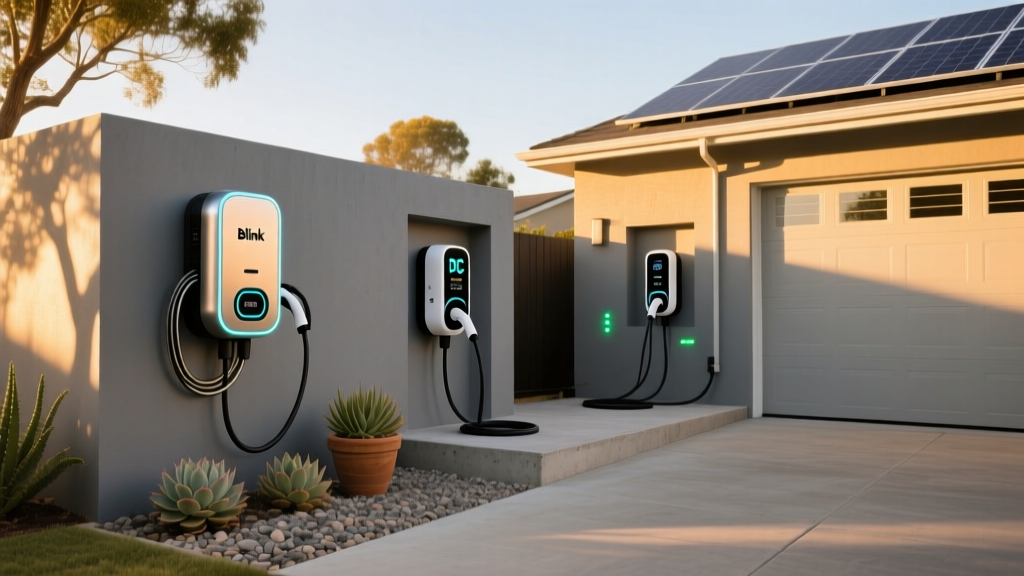
The Blink Charging network serves a specific use case: destination charging at workplaces, shopping centers, and multi-unit dwellings where home charging isn't available. For drivers who can install a home Level 2 charger, the economics strongly favor home charging.
Choose home Level 2 charging if:
- You have a garage, carport, or dedicated parking spot with electrical access
- Your daily driving is under 80 miles (most commutes) — a Level 2 charger replenishes this overnight easily
- You want the lowest possible cost per mile ($0.04-$0.06/mile vs. $0.12-$0.20/mile on public networks)
- You value convenience — plug in when you get home, wake up to a full battery every morning
- Your utility offers time-of-use rates with cheap off-peak overnight electricity
Rely on public networks like Blink if:
- You live in an apartment or condo without charging access (though advocate for your HOA/landlord to install shared chargers)
- Your workplace offers free or subsidized Level 2 charging (common at tech companies and government facilities)
- You're on a road trip and need DC fast charging (though Tesla Supercharger and Electrify America have broader highway coverage than Blink)
- You're topping up opportunistically while shopping or dining — Blink's Level 2 stations at retail locations serve this use case well
For most EV owners, the ideal setup is home Level 2 for daily charging + public DC fast charging for road trips. Public Level 2 networks like Blink fill gaps for apartment dwellers and destination charging, but they shouldn't be your primary charging strategy if you have home installation options—the cost premium adds up to $1,000-$1,500 per year for a typical driver.
Frequently Asked Questions
How much does it cost to install a home EV charger?
Typical Level 2 home charger installation costs $850-$2,600 if your electrical panel has adequate capacity. This includes the charger ($300-$750), electrician labor ($400-$1,200), permit ($50-$250), and materials ($100-$400). If your home needs a panel upgrade from 100A to 200A service, add $1,500-$3,500, bringing the total to $2,350-$6,100. Always get a load calculation from a licensed electrician before assuming your panel can handle a new 40-60A circuit.
How fast will each charging level add range?
Level 1 (120V standard outlet) adds 3-5 miles of range per hour — adequate for plug-in hybrids with 20-40 mile electric ranges, but impractical for full EVs. Level 2 (240V, 32-48A) adds 20-60 miles per hour depending on amperage and your vehicle's onboard charger capacity — this fully recharges most EVs overnight. DC fast charging adds 150-1,000+ miles per hour at peak rates, but real-world charging sessions are typically 18-45 minutes for a 10-80% charge due to the charge curve taper above 80% State of Charge.
Which connector/charger is compatible with my EV?
For 2026 models, nearly all new EVs use the NACS connector (Tesla's standard, now adopted by Ford, GM, Hyundai, Kia, Rivian, BMW, and others). Vehicles from 2022-2024 mostly use CCS1. The Nissan Leaf used CHAdeMO, but it's discontinued. For home Level 2 charging, most chargers use J1772 (the Level 2 portion of CCS1); Tesla vehicles include a J1772-to-NACS adapter. Check your vehicle's charge port or owner's manual for the specific connector, and buy a charger that matches—or get the appropriate adapter.
How much does charging cost per mile vs gas?
Home off-peak charging costs $0.04-$0.06 per mile (at $0.12-$0.18/kWh and 30 kWh/100mi efficiency). Public Level 2 charging (Blink, ChargePoint) costs $0.12-$0.18 per mile. DC fast charging costs $0.14-$0.20 per mile. A comparable gas vehicle at 25 MPG with $3.50/gallon fuel costs $0.14 per mile. Home charging delivers 60-70% fuel cost savings vs. gas; exclusive public DC fast charging may cost the same or more than gasoline.
What electrical upgrades might I need?
Common upgrades include: (1) Panel upgrade from 100A/150A to 200A service if your existing panel lacks capacity for a new 40-60A circuit — cost $1,500-$3,500. (2) New conduit and wire runs if your panel is far from the charging location — long runs increase wire gauge requirements and cost. (3) Smart load management devices (SPAN panel, Emporia VUE) that dynamically reduce EV charging when other appliances activate, potentially avoiding a panel upgrade. (4) Utility service upgrade if your transformer or service drop is undersized — this is rare but can cost $2,000-$5,000 and requires utility coordination. Always start with a professional load calculation before assuming upgrades are needed.