Why the Blink Charging Blue Logo Keeps Showing Up at Your Grocery Store
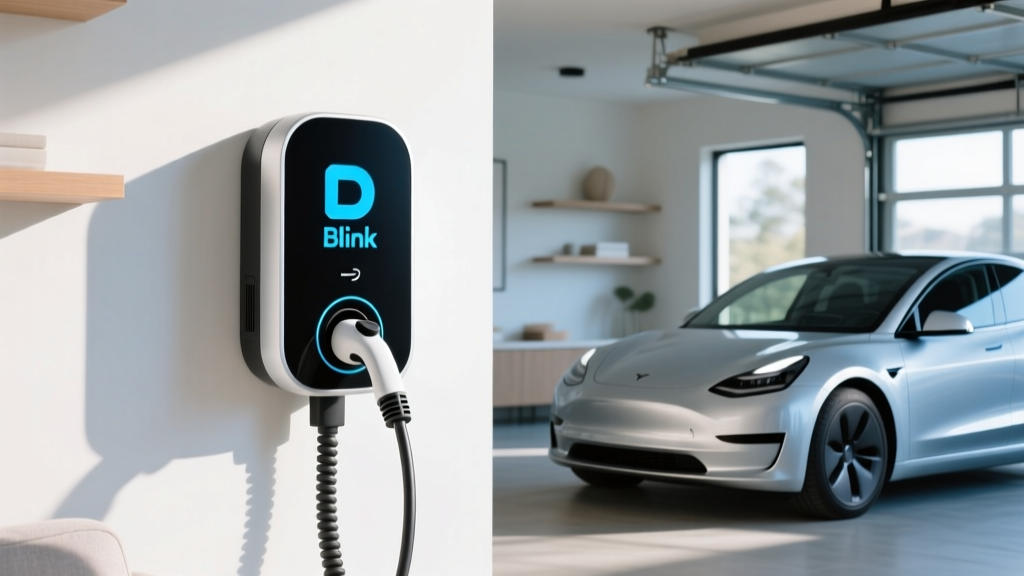
If you've noticed a distinctive blue-and-white logo on charging pedestals at shopping centers, parking garages, and workplaces across the U.S., you've encountered Blink Charging — one of the largest public EV charging networks in North America. That Blink charging logo, rendered in its signature blue color, marks both Level 2 AC destination chargers and DC fast-charging stations in 49 states.
But Blink isn't just a public network. The company also sells residential Level 2 chargers for home installation, and understanding how their hardware, network, and pricing stack up against competitors like ChargePoint, Emporia, and Tesla's Wall Connector is essential before you spend $500–$2,000 on home charging equipment.
This guide breaks down Blink's home and public charging ecosystem, the electrical requirements for installation, connector compatibility with 2026 EV models, and exactly what you'll pay per mile compared to gasoline.
Charging Levels Explained: How Fast Will Each Level Add Range?
Before evaluating any charger — Blink or otherwise — you need to understand the three charging levels and what they deliver in real-world terms. The critical distinction: kW (kilowatts) measures power (how fast energy flows), while kWh (kilowatt-hours) measures energy (how much your battery holds). A 75 kWh battery charged at 11.5 kW takes roughly 6.5 hours from empty to full, minus charging-curve taper.
| Level | Voltage | Max Power (kW) | Miles of Range Added Per Hour | Typical Use |
|---|---|---|---|---|
| Level 1 | 120V AC | 1.4 kW | 3–5 miles | Overnight top-up, PHEVs, emergencies |
| Level 2 | 240V AC | 7.2–19.2 kW | 20–65 miles | Home daily charging, workplace, destination |
| DC Fast Charge | 400–800V DC | 50–350 kW | 150–1,000+ miles/hr (peak) | Road trips, rapid top-ups |
- Tesla Model Y (75 kWh battery, NACS): ~7.5 hours on 11.5 kW Level 2; ~18 minutes on 250 kW DC fast charger
- Hyundai Ioniq 5 (77.4 kWh, CCS1/NACS): ~8 hours on 11.5 kW Level 2; ~18 minutes on 350 kW DC (800V architecture)
- Ford F-150 Lightning (131 kWh extended, CCS1/NACS): ~13 hours on 11.5 kW Level 2; ~41 minutes on 150 kW DC
Note: DC fast-charging times assume optimal battery temperature and preconditioning. Cold batteries can double these times. Charging slows significantly above 80% SoC to protect cell health.
Blink Home Chargers: Equipment, Power Output, and Pricing
Blink offers two primary residential Level 2 chargers for 2026:
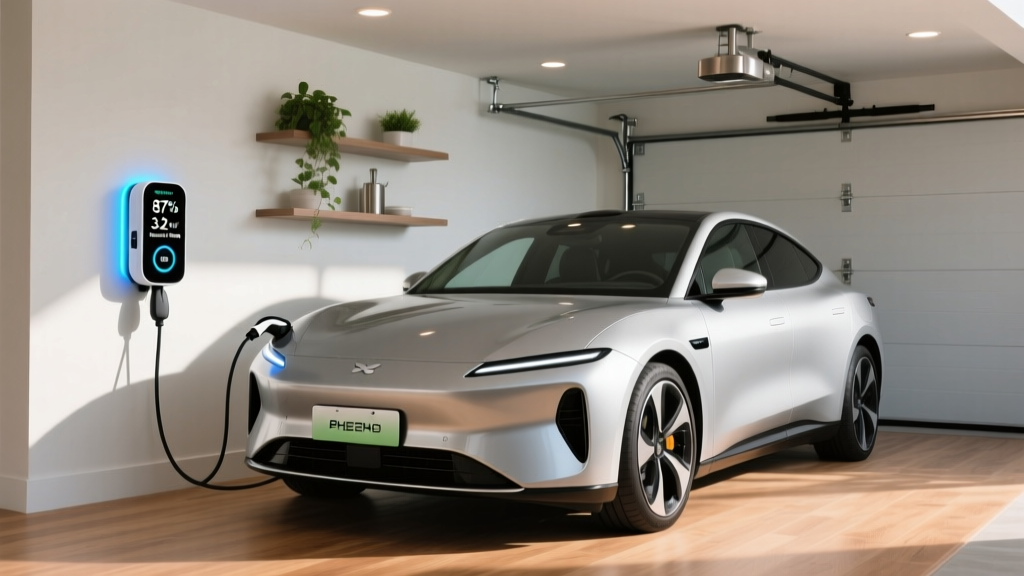
Blink HQ 200
- Power Output: 9.6 kW (40A at 240V)
- Connector: J1772 (NACS adapter available)
- Cable Length: 25 feet
- Smart Features: Wi-Fi, Blink app scheduling, energy monitoring, Alexa integration
- Price: ~$549 (equipment only)
- Indoor/Outdoor: NEMA 4 rated (outdoor-safe)
Blink HQ 100
- Power Output: 7.2 kW (32A at 240V)
- Connector: J1772
- Cable Length: 18 feet
- Smart Features: Wi-Fi, Blink app, basic scheduling
- Price: ~$399 (equipment only)
- Indoor/Outdoor: NEMA 4 rated
Both units require a dedicated 240V circuit and hardwired installation by a licensed electrician (the HQ 200 can also be installed with a NEMA 14-50 plug for portability). For most EV owners with a daily commute under 50 miles, the 9.6 kW HQ 200 replenishes a full day's driving in about 2–3 hours — more than adequate for overnight charging.
Home Charger Installation: Electrical Requirements and Total Cost
The charger itself is only part of the expense. Professional installation frequently matches or exceeds equipment cost, especially in older homes. Here's what drives the total:
| Component | Cost Range | Notes |
|---|---|---|
| Charger Equipment (Level 2) | $399–$700 | Blink HQ 100/200, ChargePoint, Emporia, Tesla Wall Connector |
| Electrician Labor (standard install) | $500–$1,500 | Varies by run length from panel to garage/carport |
| Electrical Permit | $50–$300 | Required in most jurisdictions; varies by municipality |
| Panel Upgrade (if needed) | $1,500–$4,000 | Needed if your panel lacks capacity for a 40A/50A dedicated circuit; common in homes with 100A service |
| Conduit, Wiring, Mounting Hardware | $100–$400 | Longer runs and outdoor conduit increase cost |
| Total (no panel upgrade) | $1,050–$2,900 | Typical for homes with 200A service and nearby panel |
| Total (with panel upgrade) | $2,550–$6,900 | Older homes with 100A panels or maxed-out breaker boxes |
Electrical Requirements for Blink HQ 200
- Circuit: Dedicated 50A breaker (for 40A continuous draw — NEC requires 125% overhead)
- Voltage: 240V AC, single-phase
- Wire Gauge: 6 AWG copper (THHN in conduit) for runs up to 50 feet; 4 AWG for longer runs
- GFCI Protection: Required for outdoor installations per NEC 2023/2026 updates; built into most modern Level 2 units
- Disconnect: Some jurisdictions require a visible disconnect switch within sight of the charger
Connector Compatibility: NACS, CCS1, CHAdeMO, and Adapter Needs
The North American charging connector landscape has consolidated significantly since Tesla opened its Supercharger network and the North American Charging Standard (NACS) became the dominant plug. Here's where things stand for 2026 model-year vehicles:
| Connector | Native Vehicles | Adapter Needed For | Availability |
|---|---|---|---|
| NACS (Tesla-style) | Tesla (all), Ford, GM, Rivian, Volvo, Polestar, Hyundai/Kia (2025+), Toyota (bZ series) | CCS1 public chargers require NACS-to-CCS adapter (~$200–$300) | Widely available; becoming the standard |
| CCS1 (Combo) | Older VW ID.4 (pre-2025), BMW i4/iX, some Stellantis models | Tesla Superchargers require CCS-to-NACS adapter | Still common at Electrify America, EVgo stations |
| CHAdeMO | Nissan Leaf (discontinued 2025), Mitsubishi Outlander PHEV (older) | Limited adapter options; network shrinking | Declining; few new installations |
For Blink chargers specifically: Blink's public Level 2 stations use J1772 connectors (universal for AC charging across all EVs — NACS vehicles use a simple J1772-to-NACS adapter, often included with the car). Blink's DC fast chargers offer both CCS1 and NACS connectors at most new 2025–2026 installations, though older Blink DC stations may be CCS1-only. Check the Blink app for connector availability at specific stations before you drive there.
Charging Cost Per Mile: Home vs. Public vs. Gasoline
The financial case for home charging is overwhelming. Here's how different scenarios compare on a cost-per-mile basis, using a midsize EV averaging 3.0 miles/kWh (roughly 112 MPGe) and a comparable gas car at 28 MPG combined:
| Scenario | Rate | Cost Per Mile | Annual Cost (12,000 mi) |
|---|---|---|---|
| Home Level 2 (national avg. electricity) | $0.16/kWh | $0.053 | $640 |
| Home Level 2 (off-peak TOU rate) | $0.09/kWh | $0.030 | $360 |
| Blink public Level 2 (typical) | $0.39–$0.59/kWh | $0.13–$0.20 | $1,560–$2,400 |
| Blink DC Fast Charging | $0.49–$0.69/kWh | $0.16–$0.23 | $1,920–$2,760 |
| Tesla Supercharger (avg.) | $0.30–$0.45/kWh | $0.10–$0.15 | $1,200–$1,800 |
| Gasoline (28 MPG, $3.40/gal) | $3.40/gallon | $0.121 | $1,457 |
The takeaway: home charging on off-peak rates costs roughly 75% less per mile than gasoline. Even public Level 2 charging is competitive with gas, while DC fast charging on the road is slightly more expensive per mile — but you use it only for road trips, not daily driving.
Safety, Code Compliance, and Installation Best Practices
EV charging draws sustained high current for hours — this is fundamentally different from intermittent loads like a dryer or oven. Proper installation isn't optional; it's a fire-safety requirement.
Non-Negotiable Safety Requirements
- Dedicated Circuit: Your Level 2 charger must have its own breaker — never shared with other appliances. A 40A charger needs a 50A dedicated breaker.
- GFCI Protection: NEC 2023 (and reinforced in 2026 code cycles) requires ground-fault protection for all outdoor EV charging outlets. Hardwired units with built-in GFCI (like the Blink HQ 200) satisfy this requirement.
- NEMA 4 Rating: Any charger installed outdoors (or in an unsealed garage in humid climates) must carry a NEMA 4 or NEMA 4X weather rating. All current Blink residential units meet this standard.
- Wire Sizing: Undersized wire causes heat buildup and fire risk. Always follow NEC Table 310.15 — 6 AWG copper minimum for 50A circuits, with upsizing for long runs.
- Permit and Inspection: Virtually all jurisdictions require an electrical permit for EV charger installation. The inspection ensures code compliance and protects your homeowner's insurance coverage. Unpermitted work can void claims in the event of an electrical fire.
According to NFPA's National Electrical Code guidelines, EV charging installations must also account for continuous-load derating — meaning a charger drawing 40A continuously must be on a circuit rated for at least 50A (125% of continuous load). Any electrician who suggests otherwise is cutting corners.
Public Blink Charging Network: What to Expect in 2026
Blink operates over 85,000 charging ports across the U.S., making it one of the largest networks after ChargePoint and Tesla. The network includes:
- Level 2 Destination Chargers: 7.2–19.2 kW at grocery stores, hotels, workplaces, and municipal parking. Pricing typically $0.39–$0.59/kWh, though some locations offer free charging as an amenity.
- DC Fast Chargers: 50–180 kW at highway corridors and retail centers. Pricing $0.49–$0.69/kWh. Most newer Blink DC stations include both CCS1 and NACS connectors.
- Blink Membership: The Blink app and membership card activate chargers. Membership pricing is the same as guest pricing at most stations — unlike Electrify America, Blink doesn't heavily discount members vs. guests.
Reliability varies by location. In PlugShare user reviews, Blink stations average a 78% uptime score — improved from previous years but still trailing Tesla Superchargers (~95% uptime) and Electrify America (~85%). Before relying on a specific Blink station for a road trip, check real-time status in the Blink app or PlugShare.
Should You Choose Blink for Home Charging? Equipment Comparison
Here's how the Blink HQ 200 compares to other popular home Level 2 chargers available in 2026:
| Charger | Max Power | Connector | Cable Length | Smart Features | Price |
|---|---|---|---|---|---|
| Blink HQ 200 | 9.6 kW (40A) | J1772 | 25 ft | Wi-Fi, app, Alexa, energy tracking | $549 |
| ChargePoint Home Flex | 12.0 kW (50A) | J1772 or NACS | 24 ft | Wi-Fi, app, Alexa/Google, flexible amperage | $699 |
| Emporia Vue Charger | 11.5 kW (48A) | J1772 or NACS | 24 ft | Wi-Fi, app, solar integration, load management | $549 |
| Tesla Wall Connector | 11.5 kW (48A) | NACS (J1772 adapter included) | 24 ft | Wi-Fi, app, power sharing, OTA updates | $475 |
| Grizzl-E Smart | 10.0 kW (40A) | J1772 | 24 ft | Wi-Fi, app, OCPP compatible | $549 |
The Blink HQ 200 is competitive on price and cable length but maxes out at 9.6 kW, while the ChargePoint Home Flex and Tesla Wall Connector deliver up to 12.0 kW and 11.5 kW respectively — meaning ~20–25% faster charging for vehicles that can accept higher AC rates (like the Tesla Model S/X and Lucid Air). For most daily-driving EVs with onboard chargers limited to 11.5 kW or below, the practical difference is modest.
Frequently Asked Questions
How much does it cost to install a home EV charger?
Expect $1,050–$2,900 total for a standard installation (equipment + electrician + permit) in a home with adequate panel capacity. If your home needs a 200A panel upgrade, add $1,500–$4,000, bringing the total to $2,550–$6,900. The Blink HQ 200 unit itself costs ~$549, with electrician labor typically $500–$1,500 depending on the distance from your electrical panel to the charging location.
How fast will each charging level add range?
Level 1 (120V) adds 3–5 miles of range per hour — adequate only for PHEVs or very low-mileage drivers. Level 2 (240V) at 9.6 kW adds roughly 32 miles per hour, enough to fully recharge most EVs overnight. DC fast charging at 150–350 kW can add 150–400+ miles in 15–25 minutes, though charging speed tapers significantly above 80% battery state of charge.
Which connector/charger is compatible with my EV?
For 2026 models, NACS (Tesla-style) is now the dominant standard — Ford, GM, Rivian, Hyundai, Kia, Toyota, and Volvo all use it natively. CCS1 remains on some BMW and Volkswagen models. CHAdeMO is essentially discontinued. For home Level 2 AC charging, all EVs use J1772 or NACS, and adapters between the two are widely available (often included with the vehicle). Check your vehicle's charge port or the manufacturer's spec page to confirm.
How much does charging cost per mile vs gas?
Home Level 2 charging on off-peak electricity rates costs approximately $0.03–$0.05 per mile — roughly 75% less than gasoline at $3.40/gallon in a 28 MPG car ($0.12/mile). Public Level 2 charging ($0.13–$0.20/mile) and DC fast charging ($0.16–$0.23/mile) are comparable to or slightly higher than gasoline, but you use these primarily on road trips, not daily.
What electrical upgrades might I need?
The most common upgrade is a panel capacity increase from 100A to 200A service, needed in older homes that lack headroom for a 50A dedicated EV circuit. This costs $1,500–$4,000. You may also need new conduit runs if your panel is far from the garage, or a sub-panel installation if your main panel is full. A licensed electrician will perform an NEC Article 220 load calculation to determine exactly what's needed. According to the U.S. Department of Energy's home charging guide, about 30% of homes require some electrical upgrade for Level 2 installation.