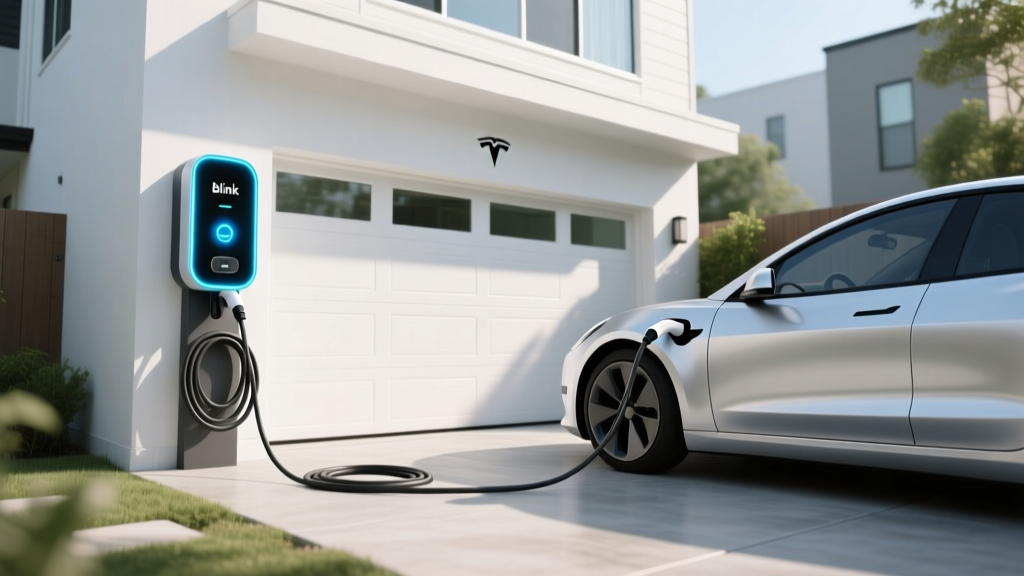
Blink Charging Corporation has built one of the most visible public EV charging networks in the United States, but the company also sells hardware for residential use. For EV owners weighing whether to install a Blink home charger versus a competitor like ChargePoint, Emporia, or Tesla's Universal Wall Connector, the decision comes down to power output, smart features, network reliability, and total installation cost. This guide breaks down exactly what Blink offers, what you'll pay to get it running, and how it stacks up against alternatives in 2026.
Blink Charging at a Glance: What the Company Offers
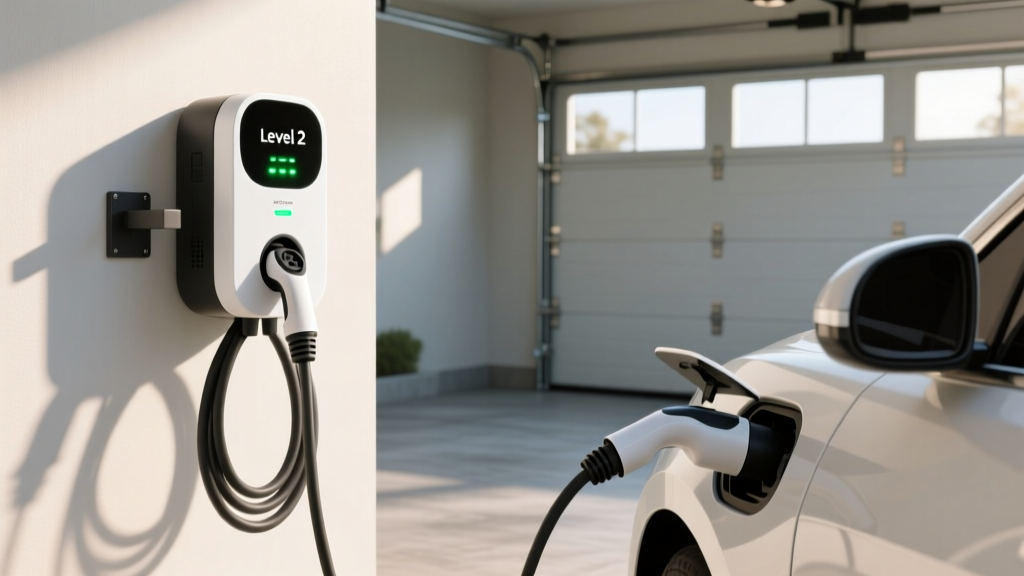
Blink Charging Corporation (NASDAQ: BLNK) operates a network of over 60,000 public charging ports across North America and internationally, while also selling residential and commercial Level 2 charging stations. The company's home product line centers on the Blink HQ 200 series — a hardwired or plug-in Level 2 charger delivering up to 80 amps (19.2 kW) on a 240-volt circuit. Blink also offers the older HQ 100 series at 32 amps (7.7 kW) for homes with limited electrical capacity.
On the public side, Blink operates a mix of Level 2 destination chargers and DC fast chargers (50 kW to 360 kW), though the public network has historically drawn mixed reviews for reliability compared to Tesla Superchargers or Electrify America. According to PlugShare user reports, Blink public station uptime has improved in recent years but still trails top-tier networks. For home use, however, the hardware itself is the relevant comparison.
Charging Levels Explained: Speeds and Range Added Per Hour
Before evaluating any charger, you need to understand the three charging levels and what they deliver in practical terms. Power is measured in kW (kilowatts — the rate of energy flow), while battery capacity is measured in kWh (kilowatt-hours — the total energy stored). A 19.2 kW charger doesn't hold 19.2 kWh; it delivers energy at a rate of 19.2 kW per hour of charging.
| Level | Voltage | Max Power (kW) | Miles of Range Added Per Hour | Typical Use |
|---|---|---|---|---|
| Level 1 | 120V AC | 1.4–1.9 kW | 3–5 miles | Overnight trickle; PHEVs or low-mileage drivers |
| Level 2 | 240V AC | 3.3–19.2 kW | 12–75 miles | Home daily charging; workplace; destination |
| DC Fast | 400–800V DC | 50–350+ kW | 150–1,000+ miles (theoretical) | Road trips; rapid top-ups (10–80% in 18–45 min) |
For context, a Blink HQ 200 running at its maximum 19.2 kW (80A) will add roughly 55–75 miles of range per hour of charging, depending on vehicle efficiency. A typical EV consuming 3 miles per kWh (like a Tesla Model Y or Hyundai Ioniq 5) gains about 57 miles per hour at that rate. A less efficient vehicle like a Ford F-150 Lightning (around 2 mi/kWh) gains roughly 38 miles per hour.
Blink HQ 200 Home Charger: Specs, Features, and Pricing
The Blink HQ 200 is the company's flagship residential Level 2 charger. Here's what you get:
| Spec | Detail |
|---|---|
| Max Power Output | 19.2 kW (80A) / configurable down to 16A |
| Voltage | 208–240V AC, single-phase |
| Connector | J1772 (NACS adapter available separately) |
| Cable Length | 25 feet |
| Wi-Fi / Smart Features | Yes — Blink app scheduling, energy tracking, remote start/stop |
| Load Sharing | Yes (with second Blink unit on same circuit) |
| Outdoor Rating | NEMA 4 (weather-resistant) |
| Energy Star Certified | Yes |
| Warranty | 3 years |
| Equipment Price (MSRP) | $649–$749 |
The HQ 200's 80-amp maximum output puts it in the upper tier of home chargers, matching the Tesla Universal Wall Connector and exceeding the ChargePoint Home Flex (which maxes at 50A/12 kW). However, most homes don't have electrical panel capacity to support an 80A continuous load — you'll need a 100A dedicated breaker, which requires a panel with at least 200A total service. This is where installation costs can escalate significantly.
Configuring Amperage to Match Your Panel
The HQ 200 is dip-switch configurable from 16A to 80A. For most homes with a 200A main panel, a 48A configuration (requiring a 60A breaker) is the practical sweet spot, delivering 11.5 kW — enough to fully charge most EV batteries overnight in 6–8 hours. At 48A, you're adding roughly 35–42 miles of range per hour for an efficient sedan.
How Much Does It Cost to Install a Home EV Charger?
The charger hardware is only part of the equation. Professional installation by a licensed electrician is required for any hardwired Level 2 charger (and recommended even for plug-in units on new circuits). Costs vary widely based on your home's electrical panel capacity, the distance from panel to charger location, and local permit fees.
| Component | Simple Install (Panel Nearby, No Upgrade) | Complex Install (Long Run or Panel Upgrade) |
|---|---|---|
| Charger Equipment (Blink HQ 200) | $649–$749 | $649–$749 |
| Electrician Labor (2–4 hrs simple / 6–12 hrs complex) | $300–$600 | $900–$2,000 |
| Electrical Materials (conduit, wire, breaker) | $100–$250 | $300–$800 |
| Permit Fee | $50–$150 | $50–$200 |
| Panel Upgrade (200A service, if needed) | N/A | $1,500–$3,500 |
| Total Estimated Cost | $1,100–$1,750 | $3,400–$7,250 |
When Do You Need a Panel Upgrade?
Homes built before 2000 often have 100A or 150A main panels. Adding a 48A or 80A EV circuit to an already-loaded panel can exceed safe capacity. A licensed electrician will perform a load calculation per NEC Article 220 to determine if your panel can handle the additional draw. If it can't, a panel upgrade to 200A (or even 325A in larger homes) becomes necessary — and this is the single biggest cost variable in home EV charger installation.
Some utilities and states offer rebates that offset panel upgrade costs. California's TECH Clean California program, for example, has offered up to $1,000 toward panel upgrades for EV charger installs. Check your local utility for current programs.
Connector Compatibility: Will Blink Work With Your EV?
The Blink HQ 200 ships with a J1772 connector — the standard plug used by nearly all non-Tesla EVs sold in North America through 2024. However, the industry is rapidly transitioning to the North American Charging Standard (NACS), pioneered by Tesla and now adopted by Ford, GM, Rivian, Hyundai, Kia, BMW, and most major automakers for 2025+ models.
| Connector Type | Brands Using It (2026 Models) | Blink HQ 200 Compatibility |
|---|---|---|
| J1772 | Older non-Tesla EVs (pre-2025 models), PHEVs | Native — plug directly in |
| NACS (Tesla) | Tesla (all years), Ford (2025+), GM (2025+), Rivian, Hyundai/Kia (2025+), BMW, others | Requires J1772-to-NACS adapter ($150–$250) or Blink NACS cable option |
| CHAdeMO | Nissan Leaf (legacy), Mitsubishi Outlander PHEV (older) | Not applicable for Level 2 (CHAdeMO is DC only) |
| CCS1 | Being phased out for NACS on new vehicles; some 2023–2024 models still CCS | J1772 portion works natively for Level 2 AC charging |
If you're buying a 2025 or 2026 model-year EV from Ford, GM, Hyundai, Kia, or Rivian, it will likely have a NACS port. Blink has begun offering NACS-equipped versions of the HQ 200, but availability varies. If you purchase the standard J1772 version, a certified adapter (such as the Lectron or A2Z J1772-to-NACS adapter) allows you to charge your NACS-equipped vehicle. Budget $150–$250 for a quality adapter.
Cost to Charge: Home vs. Public vs. Gas — Per Mile Comparison
One of the strongest arguments for home Level 2 charging is cost. Electricity rates vary by region and time of day, but home charging almost always undercuts gasoline on a per-mile basis. Here's a realistic comparison using 2026 average rates:
| Scenario | Rate | Cost Per Mile (Efficient EV: 3 mi/kWh) | Cost Per Mile (Truck/SUV: 2 mi/kWh) |
|---|---|---|---|
| Home Off-Peak (Time-of-Use rate) | $0.09–$0.13/kWh | $0.03–$0.04 | $0.05–$0.07 |
| Home Standard Rate | $0.14–$0.18/kWh | $0.05–$0.06 | $0.07–$0.09 |
| Blink Public Level 2 | $0.39–$0.59/kWh (varies by location) | $0.13–$0.20 | $0.20–$0.30 |
| Blink DC Fast Charger | $0.49–$0.69/kWh | $0.16–$0.23 | $0.25–$0.35 |
| Tesla Supercharger (comparison) | $0.25–$0.40/kWh | $0.08–$0.13 | $0.13–$0.20 |
| Gasoline ($3.50/gal, 25 MPG avg) | $3.50/gallon | $0.14 | $0.18–$0.23 |
The math is clear: home off-peak charging at $0.03–$0.04 per mile costs roughly one-quarter to one-fifth what gasoline does. Public Blink chargers are more expensive — at $0.39–$0.69/kWh, some Blink DC fast charging sessions can actually exceed the per-mile cost of gasoline for less efficient EVs. This is why home charging is the economic backbone of EV ownership.
Charging Time Examples: How Long Does a Full Session Take?
Charging time depends on battery size (kWh), the charger's power output (kW), and the vehicle's onboard charger limit. Here are practical examples for common battery sizes charging from 10% to 80% SoC:
| Battery Size | Example Vehicle | Blink HQ 200 at 48A (11.5 kW) | Blink HQ 200 at 80A (19.2 kW) | Level 1 (1.4 kW) |
|---|---|---|---|---|
| 60 kWh usable | Chevy Equinox EV, base Tesla Model 3 | ~3.6 hours | ~2.2 hours | ~30 hours |
| 77 kWh usable | Ford Mustang Mach-E, Tesla Model Y LR | ~4.7 hours | ~2.8 hours | ~38 hours |
| 84 kWh usable | Hyundai Ioniq 5, Kia EV6 | ~5.1 hours | ~3.1 hours | ~42 hours |
| 100 kWh usable | GMC Sierra EV, Lucid Air (some trims) | ~6.1 hours | ~3.6 hours | ~50 hours |
| 131 kWh usable | Ford F-150 Lightning Extended Range | ~8.0 hours | ~4.8 hours | ~65 hours |
Note that the vehicle's onboard AC charger also limits speed. If your EV's onboard charger maxes at 11.5 kW (like some base-trim models), connecting to a 19.2 kW Blink HQ 200 won't charge any faster than 11.5 kW. Check your vehicle's onboard charger specification before paying for an 80A circuit you can't fully utilize.
Blink vs. Competitors: Home Charger Equipment Comparison
How does the Blink HQ 200 compare to other leading home Level 2 chargers available in 2026?
Blink HQ 200
- Max Power: 19.2 kW (80A)
- Connector: J1772 (NACS adapter needed for new EVs)
- Cable Length: 25 ft
- Smart Features: App scheduling, energy monitoring, load sharing
- Price: $649–$749
- Warranty: 3 years
Best for: Homes with ample panel capacity wanting maximum AC charge speed.
Tesla Universal Wall Connector
- Max Power: 11.5 kW (48A)
- Connector: NACS with integrated J1772 adapter
- Cable Length: 24 ft
- Smart Features: Wi-Fi, OTA updates, Tesla app integration, Power-Share
- Price: $599
- Warranty: 4 years
Best for: Tesla owners or mixed-EV households wanting native NACS + J1772 flexibility.
Emporia Vue EV Charger
- Max Power: 11.5 kW (48A)
- Connector: J1772
- Cable Length: 24 ft
- Smart Features: Whole-home energy monitoring via Emporia Vue panel integration, solar-aware scheduling
- Price: $399–$449
- Warranty: 3 years
Best for: Solar-panel owners wanting integrated home energy management.
The Blink HQ 200's primary advantage is its 80A/19.2 kW ceiling — the highest among mainstream residential chargers. However, this advantage only materializes if your home's electrical panel and your vehicle's onboard charger both support it. For most buyers, a 48A charger on a 60A breaker delivers the best balance of speed and install cost.
Safety, Electrical Code, and Installation Requirements
Level 2 EV charging involves sustained high-current draw — often for 6–10 hours at a stretch. This is fundamentally different from plugging in a dryer or oven, which cycles on and off. The National Electrical Code (NEC) treats EV chargers as continuous loads, meaning the circuit must be rated for 125% of the charger's maximum draw. A 48A charger requires a 60A breaker; an 80A charger requires a 100A breaker.
Key Safety and Code Requirements
- Dedicated Circuit: Your EV charger must have its own dedicated breaker — no sharing with other appliances.
- GFCI Protection: NEC 2020 and later require GFCI protection for outdoor receptacles used for EV charging. Hardwired installations (recommended for 48A+) typically don't require a separate GFCI breaker since the charger has built-in ground-fault protection.
- Outdoor Rating: If mounted outdoors, the charger must carry a NEMA 4 or NEMA 4X rating. The Blink HQ 200 is NEMA 4 rated and suitable for outdoor installation.
- Wire Gauge: 48A circuits require 6 AWG copper wire; 80A circuits require 2 AWG copper or 1/0 AWG aluminum. Your electrician will size wire based on run length and local code.
- Permit Required: Nearly all jurisdictions require an electrical permit for EV charger installation. Permit fees typically range from $50–$200. The work must pass inspection before use.
Never install a Level 2 charger on an undersized circuit or attempt a DIY hardwired installation unless you are a licensed electrician. Sustained high-current faults can cause fires, and improper installations may void your homeowner's insurance coverage.
Blink Public Charging Network: What EV Owners Should Know
While this guide focuses on home charging, Blink's public network is relevant for road-trip planning. Blink operates approximately 60,000+ public ports, making it one of the larger networks in the U.S. However, the network is heavily weighted toward Level 2 destination chargers (at shopping centers, hotels, and workplaces) rather than highway DC fast chargers.
Blink's DC fast chargers range from 50 kW legacy units to newer 180–360 kW stations, but the number of high-power DC sites remains smaller than Tesla's Supercharger network or Electrify America. Pricing on the Blink public network varies by location and is set by the site host — expect $0.39–$0.69/kWh for DC fast charging, with some locations charging idle fees of $0.20–$0.50/minute after charging completes.
The Blink app provides real-time station availability, pricing, and session history. Blink also offers a membership plan that reduces per-kWh rates at some locations, though savings vary. For highway travel, most EV owners supplement Blink with Tesla Superchargers (now open to non-Tesla EVs via the Magic Dock adapter at select locations), Electrify America, or EVgo.
Frequently Asked Questions
How much does it cost to install a Blink home EV charger?
Expect $1,100–$1,750 for a straightforward installation with adequate panel capacity, or $3,400–$7,250 if you need a panel upgrade or long wire run. The Blink HQ 200 unit itself costs $649–$749. Always get a detailed quote from a licensed electrician that includes equipment, labor, materials, and permit fees.
How fast will each charging level add range?
Level 1 (120V) adds 3–5 miles per hour. Level 2 at 48A (11.5 kW) adds 35–42 miles per hour for an efficient EV. Level 2 at 80A (19.2 kW) adds 55–75 miles per hour. DC fast charging can add 150–300+ miles in a 20–30 minute session, depending on the vehicle's peak charge rate and battery preconditioning.
Which connector is compatible with my EV?
If your EV is a Tesla or a 2025+ model from Ford, GM, Hyundai, Kia, or Rivian, it likely has a NACS port. Older non-Tesla EVs use J1772. The Blink HQ 200 ships with J1772; NACS-equipped vehicles will need an adapter or a NACS-cable version of the charger. Check your vehicle's charge port specification before ordering.
How much does charging cost per mile vs. gas?
Home off-peak charging costs $0.03–$0.07 per mile for most EVs — roughly one-quarter the cost of gasoline at $3.50/gallon and 25 MPG. Public Blink Level 2 charging runs $0.13–$0.20 per mile, and DC fast charging can reach $0.16–$0.35 per mile, which narrows or eliminates the savings versus gas for less efficient EVs.
What electrical upgrades might I need?
If your home has a 100A or 150A main panel, you may need a panel upgrade to 200A ($1,500–$3,500) to safely support a 48A or 80A EV charger circuit. Homes with 200A+ service typically can accommodate a 48A charger without upgrades. A licensed electrician will perform a load calculation to determine your specific needs.
Does the Blink HQ 200 work with solar panels?
Yes, but unlike the Emporia Vue charger, the Blink HQ 200 doesn't have native solar-aware scheduling built in. You can use the Blink app to schedule charging during daylight hours when solar production is highest, but you won't get automatic solar-excess diversion without a third-party home energy management system.
Sources: Blink Charging Corporation, U.S. Department of Energy / fueleconomy.gov, IRS §30C Alternative Fuel Vehicle Refueling Property Credit, National Fire Protection Association — NEC. Pricing and tax credit rules reflect 2026 data; verify current rates with your electrician and tax professional.