If you've pulled into a shopping center, parking garage, or workplace and spotted a bright yellow-and-black EV charger, you've likely encountered Blink Charging. As one of the largest publicly traded EV charging network operators in North America, Blink has carved out a distinct niche — focusing heavily on Level 2 destination charging while expanding into DC fast charging. This Blink Charging company overview breaks down what EV owners actually need to know: network reliability, the hardware they sell for home use, real installation costs, and how their pricing compares to home charging and gasoline.
Who Is Blink Charging and How Big Is Their Network?
Blink Charging (NASDAQ: BLNK) is a vertically integrated EV charging company headquartered in Bowie, Maryland. They design, manufacture, own, and operate charging equipment across both Level 2 and DC fast charging categories. As of early 2026, Blink reports over 110,000 charging ports across 18 countries, though the U.S. remains their primary market with roughly 70,000+ domestic ports.
Unlike Electrify America or Tesla's Supercharger network — which emphasize highway DC fast charging — Blink's footprint skews heavily toward Level 2 destination chargers at workplaces, apartment complexes, retail centers, and municipal parking. This matters practically: if your daily routine involves parking for 2-8 hours at work or a gym, Blink is a network you'll encounter regularly. For road-trip fast charging, they're a smaller player.
Blink operates under a mixed business model: some stations are Blink-owned (they set pricing), while others are host-owned (the property owner sets the rate). This creates significant price variability across their network — a theme we'll address in the cost section below.
Charging Levels Explained: Speeds, kW, and Real-World Range Gains
Before evaluating Blink's hardware, it's essential to understand the three charging tiers available to EV owners. The critical distinction: kW (kilowatts) measures power — how fast energy flows into your battery. kWh (kilowatt-hours) measures energy — your battery's total capacity. Think of kW as the width of a hose and kWh as the size of the bucket.
| Level | Power (kW) | Voltage / Amps | Miles of Range per Hour | Best For |
|---|---|---|---|---|
| Level 1 | 1.0–1.4 kW | 120V / 12A | 3–5 mi/hr | Overnight top-ups, PHEVs, emergencies |
| Level 2 | 3.3–19.2 kW | 240V / 16–80A | 12–75 mi/hr | Daily home charging, workplace, destination |
| DC Fast | 50–350+ kW | 400–800V DC | 150–1,000+ mi/hr (peak) | Road trips, rapid top-ups, commercial fleets |
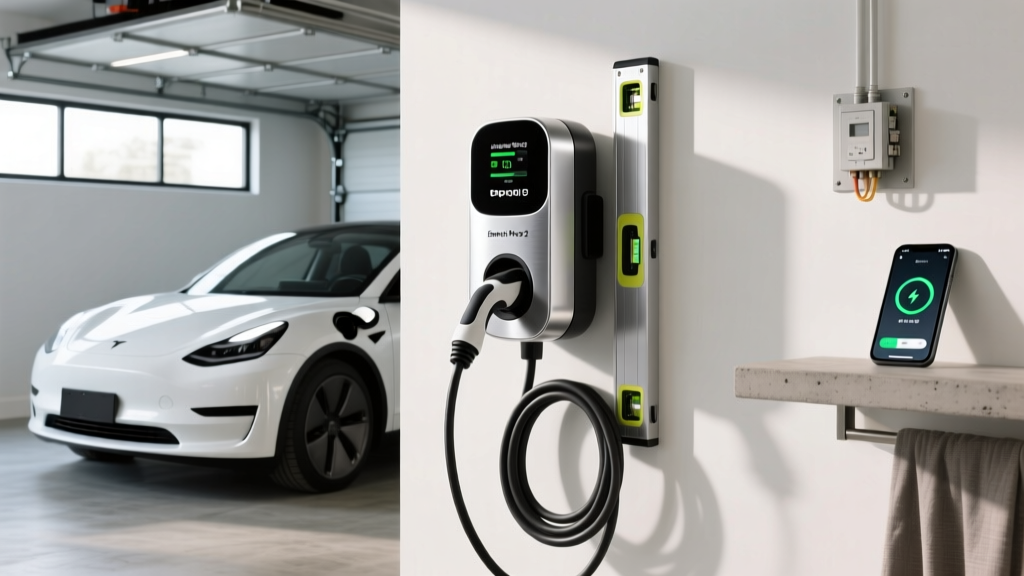
Blink's core offering is Level 2. Their flagship home unit, the Blink HQ 200, delivers up to 19.2 kW (240V / 80A) — though most residential installations cap at 48A (11.5 kW) due to typical panel constraints. Their commercial DC fast chargers range from 60 kW to 180 kW, which is slower than Electrify America's 350 kW units but adequate for 30-45 minute top-ups.
Blink Home Charging Hardware: What You Can Actually Buy
Blink sells several home and commercial Level 2 units directly to consumers and businesses. Here's how their current lineup stacks up:
Blink HQ 200 (Home/Commercial)
- Power Output: Up to 19.2 kW (80A) / adjustable to 48A, 40A, 32A, or 16A
- Connector: J1772 (NACS adapter required for Tesla vehicles)
- Cable Length: 25 feet
- Smart Features: Wi-Fi connected, Blink app scheduling, energy tracking, Alexa integration
- Price: ~$649 (MSRP, before any utility rebates)
- Warranty: 3 years
Blink HQ 150 (Budget Home Unit)
- Power Output: Up to 11.5 kW (48A)
- Connector: J1772
- Cable Length: 18 feet
- Smart Features: Wi-Fi, Blink app, basic scheduling
- Price: ~$499
- Warranty: 3 years
For context, the HQ 200 at 48A will fully recharge a 75 kWh battery (like a Tesla Model Y Long Range or Ford Mustang Mach-E Extended Range) from 10% to 100% in roughly 7 hours. At the maximum 80A setting — which requires a dedicated 100A circuit — that same charge drops to about 4.5 hours. Most homeowners will operate at 48A or 40A, which is the practical sweet spot for overnight charging.
How Much Does It Cost to Install a Home EV Charger?
The charger itself is often the cheapest part of a home Level 2 setup. The real variable is electrical work. Here's a realistic breakdown based on 2025–2026 national averages for a hardwired 48A Level 2 installation:
| Component | Low End | Typical | High End |
|---|---|---|---|
| Charger unit (e.g., Blink HQ 200) | $499 | $649 | $649 |
| Electrician labor (2–6 hrs @ $85–$150/hr) | $170 | $500 | $900 |
| Materials (conduit, wire, junction box) | $100 | $250 | $500 |
| Permit & inspection | $50 | $150 | $400 |
| Electrical panel upgrade (if needed: 100A → 200A) | $0 (not needed) | $0 (not needed) | $2,500–$4,500 |
| Total (no panel upgrade) | $819 | $1,549 | $2,449 |
| Total (with panel upgrade) | $3,319 | $4,049 | $6,949 |
Panel upgrade reality check: Homes built before 2000 often have 100A or 150A service panels. Adding a 48A continuous-load EV circuit (which requires a breaker rated at 60A, per NEC 80% rule) may leave insufficient headroom for existing loads. A licensed electrician will perform a load calculation before installation. If an upgrade to 200A service is needed, expect $2,500–$4,500 and a multi-day timeline involving your utility company.
Safety and code essentials for any Blink home install:
- Dedicated circuit — never share a breaker with other appliances
- GFCI protection required for outdoor installations (NEC 2023 and later)
- NEMA 4 rating for outdoor mounting (the HQ 200 is NEMA 4 rated)
- Hardwired preferred over NEMA 14-50 plug for reliability and to avoid receptacle overheating
- Local permit and inspection — skipping this risks insurance denial in case of electrical fire
The IRS Alternative Fuel Vehicle Refueling Property Credit (Form 8911) may cover up to 30% of home charger equipment and installation costs (capped at $1,000), though eligibility depends on census tract requirements and income phase-outs. Check current-year rules with a tax professional.
Connector Compatibility: Will Blink Work With Your EV?
Connector standards have shifted dramatically since Tesla opened its Supercharger network and the industry moved toward NACS (North American Charging Standard). Here's where Blink fits in 2026:
| Connector Type | Vehicle Brands | Blink Compatibility | Adapter Needed? |
|---|---|---|---|
| J1772 (Level 2) | Most non-Tesla EVs (Chevy, Ford, Hyundai, VW, BMW pre-2025) | Native — plug directly in | No |
| NACS (Tesla / post-2025 Ford, GM, Rivian, others) | Tesla, Ford (2025+), GM (2025+), Rivian (2025+), Volvo, Polestar | J1772 to NACS adapter required | Yes — most automakers include one; aftermarket ~$150–$250 |
| CCS1 (DC Fast) | Legacy non-Tesla DC fast charging | Blink DC stations have CCS1 cables | No (for CCS-equipped vehicles) |
| CHAdeMO | Nissan Leaf (older), Mitsubishi Outlander PHEV | Limited — Blink has phased out most CHAdeMO connectors | Not practical; CHAdeMO-to-CCS adapters are rare and expensive |
If you own a 2025+ Ford, GM, or Rivian vehicle with a native NACS port, you'll need a J1772-to-NACS adapter to use Blink's Level 2 home and public chargers. Tesla owners have used this adapter configuration for years. Blink has announced NACS-native hardware for future production runs, but as of early 2026, their shipping units still use J1772 connectors.
Charging Cost: Blink Public vs. Home vs. Gasoline
Blink's public charging rates vary by location and host, but a realistic range for their Level 2 stations is $0.39–$0.69 per kWh, with some high-demand urban locations reaching $0.79/kWh. Their DC fast chargers typically run $0.49–$0.69/kWh. For comparison:
| Scenario | Rate | Cost for 300 mi (at 3 mi/kWh) | Cost per Mile |
|---|---|---|---|
| Home charging (national avg. electricity, off-peak) | $0.14/kWh | $14.00 | $0.047 |
| Home charging (California, peak TOU) | $0.35/kWh | $35.00 | $0.117 |
| Blink public Level 2 (typical) | $0.49/kWh | $49.00 | $0.163 |
| Blink DC fast charger (typical) | $0.59/kWh | $59.00 | $0.197 |
| Gasoline vehicle (28 MPG combined, $3.40/gal) | $3.40/gallon | $36.43 | $0.121 |
The math is clear: home charging on off-peak electricity is the cheapest option by a wide margin — roughly 2.5× cheaper per mile than gasoline. Blink's public Level 2 pricing often exceeds gasoline cost per mile, which is typical for destination charging networks. The value proposition is convenience and access, not cost savings. If your daily driving is under 40 miles, home charging on a Blink HQ 200 means you'll rarely need public charging at all.
For a concrete charging-time example: a 75 kWh battery charged from 10% to 80% (52.5 kWh added) takes approximately:
- Level 1 (1.4 kW): ~37 hours — impractical for BEVs, acceptable for PHEVs with small batteries
- Blink HQ 200 at 48A (11.5 kW): ~4.5 hours — ideal overnight charge
- Blink public Level 2 (7.2 kW typical): ~7.3 hours — works for all-day workplace parking
- Blink DC fast charger (60 kW): ~52 minutes — adequate for a lunch-break top-up
- 350 kW DC fast charger (non-Blink): ~18 minutes — the road-trip benchmark
How Does Blink Compare to ChargePoint, Emporia, and Tesla Wall Connector?
Blink is one option among many for home charging. Here's how the HQ 200 stacks up against top competitors in the 48A smart-charger segment:
| Feature | Blink HQ 200 | ChargePoint Home Flex | Emporia Vue | Tesla Wall Connector |
|---|---|---|---|---|
| Max Power | 19.2 kW (80A) | 12 kW (50A) | 11.5 kW (48A) | 11.5 kW (48A) |
| Connector | J1772 | J1772 | J1772 | NACS (J1772 adapter included) |
| Cable Length | 25 ft | 23 ft | 24 ft | 24 ft |
| Wi-Fi / App | Yes | Yes | Yes | Yes (limited) |
| Energy Monitoring | Yes | Yes | Yes (whole-home panel integration) | No |
| Price (MSRP) | $649 | $699 | $399 | $475 |
| Warranty | 3 years | 3 years | 3 years | 4 years |
Blink's edge is raw power potential — the HQ 200's 80A capability is best-in-class if your electrical panel supports it. However, the Emporia Vue offers the best value at $399 with whole-home energy monitoring, and the Tesla Wall Connector is the obvious pick for NACS-native vehicles. The ChargePoint Home Flex remains a strong all-rounder with broad utility-rebate compatibility.
Blink Public Network: Reliability, App, and Membership Pricing
Blink's public charging experience is managed through the Blink app (iOS/Android), which handles station location, activation, payment, and session monitoring. Blink offers two pricing tiers:
- Guest rate: Standard per-kWh pricing, no account required at some locations
- Blink Membership: $0.99/month, reduces per-kWh rate by roughly 10–15% at Blink-owned stations
Reliability is a mixed bag. According to user-reported data aggregated by EV charging forums and the PlugShare database, Blink Level 2 stations show an average uptime of approximately 85–90%, below Tesla's ~97% Supercharger uptime but comparable to ChargePoint's destination network. Common complaints include app connectivity glitches, occasional payment processing failures, and stations that show as "available" in the app but are offline on arrival.
For a network of Blink's size, this is a meaningful concern. Before relying on a Blink station for a time-sensitive charge, check recent PlugShare user check-ins for that specific location.
Frequently Asked Questions
How much does it cost to install a Blink home EV charger?
Expect $1,200–$2,500 for a typical installation (charger + electrician + permit + materials) if your electrical panel has sufficient capacity. If a panel upgrade from 100A to 200A is required, add $2,500–$4,500. Always get a load calculation from a licensed electrician before committing.
How fast will each charging level add range to my EV?
Level 1 adds 3–5 miles per hour. Level 2 (at 48A/11.5 kW) adds roughly 35–40 miles per hour for an efficient sedan, or 25–30 miles per hour for a heavier SUV. DC fast charging at 150 kW can add 150+ miles in 15 minutes, though the charge curve tapers significantly above 80% state of charge.
Which connector do I need for my EV on Blink chargers?
Blink hardware uses J1772 connectors for Level 2. If your vehicle has a native NACS port (Tesla, or 2025+ Ford/GM/Rivian/Volvo), you'll need a J1772-to-NACS adapter. Most automakers include this adapter with new vehicles.
How much does charging cost per mile compared to gasoline?
Home charging at $0.14/kWh costs roughly $0.047/mile — about 60% cheaper than gasoline at $3.40/gallon and 28 MPG. Public Blink Level 2 at $0.49/kWh costs ~$0.163/mile, which is more expensive than gas. The economic advantage of EVs depends heavily on home charging access.
What electrical upgrades might my home need for a Level 2 charger?
A 48A charger requires a dedicated 60A breaker on a 240V circuit. If your panel is already near capacity (common in homes with electric ranges, dryers, and HVAC), you may need a panel upgrade to 200A service. Some utilities offer load-management devices that avoid a full panel upgrade by throttling charger power when other appliances cycle on.
Sources: EPA efficiency data from fueleconomy.gov; IRS refueling property credit rules at irs.gov; Blink hardware specifications from Blink Charging manufacturer documentation.