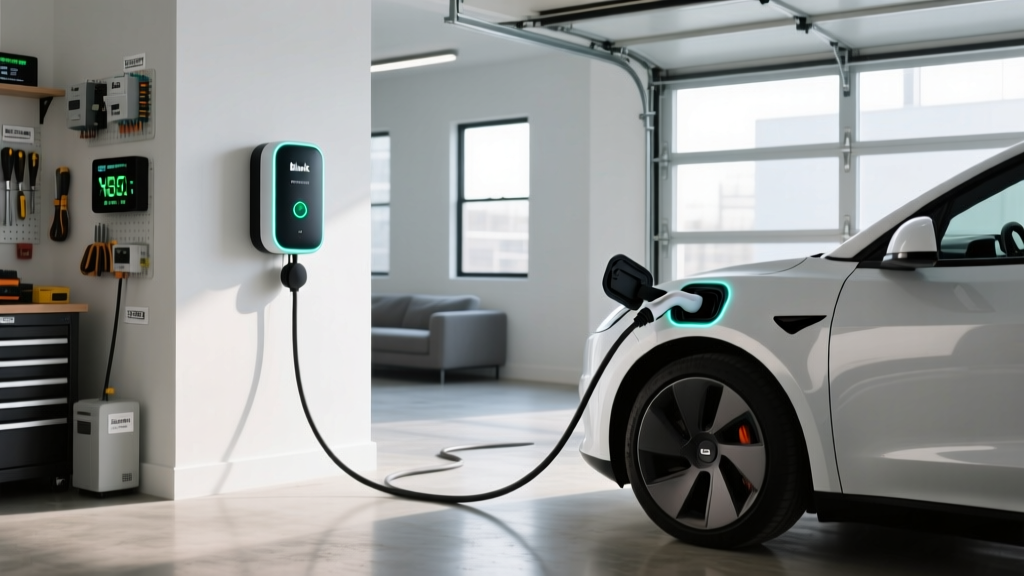
If you've seen Blink charging stations in parking garages, apartment complexes, or workplace lots, you've probably wondered whether buying one for your own garage makes financial sense. The Blink charger cost question has several layers: the hardware itself, the electrical work to install it, the ongoing per-kWh rate on Blink's public network, and how those costs compare to rivals like ChargePoint, Emporia, or Tesla's Wall Connector. This guide walks through every dollar you'll spend — and where Blink fits in the 2026 home-charging landscape.
Understanding EV Charging Levels and Speeds
Before pricing out a Blink unit, you need to know what each charging level delivers. Power is measured in kilowatts (kW) — the rate at which electricity flows — while your battery's capacity is measured in kilowatt-hours (kWh), the total energy it stores. Confusing these two is the single most common EV mistake; a 48-amp Level 2 charger delivering 11.5 kW is not the same thing as an 84 kWh battery.
| Level | Voltage / Phase | Max Power | Miles of Range Added per Hour | Typical Use |
|---|---|---|---|---|
| Level 1 | 120V AC, single-phase | 1.4–1.9 kW | 3–5 mi/hr | Overnight top-offs, PHEVs, emergency |
| Level 2 | 240V AC, single-phase | 7.2–19.2 kW | 20–75 mi/hr | Home garage, workplace, destination |
| DC Fast Charging | 200–500V DC | 50–350 kW | 150–1,000+ mi/hr | Road trips, highway corridors |
Blink's residential lineup is strictly Level 2. Their flagship Blink HQ 200 delivers up to 19.2 kW (80 amps) on a hardwired 100-amp circuit, while the more common Blink HQ 100 tops out at 7.2 kW (30 amps) — enough for overnight charging on most EVs but slower than the category leaders.
Blink Hardware Pricing: What the Charger Itself Costs
Blink sells several home and commercial units. Pricing varies by amperage, connector type, and whether the unit is Wi-Fi-connected. As of early 2026, here's what you're looking at for the residential models:
- Blink HQ 100 (30A, 7.2 kW, J1772): ~$399–$449. Compact, NEMA 14-50 plug or hardwired. Good for smaller batteries and PHEVs.
- Blink HQ 200 (80A, 19.2 kW, J1772): ~$649–$699. Requires hardwiring on a 100A dedicated circuit. Charges larger packs like the F-150 Lightning's 131 kWh Extended Range battery significantly faster.
- Blink IQ 200 (commercial/networked): $2,000+. Not a residential pick, but you'll encounter these at workplaces and multi-family housing.
For comparison, the Tesla Wall Connector (48A, 11.5 kW, NACS native) retails around $475, the ChargePoint Home Flex (up to 50A, 12 kW) runs $549–$699, and the Emporia Vue charger (48A, 11.5 kW) is often $399. Blink's HQ 200 is competitive on power at its price point, but the HQ 100 is relatively low-output for the money.
How Much Does It Cost to Install a Blink Charger at Home?
The sticker price of the charger is only part of the story. A licensed electrician needs to run a dedicated 240V circuit from your panel to the install location, and costs vary wildly depending on your home's age, panel capacity, and the distance from panel to garage.
| Component | Simple Install (panel nearby, capacity available) | Moderate Install (longer run, minor upgrades) | Complex Install (panel upgrade, trenching) |
|---|---|---|---|
| Charger hardware (Blink HQ 100–200) | $399–$699 | $399–$699 | $399–$699 |
| Electrical permit | $50–$150 | $50–$150 | $100–$250 |
| Electrician labor (2–8 hrs @ $75–$150/hr) | $150–$400 | $400–$1,200 | $1,200–$2,500 |
| Materials (wire, conduit, breaker) | $50–$150 | $150–$400 | $400–$800 |
| Panel upgrade (100A → 200A) if needed | $0 | $0 | $1,500–$3,500 |
| Total estimated cost | $649–$1,399 | $1,000–$2,449 | $3,600–$7,750 |
Most homeowners with a modern 200-amp panel and a garage close to the electrical service land in the $800–$1,800 total range. The Blink HQ 200's 80-amp draw is demanding — it requires a 100-amp breaker and 2-gauge copper wire, which costs more in materials than a 48-amp charger needing only a 60-amp breaker and 6-gauge wire. If your panel is already near capacity (common in older homes with added HVAC, electric ranges, and dryers), the HQ 200 may force a panel upgrade that the HQ 100 or a 48A competitor would not.
Always get at least two quotes from licensed electricians and confirm they are familiar with NEC Article 625, which governs EV charging equipment. The National Electrical Code requires a dedicated circuit, GFCI protection for outdoor receptacles, and specific clearances.
Connector Compatibility: Will Blink Work with Your EV?
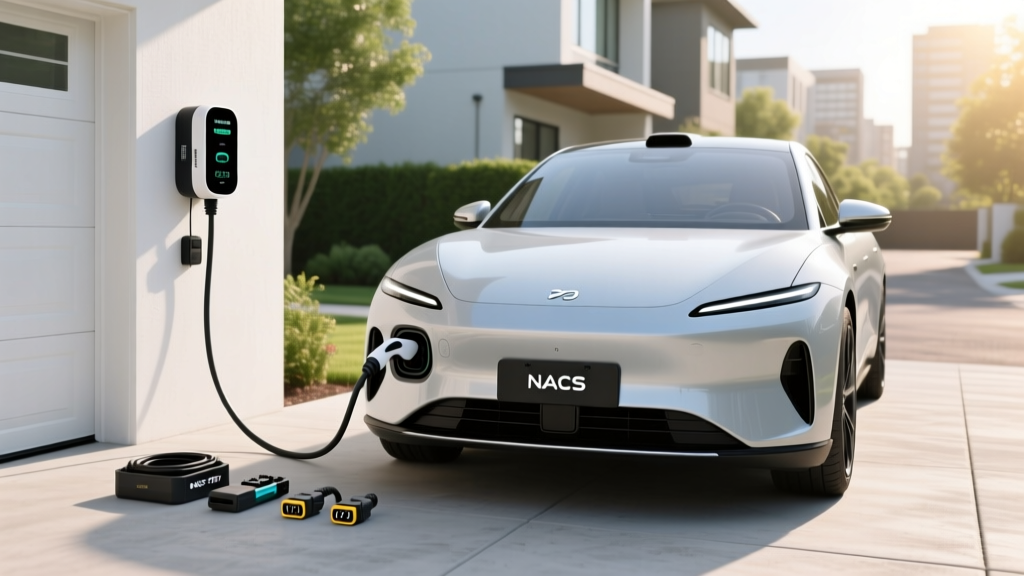
The North American charging landscape shifted dramatically between 2023 and 2025 when Ford, GM, Rivian, Volvo, BMW, and most major automakers adopted Tesla's NACS (North American Charging Standard) connector. As of 2026, virtually every new EV sold in the U.S. ships with a NACS charge port. Blink's residential chargers still come with a J1772 connector (the legacy Level 2 standard), which means:
- Legacy EVs (pre-2025 models with J1772): Plug in directly. No adapter needed.
- Newer NACS-equipped EVs (2025+ Ford, GM, Rivian, Tesla, etc.): You'll need a J1772-to-NACS adapter. Most automakers include one in the vehicle; aftermarket adapters from Lectron or Tesla run $50–$150.
- Teslas (any year): Tesla includes a J1772 adapter with every vehicle, so a Blink unit will work — though you lose the seamless NACS ecosystem integration.
| Connector | Brands Using It (2026) | Works with Blink J1772? | Adapter Needed? |
|---|---|---|---|
| J1772 | Chevy Bolt (prior gen), older Nissan LEAF, older BMW i3 | Yes, native | No |
| NACS | Tesla (all), Ford, GM, Rivian, Volvo, BMW, Hyundai/Kia (2025+) | Yes, with adapter | J1772-to-NACS ($0–$150) |
| CCS1 | Phased out for new vehicles; legacy 2020–2024 models | Yes, for AC Level 2 (CCS1 includes J1772 pins) | No (for Level 2) |
| CHAdeMO | Nissan LEAF (older), Mitsubishi Outlander PHEV | Yes, for AC Level 2 | No (for Level 2) |
One practical note: Blink has announced NACS-native versions of its chargers, but availability has been inconsistent. If you're buying today and drive a NACS vehicle, factor in the adapter or confirm the SKU ships with a NACS cable.
Blink Public Charging Cost: Per-kWh Rates and Cost Per Mile vs. Gas
Beyond home hardware, Blink operates one of the largest public Level 2 and DC fast-charging networks in the U.S. Pricing varies by location, property-owner agreements, and whether you're a Blink Member or Guest user.
| Scenario | Rate | Cost to Add 200 Miles (at 3.5 mi/kWh efficiency) | Cost Per Mile |
|---|---|---|---|
| Home charging (national avg. electricity, $0.16/kWh) | $0.16/kWh | $9.14 | $0.046 |
| Home off-peak / time-of-use rate | $0.08–$0.12/kWh | $4.57–$6.86 | $0.023–$0.034 |
| Blink public Level 2 (Guest rate) | $0.39–$0.59/kWh | $22.29–$33.71 | $0.111–$0.169 |
| Blink DC Fast Charging | $0.45–$0.69/kWh | $25.71–$39.43 | $0.129–$0.197 |
| Gasoline (25 MPG combined, $3.30/gal) | $3.30/gal | $26.40 | $0.132 |
At home, charging on off-peak utility rates, an EV costs roughly a quarter to a third of what gasoline costs per mile. On Blink's public network at Guest rates, you're paying close to or slightly above gas prices — which is why the economics of EV ownership hinge almost entirely on consistent home or workplace charging. Blink Membership (typically $1–$4/month) knocks 5–15% off Guest rates, but it still doesn't approach home-charging economics.
For the most accurate state-by-state electricity rates, check the U.S. Energy Information Administration. Your utility may also offer EV-specific time-of-use plans that cut overnight rates to $0.05–$0.10/kWh.
Charging Time Examples: How Long Does a Blink Charger Take?
Charging time depends on your battery size (kWh), the charger's power output (kW), and the vehicle's onboard charger limit. Here are realistic 10–80% estimates — the range most EV owners target, since charging slows significantly above 80% to protect battery health:
- Tesla Model Y Long Range (75 kWh usable, 11.5 kW onboard max): On the Blink HQ 200 at 11.5 kW (car-limited), 10–80% takes roughly 4.5 hours. On the HQ 100 at 7.2 kW, expect ~7 hours.
- Ford F-150 Lightning Extended Range (131 kWh usable, 19.2 kW onboard): On the HQ 200 at full 19.2 kW, 10–80% takes ~4.8 hours. On the HQ 100, closer to 12 hours — too slow for daily use on a truck this size.
- Hyundai Ioniq 5 (77.4 kWh, 10.9 kW onboard): Either Blink unit will charge 10–80% in 4.5–7 hours depending on model, which covers overnight needs.
- Chevy Equinox EV (85 kWh, 11.5 kW onboard): ~5 hours on HQ 200, ~8 hours on HQ 100.
A useful rule of thumb: divide the kWh you need to add by the lower of (a) the charger's kW output or (b) your car's onboard charger limit. That gives you hours. For a 60 kWh fill (10–80% on a typical mid-size EV) at 7.2 kW, that's ~8.3 hours. At 19.2 kW with a car that can accept it, ~3.1 hours.
Equipment Recommendations: Is Blink the Best Choice for Your Garage?
Blink is a legitimate option, but the home-charging market in 2026 is competitive. Here's how it stacks up against the strongest alternatives:
Blink HQ 200 — Best For: High-Power Needs
- Power: 19.2 kW (80A), hardwired, 100A circuit required
- Connector: J1772 (NACS adapter needed for most 2025+ EVs)
- Cable length: 25 ft
- Smart features: Blink app, scheduling, energy monitoring
- Price: ~$649–$699
- Limitation: Requires heavy electrical infrastructure; J1772 connector feels dated
Tesla Wall Connector — Best For: NACS-Native Convenience
- Power: 11.5 kW (48A), hardwired or NEMA 14-50, 60A circuit
- Connector: NACS native (J1772 adapter available separately)
- Cable length: 24 ft
- Smart features: Wi-Fi updates, load sharing with multiple units, Tesla app integration
- Price: ~$475
- Limitation: Lower peak power than Blink HQ 200; best for Tesla/NACS vehicles
Emporia Vue Charger — Best For: Budget + Solar Integration
- Power: 11.5 kW (48A), hardwired or plug-in, 60A circuit
- Connector: J1772 (NACS adapter needed)
- Cable length: 24 ft
- Smart features: Detailed energy monitoring, solar-aware charging, load management
- Price: ~$399
- Limitation: App can be complex; build quality slightly below Tesla/ChargePoint
If you already have a 100-amp circuit available or are doing new construction, the Blink HQ 200's 19.2 kW output is genuinely useful for large-battery trucks and SUVs. For most sedan and crossover owners, a 48-amp charger at 11.5 kW fills the battery overnight and costs less to install.
Safety, Electrical Code, and Installation Best Practices
Level 2 EV charging draws sustained high current for hours — more like an electric furnace than a typical appliance. Cutting corners here is a fire risk. Key requirements and best practices:
- Dedicated circuit: NEC Article 625 requires EV chargers to have their own dedicated breaker. No sharing with outlets or appliances.
- Breaker sizing: Continuous loads (3+ hours) require the breaker to be rated at 125% of the charger's max draw. A 48A charger needs a 60A breaker; an 80A charger needs a 100A breaker.
- Wire gauge: 6-gauge copper for 48A; 2-gauge copper for 80A. Longer runs may require upsizing to prevent voltage drop.
- GFCI protection: Required for outdoor receptacles (NEC 2020+). Hardwired units often satisfy this at the breaker.
- Outdoor rating: If mounting outside, confirm the unit is NEMA 4 rated (weatherproof). The Blink HQ 100 and HQ 200 are rated for indoor/outdoor use.
- Permit and inspection: Most jurisdictions require a permit for new 240V circuits. The inspection ensures code compliance and protects your home insurance coverage.
If your home has a 100-amp main panel, adding an 80-amp EV charger will almost certainly require a panel upgrade to 200 amps — a $1,500–$3,500 job. Homes with 200-amp panels generally have enough headroom for a 48A charger without upgrades, but a load calculation by your electrician is the only way to know for sure.
Frequently Asked Questions
How much does it cost to install a Blink home charger?
Total installed cost typically ranges from $650 on the very low end (simple install, HQ 100, panel nearby) to $2,500+ for a moderate Blink HQ 200 installation with a longer wire run. If your home needs a panel upgrade, total costs can reach $4,000–$7,500. The charger hardware itself is $399–$699 depending on the model.
How fast will each charging level add range?
Level 1 (120V) adds 3–5 miles per hour — fine for PHEVs with small batteries but impractical for full EVs. Level 2 (240V) adds 20–75 miles per hour depending on amperage; the Blink HQ 100 at 7.2 kW adds roughly 25 mi/hr, while the HQ 200 at 19.2 kW can add up to 75 mi/hr on vehicles with large onboard chargers. DC fast charging at 150–350 kW adds 150–1,000+ miles per hour, though charging curves taper above 80%.
Which connector does a Blink charger use, and will it fit my EV?
Blink residential chargers use the J1772 connector. This works natively with older EVs and with NACS-equipped vehicles via a J1772-to-NACS adapter (usually included with your car or available for $50–$150). Every EV sold in the U.S. can charge on a J1772 Level 2 station, either directly or with an adapter.
How much does charging on Blink's public network cost per mile vs. gas?
Blink's public Level 2 Guest rates typically run $0.39–$0.59/kWh, and DC fast charging runs $0.45–$0.69/kWh. For an efficient EV getting 3.5 miles per kWh, that works out to $0.11–$0.20 per mile — comparable to or slightly above gasoline at $3.30/gallon in a 25 MPG car ($0.13/mile). Home charging at $0.08–$0.16/kWh drops the cost to $0.02–$0.05 per mile, which is where the real savings live.
What electrical upgrades might I need for a Blink HQ 200?
The Blink HQ 200 draws 80 amps continuously and requires a dedicated 100-amp breaker on a 240V circuit. Homes with 100-amp main panels will almost certainly need a service upgrade to 200 amps ($1,500–$3,500). Even some 200-amp panels may be near capacity if you have electric heat, a large A/C unit, and an electric range. A licensed electrician can perform a load calculation to determine if your panel has room. The lower-power HQ 100 (30A, requiring a 40A breaker) is far less likely to trigger an upgrade.
Is the Blink charger eligible for any tax credits or rebates?
The federal Alternative Fuel Vehicle Refueling Property Credit (IRS Form 8911) covers up to 30% of home charger hardware and installation costs, capped at $1,000 — but only if you live in a qualifying census tract (generally non-urban or low-income areas). Many utilities also offer rebates of $200–$500 for installing a smart Level 2 charger; check with your local provider. State and local incentives vary widely; consult the AFDC incentive database for your zip code.