Owning a widebody electric vehicle — whether it's a Tesla Model S Plaid, Porsche Taycan Turbo S, Lucid Air Grand Touring, or a custom widebody build — demands a charging strategy that matches the machine. These vehicles typically pack 90–118 kWh battery packs and 265–405 miles of EPA range, meaning a standard 120V outlet won't cut it for daily replenishment. If you've been searching for the right black widebody charger setup — meaning a sleek, high-power home charging station that complements a dark-paint widebody EV — this guide covers every specification, cost, and compatibility detail you need to make an informed decision in 2026.
Understanding EV Charging Levels: kW Speeds and Range Per Hour
Before selecting equipment, you need to understand the three charging tiers available to EV owners. The critical distinction: kW (kilowatts) measures power — how fast energy flows into your battery. kWh (kilowatt-hours) measures energy — the total capacity of your battery pack. A 100 kWh battery charged at 10 kW takes roughly 10 hours from empty to full (minus charging-curve taper).
| Level | Voltage | Max Power (kW) | Miles of Range Added Per Hour | Best Use Case |
|---|---|---|---|---|
| Level 1 | 120V AC | 1.4–1.9 kW | 3–5 miles | Overnight trickle, PHEVs, emergencies |
| Level 2 | 240V AC | 7.2–19.2 kW | 20–75 miles | Daily home charging, workplace |
| DC Fast Charge | 400–900V DC | 50–350 kW | 150–1,200+ miles/hr (peak) | Road trips, rapid top-ups |
For a widebody EV with a 100 kWh pack, Level 1 charging would require 55+ hours for a full charge — completely impractical. Level 2 at 11.5 kW (48A on a 60A circuit) replenishes roughly 35–45 miles per hour, meaning an overnight session of 8–10 hours restores 280–450 miles depending on vehicle efficiency. DC fast charging at a 350 kW station can take a 900V-architecture vehicle like the Porsche Taycan or Lucid Air from 10–80% in approximately 18–22 minutes, though sustained speeds taper significantly above 80% State of Charge (SoC) to protect battery health.
Home Charging Installation: Electrical Requirements and Costs
A Level 2 home charging station requires a dedicated 240V circuit, similar to what powers an electric dryer or oven. Here's what's involved:
Electrical specifications:
- Circuit amperage: 40A, 50A, or 60A dedicated breaker (NEC requires the continuous load to be 80% of breaker rating, so a 60A breaker supports a 48A charger)
- Voltage: 240V single-phase (standard US residential split-phase)
- Wire gauge: 6 AWG copper for 50A circuits; 4 AWG for 60A circuits (varies by run length and local code)
- Outlet vs. hardwired: NEMA 14-50 outlet offers portability; hardwired installations allow higher amperage and eliminate a failure point
Panel capacity reality check: Most modern homes have 200A electrical service panels. Adding a 48A EV charger (which draws up to 11.5 kW continuously) consumes a significant portion of available capacity. If your panel is already near capacity — common in homes with electric HVAC, electric water heaters, and electric ranges — you may need a panel upgrade to 300A or 400A, or a smart load-management system like the Span smart panel or a charger with built-in load sharing.
| Component | Low Estimate | High Estimate | Notes |
|---|---|---|---|
| Level 2 Charger Equipment | $350 | $800 | 40A–48A Wi-Fi-enabled units |
| Electrician Labor | $500 | $2,000 | Depends on panel-to-garage distance, wall type |
| Electrical Permit | $50 | $300 | Varies by municipality |
| Panel Upgrade (if needed) | $1,500 | $4,500 | 200A to 300/400A service upgrade |
| Conduit & Wiring Materials | $100 | $600 | Longer runs cost more |
| Total (no panel upgrade) | $1,000 | $3,700 | Most homes with 200A service |
| Total (with panel upgrade) | $2,500 | $8,200 | Older homes or high-load panels |
The federal Residential Clean Energy Credit (IRS §25D) was modified under recent legislation, so verify current eligibility for home charging equipment. Some utilities and states also offer rebates of $250–$1,000 for Level 2 installations — check your local utility's EV program page. Consult a licensed electrician for a site-specific assessment before purchasing equipment.
Connector Compatibility: NACS, CCS1, and CHAdeMO for Widebody EVs
The connector landscape has shifted dramatically. As of 2026, the North American Charging Standard (NACS), originally developed by Tesla, has been adopted by nearly every major automaker. Here's what your widebody EV likely uses:
| Vehicle | Connector | Max DC Fast Charge | Adapter Needed for Legacy Stations? |
|---|---|---|---|
| Tesla Model S Plaid | NACS (native) | 250 kW | CCS adapter for non-Tesla DCFC ($200–$250) |
| Porsche Taycan Turbo S | NACS (2025+ models); CCS1 (pre-2025) | 270 kW (320 kW w/ preconditioning) | CCS-to-NACS adapter for newer models at CCS stations |
| Lucid Air Grand Touring | CCS1 | 300+ kW (Wunderbox) | CCS-to-NACS adapter for Tesla Superchargers |
| BMW i7 xDrive60 | CCS1 | 195 kW | CCS-to-NACS adapter for Supercharger access |
| Mercedes EQS 580 | CCS1 | 200 kW | CCS-to-NACS adapter for Supercharger access |
| Audi e-tron GT (2025+) | NACS (2025+) | 270 kW | N/A for NACS stations; CCS adapter for legacy |
Key takeaway for home charging: Level 2 home chargers universally use the J1772 connector for non-Tesla EVs, or NACS for Tesla vehicles. However, many 2026 home chargers now ship with NACS connectors or include J1772-to-NACS adapters in the box. If you own a CCS1-equipped vehicle like the Lucid Air or BMW i7, any J1772 Level 2 charger will work natively — the J1772-to-CCS adapter is only needed for DC fast charging, not Level 2 AC charging.
Charging Cost Per Mile: Home vs. Public vs. Gas Comparison
One of the strongest ownership arguments for a widebody EV is fuel-cost savings, particularly when charging at home on off-peak electricity rates. Here's how the numbers stack up:
| Scenario | Rate | Cost Per Mile (3 mi/kWh EV) | Annual Cost (12,000 mi) |
|---|---|---|---|
| Home Level 2 (off-peak utility rate) | $0.09–$0.13/kWh | $0.03–$0.043 | $360–$516 |
| Home Level 2 (standard residential avg) | $0.16–$0.18/kWh | $0.053–$0.06 | $636–$720 |
| Public Level 2 (ChargePoint, EVgo) | $0.25–$0.49/kWh | $0.083–$0.163 | $996–$1,956 |
| DC Fast Charge (Electrify America, Tesla) | $0.32–$0.56/kWh | $0.107–$0.187 | $1,284–$2,244 |
| Gasoline (premium 93 octane, 22 MPG avg) | $4.10–$4.80/gal | $0.186–$0.218 | $2,232–$2,616 |
For a high-performance widebody EV like the Tesla Model S Plaid (averaging roughly 3.0–3.2 miles per kWh or ~105 MPGe combined per fueleconomy.gov), home charging at $0.12/kWh costs approximately $0.04 per mile — roughly one-fifth the cost of premium gasoline in a comparable performance sedan. Even exclusive DC fast charging remains competitive with or cheaper than premium fuel.
Real-world charging time examples for common widebody EV battery sizes:
- Tesla Model S (100 kWh pack): 10–80% at a 250 kW V3 Supercharger in ~25–30 minutes; at home on 11.5 kW Level 2, 0–100% in ~9 hours
- Porsche Taycan Turbo S (93.4 kWh usable, 800V architecture): 10–80% at 270 kW in ~22 minutes with preconditioning; home Level 2 at 9.6 kW, ~10 hours
- Lucid Air Grand Touring (112 kWh usable): 10–80% at 300+ kW in ~20 minutes; home Level 2 at 11.5 kW, ~10.5 hours
Equipment Recommendations: Best Level 2 Chargers for a Widebody EV
When matching a charger to a widebody EV, prioritize: adequate power output (48A/11.5 kW minimum for large packs), cable length (24–25 feet to reach either side of a wide vehicle), build quality that matches your garage aesthetic, and smart features for scheduling off-peak charging.
ChargePoint Home Flex (NACS or J1772)
- Power: Up to 12 kW (50A) on a 60A circuit; adjustable down to 16A
- Connector: Available in NACS or J1772 (J1772 works with all CCS1 vehicles at Level 2)
- Cable length: 23 feet
- Smart features: Wi-Fi, app-based scheduling, Alexa integration, energy tracking
- Price: ~$599–$699
- Best for: Flexibility across current and future EVs; amperage adjustability for panel-limited homes
Tesla Wall Connector (NACS)
- Power: Up to 11.5 kW (48A) on a 60A circuit
- Connector: NACS native; includes J1772 adapter for non-Tesla EVs (2025+ versions)
- Cable length: 24 feet
- Smart features: Wi-Fi, OTA updates, power sharing between multiple units, Tesla app integration
- Price: ~$450–$475
- Best for: Tesla owners who want a clean, black aesthetic matching a black widebody Model S; power-sharing for two-car garages
Emporia Vue Level 2 Charger
- Power: Up to 11.5 kW (48A) on a 60A circuit
- Connector: J1772 (compatible with all non-Tesla EVs; CCS1 vehicles use natively)
- Cable length: 24 feet
- Smart features: Real-time energy monitoring, solar integration, scheduling, load management with Emporia Vue panel monitor
- Price: ~$399–$449
- Best for: Budget-conscious buyers with solar panels; best energy-monitoring features in the segment
Grizzl-E Smart (United Chargers)
- Power: Up to 10 kW (40A) on a 50A circuit
- Connector: J1772 or NACS
- Cable length: 24 feet
- Smart features: Wi-Fi, OCPP compatibility, adjustable amperage, extreme cold rating (-40°F)
- Price: ~$449–$549
- Best for: Cold-climate owners; durable outdoor-rated build; open protocol for commercial/fleet use
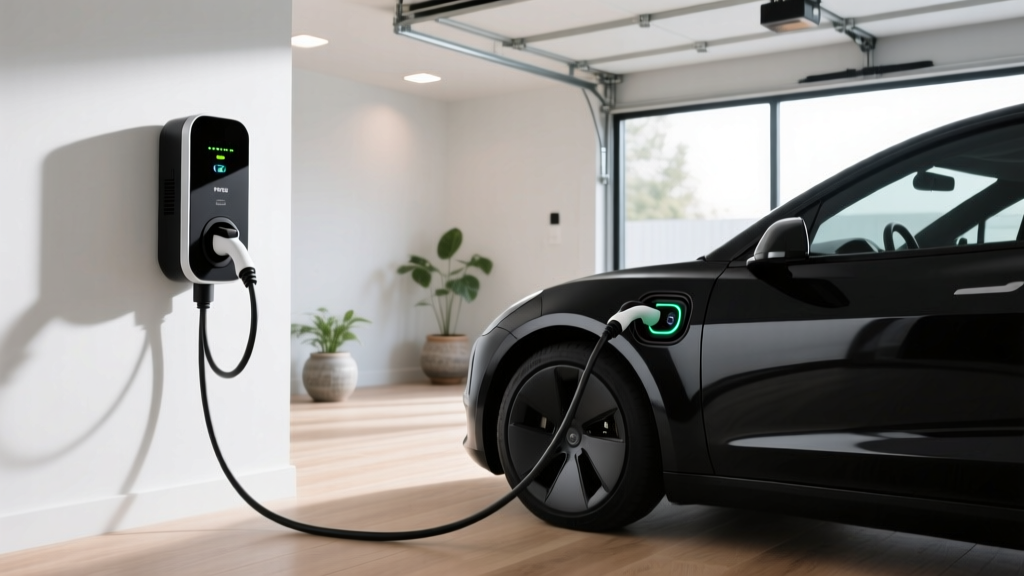
For a black widebody EV specifically, the Tesla Wall Connector in black or the ChargePoint Home Flex (available in a dark graphite finish) provide the most visually cohesive garage setup. Both support 24-foot cables — essential for routing around wide fenders and reaching charge ports located on either side of the vehicle.
Safety, Electrical Code, and Installation Best Practices
EV charging equipment draws sustained high current for hours at a time, making proper installation non-negotiable. Key requirements per the National Electrical Code (NEC Article 625):
- Dedicated circuit: Your Level 2 charger must be on its own dedicated breaker — no sharing with other appliances
- GFCI protection: NEC 2023 and later require GFCI (Ground Fault Circuit Interrupter) protection for all EV charging outlets; hardwired units may have GFCI built into the charger itself
- Outdoor rating: If installing outside or in an unenclosed carport, the charger must carry a NEMA 4 (weatherproof) rating — all recommended units above qualify
- Cable management: Widebody vehicles need clear cable routing; wall-mounted retractors or cable holsters prevent tripping hazards and cable damage from being run over
- Load calculation: Your electrician must perform an NEC Article 220 load calculation to verify your panel can handle the continuous EV load plus existing household demand
- Permit and inspection: Most jurisdictions require an electrical permit and post-installation inspection — this protects your home insurance coverage and ensures code compliance
Real-World Charging Strategy for Widebody EV Owners
Widebody EVs present unique charging logistics. The broader vehicle footprint means charge-port access can be tighter in standard garage bays, and larger battery packs demand higher-power Level 2 equipment for practical overnight charging. Here's the decision framework:
Choose a 48A (11.5 kW) charger if:
- Your EV has a 90+ kWh battery pack (Tesla Model S, Lucid Air, Porsche Taycan)
- You drive 80+ miles daily and need full overnight replenishment
- Your electrical panel has capacity on a 60A circuit
- You want to precondition the battery while charging without draining the pack
Choose a 32A–40A (7.7–9.6 kW) charger if:
- Your panel is limited to a 40A or 50A circuit
- Your daily driving is under 60 miles
- You want to avoid a panel upgrade ($1,500–$4,500 savings)
- Your EV's onboard charger maxes at 9.6 kW anyway (many non-Tesla EVs cap here)
For road trips, plan DC fast-charging stops around 350 kW-capable stations (Electrify America, Tesla Supercharger V4, IONNA) to minimize downtime. Precondition your battery using the vehicle's navigation-routed charging feature — this warms the pack to optimal temperature and can shave 5–10 minutes off a 10–80% session.
Frequently Asked Questions
How much does it cost to install a home EV charger?
Expect $1,000–$3,700 for a standard Level 2 installation on an existing 200A panel, including the charger ($350–$800), electrician labor ($500–$2,000), permit ($50–$300), and materials ($100–$600). If your home needs a panel upgrade to support the additional load, add $1,500–$4,500 to that total. Always get a site assessment from a licensed electrician before purchasing equipment.
How fast will each charging level add range?
Level 1 (120V) adds 3–5 miles per hour — impractical for large-battery widebody EVs. Level 2 (240V) at 48A/11.5 kW adds roughly 35–45 miles per hour for a vehicle averaging 3 mi/kWh. DC fast charging at 250–350 kW can add 200+ miles in 15–20 minutes, though speeds taper significantly above 80% SoC to protect battery longevity.
Which connector/charger is compatible with my EV?
For Level 2 home charging, all non-Tesla EVs use the J1772 connector (which is the AC portion of the CCS1 plug). Tesla vehicles use NACS. Most 2026 Level 2 chargers are available in either connector type, and adapters exist for cross-compatibility. For DC fast charging, verify whether your vehicle uses NACS or CCS1 and plan adapter needs for different networks accordingly.
How much does charging cost per mile vs gas?
Home charging at off-peak rates ($0.09–$0.13/kWh) costs approximately $0.03–$0.04 per mile for a widebody EV averaging 3 mi/kWh. Premium gasoline at $4.50/gal in a 22 MPG performance sedan costs roughly $0.20 per mile. That's a 5x cost difference, saving $1,500–$2,000 annually at 12,000 miles driven. Even public DC fast charging at $0.45/kWh ($0.15/mi) undercuts premium gasoline.
What electrical upgrades might I need?
The most common upgrade is a panel capacity increase from 100A/150A to 200A+ service, costing $1,500–$4,500. Other potential needs: running a new dedicated 240V circuit from the panel to the garage (especially if the panel is on the opposite side of the house), upgrading wire gauge for long conduit runs, or installing a smart load-management system to share capacity between the EV charger and other high-draw appliances without a full panel upgrade.