What Bidirectional EV Chargers Actually Do
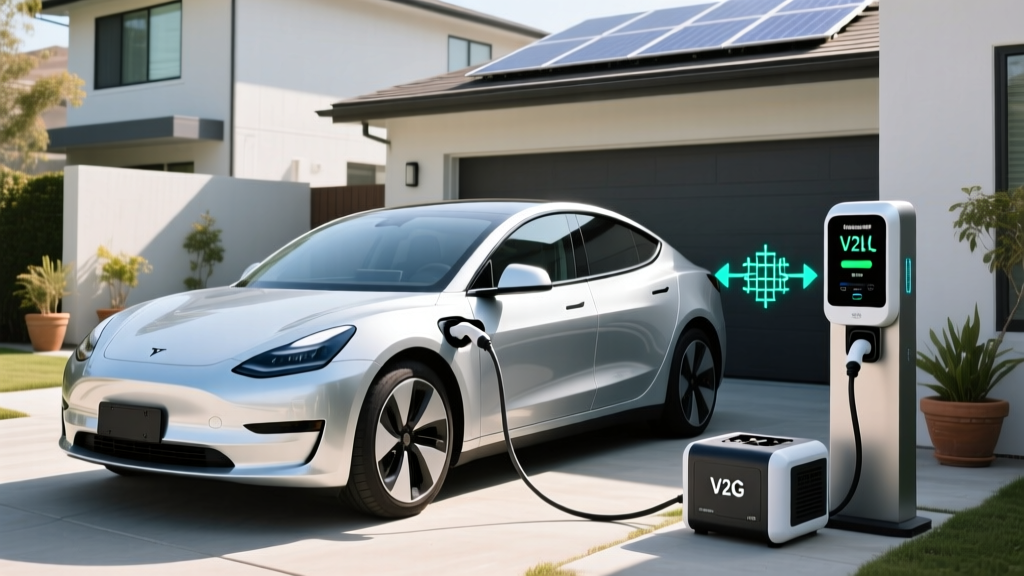
Most home EV chargers push electricity one way: from your electrical panel into your car's battery. Bidirectional EV chargers reverse that flow, letting your vehicle's battery supply power back to your home (V2H), to the grid (V2G), or to external devices and appliances (V2L). With a typical EV battery holding 60–100 kWh of usable energy, a bidirectional setup turns your car into a rolling backup generator capable of powering an average U.S. home (roughly 30 kWh/day) for two to three days during an outage.
As of early 2026, bidirectional charging remains a niche but rapidly expanding category. Only a handful of vehicles support full V2H or V2G, and the required home equipment — a bidirectional-capable wallbox plus a transfer switch or grid-integration inverter — adds cost and complexity beyond a standard Level 2 installation. But for buyers in areas with frequent outages, time-of-use utility rates, or solar-plus-storage ambitions, bidirectional EV chargers represent a compelling convergence of transportation and home energy.
Charging Levels and Bidirectional Speeds
Before evaluating bidirectional hardware, it helps to ground yourself in the three standard charging levels and their typical speeds. Bidirectional chargers operate primarily at Level 2 (AC) for home V2H, though DC bidirectional systems are emerging for commercial V2G applications.
| Level | Voltage / Power | Speed (Miles of Range/Hour) | Typical Use |
|---|---|---|---|
| Level 1 | 120V / 1.4–1.9 kW | 3–5 mi/hr | Overnight trickle, emergency |
| Level 2 | 240V / 7.7–19.2 kW | 20–60 mi/hr | Home daily charging, V2H bidirectional |
| DC Fast | 400–800V / 50–350 kW | 180–1,200+ mi/hr | Public highway charging, commercial V2G |
For context, a bidirectional Level 2 wallbox discharging to your home at 11.5 kW can sustain roughly a whole-house load during peak evening hours. The Ford F-150 Lightning with its 131 kWh extended-range battery can output up to 9.6 kW continuously via Ford's Intelligent Backup Power system, enough to keep essential circuits running for days.
Vehicles That Support Bidirectional Charging in 2026
Not every EV can send power back. Bidirectional capability requires both vehicle hardware (a bidirectional onboard charger or DC coupling) and manufacturer software authorization. Here is the current landscape:
| Vehicle | Battery (kWh) | V2L | V2H | V2G | Max Output |
|---|---|---|---|---|---|
| Ford F-150 Lightning (Ext. Range) | 131 | ✓ | ✓ (9.6 kW) | Limited pilots | 9.6 kW |
| Hyundai Ioniq 5 / Ioniq 6 | 77.4 | ✓ (3.6 kW) | ✓ (via Wallbox Quasar) | Pilot programs | 3.6 kW (V2L) / 10 kW (V2H) |
| Kia EV6 / EV9 | 77.4–100 | ✓ (3.6 kW) | Announced | — | 3.6 kW (V2L) |
| Chevrolet Silverado EV | 200+ | ✓ | ✓ (Energy Transfer Pro) | — | Up to 12 kW |
| GMC Sierra EV | 200+ | ✓ | ✓ (Energy Transfer Pro) | — | Up to 12 kW |
| VW ID.4 (2026+ models) | 82 | ✓ (limited) | Announced | Pilot (EU) | TBD |
Tesla's Cybertruck supports V2L via its Powershare outlets (up to 9.6 kW combined across bed and cabin outlets), and Tesla has announced V2H capability through the Powerwall-integrated Wall Connector, though full deployment remains limited. Most other Tesla vehicles (Model 3, Model Y, Model S, Model X) do not support bidirectional power as of 2026.
Home Installation: Electrical Requirements and Costs
Installing a bidirectional EV charger is significantly more involved than mounting a standard Level 2 wallbox. You need a bidirectional-capable unit, a dedicated high-amperage circuit, and — for V2H — an automatic transfer switch or a grid-interactive inverter that safely isolates your home from the utility grid during outages (a code requirement to protect line workers).
Electrical Specifications
- Circuit: Dedicated 60A breaker (for 48A continuous charge/discharge) or 100A breaker for higher-power units
- Voltage: 240V split-phase (standard U.S. residential)
- Wire gauge: 6 AWG copper for 60A; 3 AWG for 80A; 1 AWG for 100A
- Transfer switch: Required for V2H — typically a 200A rated automatic transfer switch (ATS) integrated with the bidirectional charger's inverter
- GFCI protection: Required by NEC 2023/2026 for all EV charging outlets (625.41); hardwired units may use ground-fault equipment protection instead
- Permit: Electrical permit required in virtually all U.S. jurisdictions; inspection before energization
Panel Upgrade Reality
Most homes built before 2000 have 100A or 150A main service panels. Adding a 60A bidirectional charger circuit plus a transfer switch may exceed available capacity, especially if you already run electric HVAC, an electric range, and a dryer. A NEC-compliant load calculation (Article 220) will determine whether your panel can accommodate the circuit. If not, a panel upgrade to 200A or 400A typically runs $2,000–$5,000 before the charger installation even begins.
| Component | Low Estimate | High Estimate | Notes |
|---|---|---|---|
| Bidirectional charger unit | $3,500 | $7,000 | Wallbox Quasar 2, Fermata, or Ford Charge Station Pro |
| Automatic transfer switch + inverter | $2,000 | $5,000 | Required for V2H; integrated in some systems |
| Electrician labor (install + wiring) | $1,500 | $4,000 | Varies by run length, conduit, and local rates |
| Electrical permit + inspection | $150 | $500 | Jurisdiction-dependent |
| Panel upgrade (if needed) | $2,000 | $5,000 | 100A → 200A or 200A → 400A |
| Total (without panel upgrade) | $7,150 | $16,500 | Turnkey bidirectional V2H system |
| Total (with panel upgrade) | $9,150 | $21,500 | For older homes needing service upgrade |
Compared to a standard Level 2 home charger installation ($500–$2,000 total for most homes with adequate panels), bidirectional systems carry a substantial premium. The payoff comes from avoiding a separate home battery system — a Tesla Powerwall 3 costs roughly $9,200 installed and stores only 13.5 kWh, while your EV may carry 80–130 kWh already paid for as part of the vehicle.
Connector Compatibility and Adapter Requirements
Bidirectional charging adds a layer of connector complexity because the charger must handle both AC-to-DC (charging) and DC-to-AC (discharging) conversion. The connector on the vehicle side must support bidirectional communication protocols (ISO 15118-20 for DC bidirectional, or specific AC bidirectional protocols).
| Connector | Bidirectional Support | Vehicles Using It | Adapter Needed? |
|---|---|---|---|
| NACS (Tesla) | V2L (Cybertruck); V2H announced | Tesla, Ford (2025+), GM (2025+), Rivian (2025+) | CCS→NACS adapter for non-Tesla bidirectional chargers |
| CCS1 | Full V2H/V2G via ISO 15118 | Hyundai, Kia, VW, BMW, older Ford/GM | None for CCS-native vehicles |
| CHAdeMO | V2H/V2G (pioneered bidirectional) | Nissan Leaf, Mitsubishi Outlander PHEV | Limited charger availability; legacy standard |
| J1772 (AC) | Limited AC bidirectional | Most EVs for charging only | NACS vehicles need J1772→NACS adapter |
The CHAdeMO connector was actually the first to support bidirectional charging commercially — Nissan has offered V2H with the Leaf since 2012 in Japan using CHAdeMO-based systems. However, with CHAdeMO fading from the U.S. market, CCS1 and NACS are the connectors to watch for bidirectional growth. The critical factor is not just the physical plug but the communication protocol: ISO 15118-20 enables DC bidirectional over CCS/NACS, and both vehicle and charger must support it.
2026 Equipment Recommendations
The bidirectional charger market is still small, with only a few consumer-available units. Here are the leading options:
Wallbox Quasar 2
Power: 11.5 kW (charge and discharge)
Connector: CCS1 (NACS adapter available)
Protocol: ISO 15118-20 DC bidirectional
Smart features: myWallbox app, solar integration, energy arbitrage scheduling, grid-services enrollment
Cable length: 18 ft (5.5 m)
Price: ~$5,500–$6,500
Best for: Hyundai Ioniq 5/6, future CCS/NACS vehicles with V2H support
Ford Charge Station Pro
Power: 9.6 kW (discharge via Intelligent Backup Power); 19.2 kW charge
Connector: NACS (native Tesla-style)
Protocol: Ford proprietary bidirectional with Sunrun Home Integration System
Smart features: FordPass app, automatic outage detection, scheduled backup reserve
Cable length: 25 ft (7.6 m)
Price: ~$3,895 (charger) + ~$3,000–$5,000 (Home Integration System + install)
Best for: F-150 Lightning owners wanting whole-home backup
Fermata House (FE-15)
Power: 15 kW bidirectional DC
Connector: CCS1
Protocol: ISO 15118-20, V2G-capable
Smart features: Utility demand-response, V2G revenue programs, commercial fleet management
Cable length: 20 ft
Price: ~$10,000–$15,000 (commercial/fleet focus)
Best for: Commercial fleets, V2G pilot participants, high-power residential
GM Energy PowerShift Charger
Power: 11.5 kW bidirectional
Connector: NACS
Protocol: GM Energy ecosystem with V2H enablement
Smart features: myChevrolet app, V2H with GM Energy Home Power Inverter, off-peak scheduling
Cable length: 20 ft
Price: ~$4,500–$6,000 (charger + inverter bundle)
Best for: Silverado EV and Sierra EV owners
Charging Time Examples for Common Battery Sizes
Whether you're charging or discharging, the math is governed by power (kW) and energy (kWh). Here are charge and discharge times for representative batteries at typical bidirectional power levels:
| Vehicle (Battery Size) | 10–80% Charge at 11.5 kW | Discharge at 9.6 kW (Full to 20%) | Home Runtime at 3 kW Avg Load |
|---|---|---|---|
| Hyundai Ioniq 5 (77.4 kWh) | ~4.7 hours | ~4.8 hours | ~15 hours (60% usable) |
| Ford F-150 Lightning ER (131 kWh) | ~7.9 hours | ~10.9 hours | ~26 hours |
| Chevy Silverado EV (200 kWh) | ~12.2 hours | ~16.7 hours | ~40 hours |
Important nuance: bidirectional discharge rates are typically lower than charge rates due to inverter limitations and thermal constraints. The F-150 Lightning charges at up to 19.2 kW on Level 2 but discharges at 9.6 kW. Also, manufacturers build in a battery buffer — you never truly drain to 0% or charge to 100% — which protects long-term battery health but reduces usable capacity by roughly 5–10%.
Cost to Charge: Home vs. Public vs. Gas
One of the strongest ownership arguments for EVs is fuel cost. Bidirectional capability doesn't change what you pay to charge, but it can help you save by time-shifting energy. Here's the cost landscape:
| Scenario | $/kWh | Cost per Mile* | Annual Cost (12,000 mi) |
|---|---|---|---|
| Home off-peak (utility TOU rate) | $0.08–$0.14 | $0.02–$0.04 | $240–$480 |
| Home standard rate | $0.16–$0.22 | $0.05–$0.07 | $600–$840 |
| Public Level 2 (ChargePoint, etc.) | $0.25–$0.49 | $0.08–$0.16 | $960–$1,920 |
| DC fast charging (Electrify America, etc.) | $0.35–$0.55 | $0.11–$0.18 | $1,320–$2,160 |
| Gas vehicle (25 MPG, $3.40/gal) | — | $0.14 | $1,680 |
*Assumes 3.0 miles per kWh (average EV efficiency). Check your vehicle's specific efficiency on fueleconomy.gov.
The bidirectional angle: if your utility offers time-of-use (TOU) rates, you can charge your EV at $0.08/kWh overnight and discharge it back to your home during peak hours (when grid power might cost $0.35/kWh). That energy arbitrage can save $3–$5/day in high-cost markets — roughly $1,000–$1,800 annually — while also providing free backup power during outages. Some utilities, through V2G pilot programs, will actually pay you $0.10–$0.25/kWh for power sent back to the grid during demand events.
Safety, Code, and Grid Interconnection
Bidirectional charging involves grid-tied inverter operation, which triggers additional code and utility requirements beyond a standard EV charger install:
- NEC Article 625: Governs all EV charging equipment; 2023/2026 editions include specific provisions for bidirectional equipment and require GFCI protection
- NEC Article 702 (Optional Standby Systems): Applies to V2H systems operating as backup power; requires transfer equipment that prevents back-feeding the utility grid
- UL 1741 SA/SB: Inverter safety standard for grid-interactive systems; your bidirectional charger's inverter must carry this listing
- Utility interconnection agreement: Most utilities require a formal application before you can operate any grid-tied inverter, even for V2H standby. V2G requires full interconnection approval and often a revenue-grade meter
- Anti-islanding protection: Mandatory feature that shuts down the inverter if the grid goes down (unless you're in intentional island mode via a transfer switch) — this protects utility workers from energized lines during outages
- Outdoor rating: If mounted outdoors, the unit must carry a NEMA 4 (weatherproof) rating; most bidirectional chargers are rated NEMA 4 or 4X
Always hire a licensed electrician experienced with bidirectional systems. The interconnection paperwork alone can take 4–8 weeks with some utilities, and improper installation can void both the charger warranty and your homeowner's insurance coverage. Consult your utility's distributed generation department before purchasing equipment.
- They do not eliminate your electric bill — V2H/V2G offsets a portion of usage depending on battery size, rate structure, and discharge patterns
- They do not provide unlimited backup — runtime depends on battery state of charge and household load; a 77 kWh battery at 80% SoC powering a 3 kW average load runs ~20 hours
- They do not work with every EV — vehicle must have bidirectional hardware AND manufacturer-enabled software; aftermarket modifications are not available
- They do not qualify for the §30D federal EV tax credit (that credit applies to the vehicle, not the charger). However, the Residential Clean Energy Credit (§25D) may cover 30% of bidirectional charger and installation costs if it qualifies as energy storage — consult a tax professional
Is Bidirectional Charging Worth the Investment?
The economics depend heavily on your situation. Here's a practical decision framework:
Choose bidirectional if:
- You live in an area with frequent multi-hour power outages (California PSPS events, Texas grid instability, Southeast hurricane zones)
- Your utility offers aggressive TOU rates with peak/off-peak spreads exceeding $0.20/kWh
- You're already buying a compatible vehicle (F-150 Lightning, Silverado EV, Ioniq 5) and value backup power
- You'd otherwise purchase a home battery ($9,000–$15,000 for a Powerwall) — your EV battery is larger and already paid for
- You have solar panels and want to store daytime generation in your EV for nighttime home use
Stick with standard Level 2 if:
- Your power is reliable and you have no backup power need
- Your utility has flat rates with no TOU incentive
- Your home electrical panel can't accommodate a 60A+ circuit without an expensive upgrade
- Your EV doesn't support bidirectional (most current Teslas, Rivians, BMWs, etc.)
- You're budget-conscious and a $1,000 standard Level 2 installation meets your needs
Frequently Asked Questions
How much does it cost to install a bidirectional home EV charger?
A full bidirectional V2H system typically costs $7,000–$16,500 installed (charger, transfer switch, electrician, permit). If your home needs a panel upgrade, add $2,000–$5,000. This is substantially more than a standard Level 2 install ($500–$2,000) but replaces the need for a separate home battery system.
How fast will each charging level add range?
Level 1 (120V) adds 3–5 miles per hour. Level 2 (240V) adds 20–60 miles per hour depending on amperage. DC fast charging adds 180–1,200+ miles per hour at peak rates. Bidirectional discharge rates are typically 3.6–12 kW, meaning your EV can supply a typical home's average load (1–3 kW) continuously for many hours.
Which connector is compatible with my EV for bidirectional charging?
CCS1 currently offers the broadest bidirectional support (Hyundai/Kia, VW). NACS is growing as Ford, GM, and others adopt it with bidirectional plans. CHAdeMO supports bidirectional (Nissan Leaf) but is declining. Check your vehicle manufacturer's specifications — physical connector compatibility alone is not sufficient; the vehicle's onboard charger and software must authorize bidirectional power flow.
How much does charging cost per mile compared to gas?
Home charging at off-peak rates costs $0.02–$0.04 per mile. Standard home rates bring it to $0.05–$0.07/mile. Public DC fast charging runs $0.11–$0.18/mile. A comparable gas vehicle at 25 MPG and $3.40/gallon costs about $0.14/mile. Home charging nearly always wins on cost; DC fast charging can approach or exceed gas costs depending on the network.
What electrical upgrades might I need for a bidirectional charger?
You'll need a dedicated 60–100A, 240V circuit. Homes with 100A or 150A main panels often require a panel upgrade to 200A or 400A ($2,000–$5,000). An electrician will perform a NEC Article 220 load calculation to determine available capacity. You'll also need an automatic transfer switch for V2H and a utility interconnection agreement — both add time and cost to the project.
Will using V2H/V2G degrade my EV battery faster?
Every charge/discharge cycle contributes to battery degradation, but modern EV batteries are designed for thousands of cycles. A National Renewable Energy Laboratory study found that moderate V2G cycling (one shallow cycle per day) added only marginal degradation beyond normal driving use — roughly 1–2% additional capacity loss over 10 years. Most manufacturers warrant the battery for 8 years/100,000 miles at 70% capacity retention. Using V2H for occasional outages has negligible impact; daily deep-cycling for energy arbitrage will accelerate wear somewhat but remains within warranty margins for most use patterns.
Does bidirectional charging qualify for any tax credits?
The §30D federal EV tax credit applies to the vehicle purchase, not the charger. However, the Residential Clean Energy Credit (IRS §25D) provides a 30% credit for qualified energy storage equipment installed in your home — and some bidirectional charger systems may qualify if classified as energy storage. The credit has no annual cap and applies through 2032. Consult a tax professional to confirm eligibility for your specific equipment and installation. Some states and utilities also offer rebates for bidirectional or V2G-capable equipment — check your utility's website and the Alternative Fuels Data Center for current programs.