You've probably seen the term "bidirectional charging" in EV marketing and wondered: what does it actually do, and do I need it? Unlike a standard Level 2 home charger that only pushes electricity into your car's battery, a bidirectional charger can also pull energy out — turning your EV into a mobile power station for your home, tools, or even the electrical grid.
But bidirectional charging isn't one single feature. It's an umbrella term covering three distinct capabilities — V2L, V2H, and V2G — each with different hardware requirements, compatible vehicles, and practical use cases. This guide explains exactly what a bidirectional charger does, which EVs support it, what the installation involves, and how it fits into the broader EV charging ecosystem.
The Three Types of Bidirectional Charging: V2L, V2H, and V2G
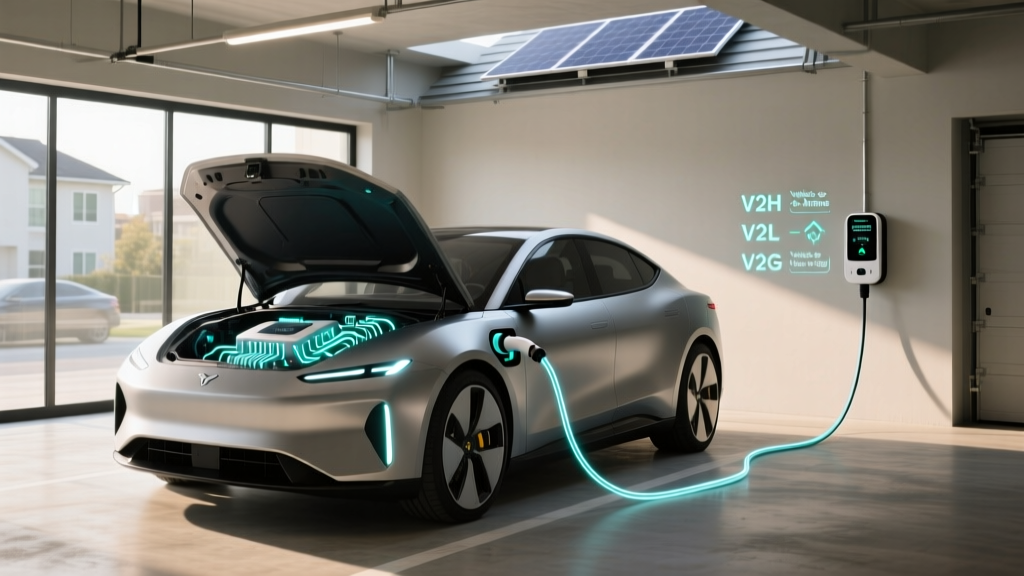
Bidirectional charging comes in three flavors, each defined by where the energy flows:
Vehicle-to-Load (V2L): The simplest form. Your EV has a built-in inverter and a standard 120V or 240V outlet (or an adapter) that lets you plug in appliances, power tools, or camping gear directly from the car. No special home equipment needed. Output is typically 1.9 kW to 3.6 kW — enough to run a microwave, space heater, or laptop simultaneously.
Vehicle-to-Home (V2H): Your EV connects to your home's electrical panel through a dedicated bidirectional charger and an automatic transfer switch. During a power outage, the car seamlessly powers your home's circuits — functioning like a whole-home battery backup (similar to a Tesla Powerwall, but using your car's much larger battery). Output ranges from 7 kW to 19.2 kW, enough to run most homes for 2–5 days on a full charge.
Vehicle-to-Grid (V2G): The most advanced and least widely available form. Your EV exports electricity back to the utility grid during peak-demand hours, earning you credits or payments from your utility. This requires utility participation, a compatible bidirectional charger, and specialized grid-interconnection agreements. Currently limited to select pilot programs in California, Texas, and the Northeast.
How Bidirectional Charging Compares to Standard Charging Levels
To understand where bidirectional charging fits, here's how all EV charging levels stack up — including speeds, requirements, and what they mean for your daily driving:
| Level | Voltage | Power (kW) | Miles of Range per Hour | Typical Use Case |
|---|---|---|---|---|
| Level 1 | 120V AC | 1.4–1.9 kW | 3–5 mi/hr | Overnight top-up, PHEVs, low-mileage drivers |
| Level 2 | 240V AC | 7.2–19.2 kW | 20–60 mi/hr | Home daily charging, workplace, public AC stations |
| DC Fast Charging | 400–800V DC | 50–350 kW | 150–1,000+ mi/hr | Road trips, highway corridors, 10–80% in 15–30 min |
| Bidirectional (V2H) | 240V AC | 7.2–19.2 kW output | N/A (powers home, not car) | Backup power, peak shaving, off-grid use |
kW vs. kWh — the critical distinction: kW (kilowatts) measures power — how fast energy flows, like water pressure in a hose. kWh (kilowatt-hours) measures energy — the total amount stored or consumed, like gallons in a tank. A 19.2 kW bidirectional charger can deliver 19.2 kWh of energy in one hour. Your EV battery capacity is measured in kWh (e.g., 84 kWh usable); your charger's speed is measured in kW.
Compatible EVs and Connector Requirements for Bidirectional Charging
Not every EV supports bidirectional charging — and support varies by type (V2L vs. V2H). Here's the current landscape for 2025–2026 model-year vehicles:
| Vehicle | V2L | V2H | V2G | Connector | Battery (kWh usable) |
|---|---|---|---|---|---|
| Ford F-150 Lightning | ✓ (Pro Power Onboard, 2.0–9.6 kW) | ✓ (with Ford Charge Station Pro) | Pilot programs | NACS (2025+) | 98 / 131 |
| Hyundai Ioniq 5 | ✓ (V2L adapter, 3.6 kW) | ✓ (2025+ with HomeStation) | Limited pilots | NACS (2025+) | 77.4 |
| Kia EV9 | ✓ (V2L, 3.6 kW) | ✓ (announced, Wallbox Quasar) | — | NACS (2025+) | 76.1 / 100 |
| Chevrolet Silverado EV | ✓ (PowerBase, up to 10.2 kW) | ✓ (with Energy Transfer Pro) | — | NACS | 200 |
| Toyota bZ4X | — | — | — | NACS (adapter) | 71.4 |
| Tesla Cybertruck | ✓ (Powershare, 11.5 kW) | ✓ (announced) | — | NACS | 123 |
Connector compatibility note: Most bidirectional-capable EVs sold in 2025–2026 use the NACS (North American Charging Standard) connector, following the industry-wide shift from CCS1. If you own a CCS1-equipped EV from 2023 or earlier, you'll likely need a NACS-to-CCS adapter for public charging, but V2L functionality (where available) uses a separate vehicle-specific adapter that plugs into the charge port or a dedicated outlet.
Home Installation: Electrical Requirements, Costs, and Panel Upgrades
Installing a bidirectional V2H charger is more complex than a standard Level 2 charger because it involves both charging your car and interconnecting with your home's electrical panel. Here's what's involved:
Electrical requirements: A bidirectional charger like the Ford Charge Station Pro requires a 240V dedicated circuit rated at 60A or 80A (depending on the unit's output). The charger itself draws up to 19.2 kW when charging and delivers up to 19.2 kW when powering your home. Lower-output units like the Wallbox Quasar 2 operate on a 40A or 50A circuit at 7.2–11.5 kW.
Automatic transfer switch (ATS): This is mandatory for V2H. The ATS detects a grid outage and automatically disconnects your home from the utility grid before switching to your EV as the power source. This prevents "backfeeding" — sending electricity into downed power lines, which is extremely dangerous for utility workers and illegal without proper isolation.
Panel upgrade considerations: Many homes built before 2000 have 100A or 150A electrical panels. Adding a 60–80A bidirectional charger circuit alongside existing loads (HVAC, electric range, dryer) may exceed your panel's capacity, requiring an upgrade to 200A or even 400A service. This is the single biggest cost variable in a bidirectional charger installation.
| Component | Low Estimate | High Estimate | Notes |
|---|---|---|---|
| Bidirectional charger unit | $1,300 | $3,500 | Wallbox Quasar 2 ~$1,300; Ford Charge Station Pro ~$3,200 |
| Automatic transfer switch | $500 | $1,500 | Required for V2H; integrated in some units |
| Electrician labor (install + wiring) | $1,500 | $4,000 | Varies by run length, conduit, and local rates |
| Permit and inspection | $150 | $500 | Required in most jurisdictions; utility interconnection approval may add time |
| Panel upgrade (if needed) | $2,000 | $5,000 | 100A → 200A service; 400A upgrade can exceed $7,000 |
| Total (no panel upgrade) | $3,450 | $9,500 | Most homes with 200A panels fall in $4,000–$6,500 range |
| Total (with panel upgrade) | $5,450 | $14,500 | Older homes with 100A service |
For comparison, a standard Level 2 charger installation (non-bidirectional, 40A/240V) typically runs $1,200–$3,500 total — the bidirectional premium comes from the transfer switch, heavier-gauge wiring, and potentially a panel upgrade.
Charging Cost: Home vs. Public vs. Gas — Per-Mile Breakdown
Whether you're charging your EV or using it to power your home, cost per mile remains the core ownership metric. Here's how charging costs compare across scenarios:
| Scenario | Rate | Cost per kWh | Cost per Mile (3.5 mi/kWh avg) |
|---|---|---|---|
| Home, off-peak (utility TOU plan) | $0.08–$0.12/kWh | $0.10 avg | $0.029 |
| Home, on-peak | $0.18–$0.30/kWh | $0.24 avg | $0.069 |
| Public Level 2 (ChargePoint, EVgo) | $0.25–$0.49/kWh | $0.35 avg | $0.100 |
| DC Fast Charging (Electrify America, Tesla Supercharger) | $0.35–$0.65/kWh | $0.48 avg | $0.137 |
| Gasoline vehicle (30 MPG, $3.40/gal) | $3.40/gallon | N/A | $0.113 |
According to fueleconomy.gov, the average 2025 EV achieves 3.0–4.0 miles per kWh (combined). At the national average residential electricity rate of approximately $0.17/kWh (U.S. EIA), home charging costs roughly $0.049/mile — less than half the cost of gasoline per mile.
Bidirectional cost offset: If your utility offers V2G demand-response credits (currently available through select programs like PG&E's EV Rate and Con Edison's Smart Charge), exporting 10 kWh during peak hours could earn $1.50–$3.00 — effectively making your daily commute partially subsidized by the grid.
Charging Time Examples: 10–80% for Common Battery Sizes
Charge times vary by battery capacity, charger power, and the vehicle's charge curve. Here's how long common EVs take to charge from 10% to 80% state of charge (SoC) — the practical charging window, since charging slows significantly above 80% to protect battery health:
| Vehicle (Battery Size) | Level 1 (1.9 kW) | Level 2 (11.5 kW) | Level 2 (19.2 kW) | DC Fast (peak kW) |
|---|---|---|---|---|
| Hyundai Ioniq 5 (77.4 kWh) | ~29 hrs | ~4.5 hrs | ~3.2 hrs | ~18 min (peak 240 kW) |
| Ford F-150 Lightning ER (131 kWh) | ~49 hrs | ~8 hrs | ~5 hrs | ~41 min (peak 155 kW) |
| Tesla Model Y LR (75 kWh) | ~28 hrs | ~4.5 hrs | ~3 hrs | ~22 min (peak 250 kW) |
| Chevy Equinox EV (85 kWh) | ~32 hrs | ~5 hrs | ~3.5 hrs | ~25 min (peak 190 kW) |
Charge curve reality: A vehicle rated for "peak 240 kW" DC fast charging only sustains that rate between roughly 10–40% SoC. Above 60%, the rate tapers to ~100 kW; above 80%, it drops to ~50 kW or less. This is why 10–80% time is the standard metric — the final 20% can take as long as the first 70%.
Equipment Recommendations: Bidirectional Chargers and Standard Level 2 Units
If you're shopping for a charger — bidirectional or standard — here are current top picks with exact specifications:
Ford Charge Station Pro (Bidirectional V2H)
- Power output: 19.2 kW charge / 19.2 kW discharge
- Circuit: 240V / 80A dedicated
- Connector: NACS (native)
- Cable length: 25 ft
- Smart features: FordPass app integration, scheduled charging, outage auto-switch
- Price: ~$3,200 (unit only)
- Compatible vehicles: F-150 Lightning, future Ford EVs
Wallbox Quasar 2 (Bidirectional V2H)
- Power output: 11.5 kW charge / 11.5 kW discharge
- Circuit: 240V / 50A dedicated
- Connector: NACS
- Cable length: 20 ft
- Smart features: myWallbox app, solar integration, TOU optimization
- Price: ~$1,300 (unit only)
- Compatible vehicles: Hyundai Ioniq 5, Kia EV9, and NACS-equipped EVs with V2H support
ChargePoint Home Flex (Standard Level 2)
- Power output: Up to 12 kW (configurable 16A–50A)
- Circuit: 240V / 50A (NEMA 14-50 or hardwired)
- Connector: NACS or J1772 (configurable)
- Cable length: 23 ft
- Smart features: ChargePoint app, Alexa, scheduling, energy tracking
- Price: ~$550
- Note: Not bidirectional — standard Level 2 only
Emporia Vue Level 2 Charger (Standard + Solar Integration)
- Power output: Up to 11.5 kW (48A)
- Circuit: 240V / 60A dedicated
- Connector: NACS or J1772
- Cable length: 24 ft
- Smart features: Emporia app, solar-aware charging, circuit-sharing
- Price: ~$400
- Note: Not bidirectional — excellent budget Level 2 option
Safety, Code, and Permit Considerations
Any EV charger installation — bidirectional or standard — must comply with the National Electrical Code (NEC) Article 625, which governs EV charging systems. Key requirements:
- Dedicated circuit: Your EV charger must be on its own dedicated breaker — no sharing with other appliances. For a 48A continuous-load charger, NEC requires a breaker rated at 125% of the continuous load, meaning a 60A breaker minimum.
- GFCI protection: NEC 2020 and later require GFCI (Ground Fault Circuit Interrupter) protection for all 240V EV charging outlets. Hardwired installations may have different requirements depending on local code amendments.
- Outdoor rating: If your charger is installed outdoors (garage exterior, carport, driveway), the unit must carry a NEMA 4 or NEMA 4X weather-resistance rating. All recommended units above meet this standard.
- Utility interconnection approval: For V2H and V2G installations, your utility company must approve the interconnection before your inspector will sign off. This process can take 2–6 weeks and may require a dedicated utility meter or grid-tie inverter certification.
- Permit and inspection: Required in virtually all U.S. jurisdictions. Typical permit fees range from $150–$500. The inspector will verify wire gauge, breaker sizing, grounding, and (for bidirectional) transfer switch compliance.
Frequently Asked Questions
What is the function of a bidirectional charger?
A bidirectional charger allows energy to flow both into your EV (charging the battery) and out of your EV (powering your home, appliances, or the electrical grid). Standard chargers are one-directional — they only push energy into the battery. Bidirectional chargers convert your EV into a large mobile battery backup, capable of powering a home during outages (V2H), running appliances at a campsite (V2L), or selling electricity back to the grid during peak hours (V2G).
How much does it cost to install a home EV charger?
A standard Level 2 home charger installation (40A–48A, 240V) typically costs $1,200–$3,500 total, including the charger unit ($400–$700), electrician labor ($600–$2,000), and permits ($150–$500). A bidirectional V2H charger installation is more expensive: $3,450–$9,500 without a panel upgrade, or $5,450–$14,500 if your home needs a panel upgrade from 100A to 200A service. The bidirectional premium comes from the automatic transfer switch, heavier wiring, and utility interconnection requirements.
How fast will each charging level add range?
Level 1 (120V, 1.4–1.9 kW) adds approximately 3–5 miles of range per hour — suitable for PHEVs with small batteries or drivers covering fewer than 30 miles daily. Level 2 (240V, 7.2–19.2 kW) adds 20–60 miles per hour, fully recharging most EVs overnight in 5–10 hours. DC Fast Charging (50–350 kW) adds 150–1,000+ miles per hour at peak rates, delivering a 10–80% charge in 15–40 minutes depending on the vehicle and charger power.
Which connector/charger is compatible with my EV?
For 2025–2026 model-year EVs, the NACS (North American Charging Standard) connector — originally Tesla's design — is now the dominant standard. Ford, GM, Hyundai/Kia, Rivian, Volvo, and most other manufacturers have adopted NACS. Older 2022–2024 EVs may have CCS1 connectors; adapters (NACS-to-CCS) are widely available for ~$150–$250. CHAdeMO is largely discontinued for new vehicles (last major user was the Nissan Leaf, now discontinued). For bidirectional V2H specifically, you need a charger matched to your vehicle's supported protocol — check manufacturer compatibility lists before purchasing.
How much does charging cost per mile vs gas?
At the U.S. average residential electricity rate of ~$0.17/kWh and an average EV efficiency of 3.5 miles/kWh, home charging costs approximately $0.049 per mile. Off-peak utility rates can drop this to $0.029/mile. DC fast charging averages $0.12–$0.14/mile. By comparison, a gasoline vehicle averaging 30 MPG at $3.40/gallon costs $0.113 per mile. Home EV charging is roughly 55–75% cheaper per mile than gasoline, while public DC fast charging is roughly comparable to gas on a per-mile basis.
What electrical upgrades might I need?
The most common upgrade is a panel capacity increase. If your home has a 100A or 150A electrical panel and you're adding a 60A or 80A EV charger circuit, your electrician may recommend upgrading to 200A service ($2,000–$5,000). Other potential upgrades include: running a new dedicated 240V circuit from the panel to the charger location ($500–$2,000 depending on distance and wall construction), replacing an outdated fuse box with a modern breaker panel, or adding a sub-panel if your main panel is full. For bidirectional V2H installations, you'll also need an automatic transfer switch ($500–$1,500) and utility interconnection approval.