What Is a Bi-Directional EV Charger — And Why It Matters in 2026
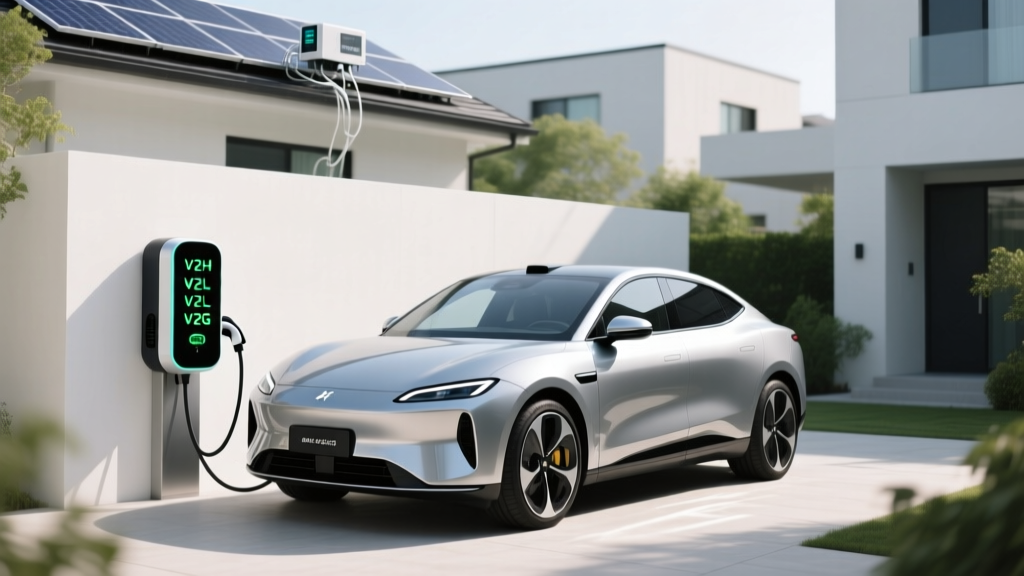
A bi-directional EV charger doesn't just push electricity into your car's battery — it can pull energy back out, powering your home during an outage (V2H), running appliances at a campsite (V2L), or selling electricity back to the grid (V2G). In 2026, with more frequent extreme-weather outages and time-of-use electricity rates spreading across the US, bi-directional charging has moved from novelty to practical home-energy tool.
But the ecosystem is fragmented. Not every EV supports bi-directional flow. Not every charger enables it. And the electrical work required goes well beyond a standard Level 2 install. This guide breaks down the exact hardware, vehicle compatibility, installation costs, and real-world economics so you can decide whether a bi-directional setup earns a spot in your garage.
- V2L (Vehicle-to-Load): Powers devices directly via a 120V or 240V outlet — no home electrical integration needed. Think camping, tailgating, or emergency appliance power.
- V2H (Vehicle-to-Home): Feeds your home's electrical panel during an outage, replacing or supplementing a generator or stationary battery like a Tesla Powerwall.
- V2G (Vehicle-to-Grid): Sends power back to the utility grid for demand-response credits — still limited in availability but expanding through pilot programs.
Charging Levels Explained: Speeds, Power, and Range Added
Before layering in bi-directional capability, you need a firm grasp of charging levels and the critical difference between kW (kilowatts — the rate of power flow) and kWh (kilowatt-hours — the total energy stored or delivered). Confusing these is the single most common EV mistake. A 19.2 kW charger delivers energy at a rate of 19.2 kilowatts; an 84 kWh battery stores 84 kilowatt-hours of energy. Time = kWh ÷ kW (roughly, accounting for charging-curve taper).
| Level | Voltage / Amps | Max Power (kW) | Miles of Range / Hour | 10–80% Time (84 kWh Battery) |
|---|---|---|---|---|
| Level 1 | 120V / 12A | 1.4 kW | 3–5 mi/hr | ~50+ hours |
| Level 2 | 240V / 32–80A | 7.7–19.2 kW | 20–60 mi/hr | 5–9 hours |
| DC Fast (Level 3) | 200–900V DC | 50–350+ kW | 150–1,200+ mi/hr | 15–35 minutes |
Bi-directional home systems operate at Level 2 speeds in both directions — typically 7.7 to 19.2 kW flowing back to your home. That's enough to run essential circuits (refrigerator, lights, well pump, HVAC fan) for days on a full battery.
Which EVs Support Bi-Directional Charging in 2026?
Not every electric vehicle can send power back. Bi-directional capability requires both hardware (an onboard inverter or compatible offboard inverter) and software authorization from the automaker. Here's the 2026 landscape:
| Vehicle | V2L | V2H | V2G | Connector | Battery (kWh Usable) |
|---|---|---|---|---|---|
| Ford F-150 Lightning | ✅ | ✅ (Pro Power Onboard + Charge Station Pro) | Limited pilots | NACS | 98 / 131 |
| Hyundai Ioniq 5 | ✅ (V2L adapter) | ✅ (with approved inverter) | Pilot programs | NACS (2025+) | 58 / 77.4 |
| Kia EV9 | ✅ | ✅ | Announced | NACS | 76.1 / 100 |
| Chevrolet Silverado EV | ✅ | ✅ (Energy Transfer Pro) | Limited | NACS | 200 |
| Tesla Cybertruck | ✅ (Powershare) | ✅ (Powershare Wall Connector) | Not available | NACS | 123 |
| Volkswagen ID.4 | ❌ | ❌ | ❌ | NACS (2025+) | 77 |
Bottom line: If bi-directional is a priority, Ford, Hyundai/Kia, GM, and Tesla trucks currently lead. Most sedans and crossovers from European brands do not yet support V2H/V2G in the US market. Always confirm with your dealer — automaker software updates can enable or restrict features post-purchase.
Home Installation: Electrical Requirements and Real Costs
A bi-directional EV charger install is more complex than a standard Level 2 wall connector. You're not just adding a charger — you're integrating a secondary power source into your home's electrical panel, which requires an automatic transfer switch (ATS) or a critical-loads subpanel, plus utility coordination for V2G.
Electrical Requirements
- Circuit: Dedicated 240V circuit, typically 60A (supports up to 48A continuous / 11.5 kW) or 100A for higher-power units like the Ford Charge Station Pro (19.2 kW / 80A continuous).
- Panel capacity: Most homes need a 200A main panel minimum. Older homes with 100A or 150A service will likely need a panel upgrade ($1,500–$3,500) or a separate subpanel.
- Transfer switch or subpanel: For V2H, an automatic transfer switch isolates your home from the grid during outages (required by NEC Article 702) and routes battery power to designated circuits. Cost: $500–$1,500 for equipment.
- Permit: Required in virtually all jurisdictions. Electrical permit fees range $50–$300 depending on locality. Inspector will verify wire gauge, breaker sizing, grounding, and GFCI protection.
- GFCI: NEC 2020 and later require GFCI protection for EV charging outlets (625.40). Hardwired units may have GFCI built into the charger.
- Outdoor rating: If mounting outside, the unit and any outlet must carry a NEMA 4 or NEMA 4X rating for weather resistance.
Installation Cost Breakdown
| Component | Basic V2L-Ready Setup | Full V2H System |
|---|---|---|
| Bi-directional charger unit | $600–$1,200 | $1,300–$3,500 |
| Automatic transfer switch / subpanel | Not required | $500–$1,500 |
| Electrician labor (licensed) | $500–$1,500 | $1,500–$3,500 |
| Electrical panel upgrade (if needed) | $0–$3,500 | $0–$3,500 |
| Permit and inspection | $50–$200 | $100–$300 |
| Total Estimated Range | $1,150–$6,400 | $3,400–$12,300 |
Bi-Directional Charger Equipment Picks for 2026
Here are the leading bi-directional-capable units available or shipping in 2026, with exact specs:
Ford Charge Station Pro
- Power: 19.2 kW (80A) / bidirectional V2H
- Connector: NACS (Tesla-style)
- Cable length: 25 ft
- Smart features: FordPass app integration, scheduled charging, energy monitoring
- Price: ~$1,300 (unit only)
- Requires: 100A dedicated circuit, transfer switch for V2H
- Compatible vehicles: F-150 Lightning (extended range)
Tesla Powershare Wall Connector
- Power: 11.5 kW (48A) bidirectional
- Connector: NACS
- Cable length: 24 ft
- Smart features: Tesla app, automatic outage detection, grid-services ready
- Price: ~$1,800 (unit + gateway)
- Requires: 60A circuit, Powershare Gateway for home backup
- Compatible vehicles: Cybertruck (Powershare-equipped)
Wallbox Quasar 2
- Power: 11.5 kW (48A) bidirectional
- Connector: NACS / CCS1 (configurable)
- Cable length: 20 ft
- Smart features: myWallbox app, solar integration, V2G-ready, load balancing
- Price: ~$2,500–$3,200
- Requires: 60A circuit, compatible EV (Hyundai/Kia V2H-enabled models)
- Compatible vehicles: Ioniq 5, EV9, EV6 (with V2H firmware)
Emporia V2X Charger
- Power: 9.6 kW (40A) bidirectional
- Connector: NACS / CCS1 adapter available
- Cable length: 24 ft
- Smart features: Full energy monitoring, solar-aware, automatic transfer, utility demand-response
- Price: ~$2,000–$2,800 (with gateway)
- Requires: 50A circuit, Emporia gateway for V2H
- Compatible vehicles: Expanding list; confirm with Emporia
Charging Cost Per Mile: Home, Public, and Gas Compared
Bi-directional chargers add a secondary benefit: they let you buy electricity when it's cheap and use it when it's expensive — whether that's powering your car or your home. Here's the cost-per-mile math for charging, using the US average EV efficiency of 3.0 miles/kWh (roughly 112 MPGe combined per fueleconomy.gov).
| Scenario | Price | Cost Per Mile | Annual Cost (12,000 mi) |
|---|---|---|---|
| Home off-peak (TOU rate) | $0.09/kWh | $0.030 | $360 |
| Home standard rate | $0.16/kWh | $0.053 | $640 |
| Public Level 2 (ChargePoint, etc.) | $0.25/kWh | $0.083 | $1,000 |
| DC Fast Charging (EA, EVgo) | $0.40/kWh | $0.133 | $1,600 |
| Gas vehicle (28 MPG avg, $3.40/gal) | $3.40/gallon | $0.121 | $1,457 |
At home off-peak rates, an EV costs roughly one-quarter what a gas car costs per mile. Even at DC fast-charger prices, EVs are competitive with gas. The bi-directional advantage: if your utility offers time-of-use rates, you can charge at $0.09/kWh overnight and discharge to your home during peak hours when grid electricity costs $0.30+/kWh — effectively arbitraging the spread.
The Economics of V2H: Can Your EV Replace a Home Battery?
A Tesla Powerwall 3 stores 13.5 kWh and costs roughly $8,500–$12,000 installed. A Ford F-150 Lightning with the 131 kWh extended-range battery stores nearly 10× that energy — and you already own it if you bought the truck.
Running essentials (refrigerator, lights, Wi-Fi, well pump) at roughly 2–3 kW continuous, a 131 kWh battery can power a home for 3 to 5 days before needing a recharge. Even the smaller 98 kWh standard-range pack delivers 2+ days. Compare that to a single Powerwall, which typically covers 12–18 hours of whole-home backup.
The catch: V2H requires you to be home (or have automated transfer logic) and your vehicle plugged in when the outage hits. If you commute and the grid goes down at 2 PM while your truck is at the office, V2H doesn't help. For households that keep a vehicle at home during the day or live in areas with predictable outage patterns (ice storms, hurricane season), V2H is a compelling alternative to a stationary battery.
Safety, Code, and Utility Coordination
Bi-directional systems introduce complexity that standard EV chargers don't:
- NEC Article 702 (Transfer Equipment): Any system that back-feeds your home panel must use a listed transfer switch to prevent energizing utility lines during an outage — a critical safety requirement for line workers.
- Anti-islanding protection: The inverter must automatically disconnect from the grid within milliseconds if grid power drops (UL 1741 certification).
- Utility notification: Most utilities require you to file an interconnection application before operating V2G or any grid-tied inverter. Failure to do so can result in fines or disconnection.
- IEEE 1547: The standard governing how distributed energy resources (including V2G-capable EVs) interact with the grid. Your equipment must be certified to the version your utility enforces.
- Warranty considerations: Some automakers limit the number of V2H/V2G cycles covered under battery warranty. Ford, for example, states that Pro Power Onboard usage is covered under the 8-year/100,000-mile battery warranty, but excessive cycling that accelerates degradation beyond normal parameters may not be. Check your owner's manual.
Always hire a licensed electrician familiar with NEC 2023/2026 EV and distributed-energy provisions. Per the National Fire Protection Association, improper back-feed wiring is a leading cause of electrical fires and utility-worker injuries during outages.
Frequently Asked Questions
How much does it cost to install a bi-directional EV charger at home?
A basic V2L-ready Level 2 install (charger + 240V circuit, no transfer switch) runs $1,150–$6,400 depending on panel capacity and wire-run distance. A full V2H system with automatic transfer switch, gateway, and potential panel upgrade ranges from $3,400 to $12,300. The wide range reflects whether your existing 200A panel has spare capacity or needs replacement. Get a load calculation from a licensed electrician before purchasing equipment.
How fast will a bi-directional charger power my home during an outage?
Most V2H systems deliver 7.7 to 19.2 kW back to your home — equivalent to a 32A–80A Level 2 circuit in reverse. At 11.5 kW (48A), you can simultaneously run a refrigerator (~0.8 kW), HVAC fan (~1.5 kW), LED lighting (~0.3 kW), a well pump (~1.0 kW), and a Wi-Fi router (~0.05 kW) with headroom to spare. You cannot typically run high-draw resistive loads like electric ovens, electric dryer, or whole-house electric heat simultaneously without exceeding the inverter's capacity.
Which connector does my EV need for bi-directional charging?
As of 2026, nearly all bi-directional-capable vehicles sold in the US use the NACS connector (formerly Tesla's proprietary plug, now the North American standard). Hyundai and Kia transitioned to NACS for the 2025 model year. If you own a CCS1-equipped vehicle from model year 2024 or earlier, you'll need a CCS-to-NACS adapter — but confirm bi-directional compatibility through the adapter with both the automaker and charger manufacturer before relying on it for V2H.
Does bi-directional charging degrade my EV battery faster?
Every charge-discharge cycle contributes to battery degradation, but the effect is proportional to depth of discharge and C-rate. Occasional V2H use during outages (a few times per year) has negligible impact on battery health. Daily V2G cycling for grid arbitrage will accelerate wear. Most 2026 EV batteries retain 70–80% capacity after 1,000 full equivalent cycles. If you discharge 20 kWh daily for V2G, that's roughly 0.15 equivalent cycles per day on a 131 kWh pack — manageable within the 8-year/100,000-mile warranty period, but monitor your State of Health (SoH) via the vehicle's telematics.
Can I get a tax credit for a bi-directional EV charger?
The federal §30D tax credit applies to the EV itself, not the charger. However, the Alternative Fuel Infrastructure Tax Credit (§30C) was revived under the Inflation Reduction Act and provides up to 30% of the cost of qualified EV charging equipment (max $1,000 for residential) installed in eligible census tracts. Bi-directional chargers may qualify as "bidirectional charging equipment" under expanded IRS guidance. Check IRS.gov §30C for current eligibility rules, income caps, and census-tract requirements. Consult a tax professional — rules vary by location and are subject to legislative changes.
Is V2G available in my area?
Vehicle-to-Grid remains limited to specific utility pilot programs as of 2026. Utilities offering or testing V2G include PG&E (California), Con Edison (New York), Duke Energy (Carolinas), and a handful of municipal utilities. Check with your local utility's distributed-energy-resources department. Even if V2G isn't available yet, V2H and V2L function independently of utility programs.