What Is a Bi-Directional Charger — And How Is It Different?
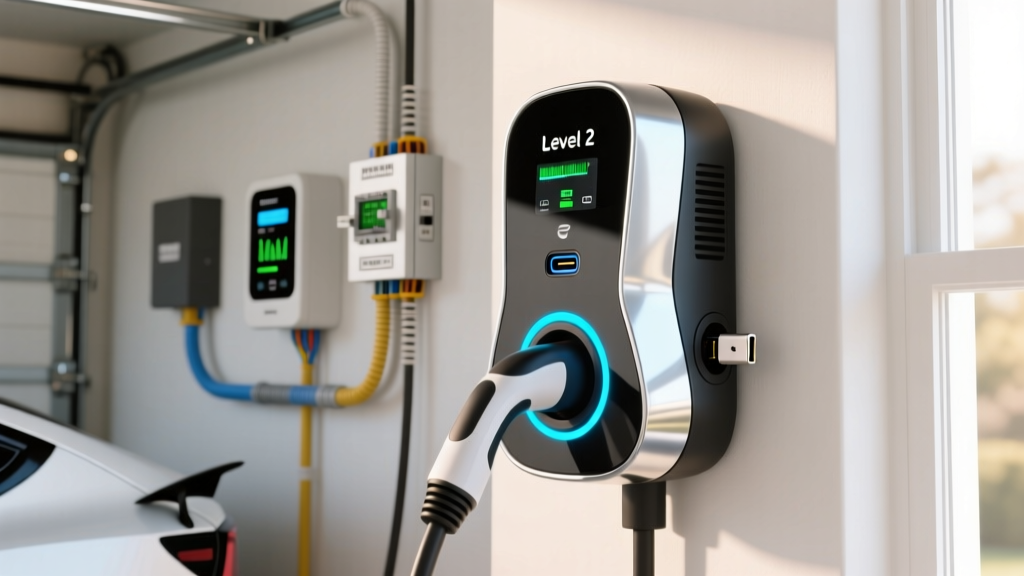
A standard Level 2 home charger pushes electricity one way: from your electrical panel into your EV's battery. A bi-directional charger reverses that flow, allowing your EV to send stored energy back — either to power your home during an outage (Vehicle-to-Home, or V2H), feed electricity back to the grid (Vehicle-to-Grid, or V2G), or run external appliances via a built-in outlet (Vehicle-to-Load, or V2L).
This isn't theoretical anymore. As of 2026, several automakers — Ford, Hyundai, Kia, GM, and others — offer production vehicles with bi-directional capability, and the charger hardware to support it is commercially available. But the ecosystem is still maturing, and the install requirements go well beyond plugging in a standard wallbox.
Before we get to bi-directional specifics, let's ground the discussion in the charging levels you'll encounter.
Charging Levels: Speed, Power, and Range Added
Understanding the difference between kW (power, or how fast energy flows) and kWh (energy, or how much your battery holds) is essential. A 19.2 kW charger delivers energy faster than a 7.7 kW charger — but your EV battery is still measured in kWh (e.g., 77 kWh usable). Here's how each level translates to real-world range recovery:
| Level | Voltage / Amperage | Power Output | Miles of Range per Hour | Typical Use |
|---|---|---|---|---|
| Level 1 | 120V / 12A | 1.4 kW | 3–5 mi/hr | Overnight trickle, PHEVs |
| Level 2 | 240V / 32–48A | 7.7–11.5 kW | 25–44 mi/hr | Daily home charging |
| Level 2 (High-power) | 240V / 80A | 19.2 kW | 50–70 mi/hr | Large-battery EVs, bi-directional |
| DC Fast Charge | 400–800V DC | 50–350 kW | 150–1,000+ mi/hr | Road trips, public stations |
Most bi-directional home chargers operate at Level 2 speeds (typically 11.5 kW or 19.2 kW) for charging your EV. The discharge rate back to your home is generally lower — usually 5–10 kW — enough to run essential circuits during an outage, not your entire 200-amp panel at full draw.
V2H, V2L, and V2G: What Each Mode Actually Does
Not all bi-directional systems are the same. Here's how the three modes break down in practice:
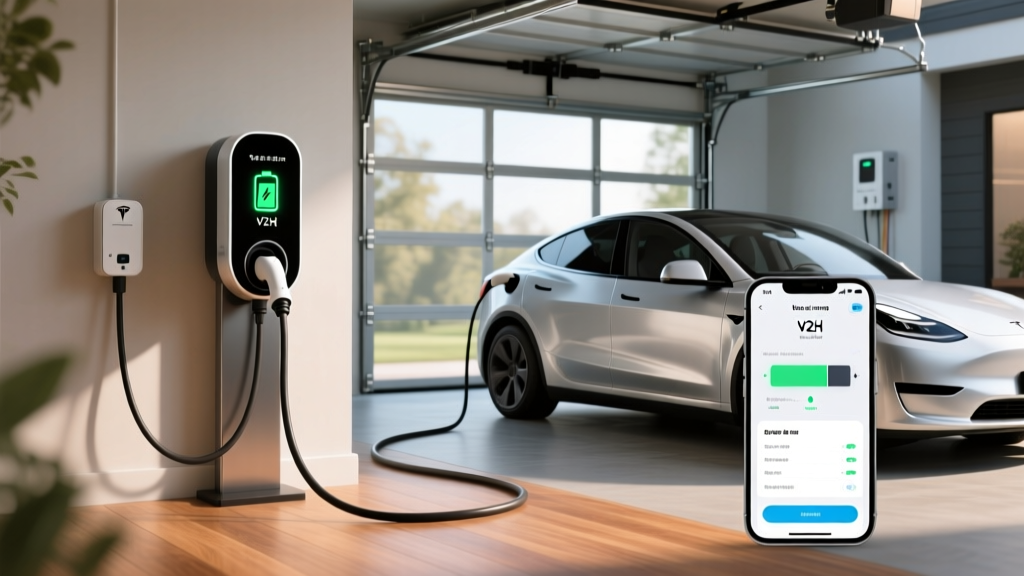
Vehicle-to-Home (V2H): Your EV connects to a dedicated bi-directional wallbox that is wired into your home's electrical panel through an automatic transfer switch. During a grid outage, the charger isolates your home from the grid (a safety requirement called "islanding") and powers designated circuits using your EV's battery. A Ford F-150 Lightning with its 131 kWh extended-range battery can power an average home's essential loads for roughly 3 days at ~30 kWh/day usage.
Vehicle-to-Load (V2L): This is the simplest form — your EV has built-in 120V or 240V outlets (no special charger needed). The Hyundai Ioniq 5, Kia EV6, and Ford F-150 Lightning all offer V2L, letting you plug in a laptop, space heater, or camp stove directly from the car. Typical output is 1.9–3.6 kW. Useful for tailgating and job sites, but not a whole-home backup solution.
Vehicle-to-Grid (V2G): The most complex mode — your EV sends power back to the utility grid during peak demand in exchange for credits or payment. As of 2026, V2G programs remain limited to select utility pilots (PG&E, San Diego Gas & Electric, and a handful of others). The hardware is the same as V2H, but the utility must authorize and manage the grid-tied discharge.
Compatible Vehicles: Which EVs Support Bi-Directional Charging?
Not every EV can push energy back out. Bi-directional capability requires both vehicle-side hardware (an onboard inverter or support for an external inverter in the charger) and software enablement from the automaker. Here's the 2026 landscape:
| Vehicle (2025–2026) | Connector | Bi-Directional Mode | Max Discharge | Battery (Usable) |
|---|---|---|---|---|
| Ford F-150 Lightning (Ext. Range) | NACS / CCS1 | V2H (Ford Intelligent Backup Power) | 9.6 kW | 131 kWh |
| Hyundai Ioniq 5 / Ioniq 5 N | NACS (2025+) | V2L (built-in outlet) | 3.6 kW | 77.4 kWh |
| Kia EV6 / EV9 | NACS (2025+) | V2L (built-in outlet) | 3.6 kW | 77.4 / 100 kWh |
| GM Silverado EV / Sierra EV | NACS | V2H (Energy Transfer Pro) | 10.2 kW | 200 kWh (max) |
| VW ID.4 (2025+ w/ update) | CCS1 / NACS | V2H (announced, limited rollout) | ~10 kW | 77 kWh |
| Tesla Cybertruck | NACS | V2L (Powershare outlets) | 11.5 kW (combined) | 123 kWh |
Important: V2L vehicles (Ioniq 5, EV6, Cybertruck) do not require a special bi-directional charger — the outlets are built into the vehicle. True V2H capability, where your car powers home circuits, requires a compatible bi-directional wallbox and professional installation.
Home Installation: Electrical Requirements, Panel Upgrades, and Costs
Installing a bi-directional charger is significantly more complex than mounting a standard Level 2 wallbox. The charger must integrate with your home's electrical panel via an automatic transfer switch, and many installations require a panel upgrade.
Electrical Requirements
Most bi-directional chargers require a 240V dedicated circuit at 60A or higher (drawing up to 48A continuous for charging at 11.5 kW). The discharge side connects through a transfer switch rated for the charger's output — typically 50A to 100A. Homes with older 100A or 150A panels often need a 200A panel upgrade to accommodate both the charger and normal household loads safely.
Installation Cost Breakdown
| Component | Cost Range | Notes |
|---|---|---|
| Bi-directional charger unit | $3,500 – $6,500 | Ford Charge Station Pro, Wallbox Quasar, etc. |
| Automatic transfer switch | $800 – $2,000 | Required for V2H islanding |
| Electrical panel upgrade (if needed) | $2,500 – $5,000 | 100A/150A → 200A; not always required |
| Electrician labor (wiring, mounting, transfer switch) | $2,000 – $5,000 | Varies by run length, conduit, local rates |
| Permit and inspection | $150 – $500 | Required in most jurisdictions |
| Total (no panel upgrade) | $6,450 – $14,000 | Typical for 200A-panel homes |
| Total (with panel upgrade) | $8,950 – $19,000 | Older homes needing 200A service |
The panel upgrade is the wild card. If your home already has a 200A panel with spare breaker slots and sufficient capacity, you'll stay at the lower end. Homes built before the 1990s frequently need the upgrade, and that's a cost many buyers don't anticipate. Always get a load calculation from a licensed electrician before committing to equipment.
Permits and Code Requirements
Every bi-directional charger installation requires a dedicated circuit with proper overcurrent protection, a GFCI breaker (per NEC 2023/2026 Article 625), and an outdoor-rated unit (NEMA 4 or NEMA 4X) if mounted outside. The transfer switch must be rated for the discharge load and installed per NEC Article 702 (standby systems) or Article 705 (interconnected power sources, for V2G). Your utility may also require notification or approval before activating V2H functionality.
Top Bi-Directional Chargers for 2026: Equipment Picks
The bi-directional charger market is still narrow compared to standard Level 2 wallboxes, but several proven options exist:
Ford Charge Station Pro (80A)
- Power: 19.2 kW charge / 9.6 kW discharge
- Connector: NACS (integrated, no adapter needed for Ford)
- Cable length: 25 ft
- Smart features: FordPass app integration, scheduled charging, Intelligent Backup Power activation
- Price: ~$3,895 (unit only)
- Best for: F-150 Lightning owners wanting full V2H backup
Wallbox Quasar 2
- Power: 11.5 kW charge / 11.5 kW discharge
- Connector: CCS1 or NACS (configurable)
- Cable length: 20 ft
- Smart features: myWallbox app, solar integration, energy tariff optimization, V2G-ready
- Price: ~$5,499 (unit only)
- Best for: Non-Ford EVs with CCS/NACS V2H support
GM Energy PowerShift Charger
- Power: 19.2 kW charge / 10.2 kW discharge
- Connector: NACS
- Cable length: 25 ft
- Smart features: myGMC app, Energy Transfer Pro, grid-tie capable (with utility approval)
- Price: ~$4,200 (unit only, bundled with GM EV purchase programs)
- Best for: Silverado EV / Sierra EV owners
CCS-to-NACS adapter note: If you own a vehicle with a CCS1 port (most pre-2025 EVs) and want to use a NACS bi-directional charger, you'll need a rated adapter. However, bi-directional functionality through an adapter is not guaranteed — the communication protocol (ISO 15118) must pass through correctly. Confirm adapter compatibility with both the charger and vehicle manufacturer before purchasing.
Cost to Charge: Home vs. Public vs. Gas, Per Mile
One advantage of a bi-directional charger is the ability to charge during cheap off-peak hours and potentially sell back during peak pricing (where V2G programs exist). Here's what charging costs look like per mile in 2026, using a 3.0 mi/kWh efficiency baseline (typical for a midsize crossover EV like the Ioniq 5 or Model Y):
| Scenario | Rate ($/kWh) | Cost per Mile | Notes |
|---|---|---|---|
| Home off-peak (TOU plan) | $0.08 – $0.12 | $0.03 – $0.04 | Overnight charging, best-case |
| Home standard rate | $0.14 – $0.18 | $0.05 – $0.06 | Average US residential (~$0.16/kWh) |
| Public Level 2 (ChargePoint, etc.) | $0.25 – $0.49 | $0.08 – $0.16 | Varies widely by network/location |
| DC Fast (Electrify America, Tesla) | $0.35 – $0.55 | $0.12 – $0.18 | Per-kWh or per-minute pricing |
| Gas equivalent (25 MPG, $3.40/gal) | — | $0.14 | Baseline comparison |
At home off-peak rates, an EV costs roughly one-quarter what a 25 MPG gas car costs per mile. Even on public DC fast chargers, you're generally at parity or below gasoline. The bi-directional advantage: if your utility offers a V2G buyback at $0.25–$0.50/kWh during peak hours, your EV battery can theoretically earn credits while parked and plugged in — offsetting your charging cost over time.
Charging Time Examples: What to Expect
Bi-directional chargers are primarily Level 2 units, so charging speed depends on your vehicle's onboard charger acceptance rate and the circuit amperage. Here are real-world 10–80% charging times for common battery sizes at typical bi-directional charger output:
| Vehicle / Battery Size | At 11.5 kW (48A) | At 19.2 kW (80A) | 10–80% Time |
|---|---|---|---|
| Hyundai Ioniq 5 (77.4 kWh) | ~5.0 hrs | ~3.0 hrs (if vehicle accepts) | ~4.5 hrs / ~2.7 hrs |
| Ford F-150 Lightning Std. (98 kWh) | ~6.4 hrs | ~3.8 hrs | ~5.7 hrs / ~3.4 hrs |
| Ford F-150 Lightning Ext. (131 kWh) | ~8.5 hrs | ~5.1 hrs | ~7.6 hrs / ~4.5 hrs |
| GM Silverado EV (200 kWh) | ~13.0 hrs | ~7.8 hrs | ~11.7 hrs / ~7.0 hrs |
These times assume the vehicle's onboard charger can accept the full power the wallbox delivers. Many EVs cap Level 2 acceptance at 11.5 kW (48A), so a 19.2 kW charger won't charge them any faster — though the extra headroom matters for the discharge side of bi-directional operation.
Is a Bi-Directional Charger Worth It? Decision Framework
Choose a bi-directional charger if:
- You live in an area with frequent or prolonged power outages (storm-prone coasts, wildfire PSPS zones, Texas grid)
- You own or plan to buy an EV with V2H capability (F-150 Lightning, Silverado EV, etc.)
- You want to offset or eliminate the cost of a standalone home battery (a Tesla Powerwall 3 costs ~$9,200 installed; your EV battery is already paid for)
- Your utility offers a V2G buyback program or time-of-use rates that reward peak discharge
Stick with a standard Level 2 charger if:
- Your EV only supports V2L (built-in outlets) — no special charger needed
- Your home has a reliable grid connection and you already have a generator or UPS
- Your panel is 100A and an upgrade is cost-prohibitive
- You rent or plan to move within 2–3 years (ROI on a $10K+ install is longer-term)
A bi-directional charger is essentially a home backup power system bundled with your daily EV charger. If you'd otherwise spend $10,000–$15,000 on a standby generator or home battery, the bi-directional charger's premium over a standard wallbox (~$3,000–$5,000 more) starts to look like a reasonable trade — especially since your EV battery is a depreciating asset that's already sitting in your driveway.
Frequently Asked Questions
How much does it cost to install a bi-directional home EV charger?
Expect $6,450–$14,000 total if your home already has a 200A electrical panel. If you need a panel upgrade from 100A or 150A to 200A, add $2,500–$5,000, bringing the total to roughly $9,000–$19,000. This includes the charger unit ($3,500–$6,500), transfer switch, electrician labor, and permit. Always get a load calculation first.
How fast will each charging level add range?
Level 1 (120V) adds 3–5 miles per hour. Level 2 at 11.5 kW adds 25–44 miles per hour depending on vehicle efficiency. Level 2 at 19.2 kW adds 50–70 miles per hour. DC fast charging at 150–350 kW can add 150–1,000+ miles per hour but tapers significantly above 80% State of Charge.
Which connector or charger is compatible with my EV for bi-directional use?
Ford's V2H system uses NACS with the Ford Charge Station Pro. GM's Energy Transfer Pro also uses NACS. Hyundai/Kia currently offer only V2L (built-in outlets, no special charger needed). If your EV has CCS1 and you want to use a NACS bi-directional charger, verify adapter compatibility — not all adapters pass the ISO 15118 communication protocol required for discharge.
How much does charging cost per mile compared to gas?
At the US average residential rate of ~$0.16/kWh and 3.0 mi/kWh efficiency, home charging costs about $0.05/mile. Off-peak TOU rates drop that to $0.03–$0.04/mile. A comparable 25 MPG gas car at $3.40/gallon costs about $0.14/mile. Home EV charging is typically 60–75% cheaper per mile.
What electrical upgrades might I need for a bi-directional charger?
The most common upgrade is a 200A panel if your home currently has 100A or 150A service. You'll also need a dedicated 60A or higher 240V circuit, a GFCI breaker per NEC Article 625, and an automatic transfer switch rated for the charger's discharge output. Homes with long wiring runs from the panel to the garage may need heavier-gauge wire (e.g., 4 AWG or 3 AWG copper), adding to the electrician's labor and materials cost.
Can I use a bi-directional charger as a normal Level 2 charger day-to-day?
Yes. When the grid is up and no outage is detected, a bi-directional charger functions exactly like a standard Level 2 wallbox — it charges your EV at its rated kW output. The V2H discharge mode only activates when the transfer switch detects a grid outage or when you manually enable it through the companion app.
Will using V2H degrade my EV battery faster?
Light to moderate V2H use (e.g., a few outage events per year, discharging 20–40% of the battery) has minimal impact on long-term battery health. The deeper concern is daily V2G cycling, which adds charge/discharge cycles. Most manufacturers warranty the traction battery at 70–75% capacity retention over 8 years or 100,000 miles (150,000 miles in California and states adopting CARB rules). Check your specific warranty terms — some automakers exclude or limit coverage for V2G use specifically.