Why a Portable EV Charger Makes Sense in 2026
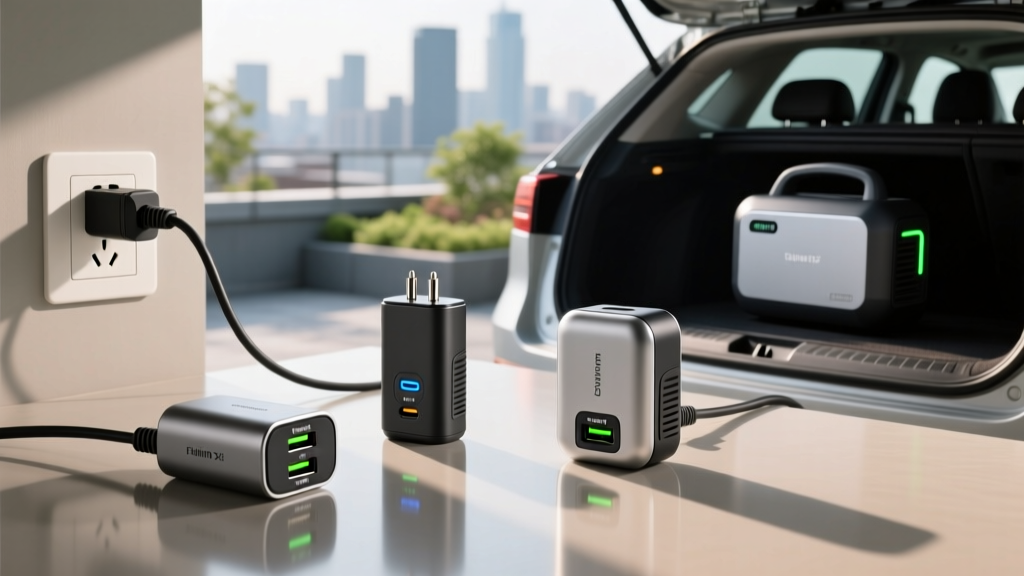
If you own an electric vehicle but lack a dedicated wall-mounted charging station — or you travel frequently and need reliable Level 2 capability on the road — a portable EV charger bridges the gap. These dual-voltage or single-voltage mobile units plug into standard 120V household outlets for slow Level 1 top-ups or into 240V dryer-style outlets (NEMA 14-50, 6-50, or 10-30) for dramatically faster Level 2 charging. For apartment dwellers, renters, road-trippers, and anyone without a permanent garage install, a quality portable EV charger is the most flexible charging hardware you can buy.
This guide breaks down exactly what portable units deliver in kilowatts (kW — the rate of power delivery), how that translates to miles of range per hour, what electrical infrastructure you actually need, and which 2026 models offer the best combination of output, connector compatibility, and price.
Charging Levels Explained: kW Speeds and Range Added Per Hour
Before evaluating portable chargers, you need to understand the three charging tiers and what each delivers. The distinction between kW (power — how fast energy flows) and kWh (energy — how much your battery stores) is critical and non-negotiable in EV ownership.
| Level | Voltage | Max Power (kW) | Miles of Range Added Per Hour | Typical Use Case |
|---|---|---|---|---|
| Level 1 | 120V AC | 1.0–1.4 kW | 3–5 mi/hr | Overnight trickle, emergency top-up |
| Level 2 | 240V AC | 3.3–19.2 kW | 12–70 mi/hr | Home daily, destination, portable 240V |
| DC Fast Charging | 400–800V DC | 50–350 kW | 150–1,200+ mi/hr (peak) | Highway road trips, 10–80% in 15–30 min |
Most portable EV chargers operate at Level 1 or Level 2. A handful of premium dual-voltage units can switch between a standard 120V outlet and a 240V NEMA 14-50 receptacle, giving you both tiers in one device. DC fast charging is exclusively a public-station affair — no portable unit delivers DC fast charging from a residential outlet.
Real-World Charging Time Examples
How long does a portable charger actually take? Here are realistic 10–80% State of Charge (SoC) times for common battery sizes, assuming you start at 10% and charge to 80% (the recommended daily ceiling for NMC chemistry batteries):
- Tesla Model Y (75 kWh usable) on a 1.4 kW Level 1 portable: ~37 hours (10–80%). On a 7.7 kW Level 2 portable (NEMA 14-50): ~6.8 hours.
- Hyundai Ioniq 5 (77.4 kWh usable) on a 1.2 kW Level 1 portable: ~46 hours. On an 11.5 kW Level 2 portable: ~4.5 hours.
- Ford F-150 Lightning Extended Range (131 kWh usable) on a 1.4 kW Level 1 portable: ~61 hours. On a 9.6 kW Level 2 portable: ~8.7 hours.
The takeaway: Level 1 portable charging is viable only for overnight top-ups of 30–50 miles, or as a backup. Level 2 portable units on 240V circuits are genuinely practical for daily charging.
Which Connector Does Your EV Need?
Connector compatibility determines whether a portable charger physically plugs into your vehicle. The North American market in 2026 has largely consolidated around the NACS (North American Charging Standard, originally the Tesla connector), but millions of CCS1-equipped EVs remain on the road, and adapters are widely available.
| Connector | Brands Using It (Native) | Adapter Availability | Notes |
|---|---|---|---|
| NACS (J3400) | Tesla, Ford, GM, Rivian, Volvo, Polestar, Hyundai/Kia (2025+), most new 2026 models | CCS1-to-NACS adapters from Tesla, Lectron, A2Z | Becoming the universal standard |
| CCS1 (Combo) | VW ID.4 (pre-2025), older Hyundai/Kia, BMW i4/iX, Mercedes EQS/EQE, Stellantis | NACS-to-CCS1 adapters available | Legacy standard, still widely supported |
| CHAdeMO | Nissan Leaf (legacy) | Limited adapters | Effectively discontinued; avoid for new purchases |
If you drive a 2025+ model from Ford, GM, Rivian, Hyundai, or Kia, your vehicle likely has a native NACS port. If you drive a 2022–2024 VW ID.4 or BMW i4, you have CCS1. When buying a portable EV charger, match the connector to your vehicle — or buy a unit with a swappable connector head, which several 2026 models now offer.
For authoritative connector and charging data, the U.S. Department of Energy's fueleconomy.gov maintains current EV charging specifications by model.
Top Portable EV Chargers for 2026: Equipment Comparison
Below are five well-regarded portable EV chargers available in 2026, selected for output, connector flexibility, safety certifications, and real-world usability. Each entry lists power output, connector type, cable length, smart features, and approximate retail price.
ChargePoint Home Flex (Portable Configuration)
- Power Output: Up to 12 kW (50A) on NEMA 14-50; derates to 9.6 kW (40A) on NEMA 6-50
- Connector: NACS native; CCS1 adapter included in box
- Cable Length: 23 feet
- Smart Features: Wi-Fi, ChargePoint app scheduling, Alexa integration, energy tracking
- Price: ~$549
- Best For: Owners wanting a single unit that works at home and on the road with both connector types
Emporia Level 2 Portable EV Charger
- Power Output: Up to 11.5 kW (48A) on NEMA 14-50
- Connector: NACS native (J3400 certified)
- Cable Length: 24 feet
- Smart Features: Wi-Fi, Emporia Energy app, solar integration, real-time cost tracking
- Price: ~$399
- Best For: Budget-conscious buyers with NACS-port vehicles who want solar-aware scheduling
Lectron V-Box Pro Dual-Voltage
- Power Output: 1.4 kW (12A) on 120V; up to 9.6 kW (40A) on 240V NEMA 14-50
- Connector: NACS native; CCS1 adapter sold separately (~$99)
- Cable Length: 21 feet
- Smart Features: LED status display, no Wi-Fi (fully offline operation)
- Price: ~$279
- Best For: No-frills dual-voltage charging; renters who move frequently
Tesla Mobile Connector (2026 Revision)
- Power Output: 1.4 kW (12A) on 120V; up to 7.7 kW (32A) on 240V NEMA 14-50
- Connector: NACS native (Tesla vehicles); J1772 adapter included for non-Tesla Level 2 stations
- Cable Length: 20 feet
- Smart Features: Integrated with Tesla app, vehicle-native scheduling
- Price: ~$230 (included with new Tesla vehicles)
- Best For: Tesla owners who want the simplest, lightest portable option
Grizzl-E Smart Portable
- Power Output: Up to 10 kW (40A) on NEMA 14-50; adjustable down to 16A for weaker circuits
- Connector: NACS or CCS1 (select at purchase)
- Cable Length: 24 feet
- Smart Features: Wi-Fi, OCPP compatibility, adjustable amperage via app, extreme-cold rated to -40°F
- Price: ~$499
- Best For: Cold-climate owners and those with older electrical panels who need adjustable amperage
Electrical Requirements: What Your Home Wiring Actually Needs
A portable EV charger is only as capable as the outlet it plugs into. Here is what each voltage tier demands from your home's electrical system:
Level 1 (120V) Requirements
- Standard 15A or 20A household outlet (NEMA 5-15 or 5-20)
- Dedicated circuit strongly recommended — sharing a circuit with space heaters, microwaves, or AC units risks tripping the breaker
- No electrical panel upgrade needed in virtually all homes
- Expect 1.0–1.4 kW output and 3–5 miles of range per hour
Level 2 (240V) Requirements
- NEMA 14-50 outlet (most common): 240V, 50A circuit, delivers up to 40A continuous (9.6–12 kW depending on charger)
- NEMA 6-50 outlet: 240V, 50A circuit, no neutral wire — compatible with many portable chargers but verify before purchasing
- NEMA 10-30 outlet: 240V, 30A circuit (older dryer outlet) — delivers up to 24A continuous (~5.8 kW)
- A dedicated circuit is mandatory per NEC (National Electrical Code) for EV charging — you cannot share the circuit
- Continuous load rule: EV charging is classified as a continuous load, so the circuit must be rated for 125% of the charger's maximum draw. A 40A charger requires a 50A circuit.
Panel Upgrade Considerations
Older homes with 100A electrical service panels may not have sufficient spare capacity for a 50A dedicated EV circuit. A licensed electrician will perform a load calculation to determine whether your panel can support the additional draw. If your panel is already near capacity (common in homes with electric ranges, dryers, and central AC), you may need a panel upgrade to 200A service — a significant expense that must be factored into your total cost.
How Much Does It Cost to Install a Home 240V Outlet for a Portable Charger?
One of the biggest advantages of a portable EV charger over a hardwired wall unit is lower installation cost — you are paying for an outlet, not a permanently mounted charger. However, costs vary dramatically based on your home's existing wiring, panel capacity, and the distance from the panel to the desired outlet location.
| Component | Simple Install (panel adjacent, no upgrade) | Complex Install (long run, panel upgrade needed) |
|---|---|---|
| NEMA 14-50 receptacle + wiring materials | $50–$150 | $150–$400 |
| Electrician labor (2–6 hours at $85–$150/hr) | $170–$450 | $510–$900 |
| Permit and inspection | $50–$150 | $50–$200 |
| Electrical panel upgrade (100A → 200A, if needed) | $0 | $1,500–$3,500 |
| Total estimated cost | $270–$750 | $2,210–$5,000+ |
Critical note: Always hire a licensed electrician for 240V outlet installation. DIY 240V work is dangerous, violates electrical code in most jurisdictions, and can void your homeowner's insurance in the event of a fire. The National Electrical Contractors Association provides a directory of qualified electricians.
Some utility companies offer rebates of $200–$500 for EV outlet installation — check with your local provider before scheduling work.
Cost to Charge: Per-Mile Electricity Cost vs. Gasoline
The financial case for EV charging hinges on the cost per mile. Below are realistic 2026 scenarios using the national average electricity rate of ~$0.17/kWh (residential) and a gasoline price of ~$3.40/gallon. We use a comparable efficiency of 3.5 miles per kWh for the EV (typical for a midsize crossover like the Tesla Model Y or Hyundai Ioniq 5) and 28 MPG combined for a gas equivalent.
| Scenario | Rate | Cost Per Mile | Annual Cost (12,000 mi) |
|---|---|---|---|
| Home Level 2, off-peak TOU rate | $0.09/kWh | $0.026/mi | $312 |
| Home Level 2, standard residential rate | $0.17/kWh | $0.049/mi | $588 |
| Public Level 2 (ChargePoint, EVgo) | $0.30/kWh | $0.086/mi | $1,032 |
| DC Fast Charging (Electrify America, Tesla Supercharger) | $0.40/kWh | $0.114/mi | $1,368 |
| Gasoline vehicle (28 MPG, $3.40/gal) | $3.40/gal | $0.121/mi | $1,452 |
Even at public DC fast charging rates, EVs cost less per mile than gasoline vehicles in most 2026 markets. Home charging on an off-peak time-of-use (TOU) plan delivers savings of over $1,100 per year compared to gasoline — enough to pay for a portable Level 2 charger and outlet installation within the first year.
Safety, Code Compliance, and Outdoor Use
Portable EV chargers are rated for indoor and outdoor use, but several safety and code considerations apply:
- GFCI protection: The 2020 NEC requires GFCI (Ground Fault Circuit Interrupter) protection for all 120V and 240V receptacles used for EV charging in garages and outdoor locations. Most quality portable chargers have built-in GFCI, but your outlet may also need a GFCI breaker — your electrician will confirm.
- Outdoor rating: If you plan to charge outdoors, verify the charger carries an IP65 or higher ingress protection rating (dust-tight and water-jet resistant). All five chargers recommended above meet IP65 or IP66.
- Dedicated circuit: NEC Article 625 requires a dedicated branch circuit for EV charging equipment. Do not plug a Level 2 portable charger into an outlet shared with other high-draw appliances.
- Cable management: Never run a charging cable across a driveway or walkway where it can be driven over or create a trip hazard. Use a cable organizer or conduit if the cable must cross a traffic area.
- UL certification: Only purchase chargers with UL (Underwriters Laboratories) or ETL listing. Uncertified chargers from marketplace sellers may lack critical safety protections and can void insurance coverage.
Frequently Asked Questions
Can I use a portable EV charger with any household outlet?
For Level 1 (120V) charging, yes — any standard 15A or 20A household outlet will work, though a dedicated circuit is recommended to prevent breaker trips. For Level 2 (240V) charging, you need a NEMA 14-50, 6-50, or 10-30 outlet installed by a licensed electrician on a dedicated circuit. You cannot plug a Level 2 charger into a standard 120V outlet.
How fast will a portable Level 2 charger charge my EV overnight?
A portable Level 2 charger on a NEMA 14-50 outlet delivers 7.7–12 kW depending on the unit and your vehicle's onboard charger limit. That translates to roughly 25–45 miles of range per hour of charging. Over an 8-hour overnight session, you can add 200–350 miles of range — more than enough to fully replenish most EVs for daily driving.
Do I need a NACS or CCS1 portable charger?
Check your vehicle's charge port. If you drive a 2025+ Tesla, Ford, GM, Rivian, Hyundai, Kia, or Volvo EV, you likely have a NACS port and should buy a NACS-native portable charger. If you drive a 2022–2024 VW ID.4, BMW i4, or Mercedes EQS, you have CCS1 and need a CCS1 charger or a NACS-to-CCS1 adapter. CHAdeMO (Nissan Leaf) is effectively legacy — adapters are limited.
Is a portable charger as good as a hardwired wall unit?
In terms of charging speed, a portable Level 2 charger on a 50A circuit delivers nearly identical performance to a hardwired wall unit of the same amperage. The trade-offs are minor: portable units typically max out at 40–48A (vs. 48–80A for some hardwired units), and you must manage the cable and connector yourself. For most EV owners charging at 7–12 kW, a portable unit is entirely sufficient.
Will the federal tax credit cover my portable charger and installation?
The IRS §30D tax credit applies to the vehicle purchase, not to charging equipment. However, a separate provision — the Alternative Fuel Vehicle Refueling Property Credit (IRS §30C) — previously offered up to $1,000 for home charging equipment installation. As of 2026, check IRS.gov for current §30C eligibility, as this credit has specific income limits and census-tract requirements. Consult a tax professional for your specific situation.
What electrical upgrades might I need for a 240V portable charger?
If your home has a 200A electrical panel with spare capacity, you likely need only a dedicated 50A circuit and NEMA 14-50 outlet — costing $270–$750 total. If your home has an older 100A panel that is already near capacity, you may need a panel upgrade to 200A service, which adds $1,500–$3,500. A licensed electrician's load calculation is the definitive answer.
Can I take my portable EV charger to public campgrounds or RV parks?
Yes — many campgrounds and RV parks have NEMA 14-50 outlets at their sites, originally installed for RVs. A dual-voltage portable Level 2 charger can plug directly into these outlets, giving you 9.6–12 kW of charging while you stay overnight. Always confirm the outlet's amperage rating with the site operator before plugging in.