Why a Mobile EV Charger Might Be All You Need
Not every EV owner needs a hardwired wall box. A mobile EV charger — the portable unit that plugs into a standard outlet or a 240V receptacle — covers daily commuting needs for most drivers while doubling as a road-trip backup. Every new EV ships with one, but the included units are often limited to 1.4 kW on a standard 120V household outlet, adding roughly 4 miles of range per hour. Upgrading to a higher-capacity mobile charger that can tap a 240V outlet transforms that trickle into a legitimate overnight replenishment strategy, delivering 25–35 miles of range per hour without the permanence or cost of a hardwired installation.
This guide breaks down exactly what mobile EV chargers can do, what electrical infrastructure they require, and which models deliver the best combination of speed, portability, and value for 2026 EV buyers.
Charging Levels Explained: Speeds That Actually Matter
Before picking hardware, you need to understand the three charging tiers. Power is measured in kilowatts (kW) — the rate of energy flow — while battery capacity is measured in kilowatt-hours (kWh), the total energy stored. Confusing the two is the most common mistake new EV owners make.
| Level | Voltage | Max Power (kW) | Miles of Range Added per Hour | Typical Use |
|---|---|---|---|---|
| Level 1 | 120V AC | 1.4–1.9 kW | 3–5 mi/hr | Overnight top-up, low-mileage commuters |
| Level 2 | 240V AC | 7.2–19.2 kW | 25–70 mi/hr | Primary home charging, workplace |
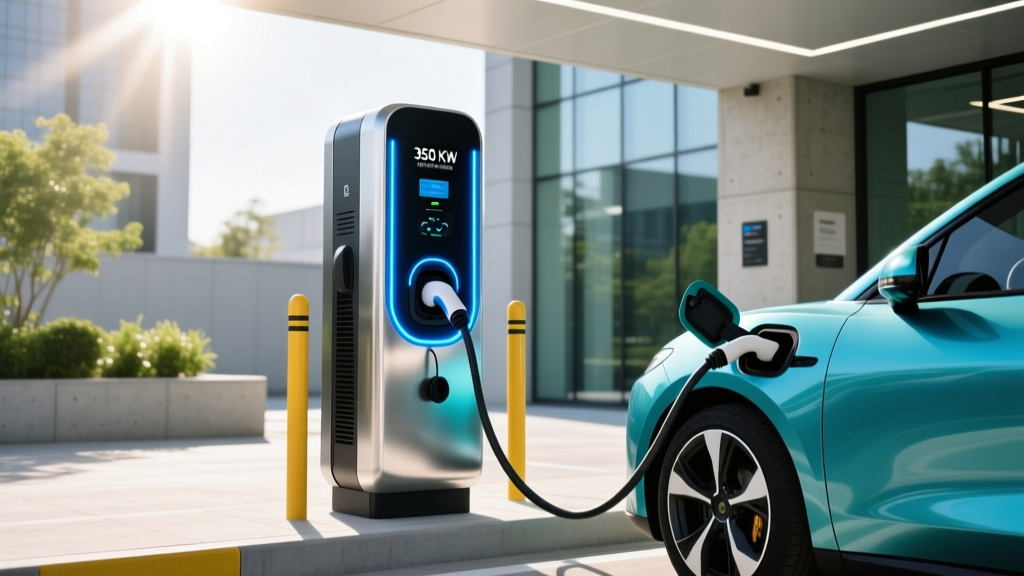
| DC Fast | 400–800V DC | 50–350 kW | 150–1,000+ mi/hr | Road trips, highway corridors |
Most mobile EV chargers operate at Level 1 or Level 2. A few premium portables now support up to 19.2 kW when connected to a NEMA 14-50 outlet on a 60-amp circuit, though the 32–40 amp range (7.7–9.6 kW) is far more common for portable units. DC fast charging requires dedicated commercial stations and is not available through any portable consumer device.
Mobile EV Charger Equipment: What to Buy in 2026
The market has matured past the basic cord-in-a-bag that ships with most EVs. Here are the top-performing mobile EV chargers available, evaluated on power output, connector options, cable length, smart features, and price.
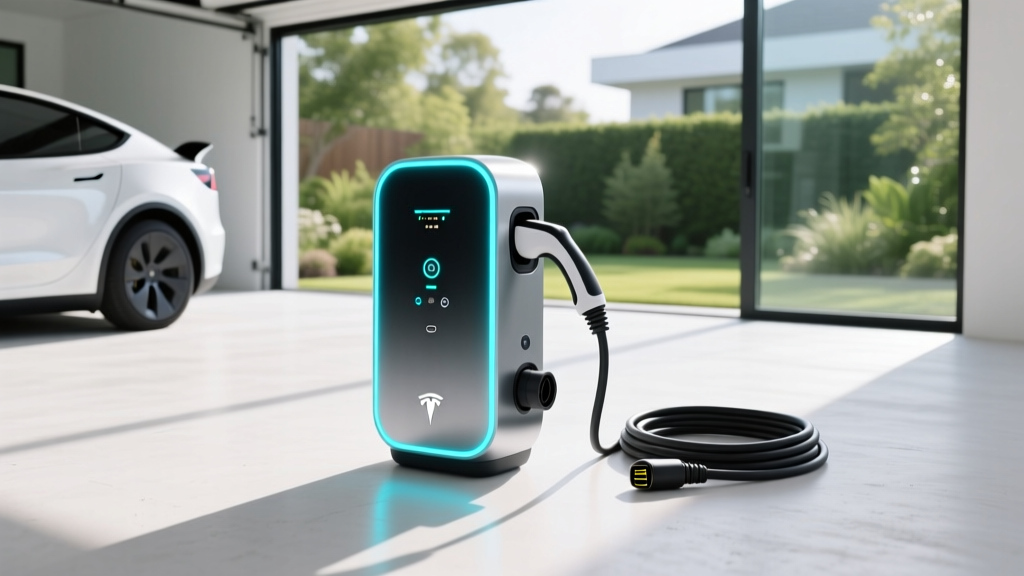
Tesla Mobile Connector (Gen 2)
- Power Output: Up to 9.6 kW (40A) on NEMA 14-50; 1.4 kW on NEMA 5-15 (120V)
- Connector: NACS (native Tesla); CCS adapter available separately (~$175)
- Cable Length: 20 feet
- Smart Features: None — no Wi-Fi, no app scheduling, no energy metering
- Price: ~$300 (includes NEMA 5-15 and NEMA 14-50 adapter pigtails)
- Best For: Tesla owners who want a simple, reliable backup/travel charger
Lectron V-BOX Pro 48A
- Power Output: Up to 11.5 kW (48A) on NEMA 14-50; includes J1772 connector
- Connector: J1772 (standard for non-Tesla EVs; Tesla owners use a J1772-to-NACS adapter)
- Cable Length: 21 feet
- Smart Features: LED status display, adjustable amperage (16A–48A), NEMA 4 outdoor rating
- Price: ~$340
- Best For: Non-Tesla EV owners wanting maximum portable Level 2 speed on a budget
ChargePoint Home Flex (Portable Mode)
- Power Output: Up to 12 kW (50A) on NEMA 14-50; adjustable down to 16A
- Connector: J1772 (23-foot cable)
- Smart Features: Wi-Fi enabled, ChargePoint app scheduling, Alexa integration, energy tracking
- Price: ~$550 (can be hardwired or used with plug — portable with NEMA 14-50 pigtail)
- Best For: Drivers who want smart scheduling and energy monitoring in a unit that can travel
Emporia Level 2 EV Charger
- Power Output: Up to 11.5 kW (48A) on NEMA 14-50
- Connector: J1772 (24-foot cable)
- Smart Features: Wi-Fi, Emporia Energy app with real-time kWh tracking, solar-integration scheduling, adjustable amperage
- Price: ~$399
- Best For: Solar-panel owners who want to charge on excess production; budget-conscious smart-charger buyers
When choosing, match the charger's maximum amperage to your circuit. A NEMA 14-50 outlet on a 50-amp breaker supports continuous loads up to 40 amps (9.6 kW). Pushing to 48 amps requires a 60-amp breaker. Never exceed 80% of a circuit's rated capacity for continuous EV charging — this is a National Electrical Code (NEC) requirement, not a suggestion.
Connector Compatibility: NACS, CCS1, and CHAdeMO
The connector landscape has consolidated significantly since Ford, GM, Rivian, and most major automakers adopted the North American Charging Standard (NACS) for their 2025–2026 models. Here's where things stand:
| Connector | Brands Using It (2026) | Adapter Needed? |
|---|---|---|
| NACS (Tesla) | Tesla, Ford, GM, Rivian, Volvo, Polestar, Mercedes-Benz (new models), Hyundai/Kia (select 2026+) | Non-Tesla NACS vehicles may need a CCS-to-NACS adapter for older public CCS stations |
| CCS1 (J1772 Combo) | Volkswagen, BMW (pre-2026), Stellantis, Subaru, Toyota (bZ series), most pre-2025 non-Tesla EVs | Tesla owners need a CCS1-to-NACS adapter (~$175) for CCS public chargers |
| CHAdeMO | Nissan Leaf (legacy); essentially discontinued for new models | No mainstream adapter path; CHAdeMO stations are declining |
For Level 2 mobile chargers, the relevant connector is the J1772 plug (the AC standard used by all non-Tesla EVs in North America). Tesla vehicles use a proprietary NACS connector for AC charging but can accept J1772 with the included adapter that ships in every Tesla's glovebox. If you buy a J1772 mobile charger and own a Tesla, that adapter handles it. If you buy a Tesla Mobile Connector and own a non-Tesla NACS vehicle (2025+ Ford, GM, etc.), it works natively.
Electrical Requirements and Home Installation Costs
A mobile EV charger's portability doesn't eliminate electrical requirements — it shifts them. Instead of hardwiring a wall unit, you're installing a 240V receptacle (typically NEMA 14-50) that the mobile charger plugs into. This approach offers flexibility but carries its own costs and code considerations.
What a NEMA 14-50 Installation Requires
- Circuit: Dedicated 50-amp breaker (for 40A continuous charging) or 60-amp breaker (for 48A continuous)
- Wiring: 6 AWG copper (for 50A) or 4 AWG copper (for 60A) run from your electrical panel
- Outlet: NEMA 14-50R receptacle, properly grounded
- GFCI Protection: NEC 2020 and later require GFCI breakers for EV charging outlets in garages — this adds $50–$120 to breaker cost
- Permit: Most jurisdictions require an electrical permit for new 240V circuits ($50–$200 depending on locality)
| Component | Cost Range | Notes |
|---|---|---|
| Electrical Permit | $50–$200 | Required in most jurisdictions; varies by city/county |
| Electrician Labor (standard install) | $400–$1,200 | Outlet within 20 ft of panel, same wall; price increases with distance and complexity |
| Electrician Labor (complex run) | $1,200–$3,000+ | Long wire runs, conduit through walls/attic, sub-panel addition |
| 50A GFCI Breaker | $80–$150 | NEC-required for garage/outdoor receptacles |
| Wiring & Materials | $100–$400 | 6 AWG copper, conduit, junction boxes |
| Panel Upgrade (if needed) | $1,500–$4,000 | Required if existing panel lacks capacity; common in pre-1990 homes with 100A service |
| Total (no panel upgrade) | $630–$1,950 | Most homes with 200A service and nearby panel |
| Total (with panel upgrade) | $2,130–$5,950 | Older homes needing 200A service upgrade |
Safety and Code Requirements
- Dedicated circuit: Your EV charging outlet must be on its own breaker — never share a circuit with other appliances
- Outdoor rating: If installing outside, the receptacle must have an in-use weatherproof cover (NEMA 3R or 4 rated); the charger itself should carry at least a NEMA 4 rating
- No extension cords: Never use an extension cord between the outlet and your mobile charger — this creates a fire risk and voids most charger warranties
- Strain relief: Hang the charger control box on a bracket or hook so the plug isn't bearing the cable's full weight — this prevents outlet wear and arcing over time
What It Actually Costs to Charge: Per-Mile Economics
The cost advantage of electric driving depends heavily on where and when you charge. Here's how real electricity prices translate to per-mile costs, benchmarked against a comparable gasoline vehicle at 28 MPG combined.
| Charging Scenario | Price per kWh | Cost to Add 200 Miles* | Cost per Mile |
|---|---|---|---|
| Home Level 2 (off-peak utility rate) | $0.09–$0.13 | $5.40–$7.80 | $0.027–$0.039 |
| Home Level 2 (standard residential avg) | $0.16–$0.18 | $9.60–$10.80 | $0.048–$0.054 |
| Public Level 2 (network pricing) | $0.25–$0.40 | $15.00–$24.00 | $0.075–$0.12 |
| DC Fast Charging (public, peak) | $0.35–$0.55 | $21.00–$33.00 | $0.105–$0.165 |
| Gasoline (28 MPG at $3.40/gal) | — | $24.29 | $0.121 |
*Based on an EV consuming 30 kWh per 100 miles (a realistic average for a midsize crossover like the Hyundai Ioniq 5 or Tesla Model Y). Actual consumption varies by vehicle, speed, temperature, and terrain. Source: fueleconomy.gov EPA data.
The takeaway: home charging during off-peak hours delivers a 3–4× cost advantage over gasoline. Even standard-rate home charging undercuts gas by roughly half. Public DC fast charging, however, narrows the gap — on some networks at peak times, it can approach or exceed gas costs per mile. This is why a mobile EV charger paired with a home 240V outlet is the economic sweet spot for most owners.
Charging Time Examples: How Long Does It Really Take?
Charge times depend on your battery's usable capacity (in kWh) and the charger's sustained power (in kW). These examples assume charging from 10% to 80% state of charge — the practical daily window most owners use, since charging above 80% slows dramatically due to the battery management system's taper curve.
| Vehicle Example | Usable Battery (kWh) | Level 1 Mobile (1.4 kW) | Level 2 Mobile (9.6 kW, 40A) | Level 2 Mobile (11.5 kW, 48A) | DC Fast (Peak kW) |
|---|---|---|---|---|---|
| Chevy Equinox EV (85 kWh) | 85 | ~42 hours | ~6.2 hours | ~5.2 hours | ~28 min (150 kW peak) |
| Tesla Model Y LR (75 kWh) | 75 | ~37 hours | ~5.5 hours | ~4.6 hours | ~25 min (250 kW peak) |
| Hyundai Ioniq 5 (77.4 kWh) | 77.4 | ~38 hours | ~5.6 hours | ~4.7 hours | ~18 min (240 kW peak, 800V) |
| Ford F-150 Lightning Ext. (131 kWh) | 131 | ~65 hours | ~9.6 hours | ~8.0 hours | ~41 min (150 kW peak) |
| BMW i4 eDrive40 (81.5 kWh) | 81.5 | ~40 hours | ~6.0 hours | ~5.0 hours | ~31 min (200 kW peak) |
Mobile Charger vs. Hardwired Wall Box: Decision Framework
Choose a Mobile EV Charger If:
- You rent and can't permanently modify the property
- You need to charge at multiple locations (home, office, family members' houses)
- You travel frequently and want a road-trip charging backup
- Your daily driving is under 60 miles and overnight Level 2 replenishment is sufficient
- You want to minimize upfront hardware cost ($300–$550 vs. $500–$800 for wall units)
Choose a Hardwired Wall Box If:
- You own your home and want the cleanest, most permanent installation
- You need maximum amperage (hardwired units can deliver up to 19.2 kW / 80A on a 100A circuit — beyond what any NEMA plug supports)
- You want integrated cable management, wall-mount holstering, and a tidy garage
- You charge a large-battery vehicle (F-150 Lightning, Rivian R1T) and need every available kW overnight
- Local utility rebates specifically require hardwired, Wi-Fi-enabled stations
A practical middle ground: install a NEMA 14-50 outlet with a high-quality mobile charger. You get near-wall-box speeds (9.6–11.5 kW) with the flexibility to unplug and take the charger with you when you move or travel. This is the setup most EV analysts recommend for first-time buyers.
Frequently Asked Questions
How much does it cost to install a home EV charger outlet?
A NEMA 14-50 outlet installation by a licensed electrician typically costs $630–$1,950 if your electrical panel has adequate capacity (200A service with available breaker slots). If your home requires a panel upgrade from 100A to 200A service, add $1,500–$4,000, bringing the total to $2,130–$5,950. Always get a load calculation before committing — some homes can accommodate the circuit without an upgrade even with 100A service if overall demand is low.
How fast will a mobile EV charger add range?
On a standard 120V outlet (Level 1), a mobile charger adds 3–5 miles of range per hour — adequate only for drivers covering under 30 miles daily. On a 240V NEMA 14-50 outlet (Level 2 at 40A/9.6 kW), expect 25–35 miles per hour depending on your vehicle's efficiency. At 48A/11.5 kW, that rises to roughly 30–40 miles per hour. An 8-hour overnight session at 9.6 kW adds approximately 200–250 miles — enough for nearly any daily commute.
Which connector is compatible with my EV?
If you drive a 2025–2026 Tesla, Ford, GM, Rivian, Volvo, or Polestar, your vehicle uses the NACS connector. Most other non-Tesla EVs from model years 2024 and earlier use CCS1 (J1772 Combo). For Level 2 AC charging, all non-Tesla EVs use the J1772 plug, and Teslas accept J1772 via the adapter included with every vehicle. Check your vehicle's charge port or owner's manual to confirm before purchasing a mobile charger.
How much does charging cost per mile compared to gasoline?
Home charging at off-peak utility rates ($0.09–$0.13/kWh) costs approximately $0.03–$0.04 per mile for an average EV — roughly one-quarter the cost of gasoline at $3.40/gallon and 28 MPG ($0.12/mile). Standard-rate home charging ($0.16–$0.18/kWh) runs $0.05–$0.05 per mile. Public DC fast charging ($0.35–$0.55/kWh) narrows the advantage to $0.11–$0.17 per mile, sometimes matching or exceeding gas costs. The economic case for EVs is strongest with consistent home charging access.
What electrical upgrades might I need for a mobile charger?
The most common upgrade is a new 50-amp or 60-amp breaker and a dedicated wire run to a NEMA 14-50 receptacle. Older homes (pre-1990) with 100-amp service may need a panel upgrade to 200 amps if the load calculation shows insufficient headroom. Homes with existing 240V outlets (electric dryer, range) may be able to use a smart splitter device (e.g., NeoCharge Smart Splitter, ~$400) that shares the outlet with the appliance, avoiding a new circuit entirely — though this limits charging speed and requires the appliance to be idle.
Is a mobile EV charger safe for outdoor use?
Most quality mobile chargers carry a NEMA 4 rating, meaning they're protected against splashing water and dust — suitable for outdoor use. However, the 240V receptacle itself needs an in-use weatherproof cover (a "bubble cover") rated for outdoor installation. Never leave a charger control box sitting in a puddle or buried in snow; mount it on a wall bracket or post at least 18 inches above ground level.
Can I use a mobile EV charger with a standard 120V outlet?
Yes — every mobile EV charger includes a NEMA 5-15 adapter pigtail for standard 120V household outlets. At 12 amps (1.4 kW), this adds roughly 4 miles of range per hour. It's suitable for plug-in hybrids with small batteries (e.g., Toyota RAV4 Prime with 18.1 kWh, fully charged in ~12 hours) or as an emergency top-up for BEVs. For daily BEV use, 120V is too slow for most owners.
For authoritative reference on EV efficiency ratings and energy consumption data, consult the U.S. Department of Energy's fueleconomy.gov database. For electrical installation standards, the National Electrical Code (NEC) Article 625 governs EV charging equipment — your licensed electrician will follow these requirements during installation. For information on federal incentives that may offset charger installation costs, see the IRS guidance on the Residential Clean Energy Credit (IRC §25D), which covers 30% of qualified EV supply equipment costs through 2032.