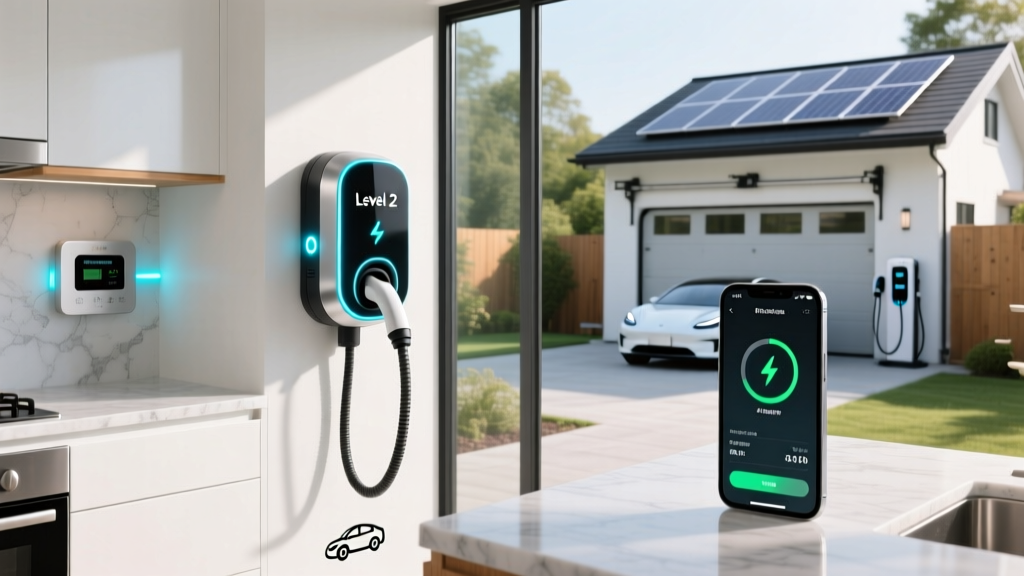
Choosing the best location for an EV charger in your garage is about more than convenience — it determines your installation cost, charging speed, daily usability, and even long-term safety. A poorly placed charger means stretched cables across your driveway, an undersized circuit that throttles your charge rate, or a $3,000 panel upgrade you didn't budget for. This guide walks through placement strategy, electrical requirements, real installation costs, and the exact equipment to buy in 2026.
How to Pick the Best Location for an EV Charger in Your Garage
The ideal garage charger location satisfies four criteria simultaneously: proximity to your electrical panel, alignment with your vehicle's charge port, adequate cable reach, and compliance with the National Electrical Code (NEC). Here's how to evaluate your space.
Start with your charge port side
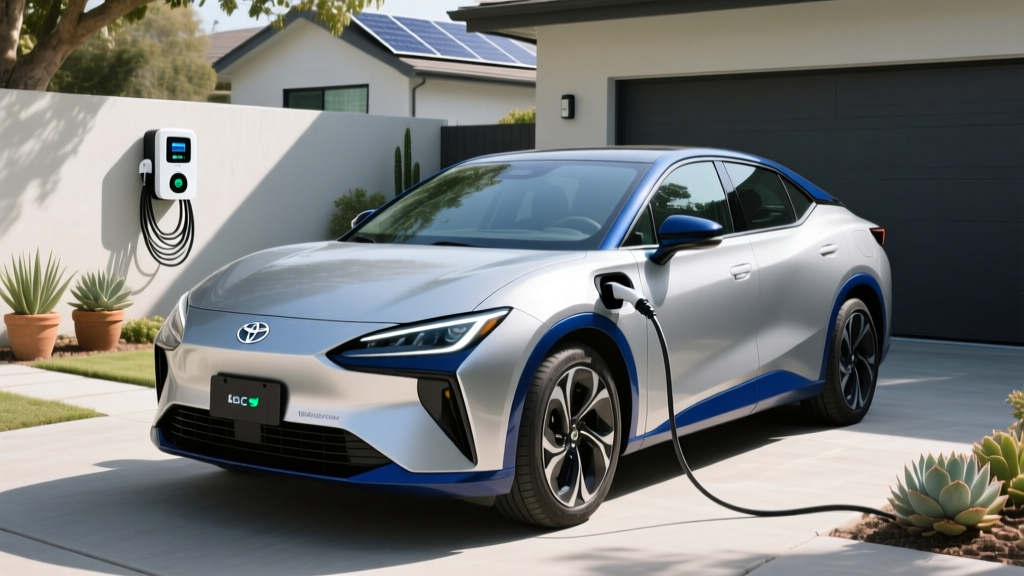
Most North American EVs place the charge port on the driver's side rear quarter panel (Tesla Model 3/Y, Hyundai Ioniq 5/6, Ford Mustang Mach-E) or the front fender (some older models). Park your EV in your normal garage spot, open the charge port, and measure from the port to the nearest wall. The charger should mount on the wall closest to that port — ideally within 18–24 inches of the port when parked — so the cable doesn't drape over the hood or drag on the floor.
Minimize distance to the electrical panel
Installation cost scales almost linearly with the wire run from your panel to the charger. A 10-foot run through open stud bays might cost $400–$600 in labor and materials; a 60-foot run through finished walls with conduit can push past $1,800. If your panel is on the opposite side of the garage from your parking spot, consider whether a sub-panel or a shorter route through the attic or crawlspace is feasible.
Allow for cable management and clearance
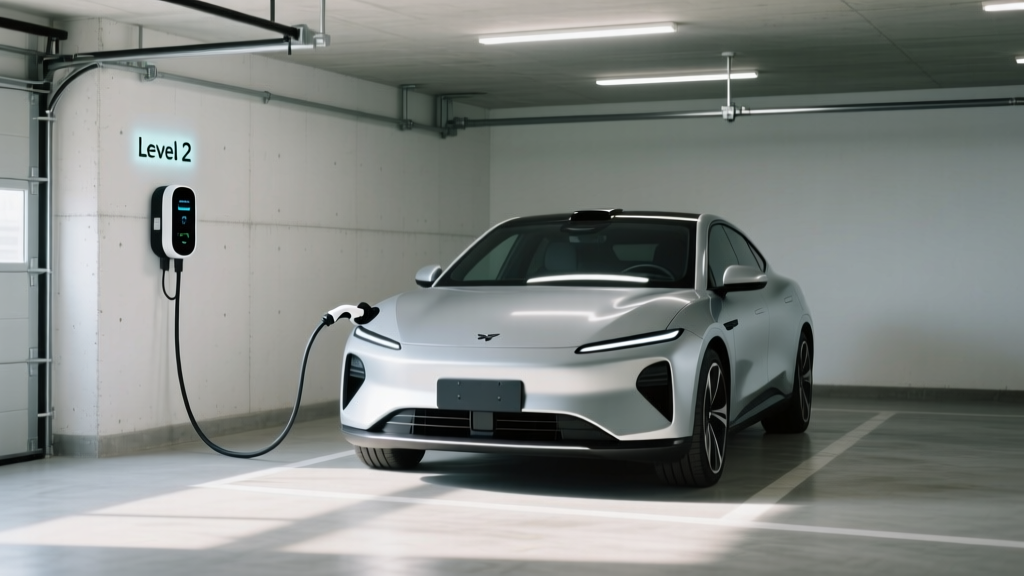
The NEC requires that EV supply equipment (EVSE) be mounted at least 18 inches above the garage floor (some jurisdictions require 24 inches for outdoor installations). Choose a spot where the cable can hang or retract without crossing a walkway. Wall-mounted cable organizers or retractable reels prevent tripping hazards and reduce cable wear.
Think about your next EV, not just your current one
If you plan to add a second EV or upgrade to a larger-battery truck or SUV, position the charger where a 25-foot cable can reach two side-by-side parking spots. A centrally mounted charger between two stalls offers more future flexibility than a corner installation.
Charging Levels Explained: Speeds, Power, and Range Added
Before sizing your circuit, understand what each charging level delivers. Power is measured in kilowatts (kW) — the rate of energy flow — while your battery stores energy in kilowatt-hours (kWh). A higher kW rating means faster charging, but the actual speed also depends on your vehicle's onboard charger and battery acceptance rate.
| Level | Voltage | Power (kW) | Miles of Range per Hour | Typical Use |
|---|---|---|---|---|
| Level 1 | 120V AC | 1.0–1.4 kW | 3–5 mi/hr | Overnight trickle; PHEVs and low-mileage commuters |
| Level 2 (Home) | 240V AC | 3.3–19.2 kW | 12–70 mi/hr | Daily home charging; covers most BEV needs overnight |
| DC Fast Charge | 400–900V DC | 50–350+ kW | 150–1,200+ mi/hr | Road trips; public stations (not a home option) |
For a typical 75 kWh battery (e.g., Tesla Model Y Long Range), a Level 2 charger at 11.5 kW (48A) adds roughly 44 miles of range per hour — enough to replenish a full day's driving in about 2 hours. A Level 1 outlet at 1.2 kW would take over 60 hours for the same battery, making it impractical as a primary charging method for BEVs.
Real-world charging time examples (10–80% SoC)
Charging slows significantly above 80% State of Charge to protect battery health. Here's how common battery sizes perform on a 48-amp (11.5 kW) Level 2 circuit:
- 60 kWh battery (Chevrolet Equinox EV): ~4.5 hours, 10–80%
- 77 kWh battery (Ford Mustang Mach-E Extended Range): ~5.5 hours, 10–80%
- 82 kWh battery (Tesla Model 3 Long Range): ~6 hours, 10–80%
- 100 kWh battery (GMC Sierra EV): ~7.5 hours, 10–80%
On a 350 kW DC fast charger, those same 10–80% sessions compress to 18–40 minutes depending on the vehicle's charge curve and battery preconditioning.
Electrical Requirements: What Your Garage Actually Needs
A Level 2 home charger requires a dedicated 240-volt circuit. The amperage of that circuit determines your maximum charging speed, and the NEC mandates that continuous loads (including EVSE) use no more than 80% of a circuit's rated capacity.
| Circuit Breaker | Max Continuous Draw | Charger Output (kW at 240V) | Mi/Hr (approx.) |
|---|---|---|---|
| 20A | 16A | 3.8 kW | ~15 mi/hr |
| 30A | 24A | 5.8 kW | ~22 mi/hr |
| 40A | 32A | 7.7 kW | ~30 mi/hr |
| 50A | 40A | 9.6 kW | ~37 mi/hr |
| 60A | 48A | 11.5 kW | ~44 mi/hr |
Most EV owners install a 60-amp circuit to support 48A charging, which covers overnight needs for any current-production BEV. However, your existing electrical panel must have the capacity to support this load.
When do you need a panel upgrade?
Homes built before 2000 often have 100-amp or 150-amp main panels. Adding a 60-amp EV circuit to a 100-amp panel that's already near capacity (electric range, dryer, HVAC) will likely require a panel upgrade to 200 amps, which costs $1,500–$3,500 depending on your utility's requirements and local labor rates. A licensed electrician will perform a load calculation per NEC Article 220 to determine if your panel has headroom.
Some newer EV chargers support load management — they communicate with your panel via a current transformer (CT) clamp and automatically reduce charging speed when other appliances draw heavy power. This can avoid a panel upgrade entirely. The Emporia Level 2 EV Charger and Wallbox Pulsar Plus both offer this feature.
How Much Does It Cost to Install a Home EV Charger?
Total installation cost varies widely based on wire run length, panel capacity, and local permitting. Here's a realistic 2026 breakdown:
| Component | Low Estimate | High Estimate | Notes |
|---|---|---|---|
| Level 2 EVSE (hardware) | $300 | $700 | 40A–48A smart charger, NACS or J1772 |
| Electrician labor | $400 | $1,500 | Depends on wire run length and wall type |
| Materials (wire, conduit, breaker) | $150 | $500 | 6 AWG copper for 60A; longer runs cost more |
| Permit & inspection | $50 | $300 | Varies by municipality |
| Panel upgrade (if needed) | $1,500 | $3,500 | 100A → 200A service upgrade |
| Total (no panel upgrade) | $900 | $3,000 | Most homes with 200A panels |
| Total (with panel upgrade) | $2,400 | $6,500 | Older homes with 100A–150A panels |
The IRS §30D federal tax credit does not cover home charging equipment directly for most buyers, but the Alternative Fuel Vehicle Refueling Property Credit (IRS §30C) can cover up to 30% of charger hardware and installation costs (capped at $1,000 for residential property) if you live in an eligible census tract. Check irs.gov and consult a tax professional for your specific eligibility.
Which Connector Does Your EV Use?
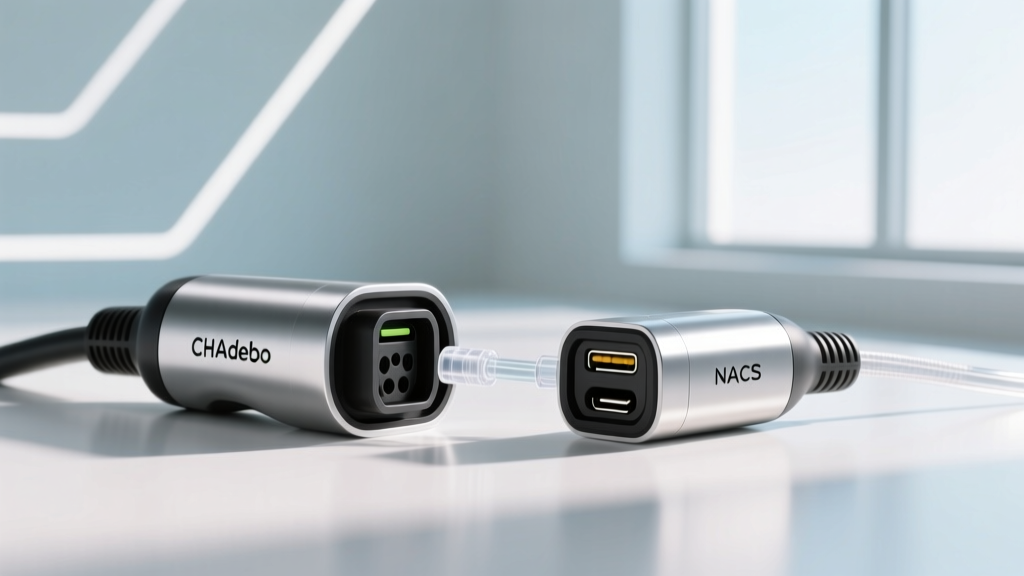
The North American charging connector landscape has shifted dramatically. As of 2025–2026, nearly every major automaker has adopted the North American Charging Standard (NACS), originally developed by Tesla. Here's what that means for your garage charger purchase:
| Connector | Brands Using It (2026 Models) | Adapter Needed? |
|---|---|---|
| NACS (Tesla plug) | Tesla, Ford, GM, Rivian, Volvo, Polestar, Hyundai, Kia, BMW, Mercedes, Toyota, Subaru | None for NACS vehicles; CCS→NACS adapters available for older CCS cars |
| CCS1 (Combined Charging System) | Remaining 2024–2025 carryover models; Stellantis (some); VW ID.4 (2024 and earlier) | NACS→CCS adapter needed at Tesla Superchargers |
| CHAdeMO | Nissan Leaf (legacy only — discontinued after 2025 model year) | Limited adapter options; network shrinking |
Recommendation for 2026: If you're buying a new EV charger today, choose a NACS-equipped model. Even if your current EV uses CCS1, a NACS-to-CCS adapter (approximately $150–$250) lets you charge a CCS car on a NACS connector, and your next EV will almost certainly be NACS-native.
Home EV Charger Equipment Picks for 2026
These are proven Level 2 chargers available in 2026, selected for reliability, power output, cable length, and smart features.
1. Tesla Wall Connector (NACS) — Best Overall
- Power output: Up to 11.5 kW (48A on a 60A circuit)
- Connector: NACS native
- Cable length: 24 ft
- Smart features: Wi-Fi, OTA updates, power sharing (link two units on one circuit), load management
- Price: ~$475
- Best for: Tesla owners and anyone buying a NACS-equipped EV in 2026. The power-sharing feature lets you charge two vehicles on a single 60A circuit — ideal for two-EV garages.
2. ChargePoint Home Flex — Best for CCS/J1772 Vehicles
- Power output: Up to 12 kW (50A on a 60A circuit)
- Connector: J1772 (NACS adapter available separately)
- Cable length: 23 ft
- Smart features: Wi-Fi, app scheduling, Alexa integration, energy tracking
- Price: ~$550
- Best for: Owners of CCS1/J1772 vehicles who want a flexible, amperage-adjustable unit. You can dial the amperage down to match a smaller circuit.
3. Emporia Level 2 EV Charger — Best Budget with Load Management
- Power output: Up to 11.5 kW (48A)
- Connector: J1772 (NACS version available)
- Cable length: 24 ft
- Smart features: Wi-Fi, real-time energy monitoring, load management with CT clamps (avoids panel upgrade), solar integration
- Price: ~$350
- Best for: Budget-conscious buyers or homes where a panel upgrade would be costly. The built-in load management can save $1,500–$3,500 on a panel upgrade.
4. Wallbox Pulsar Plus — Most Compact
- Power output: Up to 11.5 kW (48A)
- Connector: J1772 or NACS (choose at purchase)
- Cable length: 25 ft
- Smart features: Wi-Fi + Bluetooth, Eco-Smart mode (solar matching), Power Boost load management
- Price: ~$499
- Best for: Tight garages where space matters — the Pulsar Plus is roughly the size of a paperback book.
Charging Cost per Mile: EV vs. Gas
One of the strongest arguments for home Level 2 charging is the per-mile fuel cost advantage. Here's how it breaks down in 2026 using national average electricity and gasoline prices:
| Scenario | Cost per kWh | Vehicle Efficiency | Cost per Mile |
|---|---|---|---|
| Home Level 2 (national avg. residential) | $0.16/kWh | 3.0 mi/kWh (105 MPGe) | $0.053/mi |
| Home Level 2 (off-peak utility rate) | $0.09/kWh | 3.0 mi/kWh | $0.030/mi |
| Public Level 2 (network charging) | $0.30/kWh | 3.0 mi/kWh | $0.100/mi |
| DC Fast Charge (public, peak) | $0.48/kWh | 3.0 mi/kWh | $0.160/mi |
| Gasoline car (30 MPG combined) | $3.30/gal national avg. | $0.110/mi | |
| Gasoline car (22 MPG combined, truck/SUV) | $3.30/gal | $0.150/mi | |
At home on an off-peak rate, an EV costs roughly $0.03 per mile to fuel — about one-quarter the cost of a 30 MPG gas car. Even at public DC fast charging rates, EVs can break even with or beat gasoline on a per-mile basis. According to fueleconomy.gov, the average 2026 EV achieves 100–120 MPGe combined, translating to 3.0–3.5 miles per kWh.
For a driver covering 12,000 miles annually, home charging saves approximately $700–$900 per year compared to a 27 MPG gas car. Over five years, that's $3,500–$4,500 in fuel savings — enough to offset most installation costs.
Safety, Code Compliance, and Installation Best Practices
Your garage EV charger installation must comply with NEC Article 625 (Electric Vehicle Charging System Equipment) and your local jurisdiction's amendments. Key requirements:
- Dedicated circuit: Your EVSE must be on its own dedicated breaker — no sharing with outlets, lights, or appliances.
- GFCI protection: The 2023 NEC (and 2026 adoptions) requires GFCI protection for all 150V-to-ground receptacles used for EV charging in garages. Hardwired EVSE units typically have GFCI built in; receptacle-plugged units require a GFCI breaker.
- Mounting height: Minimum 18 inches above the garage floor (measured to the lowest point of the EVSE enclosure). Outdoor installations may require 24 inches.
- Outdoor rating: If any portion of the cable will exit the garage (e.g., to charge a car in the driveway), the EVSE must carry a NEMA 4 or NEMA 4X weather rating. All four chargers recommended above carry outdoor ratings.
- Permit and inspection: Most jurisdictions require an electrical permit for new 240V circuits. The inspection verifies proper wire gauge, breaker sizing, grounding, and GFCI compliance. Skipping the permit risks voiding your homeowner's insurance in the event of an electrical fire.
Always hire a licensed electrician — not a general handyman — for a 240V, 48A+ circuit. The sustained high current draw of EV charging (8–12 hours at a time) is far more demanding than intermittent loads like a dryer, and poor connections are a fire risk.
Frequently Asked Questions
How much does it cost to install a home EV charger?
A typical Level 2 installation with a 60-amp circuit runs $900–$3,000 if your panel has capacity, or $2,400–$6,500 if you need a panel upgrade. The hardware itself costs $300–$700; the remainder is electrician labor, materials, and permitting.
How fast will each charging level add range?
Level 1 (120V) adds 3–5 miles per hour. Level 2 (240V, 48A) adds roughly 44 miles per hour for most EVs. DC fast charging at 150–350 kW can add 150–1,200+ miles per hour but is only available at public stations and tapers significantly above 80% State of Charge.
Which connector/charger is compatible with my EV?
For 2026 model-year vehicles, nearly all new EVs use the NACS connector (Tesla's standard, now adopted by Ford, GM, Hyundai, Kia, BMW, Toyota, and others). If you drive a 2024 or earlier CCS1-equipped EV, you can use a NACS-to-CCS adapter. CHAdeMO is effectively discontinued for new vehicles.
How much does charging cost per mile vs. gas?
Home Level 2 charging on a national average residential rate ($0.16/kWh) costs about $0.053 per mile. A 30 MPG gas car at $3.30/gal costs $0.110 per mile. On off-peak utility rates, EV home charging drops to roughly $0.03/mile — a 73% savings.
What electrical upgrades might I need?
The most common upgrade is a panel capacity increase from 100A or 150A to 200A, costing $1,500–$3,500. If your panel already has capacity but lacks physical breaker spaces, a sub-panel ($400–$800) can add slots. Load-management-capable chargers (Emporia, Wallbox) can sometimes avoid a panel upgrade entirely by throttling charge speed when other appliances are active.
Can I install the charger on the ceiling or a pillar instead of the wall?
Wall mounting is standard and preferred for cable management and code compliance. Ceiling-mounted retractors exist (e.g., EV Safe Charge) but add $500–$1,200 in hardware and require structural assessment. Free-standing pedestal mounts work for detached garages or carports but require underground conduit, adding $500–$1,500.
Does the federal tax credit cover home charger installation?
The §30D new clean vehicle credit does not cover charging equipment. However, the separate §30C Alternative Fuel Vehicle Refueling Property Credit covers up to 30% of hardware and installation costs (max $1,000 for residential) if your home is in an eligible census tract — typically lower-income or rural areas. Verify eligibility on irs.gov or with a tax professional.