Why Aesthetics Matter for Your Garage Charging Setup
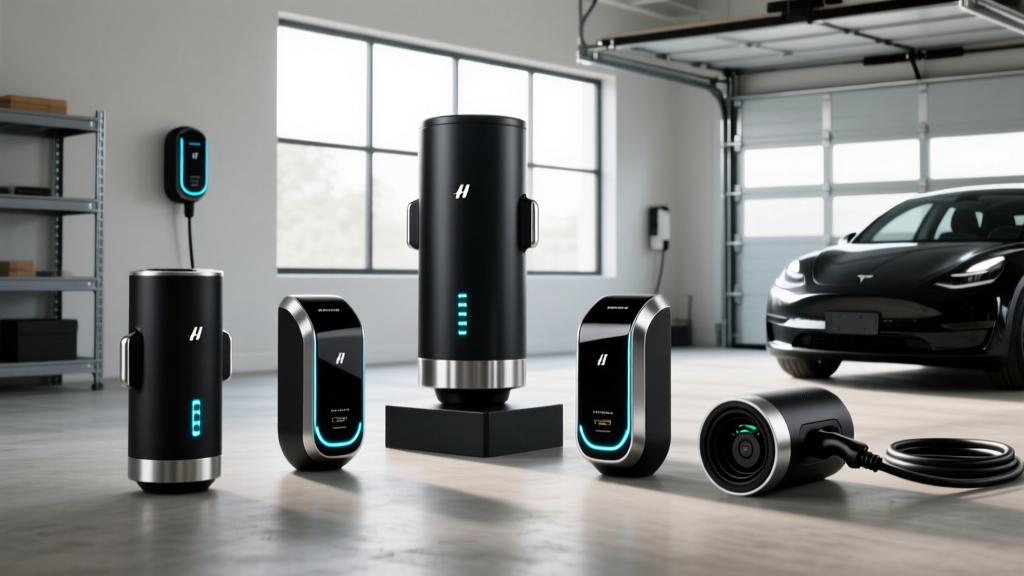
Most Level 2 home chargers ship in industrial white or safety yellow. For owners finishing a garage, mounting a unit next to a Tesla Model Y, Ford Mustang Mach-E, or Rivian R1T, a matte or gloss black charger blends cleanly with dark-painted vehicles and modern interior trim. Beyond looks, black enclosures tend to hide scuff marks from cables and UV-yellowing better than white plastic over a 5- to 10-year service life. The units below are selected on electrical merit first — amperage, continuous duty rating, cable quality, smart features — with the black finish as the tiebreaker.
Charging Levels Explained: kW, Miles Per Hour, and What You Actually Need
The single most common confusion in EV ownership is mixing up kW (power — how fast energy flows) with kWh (energy — how much the battery holds). A 48A Level 2 charger delivers up to 11.5 kW of power; a 75 kWh battery holds 75 kWh of energy. Divide the battery by the power and you get rough charge time: 75 kWh ÷ 11.5 kW ≈ 6.5 hours from 0–100%. The table below translates each level into practical miles-per-hour numbers using a typical 3.0–3.5 mi/kWh efficiency baseline for modern crossovers and sedans.
| Level | Voltage / Amperage | Max Power (kW) | Miles of Range Per Hour | Typical Use Case |
|---|---|---|---|---|
| Level 1 | 120V / 12A | 1.4 kW | 3–5 mi/hr | Overnight top-up, PHEVs, low-mileage drivers |
| Level 2 (32A) | 240V / 32A | 7.7 kW | 23–27 mi/hr | Most homes, standard 40A circuit |
| Level 2 (48A) | 240V / 48A | 11.5 kW | 34–40 mi/hr | Large batteries (F-150 Lightning, Rivian), 60A circuit |
| Level 2 (80A) | 240V / 80A | 19.2 kW | 56–67 mi/hr | Trucks, commercial, requires 100A circuit |
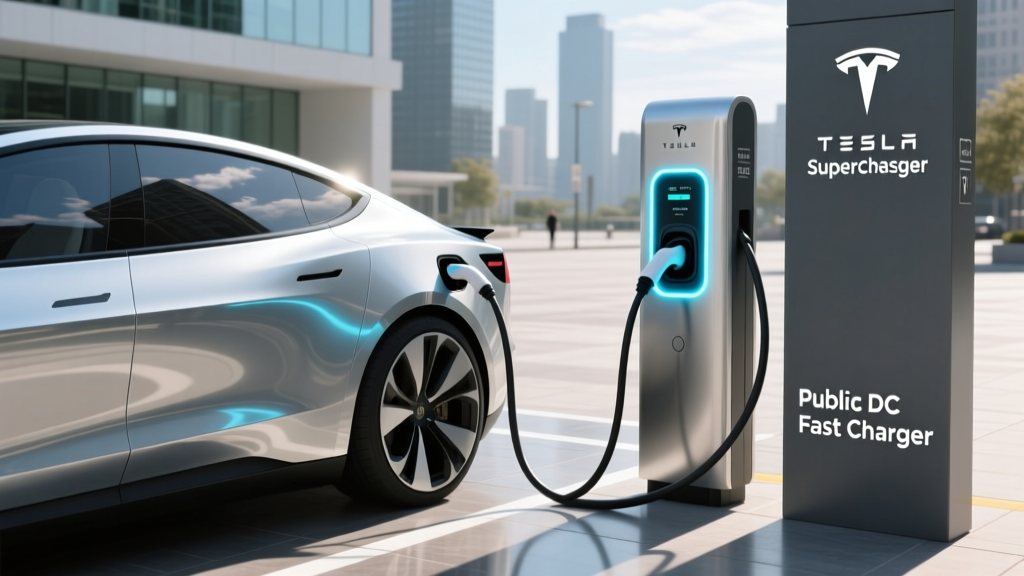
| DC Fast (150 kW) | 400V DC | 150 kW | ~500+ mi/hr (peak) | Road trips, public stations, 10–80% in ~20–30 min |
| DC Fast (350 kW) | 800V DC | 350 kW | ~1,000+ mi/hr (peak) | Hyundai Ioniq 5/6, Porsche Taycan, Kia EV6 — 10–80% in ~18 min |
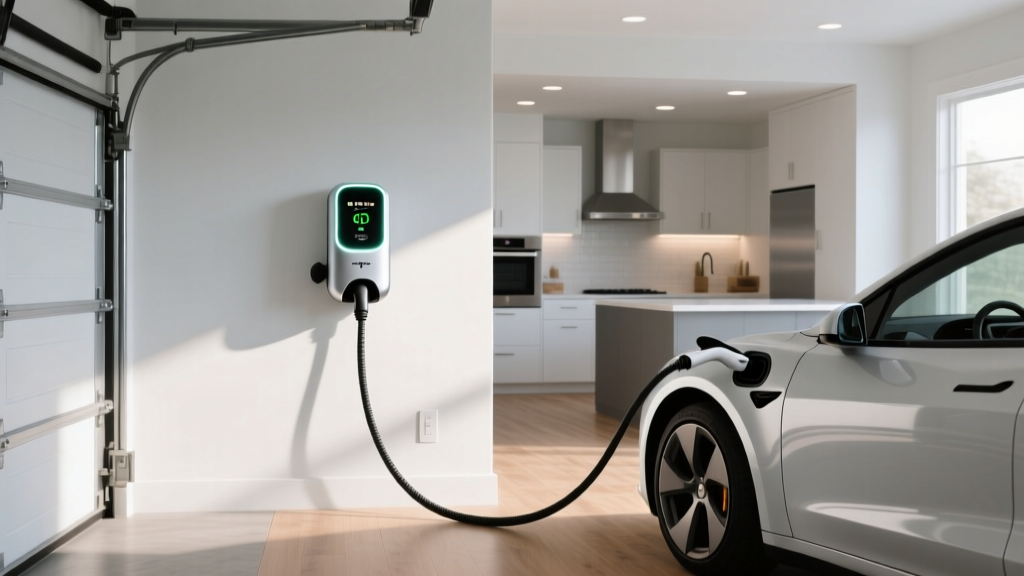
For most homeowners, a 48A black Level 2 unit on a 60A breaker is the sweet spot: it fully replenishes a 75–100 kWh battery overnight and matches the onboard charger capacity of vehicles like the Tesla Model Y (11.5 kW AC max) and Ford F-150 Lightning Extended Range (19.2 kW AC capable).
Home Installation Cost: Equipment, Electrician, Permits, and Panel Upgrades
The wallbox itself is usually the cheapest line item. Labor, conduit runs, and possible panel work dominate the final invoice. Based on 2025–2026 installer surveys and quotes aggregated across U.S. metro areas, expect the following ranges for a hardwired 48A or 60A black charger install:
| Line Item | Low End | High End | Notes |
|---|---|---|---|
| Level 2 charger (black, 40–48A, NACS/CCS) | $350 | $750 | Wi-Fi smart units cost more |
| Electrician labor (2–6 hours) | $400 | $1,500 | Depends on conduit run length, drywall work |
| Materials (wire, conduit, breaker, disconnect) | $150 | $400 | Long runs in finished walls increase cost |
| Permit and inspection | $50 | $250 | Required in most jurisdictions for new 240V circuits |
| Electrical panel upgrade (if needed) | $1,500 | $4,500 | Older 100A panels often need 200A service for 48A+ chargers |
| Total (no panel upgrade) | $950 | $2,900 | Most common scenario for post-2000 homes |
| Total (with panel upgrade) | $2,450 | $7,400 | Common in pre-1990 homes with 100A service |
The NEC requires the continuous load of an EV charger to be no more than 80% of the breaker rating. That means a 48A charger needs a 60A breaker; a 32A charger fits a 40A breaker. Hardwired installs avoid the NEMA 14-50 receptacle debate (loose outlets have caused documented fires), and most black chargers from Emporia, ChargePoint, and Wallbox ship with both hardwire and plug options.
Connector Compatibility: NACS, CCS1, and CHAdeMO in 2026
By the 2026 model year, nearly every major automaker selling in the U.S. — Ford, GM, Rivian, Volvo, Polestar, Mercedes-Benz, BMW, Hyundai, Kia, Lucid, Fisker — has adopted the North American Charging Standard (NACS, the former Tesla connector) as the native charge port on new vehicles. Legacy CCS1 vehicles remain on the road, and CHAdeMO is effectively limited to the Nissan Leaf and older Mitsubishi Outlander PHEV.
| Connector | Brands (native 2026) | Adapter Required? |
|---|---|---|
| NACS (Tesla / SAE J3400) | Tesla, Ford, GM, Rivian, Volvo, Polestar, Mercedes, BMW, Hyundai, Kia, Lucid | No — buy a NACS-terminated charger for new EVs |
| CCS1 | 2024 and older Ford/GM/VW/Hyundai/Kia, remaining Stellantis models | NACS-to-CCS adapter ($150–$250) if charger is NACS |
| CHAdeMO | Nissan Leaf (all years), older Mitsubishi | CHAdeMO-specific DC station; no home Level 2 equivalent issue (L2 uses J1772) |
| J1772 (Level 1/2) | All non-Tesla EVs pre-2025; still the L2 standard for CCS cars | Tesla Mobile Connector includes J1772 adapter |
Practical advice: if you own a 2025+ Ford, GM, or Rivian, buy a NACS-terminated black charger. If you own a 2022–2024 CCS vehicle you plan to keep long-term, a CCS/J1772-terminated unit plus a NACS adapter (for future-proofing) makes sense. The black Emporia V2L-capable and Wallbox Pulsar Plus models both ship with configurable connector pigtails.
Cost to Charge Per Mile vs Gasoline
The economic argument for home charging rests on electricity rates, not public DCFC prices. A 2026 national average residential rate hovers around $0.16/kWh (per EIA data), while DC fast-charging networks charge $0.35–$0.60/kWh. Compare that against $3.40/gallon regular unleaded at 28 MPG combined:
| Scenario | Energy Cost | Vehicle Efficiency | Cost Per Mile |
|---|---|---|---|
| Home Level 2 (national avg) | $0.16/kWh | 3.2 mi/kWh | $0.050 |
| Home Level 2 (off-peak TOU, CA/NE) | $0.09/kWh | 3.2 mi/kWh | $0.028 |
| Home Level 2 (peak TOU, summer) | $0.35/kWh | 3.2 mi/kWh | $0.109 |
| Public DCFC (Electrify America, EVgo avg) | $0.48/kWh | 3.2 mi/kWh | $0.150 |
| Gasoline (28 MPG combined) | $3.40/gallon | 28 mi/gal | $0.121 |
| Gasoline (truck, 19 MPG) | $3.40/gallon | 19 mi/gal | $0.179 |
Home off-peak charging delivers roughly a 4× cost advantage over gasoline. Public DC fast charging is often more expensive per mile than a fuel-efficient gas car — which is why a reliable black Level 2 charger at home is the single highest-leverage purchase an EV owner makes.
Top Black EV Chargers for Home Use in 2026
Units below were selected for black enclosure availability, continuous-duty amperage rating, UL/ETL listing, smart features, and cable quality. Prices reflect Q1 2026 MSRPs before any utility rebates.
Emporia V2 Vue-Linked Charger (Black, 48A)
- Power output: 48A / 11.5 kW (hardwired, 60A breaker)
- Connector: J1772 or NACS (selectable at purchase)
- Cable length: 24 ft
- Smart features: Solar-aware scheduling via Emporia Vue panel monitor, load management, Wi-Fi, utility TOU integration
- Price: $399
- Best for: Homes with solar or Emporia Vue energy monitors; budget-conscious buyers who want 48A without paying premium brand tax
Wallbox Pulsar Plus (Black, 48A)
- Power output: 48A / 11.5 kW (hardwired or NEMA 14-50)
- Connector: J1772 (NACS adapter bundled with 2025+ kits)
- Cable length: 25 ft
- Smart features: Power Sharing (daisy-chain two units on one circuit), app scheduling, OTA updates, Bluetooth fallback
- Price: $549
- Best for: Two-EV garages; the Power Sharing feature lets two Pulsars split a single 60A circuit dynamically
ChargePoint Home Flex (Black, 50A)
- Power output: Configurable 16–50A / up to 12 kW (NEMA 14-50 or hardwire)
- Connector: J1772 (NACS pigtail available)
- Cable length: 23 ft
- Smart features: Alexa integration, detailed app energy reporting, utility demand-response programs, flexible amperage dip-switch
- Price: $699
- Best for: Homes with older panels — the dip-switch lets you set 32A on a 40A breaker without buying a different unit
Tesla Wall Connector (Black Glass Face, 48A)
- Power output: 48A / 11.5 kW (hardwired, 60A breaker)
- Connector: NACS native (J1772 adapter included in box)
- Cable length: 24 ft
- Smart features: Wi-Fi OTA updates, Tesla app integration, Power Sharing with second Wall Connector, vehicle-charge-port auto-open
- Price: $475
- Best for: Tesla-only or Tesla-primary households; the black glass fascia version matches Model Y/3 Highland trim best
Grizzl-E Smart (Satin Black, 40A)
- Power output: 40A / 9.6 kW (NEMA 14-50 or hardwire)
- Connector: J1772 or NACS
- Cable length: 24 ft
- Smart features: OCPP-compatible (works with utility programs), -40°C cold-weather rating, aluminum enclosure
- Price: $449
- Best for: Cold-climate and outdoor installs; Canadian-built, proven in -30°F winters without cable stiffening
Real-World Charging Times for Common Battery Sizes
The 10–80% window is what matters for daily use — charging slows dramatically above 80% as the battery management system tapers current to protect cell health. These times assume a hardwired black 48A Level 2 charger at full 11.5 kW, with a 240V stable supply:
- Tesla Model Y Long Range (75 kWh usable): 10–80% in ~4 hours 30 minutes
- Ford Mustang Mach-E Extended Range (91 kWh usable): 10–80% in ~5 hours 40 minutes
- Hyundai Ioniq 5 (77.4 kWh usable): 10–80% in ~4 hours 45 minutes
- Ford F-150 Lightning Extended Range (131 kWh usable): 10–80% in ~8 hours 15 minutes
- Chevrolet Equinox EV (85 kWh usable): 10–80% in ~5 hours 15 minutes
- BMW iX xDrive50 (111.5 kWh usable): 10–80% in ~7 hours
Owners of 100+ kWh batteries (Lightning, Rivian R1T Dual-Motor Max, Hummer EV) should strongly consider a 60A or 80A charger if their panel supports it — the 80A / 19.2 kW option cuts the Lightning's 10–80% time to roughly 5 hours, which matters if you drive 200+ miles daily or tow frequently.
Safety, Code, and Electrical Requirements
A Level 2 charger is a continuous load — defined by the NEC as operating for 3 hours or more — and the circuit must be sized at 125% of the charger's rated amperage. Specific requirements that frequently catch homeowners off guard:
- Dedicated circuit: EV chargers cannot share a breaker with other appliances. A 48A charger needs a dedicated 60A breaker.
- GFCI protection: NEC 2020 and later require GFCI protection on 240V receptacles in garages. Hardwired chargers bypass this requirement, which is one reason installers increasingly recommend hardwiring.
- Outdoor rating: If mounting outside, confirm the unit is rated NEMA 4 (weatherproof). All five chargers above carry at least NEMA 4 ratings; Grizzl-E specifically markets its -40°C cold rating.
- Wire gauge: 48A on a 60A breaker typically requires 6 AWG copper THHN; 80A requires 3 AWG. Your electrician will size based on run length and local code.
- Panel capacity: A 200A residential panel can typically support a 60A EV circuit if other major loads (electric range, dryer, HVAC) are gas or modest. A 100A panel almost always requires an upgrade before adding 48A+ charging.
- Permit: Most jurisdictions require a permit for new 240V circuits; skipping it can void homeowner's insurance in the event of a fire.
The National Electrical Code (NFPA 70) is the baseline, but local amendments vary. Get three quotes and confirm each electrician is pulling a permit — the cheapest bid often skips this step.
Frequently Asked Questions
How much does it cost to install a black home EV charger?
Between $950 and $2,900 all-in for most post-2000 homes with a 200A panel, including a $350–$750 black Level 2 unit, $400–$1,500 electrician labor, $150–$400 in materials, and a $50–$250 permit. Homes with 100A service will likely need a $1,500–$4,500 panel upgrade, pushing total cost to $2,450–$7,400.
How fast will each charging level add range?
Level 1 (120V) adds 3–5 miles per hour. Level 2 at 32A adds 23–27 mi/hr; at 48A adds 34–40 mi/hr; at 80A adds 56–67 mi/hr. DC fast charging at 150 kW adds roughly 500+ mi/hr at peak, delivering 10–80% in 20–30 minutes on most vehicles. Exact figures depend on your vehicle's mi/kWh efficiency.
Which connector is compatible with my EV?
If you own a 2025 or newer Ford, GM, Rivian, Volvo, Polestar, BMW, Mercedes, Hyundai, or Kia, your vehicle has a NACS port — buy a NACS-terminated charger. Older CCS1 vehicles need a J1772 Level 2 charger with a NACS adapter for future-proofing. The Nissan Leaf uses J1772 for Level 2 and CHAdeMO for DC fast charging.
How much does charging cost per mile vs gas?
Home Level 2 charging at the national average $0.16/kWh costs about $0.05 per mile in a typical EV — roughly 60% less than a 28 MPG gas car at $3.40/gallon ($0.12/mi). Off-peak TOU rates as low as $0.09/kWh drop the EV cost to $0.028/mi. Public DC fast charging at $0.48/kWh costs $0.15/mi, which is more expensive than most gas cars — use DCFC for road trips, not daily charging.
What electrical upgrades might I need?
The most common and expensive upgrade is a panel replacement from 100A to 200A service ($1,500–$4,500), required in older homes that want 48A+ charging. You may also need a new breaker slot (your panel must have physical space for a 2-pole 60A breaker), upgraded service entrance wire if coming from overhead, or a meter-main combo replacement in homes with original 1970s equipment. A licensed electrician's load calculation is the only way to know for certain.
Does the color of the charger affect performance?
No. Black enclosures use the same internal power electronics as white or gray versions of the same model. Black does resist visible scuffing and UV yellowing slightly better over a 10-year lifespan, which is why it's a popular choice for finished garages and outdoor mounts in sunny climates.