Why Aesthetics Matter in Your Garage: The Black Charger Trend
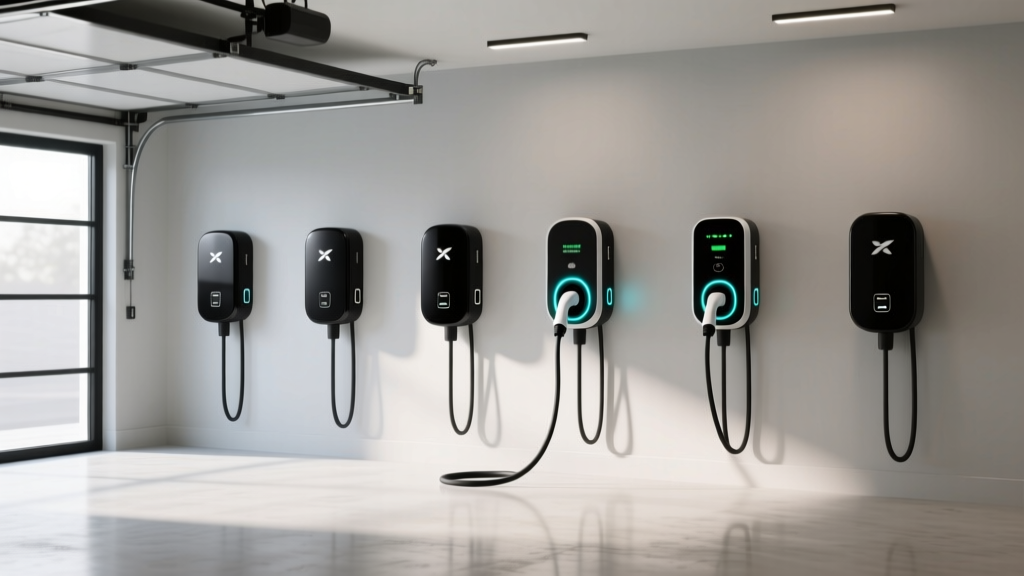
When you mount a Level 2 wall charger in your garage or on your home's exterior, it becomes a permanent fixture — visible every day and often part of your home's curb appeal. That's why the "charger black" search trend has grown among EV owners who want a sleek, minimalist unit that blends with modern architecture rather than standing out in industrial white or bright green. Fortunately, most premium Level 2 chargers ship in black or dark-gray finishes as standard, and several manufacturers now treat industrial design as a selling point alongside electrical performance.
But finish is only skin-deep. The real decision involves power output (kW), connector type (NACS vs CCS1), cable length, smart features, and — critically — whether your home's electrical panel can support a dedicated 240V circuit. This guide walks through every factor, with exact numbers for 2026's leading black-finish chargers.
Understanding Charging Levels: kW Power and Miles Per Hour
The single most common point of confusion for new EV owners is the difference between kW (kilowatts), which measures the rate of energy delivery, and kWh (kilowatt-hours), which measures the total amount of energy stored in your battery. Think of kW as the width of the pipe and kWh as the size of the tank. A 11.5 kW charger fills your battery faster than a 7.2 kW charger — period.
Here is how each charging level translates into real-world range recovery:
| Level | Voltage / Amps | Max Power (kW) | Miles of Range Per Hour | Typical Use Case |
|---|---|---|---|---|
| Level 1 | 120V / 12A | 1.4 kW | 3–5 mi/hr | Overnight trickle; PHEVs with small batteries |
| Level 2 | 240V / 32–48A | 7.7–11.5 kW | 25–44 mi/hr | Daily home charging; primary method for most BEV owners |
| DC Fast Charge | 400–800V DC | 50–350 kW | 150–1,200+ mi/hr | Road trips; 10–80% in 15–30 minutes |
Home Installation: Electrical Requirements and True Costs
Before ordering any charger, confirm your electrical panel has capacity for a dedicated 240V circuit. Most Level 2 chargers require either a NEMA 14-50 outlet (for plug-in units, 50A breaker supporting up to 40A continuous draw) or a hardwired connection (which can support up to 48A or even 64A continuous on a properly sized breaker). The National Electrical Code (NEC) requires that continuous loads not exceed 80% of breaker capacity — so a 50A breaker supports 40A continuous, and a 60A breaker supports 48A continuous.
Panel Upgrade Reality Check
Homes built before 2000 often have 100A or even 60A main panels. Adding a 50A EV circuit to an already-loaded 100A panel may require a panel upgrade to 200A, which is the single largest variable in installation cost. A licensed electrician will perform a load calculation per NEC Article 220 to determine if your panel has headroom. If your panel is in a detached garage or the run from panel to charger location exceeds 50–70 feet, wire costs escalate significantly.
| Component | Low End | High End | Notes |
|---|---|---|---|
| Level 2 Charger Unit | $350 | $750 | Varies by kW output, smart features, cable length |
| Electrical Permit | $50 | $200 | Required in most jurisdictions; varies by city/county |
| Electrician Labor (short run) | $300 | $800 | Panel to charger under 30 ft, accessible attic/crawlspace |
| Electrician Labor (long run) | $800 | $2,000+ | Long wire runs, conduit, trenching, or through finished walls |
| Panel Upgrade (if needed) | $1,500 | $4,000 | 100A to 200A service upgrade; older homes most likely |
| Total (no panel upgrade) | $700 | $2,750 | Most homes with modern 200A panels |
| Total (with panel upgrade) | $2,200 | $6,750 | Older homes or high-load existing panels |
Always get at least two quotes from licensed electricians, and verify they pull a permit — unpermitted EV charger work can void homeowner's insurance claims and complicate future home sales. According to the National Electrical Contractors Association, improper EV charging installations have been a growing cause of residential electrical fires, making code compliance essential.
Connector Compatibility: NACS, CCS1, and CHAdeMO in 2026
The connector landscape has consolidated significantly. Tesla's North American Charging Standard (NACS) has been adopted by Ford, GM, Rivian, Volvo, Polestar, Mercedes-Benz, BMW, and most major automakers for their 2025–2026 models. CCS1 (Combined Charging System) remains on many vehicles sold through 2024–2025, and CHAdeMO is effectively limited to the Nissan LEAF, now in its final production years.
| Connector | Brands Using It (2026) | Adapter Needed? |
|---|---|---|
| NACS (Tesla standard) | Tesla, Ford, GM, Rivian, Volvo, Polestar, Mercedes, BMW, Hyundai/Kia (select) | No — native on new models |
| CCS1 | Hyundai, Kia, VW, Audi, Stellantis (legacy models), Honda Prologue | CCS-to-NACS adapter ($150–$250) for Supercharger access |
| CHAdeMO | Nissan LEAF (discontinued after 2025) | No adapter available for DC fast; CHAdeMO stations declining |
For your home Level 2 charger, the connector choice is simpler: all Level 2 chargers use the J1772 connector (for non-Tesla) or NACS (for Tesla and NACS-native vehicles). Tesla includes a J1772 adapter with every vehicle, and most aftermarket NACS chargers include or offer a J1772 adapter. If you own a CCS1 vehicle today but plan to switch to a NACS-native vehicle within a few years, buying a NACS-connector charger with a J1772 adapter is the most future-proof path.
Top Black-Finish Level 2 Chargers: Specs and Prices
Below are the leading black-finish Level 2 wall chargers available in 2026, ranked by power output and feature set. All units listed are UL-listed (or ETL-listed to UL standards), which is required for code compliance and insurance.
Tesla Wall Connector (Gen 4) — NACS
- Power Output: Up to 11.5 kW (48A) on a 60A circuit
- Connector: NACS native; J1772 adapter available (~$50)
- Cable Length: 24 feet
- Smart Features: Wi-Fi connectivity, over-the-air updates, scheduled charging via Tesla app, Power Sharing (link two units on one circuit)
- Finish: Matte black with black or silver faceplate options
- Price: ~$475 (charger only)
- Best For: Tesla owners and NACS-native vehicle buyers who want maximum power at a mid-range price
ChargePoint Home Flex (2nd Gen) — J1772 or NACS
- Power Output: Up to 12 kW (50A) on a 60A circuit (selectable down to 16A for lower-capacity panels)
- Connector: Available in J1772 or NACS configurations; NACS version launched late 2025
- Cable Length: 23 feet
- Smart Features: Wi-Fi + Bluetooth, ChargePoint app with detailed energy tracking, Alexa/Google Home integration, flexible amperage dial for panel-constrained homes
- Finish: Satin black
- Price: ~$599 (J1772), ~$649 (NACS)
- Best For: Multi-EV households with different connector needs, or homes with limited panel capacity that need adjustable amperage
Emporia Vue Level 2 Charger — J1772
- Power Output: Up to 11.5 kW (48A) on a 60A circuit
- Connector: J1772 (NACS adapter available separately)
- Cable Length: 24 feet
- Smart Features: Wi-Fi, Emporia Energy app with real-time cost tracking, integration with Emporia Vue home energy monitor for solar-aware charging, scheduled and off-peak optimization
- Finish: Matte black
- Price: ~$399
- Best For: Budget-conscious buyers and solar-panel owners who want energy-cost tracking and solar-divert charging
Grizzl-E Smart — J1772
- Power Output: Up to 10 kW (40A) on a 50A circuit
- Connector: J1772
- Cable Length: 24 feet
- Smart Features: Wi-Fi, OCPP-compatible (works with utility demand-response programs), adjustable amperage (16A–40A), built-in load management
- Finish: Matte black aluminum housing
- Price: ~$449
- Best For: Cold-climate owners (rated to -40°F) and utility-program participants needing OCPP compatibility
Charging Time Examples for Common Battery Sizes
Here is how long a full Level 2 session takes for popular 2026 EVs on a 48A / 11.5 kW charger. Times shown are for a 10–80% State of Charge (SoC) session, which is the daily-useful range most owners target to preserve battery longevity:
| Vehicle | Battery (kWh usable) | Onboard AC Limit | 10–80% Time at 11.5 kW |
|---|---|---|---|
| Tesla Model Y Long Range | 75 kWh | 11.5 kW | ~4.5 hours |
| Hyundai IONIQ 5 (Long Range) | 77.4 kWh | 10.9 kW | ~5.0 hours |
| Ford Mustang Mach-E Extended Range | 91 kWh | 10.5 kW | ~6.0 hours |
| Chevrolet Equinox EV | 85 kWh | 11.5 kW | ~5.2 hours |
| Toyota bZ4X | 64 kWh | 7.2 kW | ~5.0 hours (limited by onboard charger) |
Note that the Toyota bZ4X has a 7.2 kW onboard AC charger limit, meaning even a 48A / 11.5 kW wall unit can only deliver 7.2 kW to its battery. This is a vehicle limitation, not a charger limitation. Always check your EV's onboard AC charging rate — listed in the owner's manual or on fueleconomy.gov — to avoid over-investing in a high-power charger your car cannot fully use.
Charging Cost Per Mile: Home vs Public vs Gas
The economic case for home charging rests on the gap between residential electricity rates and gasoline prices. Below is a comparison using national averages as of early 2026, with regional variation noted.
| Scenario | Rate | Vehicle Efficiency | Cost Per Mile |
|---|---|---|---|
| Home Level 2 (national avg electricity) | $0.17/kWh | 3.0 mi/kWh (typical EV) | $0.057/mi |
| Home Level 2 (off-peak TOU rate) | $0.09/kWh | 3.0 mi/kWh | $0.030/mi |
| Public Level 2 (network pricing) | $0.35/kWh | 3.0 mi/kWh | $0.117/mi |
| DC Fast Charge (Electrify America, Tesla Supercharger) | $0.40–$0.55/kWh | 3.0 mi/kWh | $0.133–$0.183/mi |
| Gasoline (28 MPG combined, $3.40/gal) | $3.40/gal | 28 MPG | $0.121/mi |
| Gasoline (22 MPG combined, $3.40/gal) | $3.40/gal | 22 MPG | $0.155/mi |
At home off-peak rates, an EV costs roughly $0.03 per mile — about one-fifth the cost of a 28 MPG gas car. Even on public DC fast chargers at $0.50/kWh, the EV is roughly cost-competitive with a 22 MPG truck. The key takeaway: home charging is where the economics work best. Relying exclusively on public DC fast charging erases most of the fuel-cost advantage and can accelerate battery degradation due to sustained high-C-rate charging.
Many utilities offer Time-of-Use (TOU) plans that drop rates to $0.07–$0.10/kWh between 11 PM and 6 AM. Programming your charger's scheduled charging feature to start at midnight can cut your annual fuel cost by 40–50% compared to unmanaged charging. Check your utility's EV rate plans — most are listed on the Department of Energy's EV rate plan directory.
Safety, Code Compliance, and Outdoor Considerations
A compliant Level 2 installation is not optional — it protects your home, your insurance coverage, and future resale value. Key requirements include:
- Dedicated circuit: Your EV charger must be on its own breaker — no shared circuits with dryers, HVAC, or workshop tools.
- GFCI protection: NEC 2023 (Article 625.54) requires GFCI protection for all receptacles used for EV charging. Hardwired installations may have different GFCI requirements depending on jurisdiction; your electrician will apply the local code.
- Outdoor rating: If mounting outdoors, the charger must carry a NEMA 4 (or IP65+) rating for weather resistance. All chargers listed above meet this standard.
- UL/ETL listing: Only install chargers that carry a UL or ETL listing mark. Uncertified units from overseas marketplaces may not meet NEC requirements and will fail inspection.
- Cable management: A 24-foot cable is heavy. Wall-mounted cable organizers or retractors (often $30–$50) prevent tripping hazards and cable wear.
Federal Tax Credit for Home Charging Equipment
The IRS Alternative Fuel Vehicle Refueling Property Credit (IRC §30C) covers up to 30% of home EV charger equipment and installation costs, capped at $1,000. However, this credit is only available for installations in eligible census tracts (low-income or non-urban areas). Check the IRS eligibility tool at irs.gov before assuming you qualify. The credit is non-refundable and claimed on your federal tax return for the year of installation.
Frequently Asked Questions
How much does it cost to install a home EV charger?
For a home with an existing 200A electrical panel and a short wire run (under 30 feet), expect to pay $700–$1,500 total including the charger unit, permit, and electrician labor. If your panel needs upgrading from 100A to 200A, total project cost rises to $2,200–$6,750. Always get a load calculation from a licensed electrician before committing to a charger purchase.
How fast will each charging level add range?
Level 1 (120V) adds 3–5 miles per hour — adequate for PHEVs with 30–40 mile batteries but impractical for full BEVs. Level 2 (240V, 32–48A) adds 25–44 miles per hour, easily replenishing a day's driving in 2–4 hours. DC Fast Charging adds 150–1,200+ miles per hour at peak power, but is intended for road trips, not daily use, due to higher cost and battery wear from sustained high-rate sessions.
Which connector or charger is compatible with my EV?
For 2026 models: Tesla, Ford, GM, Rivian, Volvo, Polestar, and most new BMW/Mercedes vehicles use NACS. Hyundai, Kia, VW, Audi, Honda, and Stellantis legacy models use CCS1 (with J1772 for AC Level 2). The Nissan LEAF uses CHAdeMO. At home, all EVs charge via J1772 or NACS — check your vehicle's AC charging port and buy the matching connector, or use an adapter.
How much does charging cost per mile compared to gas?
Home Level 2 charging at the national average electricity rate ($0.17/kWh) costs about $0.057 per mile for a typical EV. Off-peak TOU rates can drop this to $0.03 per mile. A comparable 28 MPG gas car at $3.40/gallon costs $0.121 per mile. The savings gap is largest when charging at home overnight and narrowest when relying on public DC fast chargers at $0.45–$0.55/kWh.
What electrical upgrades might I need for a Level 2 charger?
The most common upgrade is a panel capacity increase from 100A to 200A service, needed in older homes where the existing panel is near capacity. Other potential upgrades include: running new 6-gauge or 4-gauge copper wire from the panel to the charger location, installing a NEMA 14-50 receptacle (for plug-in chargers) or a junction box (for hardwired units), and adding GFCI breaker protection per NEC 2023 requirements. Your electrician's load calculation will determine exactly what is needed.