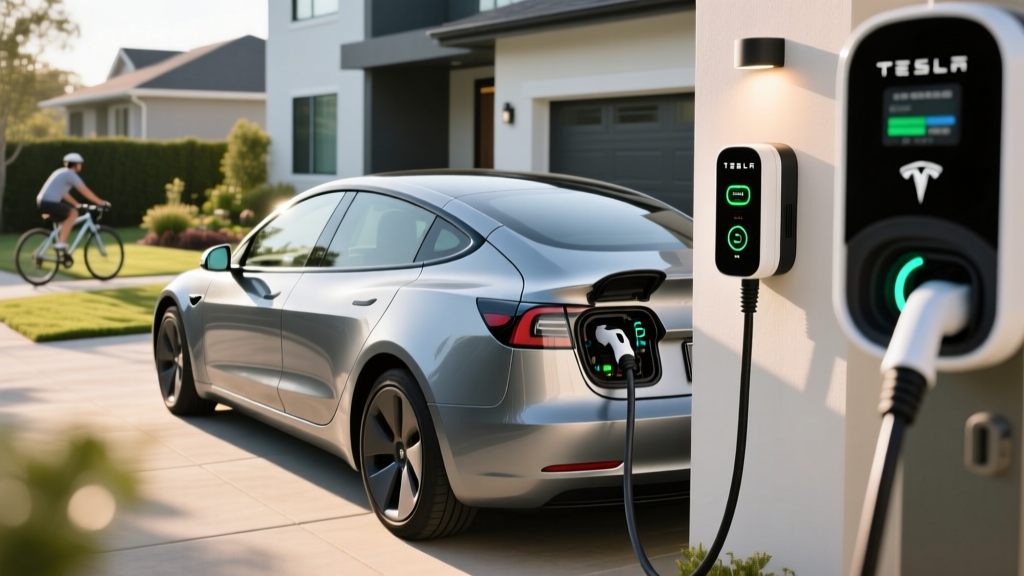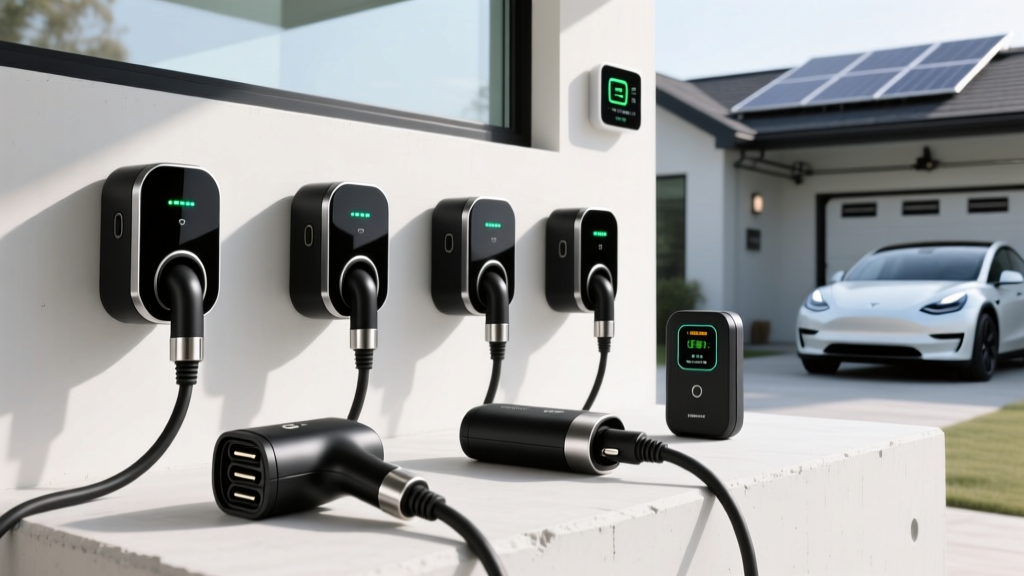
If you've searched for a "charger car black" hoping to find a sleek, dark-finished Level 2 home EV charger, you're not alone. Black housings dominate the EV charging market — they hide garage dust, match modern exteriors, and resist UV yellowing far better than white plastics. But aesthetics should never outrank electrical safety, sustained power delivery, or connector compatibility. This guide breaks down the best black EV chargers available in 2026, what it actually costs to install one, and how to avoid the panel-upgrade trap that catches many older-home buyers off guard.
Charging Levels Explained: How Fast Will Each Add Range?
The single most important EV literacy point is the difference between kW (power, i.e. how fast energy flows) and kWh (energy, i.e. how much the battery stores). Think of kW as the width of a hose and kWh as the size of the bucket. A 48 kW charger fills a 75 kWh battery far faster than a 7.2 kW unit, but both deliver the same electrons — just at different rates.
| Level | Voltage | Typical Power (kW) | Miles of Range Added Per Hour | Best Use Case |
|---|---|---|---|---|
| Level 1 | 120V AC | 1.0–1.4 kW | 3–5 mi/hr | Overnight top-up, PHEVs, emergency |
| Level 2 (Home) | 240V AC | 7.2–11.5 kW | 22–44 mi/hr | Daily home charging, most BEVs |
| Level 2 (Public) | 208–240V AC | 6.6–19.2 kW | 20–70 mi/hr | Workplace, retail, apartments |
| DC Fast (Level 3) | 400–800V DC | 50–350 kW | 180–1,200+ mi/hr (peak) | Road trips, highway corridors |
For a typical 75 kWh battery (think Tesla Model Y, Hyundai Ioniq 5, Ford Mustang Mach-E), a 48-amp / 11.5 kW Level 2 charger adds roughly 40 miles of range per hour, reaching 10–80% State of Charge (SoC) in about 5–6 hours. A 32-amp / 7.7 kW unit stretches that to 8–9 hours — fine for overnight, but tight if you drive 80+ miles daily and arrive home near empty.
Home Installation: Electrical Requirements, Permits & Real Costs
A Level 2 charger isn't plug-and-play unless you already have a 240V outlet (like a dryer receptacle) within cable reach. Most installations require a dedicated circuit run from your main panel, and the cost varies wildly depending on your home's age, panel capacity, and the distance from panel to garage.
What Your Electrician Will Check
- Panel capacity: A 48A charger needs a 60A breaker (NEC 125% continuous-load rule). If your home has a 100A main panel already near capacity, you'll need a panel upgrade to 200A — adding $1,500–$3,500 to the project.
- Circuit run distance: Longer runs require thicker (and pricier) copper wire — 6 AWG for 48A, 8 AWG for 32A.
- Outlet vs hardwire: A NEMA 14-50 outlet offers portability; hardwiring is safer for higher amperages and avoids GFCI nuisance trips common with 14-50 receptacles on some panels.
- Permit and inspection: Most jurisdictions require an electrical permit ($50–$200) and a post-install inspection to close the permit. Skipping this risks insurance denial in a fire event.
| Item | Typical Cost Range | Notes |
|---|---|---|
| Level 2 Charger (Equipment) | $350–$750 | Smart Wi-Fi units cost more; dumb units are cheaper |
| Electrician Labor (standard run) | $500–$1,500 | Short run, same wall as panel, drywall |
| Electrician Labor (long/complex) | $1,500–$3,000 | Attic crawl, concrete cutting, detached garage |
| Permit & Inspection | $50–$250 | Varies by municipality |
| Panel Upgrade (if needed) | $1,500–$3,500 | 100A → 200A service; not always required |
| EVSE Mounting & Conduit | $100–$400 | Outdoor-rated post or wall bracket |
| Total (no panel upgrade) | $900–$2,900 | Most homes with 200A service |
| Total (with panel upgrade) | $2,500–$6,500 | Older homes with 100A service |
Connector Compatibility: NACS, CCS1, and CHAdeMO in 2026
The connector landscape has consolidated significantly. As of 2026, the North American Charging Standard (NACS) — originally Tesla's proprietary plug — is the dominant connector for new EVs. Ford, GM, Rivian, Hyundai, Kia, and most major OEMs now ship with NACS charge ports. The CCS1 connector still appears on legacy models (VW ID.4 built before 2025, some BMW iX), while CHAdeMO is effectively discontinued outside the used Nissan Leaf market.
| Connector | Common Vehicles (2026) | Home Charger Availability | Adapter Needed? |
|---|---|---|---|
| NACS (Tesla/J3400) | Tesla Model 3/Y/S/X, Ford F-150 Lightning, GM Ultium vehicles, Hyundai Ioniq 5/6 (2025+), Rivian R1S/R1T | Widely available — Tesla Wall Connector, ChargePoint, Emporia | CCS-to-NACS adapters ~$150–$250 for legacy chargers |
| CCS1 | VW ID.4 (pre-2025), BMW i4/iX (pre-2025), older Hyundai/Kia models | Still available; being phased out in favor of NACS | NACS-to-CCS1 adapter for newer NACS home chargers |
| CHAdeMO | Nissan Leaf (all years), Mitsubishi Outlander PHEV (older) | Rare for home; mostly public DC stations | No practical adapter to NACS for DC fast charging |
If you own a CCS1 vehicle but want a future-proof NACS charger, budget $150–$250 for a certified adapter. If you drive a Tesla and plan to use third-party public chargers, Tesla includes a NACS-to-CCS adapter with new vehicles as of 2025.
Cost to Charge: Home vs Public vs Gas — Per Mile Breakdown
Charging economics depend entirely on your local electricity rate and whether you can charge at home during off-peak hours. The national average residential rate in 2026 is roughly $0.16/kWh, but time-of-use (TOU) plans can drop that to $0.08–$0.10/kWh overnight. Public DC fast charging is significantly more expensive — typically $0.35–$0.55/kWh at networks like Electrify America, EVgo, and Tesla Superchargers.
| Scenario | Rate ($/kWh) | Efficiency (kWh/100 mi) | Cost Per Mile | Equiv. Gas Price at 28 MPG |
|---|---|---|---|---|
| Home Off-Peak (TOU) | $0.09 | 30 kWh/100 mi | $0.027 | $0.76/gallon |
| Home Standard Rate | $0.16 | 30 kWh/100 mi | $0.048 | $1.34/gallon |
| Public Level 2 (ChargePoint) | $0.25 | 30 kWh/100 mi | $0.075 | $2.10/gallon |
| DC Fast Charging | $0.45 | 30 kWh/100 mi | $0.135 | $3.78/gallon |
| Gas Car (28 MPG avg) | — | — | $0.125 | $3.50/gallon |
At home off-peak rates, driving an EV costs roughly one-fifth of an equivalent gas car. Even at DC fast charging rates, you're near parity with gas — which is why exclusive public-DC charging erases most of the EV cost advantage. Home charging is the economic backbone of EV ownership. According to fueleconomy.gov, the average EV uses 25–35 kWh per 100 miles depending on weight and aerodynamics.
Best Black EV Chargers: Equipment Picks for 2026
Below are the top-rated black-finish Level 2 home chargers based on sustained power delivery, build quality, smart features, and connector availability. All prices reflect MSRP as of early 2026.
ChargePoint Home Flex (Black)
- Power Output: Up to 11.5 kW (48A) on a 60A circuit; configurable down to 16A
- Connector: NACS (J3400) — CCS1 adapter available separately
- Cable Length: 23 feet
- Smart Features: Wi-Fi, app scheduling, Alexa integration, energy tracking, TOU optimization
- Price: ~$699
- Best For: Drivers wanting app-based scheduling and utility TOU integration
Emporia Vue Smart EV Charger (Black)
- Power Output: Up to 11.5 kW (48A)
- Connector: NACS (J3400)
- Cable Length: 24 feet
- Smart Features: Wi-Fi, integrates with Emporia whole-home energy monitor, solar-aware charging, TOU scheduling
- Price: ~$449
- Best For: Solar-panel owners and budget-conscious buyers wanting smart features
Grizzl-E Smart (Black)
- Power Output: Up to 10 kW (40A) on a 50A circuit
- Connector: NACS (J3400) — CCS1 version also available
- Cable Length: 24 feet
- Smart Features: Wi-Fi, OCPP-compatible, adjustable amperage, extreme cold-rated (-40°F)
- Price: ~$549
- Best For: Cold-climate owners and outdoor installations; built in Canada
Tesla Wall Connector (Black)
- Power Output: Up to 11.5 kW (48A)
- Connector: NACS native
- Cable Length: 24 feet
- Smart Features: Wi-Fi, OTA firmware updates, power sharing (link multiple units on one circuit), Tesla app integration
- Price: ~$475
- Best For: Tesla owners who want seamless integration and clean aesthetics
Safety, Code & Smart Features Worth Paying For
Every Level 2 installation in the U.S. must comply with NEC Article 625 (National Electrical Code for EV charging). Key requirements that affect your install:
- Dedicated circuit: Your EV charger must be on its own breaker — no sharing with dryers, ranges, or HVAC.
- Continuous-load derating: NEC treats EV charging as a continuous load, meaning a 48A charger requires a 60A breaker (48A × 1.25 = 60A). Never install a charger that draws more than 80% of the breaker rating.
- GFCI protection: The 2023 NEC update requires GFCI for indoor and outdoor EV receptacles. Hardwired units are exempt, which is one reason many electricians prefer hardwiring.
- Outdoor rating: If mounting outside, ensure the charger carries a NEMA 4 (weatherproof) rating. All picks above are outdoor-rated.
- UL listing: Only purchase UL-listed (or ETL-listed) chargers. Uncertified imports from marketplace sellers may lack overcurrent and ground-fault protection — a serious fire risk.
Charging Time Examples: 10–80% by Battery Size and Charger Power
Here's how long common EV battery sizes take to charge from 10% to 80% SoC on different Level 2 outputs. We use 10–80% because charging slows dramatically above 80% to protect battery health — the same principle that applies to DC fast charging.
| Vehicle (Battery kWh) | 7.7 kW (32A) | 11.5 kW (48A) | 19.2 kW (80A)* |
|---|---|---|---|
| Tesla Model Y (75 kWh usable) | ~6.8 hrs | ~4.6 hrs | ~2.7 hrs |
| Ford F-150 Lightning (131 kWh extended) | ~11.9 hrs | ~8.0 hrs | ~4.8 hrs |
| Hyundai Ioniq 5 (77.4 kWh) | ~7.0 hrs | ~4.7 hrs | ~2.8 hrs |
| Chevrolet Equinox EV (85 kWh) | ~7.7 hrs | ~5.2 hrs | ~3.1 hrs |
| Toyota RAV4 Prime PHEV (18.1 kWh) | ~1.6 hrs | ~1.1 hrs | ~0.7 hrs |
*19.2 kW / 80A chargers require a 100A circuit and are rare in residential settings — mostly found in commercial and multi-family installations.
Federal Tax Credit for Home Charger Installation
The Alternative Fuel Vehicle Refueling Property Credit (IRS §30C) — not to be confused with the §30D vehicle purchase credit — covers 30% of home EV charger equipment and installation costs, up to $1,000. As of 2026, this credit is available for installations in eligible census tracts (generally low-income or non-urban areas per IRS guidelines). Check your census tract eligibility before counting on this credit, and consult a tax professional — income and location rules apply.
Frequently Asked Questions
How much does it cost to install a home EV charger?
Most homes with a 200-amp electrical panel spend between $900 and $2,900 total (equipment + electrician + permit). Homes needing a panel upgrade from 100A to 200A should budget $2,500–$6,500 total. Always get at least two quotes from licensed electricians and confirm the quote includes permit and inspection fees.
How fast will each charging level add range?
Level 1 (120V) adds 3–5 miles per hour. Level 2 (240V) adds 22–44 miles per hour depending on amperage. DC fast charging can add 180–1,200+ miles per hour at peak, but sustained rates are lower due to charge-curve taper. For daily driving, Level 2 at 48A covers most needs overnight.
Which connector/charger is compatible with my EV?
If your EV is a 2025+ model from Tesla, Ford, GM, Hyundai, Kia, or Rivian, it almost certainly uses NACS. Older VW, BMW, and pre-2025 Hyundai/Kia models use CCS1. Check your vehicle's charge port or owner's manual. When buying a charger, match the connector — or budget $150–$250 for a certified adapter.
How much does charging cost per mile vs gas?
At home off-peak rates (~$0.09/kWh), an efficient EV costs about $0.027 per mile — equivalent to $0.76/gallon gas. At the standard residential rate ($0.16/kWh), it's about $0.048/mile, or ~$1.34/gallon equivalent. Public DC fast charging at $0.45/kWh reaches ~$0.135/mile, near gas parity at $3.50/gallon.
What electrical upgrades might I need?
The most common upgrade is a panel increase from 100A to 200A service ($1,500–$3,500). Other potential needs include a new conduit run for detached garages, a smart load-management device if panel capacity is tight, and a GFCI breaker if you're installing a NEMA 14-50 receptacle rather than hardwiring. A licensed electrician can assess your panel's available capacity during a site visit.
Should I hardwire or use a NEMA 14-50 outlet?
Hardwiring is generally preferred for chargers above 32A — it eliminates the GFCI nuisance-trip issue common with 14-50 receptacles, reduces connection points that can overheat, and is required by some local codes for 48A+ installations. A 14-50 outlet makes sense if you want portability (e.g., taking the charger when you move) or if you're charging at 32A or below.