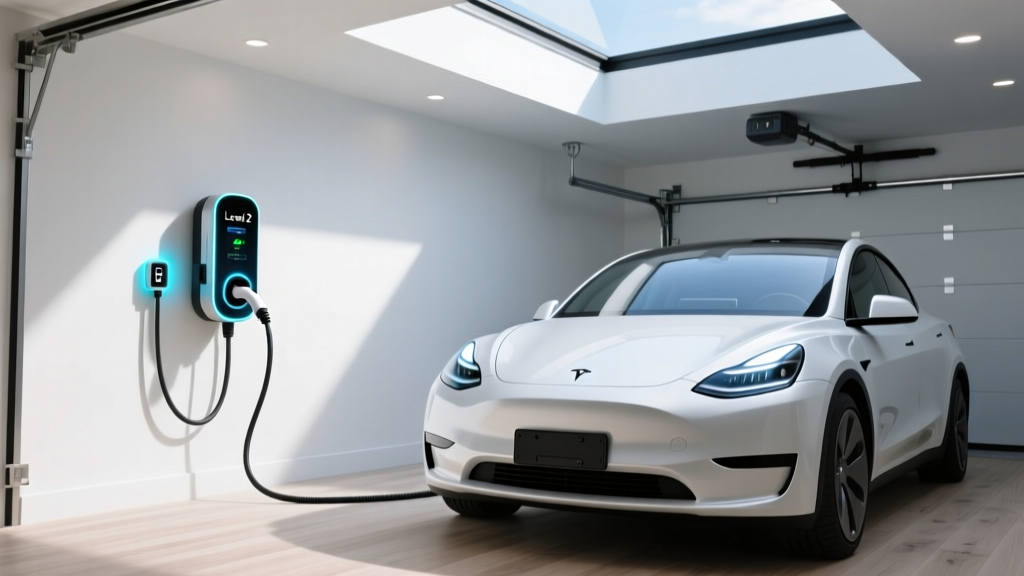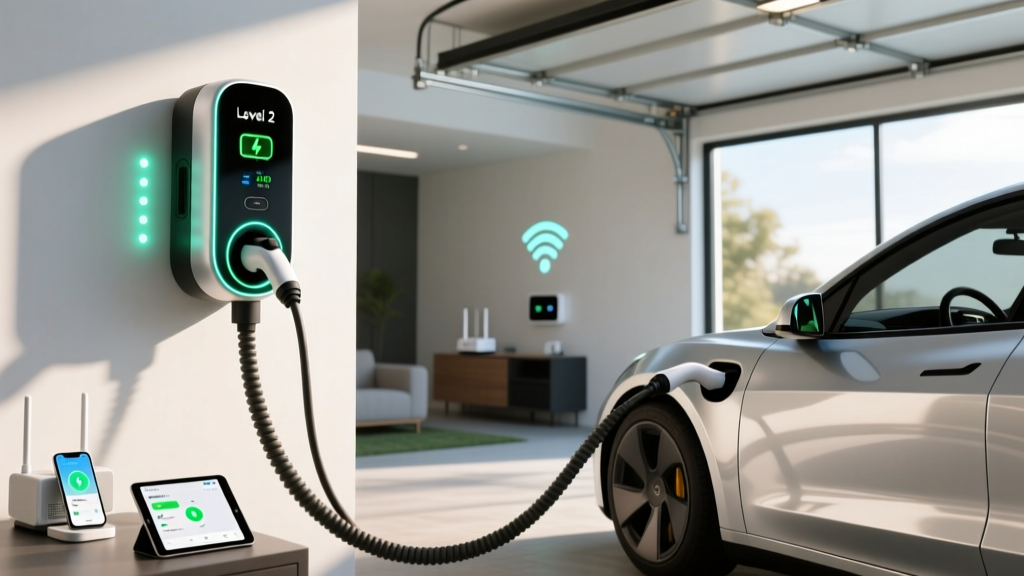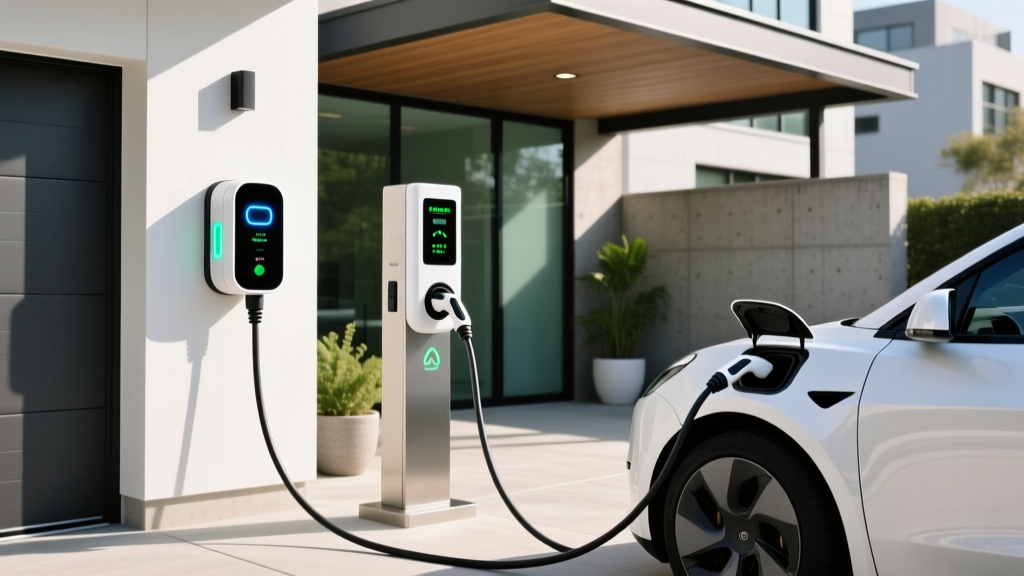
Charging Levels Explained: How Fast Will Each Level Add Range?
Before picking hardware, you need to understand the three charging levels available to EV owners. The single most important distinction in EV charging is between kW (kilowatts — the rate of power delivery, like water pressure from a hose) and kWh (kilowatt-hours — the total energy stored in your battery, like gallons in a tank). A charger's kW rating tells you how fast it can push energy; your battery's kWh rating tells you how much it can hold.
| Level | Voltage / Amps | Power (kW) | Miles of Range Per Hour | Typical Use Case |
|---|---|---|---|---|
| Level 1 (120V) | 120V / 12-16A | 1.4 – 1.9 kW | 3 – 5 mi/hr | Overnight trickle; PHEVs; low-mileage commuters |
| Level 2 (240V) | 240V / 16-80A | 3.8 – 19.2 kW | 12 – 60+ mi/hr | Primary home charging; workplace; destination |
| DC Fast Charging | 400-900V DC | 50 – 350+ kW | 150 – 1,200+ mi/hr (peak) | Road trips; quick top-ups; commercial fleets |
A practical example: if your EV has a 75 kWh usable battery and you're charging from 10% to 80% (adding roughly 52.5 kWh), a 48-amp Level 2 charger delivering 11.5 kW will take about 4.5 hours. A 150 kW DC fast charger can accomplish the same 10-80% session in roughly 25-30 minutes, though the charge curve tapers significantly above 80% State of Charge (SoC). That taper is why manufacturers quote 10-80% times rather than 0-100% — the final 20% can take as long as the first 80%.
Home EV Charger Installation: Requirements, Costs, and Panel Upgrades
Most EV owners charge at home over 80% of the time, according to fueleconomy.gov. A properly installed Level 2 home charger is the single best investment for convenient, low-cost EV ownership. But installation costs vary dramatically based on your home's electrical infrastructure.
Electrical Requirements for Level 2 Home Charging
A Level 2 charger requires a dedicated 240-volt circuit — the same voltage your electric dryer or oven uses. The most common residential setups are:
- 40-amp circuit (32A continuous): Delivers up to 7.7 kW. Suitable for most EVs with nightly charging needs. Requires a NEMA 14-50 outlet or hardwired connection.
- 50-amp circuit (40A continuous): Delivers up to 9.6 kW. The sweet spot for most homes — charges a 75 kWh battery from 10-80% in roughly 5.5 hours.
- 60-amp circuit (48A continuous): Delivers up to 11.5 kW. Ideal for larger batteries (100+ kWh) or faster turnaround needs.
- 80-amp circuit (64A continuous): Delivers up to 15.4 kW. Requires significant panel capacity; best for homes with 200A+ service and high-demand EVs like the GMC Hummer EV or Rivian R1T with dual-motor configs.
The National Electrical Code (NEC) requires that continuous loads (anything running 3+ hours, which includes EV charging) use no more than 80% of a circuit's rated capacity. That's why a 40-amp breaker yields 32 amps of continuous charging current.
Installation Cost Breakdown
| Component | Basic Install (Near Panel) | Standard Install (Garage, 20-40 ft run) | Complex Install (Long Run, Conduit, Panel Upgrade) |
|---|---|---|---|
| Level 2 Charger Equipment | $300 – $500 | $400 – $700 | $500 – $800 |
| Electrician Labor | $300 – $600 | $600 – $1,500 | $1,500 – $4,000+ |
| Permit & Inspection | $50 – $150 | $100 – $300 | $150 – $500 |
| Panel Upgrade (if needed) | $0 | $0 – $500 | $1,500 – $4,500 |
| Total Estimated Cost | $650 – $1,250 | $1,100 – $3,000 | $3,650 – $9,800+ |
When Will You Need a Panel Upgrade?
This is the cost variable that catches many homeowners off guard. You'll likely need a panel upgrade if:
- Your home has a 100-amp main service panel (common in homes built before the 1990s). Adding a 40-60 amp EV circuit may exceed the panel's capacity, especially if you already run electric HVAC, a dryer, and an electric range.
- Your panel has no available breaker slots — a physical limitation separate from amperage capacity.
- Your utility service drop is limited to 100A and cannot be upgraded without a new transformer or service lateral.
Homes with 200-amp service (standard in most post-2000 construction) can typically accommodate a 40-60 amp Level 2 circuit without a panel upgrade. A licensed electrician will perform a load calculation per NEC Article 220 to determine your available capacity. Don't skip this step — an overloaded panel is a fire risk.
Connector Compatibility: NACS, CCS1, and CHAdeMO in 2026
The connector landscape has shifted dramatically. As of the 2025-2026 model years, the North American Charging Standard (NACS) — originally developed by Tesla — has become the dominant connector for new EVs sold in North America. Here's where each brand stands:
| Connector | Brands Using It (Native) | Adapter Needed For |
|---|---|---|
| NACS (Tesla-style) | Tesla (all), Ford, GM, Rivian, Volvo, Polestar, Mercedes-Benz, BMW, Hyundai, Kia (2025+) | Access to CCS-only public chargers (legacy Electrify America, some ChargePoint) |
| CCS1 (Combo) | Volkswagen ID.4 (carryover), older Ford/GM/Rivian models (pre-NACS switch) | Tesla Supercharger access (CCS-to-NACS adapter, ~$200-$250) |
| CHAdeMO | Nissan Leaf (legacy only — no new models planned) | Limited network; adapter options shrinking |
What this means for home charger buyers: Most Level 2 home chargers sold in 2026 come with a J1772 connector (the long-standing Level 2 standard). NACS-equipped EVs include a J1772-to-NACS adapter in the vehicle. Alternatively, you can buy a home charger with a native NACS plug — Tesla's Wall Connector and several third-party options now offer this. For DC fast charging, the public network is rapidly converting to NACS, but CCS1 stations remain widespread and will for years.
Cost to Charge: Home vs. Public vs. Gas — The Per-Mile Math
One of the strongest arguments for EV ownership is fuel cost savings, but the actual number depends heavily on where and when you charge. Here's a realistic breakdown using national average electricity rates and a mid-size EV averaging 3.0 miles per kWh (roughly 115 MPGe combined):
| Charging Scenario | Rate ($/kWh) | Cost Per Mile | Annual Fuel Cost (12,000 mi) |
|---|---|---|---|
| Home Level 2 (off-peak utility rate) | $0.08 – $0.14 | $0.027 – $0.047 | $320 – $560 |
| Home Level 2 (standard residential rate) | $0.14 – $0.20 | $0.047 – $0.067 | $560 – $800 |
| Public Level 2 (network pricing) | $0.25 – $0.49 | $0.083 – $0.163 | $1,000 – $1,960 |
| DC Fast Charging (public networks) | $0.35 – $0.65 | $0.117 – $0.217 | $1,400 – $2,600 |
| Gasoline (28 MPG avg, $3.40/gal) | — | $0.121 | $1,457 |
The takeaway is clear: home charging is where the savings live. An EV owner charging primarily at home on off-peak rates saves $900-$1,100+ per year versus gasoline. If you rely exclusively on DC fast charging at public networks, your per-mile cost can actually exceed gasoline — a reality that matters for apartment dwellers or those without home charging access.
Charging Time Examples: 10-80% for Common Battery Sizes
How long will it take to charge your specific EV? The answer depends on battery capacity (kWh), the charger's power output (kW), your vehicle's onboard charger limit (for Level 2), and the DC fast-charging curve. Below are estimates for popular 2026 EVs:
| Vehicle (Battery kWh) | Level 2 at 11.5 kW (48A) | DC Fast at Peak kW | Peak DC Rate |
|---|---|---|---|
| Tesla Model Y Long Range (78 kWh) | ~4.7 hrs | ~25 min | 250 kW |
| Hyundai Ioniq 5 (77.4 kWh) | ~4.6 hrs | ~18 min | 240 kW (800V) |
| Ford Mustang Mach-E Extended Range (91 kWh) | ~5.5 hrs | ~32 min | 150 kW |
| Chevrolet Equinox EV (85 kWh) | ~5.1 hrs | ~30 min | 150 kW |
| GMC Sierra EV (200+ kWh Ultium) | ~12+ hrs | ~45 min | 350 kW (800V) |
Notice that the Hyundai Ioniq 5's 800-volt architecture enables a faster DC session than vehicles with similar battery sizes on 400V systems. The sustained charge rate matters more than the peak — the Ioniq 5 holds above 200 kW longer than most competitors, which is why its 10-80% time is industry-leading at its price point.
Best EV Chargers for Home in 2026: Equipment Picks
After testing and tracking reliability data across dozens of Level 2 home chargers, these are the units that deliver the best combination of power, build quality, smart features, and value for most EV owners:
Tesla Wall Connector (Gen 4)
- Power Output: Up to 11.5 kW (48A) on a 60A circuit
- Connector: Native NACS; includes J1772 adapter in box
- Cable Length: 24 feet
- Smart Features: Wi-Fi OTA updates, power sharing (link up to 6 units on one circuit), load management, scheduling via Tesla app
- Price: ~$475
- Best For: Tesla owners and any NACS-equipped EV; best power-sharing for multi-EV households
ChargePoint Home Flex (2nd Gen)
- Power Output: Up to 12 kW (50A adjustable) on a 60A circuit
- Connector: J1772 (NACS adapter included with newer EVs)
- Cable Length: 23 feet
- Smart Features: Wi-Fi, amperage adjustment via app (set to match your circuit), Alexa integration, charging history, flexible scheduling
- Price: ~$550-$650
- Best For: Non-Tesla EVs; renters who may move (adjustable amperage works in different homes)
Emporia Vue Level 2 Charger
- Power Output: Up to 11.5 kW (48A) on a 60A circuit
- Connector: J1772 (NACS version available)
- Cable Length: 24 feet
- Smart Features: Wi-Fi, integrates with Emporia Vue energy monitor for whole-home load tracking, solar-aware scheduling, EV energy cost tracking
- Price: ~$350-$400
- Best For: Budget-conscious buyers; solar panel owners wanting integrated energy management
For homes with only a 40-amp circuit available (yielding 32A / 7.7 kW continuous), the Grizzl-E Smart (~$420, 40A max, J1772, 24-ft cable) remains a rugged, Canadian-built option rated for outdoor use down to -22°F (-30°C) — making it the best pick for cold-climate garage or driveway installations.
Safety, Electrical Code, and Installation Best Practices
EV charging is a high-duration, high-current electrical load. Cutting corners on installation is a fire hazard. Here are the non-negotiable safety and code requirements:
- Dedicated circuit: Your Level 2 charger must be on its own dedicated breaker — never shared with other appliances or outlets.
- GFCI protection: The 2023 NEC (adopted in most jurisdictions by 2025-2026) requires GFCI protection for all EV charging outlets. Hardwired chargers may have GFCI built into the unit; plug-in units via NEMA 14-50 require a GFCI breaker.
- Outdoor rating: If installing outside, ensure the charger carries a NEMA 4 (weatherproof) rating. Most quality units do, but verify — indoor-rated units will fail when exposed to rain or snow.
- Wire gauge: A 60A circuit requires 6 AWG copper wire (or 4 AWG aluminum). A 40A circuit needs 8 AWG copper. Your electrician will size wire to the circuit and run length — longer runs may require thicker gauge to prevent voltage drop.
- Permit and inspection: Nearly all jurisdictions require an electrical permit for EV charger installation. The inspection verifies wire sizing, breaker rating, grounding, and GFCI compliance. Skipping the permit can void your homeowner's insurance coverage for electrical fires.
- NEMA 14-50 vs. hardwired: A NEMA 14-50 outlet offers portability (take the charger when you move) but requires a GFCI breaker (~$50-$100 extra). Hardwired installations are typically $100-$200 cheaper in labor and don't need a separate GFCI breaker if the unit has internal ground-fault protection.
Frequently Asked Questions
How much does it cost to install a home EV charger?
A basic Level 2 installation near your electrical panel runs $650-$1,250 all-in (equipment, electrician, permit). A standard garage install with a 20-40 foot wire run costs $1,100-$3,000. If your home needs a panel upgrade from 100A to 200A service, total costs can reach $3,650-$9,800+. Get at least three quotes from licensed electricians, and confirm they perform a NEC Article 220 load calculation before recommending a circuit size.
How fast will each charging level add range?
Level 1 (120V) adds 3-5 miles of range per hour — adequate for PHEVs with small batteries or EVs driven under 30 miles daily. Level 2 (240V) at 48 amps adds roughly 35-45 miles per hour for a typical mid-size EV, fully replenishing overnight. DC fast charging adds 150-1,200+ miles per hour at peak rates, though real-world sessions average 25-35 minutes for a 10-80% fill due to charge-curve tapering above 80% SoC.
Which connector/charger is compatible with my EV?
Check your vehicle's charge port. If you drive a 2025-2026 Tesla, Ford, GM, Rivian, Hyundai, Kia, BMW, Mercedes, or Volvo, your vehicle uses NACS. Most Level 2 home chargers ship with J1772 connectors, and your EV includes a J1772-to-NACS adapter. For a cleaner setup, buy a charger with a native NACS plug (Tesla Wall Connector or ChargePoint Home Flex NACS edition). If you drive an older CCS1-equipped EV, any J1772 Level 2 charger works natively. CHAdeMO (Nissan Leaf) is a legacy standard with shrinking infrastructure — plan accordingly.
How much does charging cost per mile vs gas?
Home charging at off-peak utility rates ($0.08-$0.14/kWh) costs $0.027-$0.047 per mile for a typical EV — roughly one-quarter to one-third the cost of gasoline at $3.40/gallon in a 28 MPG vehicle ($0.121/mile). Standard residential rates ($0.14-$0.20/kWh) still deliver 40-60% savings. Public DC fast charging at $0.35-$0.65/kWh can match or exceed gasoline costs, which is why home charging access is the single biggest factor in EV ownership economics.
What electrical upgrades might I need?
The most common upgrade is a panel capacity increase from 100A to 200A service ($1,500-$4,500), needed in older homes with high electrical loads. You may also need: a new breaker slot (if your panel is full — sometimes solvable with tandem breakers for ~$50-$100), a heavier service drop from the utility (rare, but possible in homes with original 1960s-70s wiring), or a sub-panel in the garage if the main panel is far from the charging location. Some utilities now offer managed charging programs that allow a lower-amperage circuit (e.g., 30A) in exchange for the utility briefly throttling charge during peak demand — this can avoid a panel upgrade entirely. Ask your utility about these programs before committing to a panel upgrade.