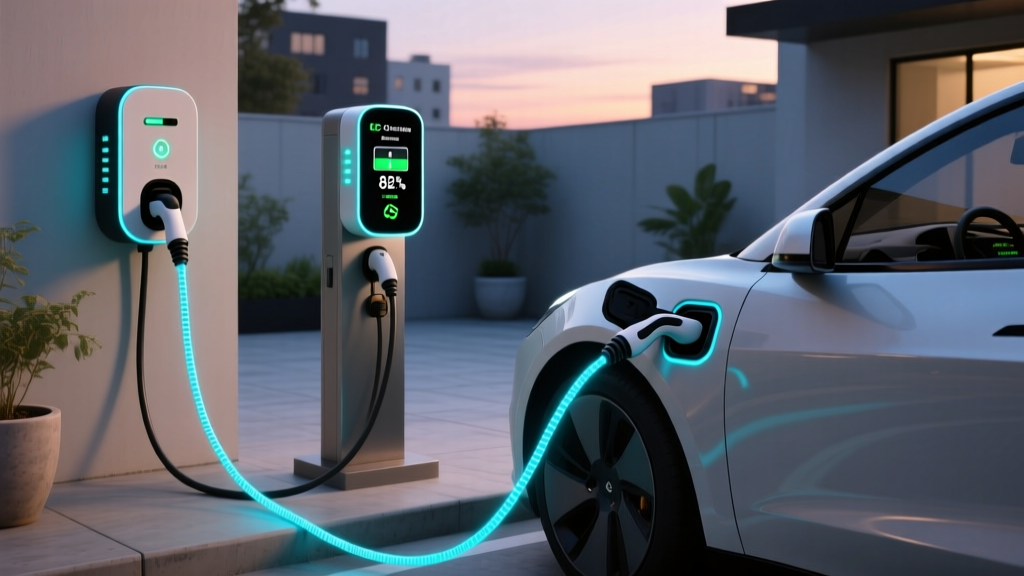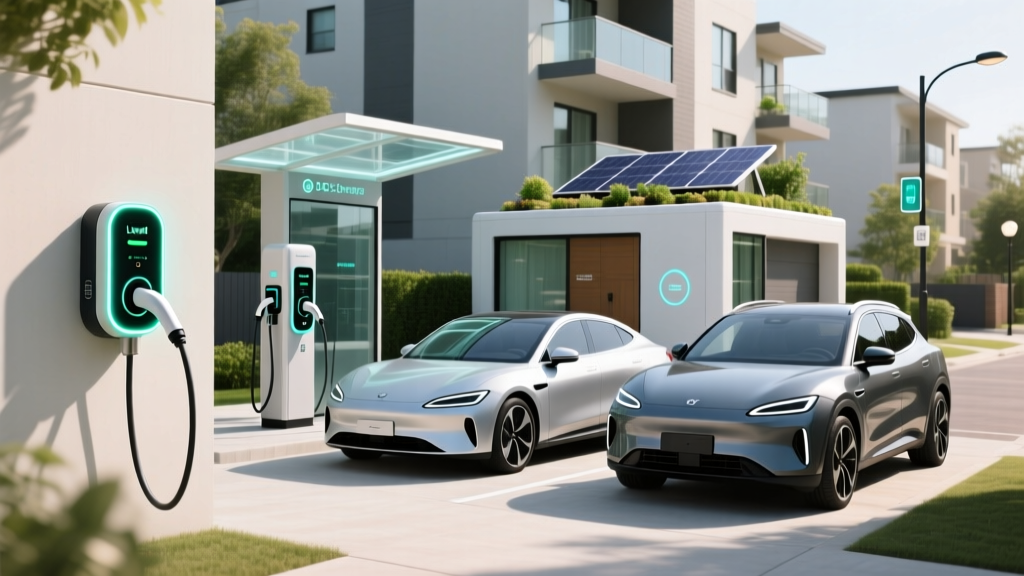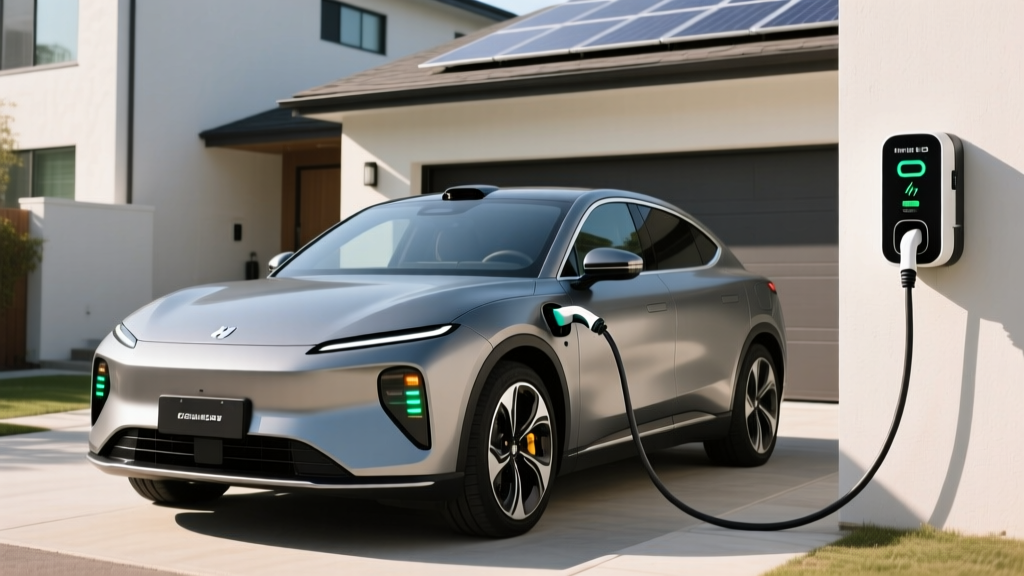
If you drive an all-wheel-drive EV — from the Tesla Model Y Long Range AWD to the Hyundai Ioniq 5 AWD or Ford Mustang Mach-E GT — you likely have a larger battery (75–100 kWh usable) and higher energy consumption than a single-motor sibling. That means your home charging setup matters more: a sluggish Level 2 charger won't replenish an 84 kWh pack overnight, and undersized electrical service can bottleneck your daily routine. This guide walks you through choosing the right AWD charger setup, sizing your home installation correctly, and understanding the real costs per mile in 2026.
Charging Levels Explained: kW Speeds and Range Added per Hour
The single most important distinction in EV charging is kW (kilowatts), which measures power — how fast energy flows into your car — versus kWh (kilowatt-hours), which measures energy capacity, like the size of your battery tank. Confusing the two is the most common EV literacy mistake. Think of kW as the flow rate of a hose and kWh as the size of the bucket.
| Level | Voltage | Max Power (kW) | Miles of Range per Hour | Typical Use Case |
|---|---|---|---|---|
| Level 1 | 120V AC | 1.4 kW | 3–5 mi/hr | Overnight trickle; emergency top-ups |
| Level 2 | 240V AC | 7.2–19.2 kW | 20–60+ mi/hr | Daily home and workplace charging |
| DC Fast Charging | 400–800V DC | 50–350 kW | 150–1,000+ mi/hr (peak) | Road trips; rapid public stations |
For a typical AWD EV consuming around 300–340 Wh/mile (e.g., the 2026 Tesla Model Y Long Range AWD at roughly 310 Wh/mile combined), a 11.5 kW Level 2 charger delivers approximately 34 miles of range per hour. A 7.7 kW charger on the same vehicle delivers about 22 miles per hour. For larger AWD platforms like the Rivian R1S Dual-Motor (141 kWh Max Pack, ~330 Wh/mile), Level 1 charging at 1.4 kW adds just 4 miles per hour — essentially useless for daily driving needs.
Home EV Charger Installation: Electrical Requirements and Costs
Installing a Level 2 home charger — the backbone of any AWD EV ownership experience — involves more than plugging into a dryer outlet. Here's what your licensed electrician will evaluate:
- Circuit amperage: A 48A charger requires a dedicated 60A circuit (NEC code requires circuits rated at 125% of continuous load). A 40A charger needs a 50A circuit.
- Wire gauge: 6 AWG copper for 50A circuits; 4 AWG for 60A circuits, with runs over 50 feet potentially requiring thicker gauge to prevent voltage drop.
- Panel capacity: Your main service panel must have enough spare amperage headroom. A 200A panel serving a home with central A/C, electric range, and electric dryer may be near capacity — adding a 60A EV circuit could push it over.
- Permit requirements: Most US jurisdictions require an electrical permit for new 240V circuits, with an inspection after installation.
Do You Need a Panel Upgrade?
Homes built before 2000 often have 100A or 150A main panels. If your existing loads already consume 80%+ of panel capacity (calculated via a NEC Article 220 load calculation), you'll need either:
- A panel upgrade to 200A — typically $1,500–$3,500 depending on your utility and local labor rates
- A smart load management device (e.g., Emporia Smart Load Center or Span Drive) that throttles charger amperage when other high-draw appliances activate — $400–$800 for equipment
- Downsizing to a 32A charger on a 40A circuit, which still delivers ~22 miles/hr on most AWD EVs
| Component | Simple Install (panel nearby) | Complex Install (long run / panel upgrade) |
|---|---|---|
| Level 2 Charger (hardware) | $350–$700 | $350–$700 |
| Electrician labor (2–6 hrs @ $85–$150/hr) | $170–$450 | $510–$900 |
| Wire, conduit, breaker, junction box | $50–$150 | $200–$600 |
| Electrical permit | $50–$200 | $50–$200 |
| Panel upgrade (if needed) | $0 | $1,500–$3,500 |
| Total | $620–$1,500 | $2,610–$5,900 |
Many utilities and states offer rebates that offset $200–$1,000 of installation costs. Check with your local utility and the Alternative Fuels Data Center for current incentive programs.
Connector Compatibility: NACS, CCS1, CHAdeMO, and Adapters
As of 2026, the North American EV charging landscape has consolidated heavily around NACS (North American Charging Standard), the connector pioneered by Tesla and now adopted by nearly every major automaker. Here's where things stand:
| Connector | Brands Using It (Native) | Access to Tesla Superchargers | Adapter Needed? |
|---|---|---|---|
| NACS | Tesla, Ford, GM, Rivian, Volvo, Polestar, Nissan (2026+), Hyundai/Kia (2026+), BMW, Mercedes-Benz | Yes — direct plug | CCS adapter for legacy public stations |
| CCS1 | Volkswagen, older Hyundai/Kia (pre-2026), Stellantis, Lucid, some legacy models | Yes — with Tesla-approved NACS adapter | NACS-to-CCS adapter (~$200–$250) |
| CHAdeMO | Nissan Leaf (discontinued), Mitsubishi Outlander PHEV (legacy) | No | Increasingly limited public infrastructure |
For home Level 2 charging, the connector situation is simpler: all Level 2 chargers use a J3400 (NACS) or J1772 plug. If your EV has a NACS port, buy a NACS-connector charger. If it has a J1772 port, buy a J1772 charger — or use the J1772-to-NACS adapter that ships with most new EVs. Hardwired chargers with detachable cables offer the most flexibility.
Charging Time Examples for Popular AWD EV Battery Sizes
AWD EVs carry larger batteries and consume more energy, so charging times matter. Here's how long common AWD models take to charge from 10% to 80% SoC across different power levels:
| Vehicle (2026 MY) | Battery (usable kWh) | 7.7 kW Level 2 | 11.5 kW Level 2 | 19.2 kW Level 2 | 250 kW DCFC (peak) |
|---|---|---|---|---|---|
| Tesla Model Y LR AWD | 75 kWh | ~7.0 hrs | ~4.7 hrs | ~2.8 hrs | ~22 min |
| Hyundai Ioniq 5 AWD | 81 kWh | ~7.6 hrs | ~5.1 hrs | ~3.0 hrs | ~18 min (800V) |
| Ford Mustang Mach-E GT AWD | 91 kWh | ~8.5 hrs | ~5.7 hrs | ~3.4 hrs | ~32 min |
| BMW iX xDrive50 AWD | 105 kWh | ~9.8 hrs | ~6.6 hrs | ~3.9 hrs | ~31 min |
| Rivian R1S Dual-Motor (Max Pack) | 141 kWh | ~13.2 hrs | ~8.8 hrs | ~5.3 hrs | ~42 min |
Key insight for AWD owners: If you drive a Rivian R1S Max Pack or BMW iX and only have a 7.7 kW charger, you cannot fully replenish from 10–80% in a single overnight sleep cycle. Upgrading to 11.5 kW or 19.2 kW is not a luxury — it's a practical necessity for larger packs.
Cost to Charge: Per-Mile Economics vs. Gas
One of the strongest arguments for electrifying an AWD vehicle is operating cost. AWD gas SUVs like the Toyota RAV4 AWD (28 MPG combined) or BMW X3 xDrive30i (26 MPG combined) burn through fuel at a steep rate. Here's how electricity costs compare:
| Scenario | Energy Cost | Efficiency | Cost Per Mile |
|---|---|---|---|
| Home charging (off-peak, $0.12/kWh) | $0.12/kWh | 3.0 miles/kWh (333 Wh/mi) | $0.04 |
| Home charging (standard, $0.18/kWh) | $0.18/kWh | 3.0 miles/kWh | $0.06 |
| Public Level 2 (e.g., ChargePoint, $0.35/kWh) | $0.35/kWh | 3.0 miles/kWh | $0.12 |
| DC Fast Charging (e.g., Electrify America, $0.48/kWh) | $0.48/kWh | 3.0 miles/kWh | $0.16 |
| Gas AWD SUV (28 MPG, $3.40/gal) | $3.40/gal | 28 miles/gal | $0.12 |
| Gas AWD SUV (22 MPG, $3.40/gal) | $3.40/gal | 22 miles/gal | $0.15 |
At national average electricity and gas prices, home charging an AWD EV costs $0.04–$0.06 per mile — roughly one-third the cost of fueling a comparable gas AWD SUV. Even DC fast charging on road trips at $0.48/kWh competes with gas on a per-mile basis. The savings compound: at 12,000 miles per year, home charging saves $720–$960 annually versus a 28 MPG gas AWD, and up to $1,320 versus a 22 MPG truck-based AWD.
Equipment Recommendations: Best Level 2 Chargers for AWD EVs
Below are proven Level 2 chargers well-suited for AWD EVs with larger batteries. All recommendations include power output, connector type, cable length, and smart features.
ChargePoint Home Flex
- Power: Up to 12 kW (50A circuit) — configurable down to 16A
- Connector: J1772 (NACS adapter included or available)
- Cable length: 23 feet
- Smart features: Wi-Fi, app scheduling, Alexa integration, energy tracking
- Price: ~$550–$650
- Best for: Flexible amperage for homes with limited panel capacity
Wall Connector (Tesla, Gen 3 with J3400)
- Power: Up to 11.5 kW (48A / 60A circuit)
- Connector: NACS native; J1772 version also available
- Cable length: 24 feet
- Smart features: Wi-Fi, OTA updates, power sharing between two units, load management
- Price: ~$475
- Best for: Tesla and NACS-equipped owners; best value per kW
Emporia Level 2 EV Charger
- Power: Up to 11.5 kW (48A / 60A circuit)
- Connector: J1772 (NACS adapter available)
- Cable length: 24 feet
- Smart features: Wi-Fi, real-time energy monitoring, solar integration, load balancing with Emporia Vue panel monitor
- Price: ~$350–$400
- Best for: Budget-conscious buyers who want smart energy management
FLO Home X5
- Power: Up to 12 kW (50A circuit)
- Connector: J1772 (NACS-compatible with adapter)
- Cable length: 25 feet
- Smart features: Wi-Fi, scheduling, robust outdoor-rated enclosure (NEMA 4X)
- Price: ~$600–$700
- Best for: Outdoor installations in harsh climates
For AWD owners with 100+ kWh batteries (Rivian Max Pack, BMW iX, Mercedes EQS SUV), prioritize chargers capable of 11.5 kW or higher. At 7.7 kW, an overnight charge may not be sufficient to go from a low SoC back to 80% in 8 hours.
Safety and Code Considerations for Your AWD Charger Setup
EV chargers draw significant continuous current — more than most household appliances. Safety and code compliance are not optional:
- Dedicated circuit: Your Level 2 charger must be on its own dedicated breaker — never shared with other outlets or appliances. NEC 625.41 requires this.
- GFCI protection: NEC 2023 and later require GFCI protection for all EV charging outlets. Hardwired installations are exempt from the GFCI breaker requirement (the charger itself provides ground-fault protection), which is why many electricians prefer hardwiring.
- Outdoor rating: If your charger is mounted outside or in an unconditioned garage, ensure the unit is rated NEMA 3R (rain-resistant) or NEMA 4X (hose-down and corrosion resistant).
- Cable management: A 24-foot cable dragging on a garage floor becomes a trip hazard and degrades over time. Wall-mounted cable organizers ($15–$30) protect your investment.
- Grounding verification: Your electrician should verify proper grounding at the outlet or junction box — an ungrounded 240V circuit is a serious shock hazard.
Frequently Asked Questions
How much does it cost to install a home EV charger?
A straightforward Level 2 installation with the electrical panel nearby typically costs $620–$1,500 total (charger hardware + electrician labor + materials + permit). If you need a panel upgrade, a long conduit run, or trenching to a detached garage, costs can reach $2,600–$5,900. Always get three quotes from licensed electricians.
How fast will each charging level add range?
Level 1 (120V) adds 3–5 miles per hour. Level 2 (240V) adds 20–60+ miles per hour depending on charger amperage and vehicle efficiency. DC fast charging adds 150–1,000+ miles per hour at peak, but sustained rates taper significantly above 50% SoC. For a typical AWD EV at 310 Wh/mile, expect ~22 mi/hr at 7.7 kW, ~34 mi/hr at 11.5 kW, and ~55 mi/hr at 19.2 kW.
Which connector/charger is compatible with my EV?
Check your vehicle's charge port. If it's NACS (the smaller Tesla-style port, now on Ford, GM, Rivian, Hyundai/Kia 2026+, BMW, Mercedes), buy a NACS-connector charger or use a J1772-to-NACS adapter. If it's CCS1 (the larger Combo port, on VW, older Hyundai/Kia, Stellantis, Lucid), buy a J1772 charger — most CCS vehicles include a J1772-to-CCS adapter for Level 2 charging. CHAdeMO is essentially discontinued in the US market.
How much does charging cost per mile vs. gas?
Home charging at $0.12–$0.18/kWh costs $0.04–$0.06 per mile for a typical AWD EV. Gas AWD SUVs at 22–28 MPG with fuel at $3.40/gal cost $0.12–$0.15 per mile. Home EV charging is roughly 60–70% cheaper per mile. Public DC fast charging at $0.40–$0.50/kWh ($0.13–$0.17/mile) is roughly cost-competitive with gas but still avoids oil-change and transmission maintenance costs.
What electrical upgrades might I need?
The most common upgrade is a panel capacity increase from 100A or 150A to 200A ($1,500–$3,500). Older homes may also need a new grounding rod, updated service entrance conductors, or utility transformer upgrades. If your panel is maxed out but you don't want to upgrade, a smart load management system ($400–$800) can dynamically reduce charger amperage when other appliances draw power, avoiding a panel upgrade entirely.