If you've picked up an electric vehicle from an Avis rental lot, you've probably noticed the paperwork includes language about an Avis EV charging fee — a per-kWh or flat-rate charge applied if you return the car without a full battery. For first-time EV renters, this can feel opaque. How much does it actually cost? Is it cheaper to charge yourself or just pay the fee? And how does it compare to the gas-refueling charges rental companies have used for decades?
This guide breaks down exactly what Avis charges, how public and home charging costs compare in 2026, the charging hardware you'll encounter on a rental trip, and how to minimize your total cost. Whether you're renting a Tesla Model Y, a Ford Mustang Mach-E, or a Hyundai Ioniq 5, the math and the connectors matter.
Understanding the Avis EV Charging Fee Structure
Avis introduced EV-specific return policies as their fleet electrified. Unlike gas cars — where you simply refill the tank at a nearby station and return it — EVs require planning around charging time and infrastructure. Here's how the fee typically works:
- Full-battery return: No additional charge. You return the vehicle at the same state of charge (SoC) it had at pickup (usually 80–100%).
- Partial-battery return (self-charged): Some locations charge a per-kWh rate for the deficit, typically $0.45–$0.79/kWh, depending on the location and local electricity rates.
- Uncharged return (Avis charges for you): If you return the EV without charging and below the agreed SoC, Avis applies a premium recharge fee — often $0.79–$1.25/kWh plus a service surcharge of $10–$25 at some locations. This is the scenario every renter wants to avoid.
The exact fee varies by airport, city, and franchise operator. Always check your rental agreement for the specific per-kWh rate or flat fee listed. Think of it like the gas-refuel charge: the rental company's rate is always higher than what you'd pay doing it yourself.
Charging Levels Explained: Speeds, Costs, and Real-World Times
Before you can calculate whether the Avis EV charging fee is worth paying, you need to understand the three charging levels available to you on a rental trip. A critical distinction: kW (kilowatts) measures charging power — how fast energy flows into the battery. kWh (kilowatt-hours) measures energy capacity — how much the battery holds. You pay for kWh; the charger's kW rating determines how long it takes.
| Level | Voltage | Power (kW) | Miles of Range Added per Hour | Typical Use Case |
|---|---|---|---|---|
| Level 1 | 120V AC | 1.4–1.9 kW | 3–5 mi/hr | Overnight emergency top-up; impractical for rental returns |
| Level 2 | 240V AC | 7.2–19.2 kW | 20–60 mi/hr | Home charging, hotels, workplaces, shopping centers |
| DC Fast Charging (DCFC) | 400–800V DC | 50–350 kW | 150–1,200+ mi/hr (peak) | Highway travel, quick top-ups, rental return prep |
Real-world charging time examples (10% to 80% SoC):
- Tesla Model Y (75 kWh battery, NMC): ~25 minutes on a 250 kW Tesla Supercharger (V3/V4); ~45 minutes on a 150 kW Electrify America CCS station using a NACS-to-CCS adapter.
- Hyundai Ioniq 5 (77.4 kWh battery, NMC, 800V architecture): ~18 minutes on a 350 kW DCFC; ~25 minutes on a 150 kW station.
- Ford Mustang Mach-E Extended Range (91 kWh usable, NMC): ~32 minutes on a 150 kW DCFC; ~45 minutes on a 50 kW station.
- Chevrolet Equinox EV (85 kWh, NMC): ~28 minutes on a 150 kW DCFC.
Important caveat: DC fast charging follows a charge curve. You'll see peak kW rates only between roughly 10–50% SoC. Above 80%, charging slows dramatically to protect the battery — sometimes dropping below 30 kW. This is why rental companies and most guides recommend charging to 80% on road trips and only going higher when necessary (like meeting a rental return requirement).
How Much Does EV Charging Actually Cost vs. the Avis Fee?
The core question for any rental EV driver: is it cheaper to charge yourself, or just pay the Avis EV charging fee and return it low? Let's run the numbers with 2026 national averages.
| Charging Scenario | Cost per kWh | Cost to Add 200 Miles (avg EV at 3.5 mi/kWh = ~57 kWh) | Cost per Mile |
|---|---|---|---|
| Home Level 2 (national avg residential) | $0.16/kWh | $9.12 | $0.046/mi |
| Home Level 2 (off-peak time-of-use rate) | $0.09/kWh | $5.13 | $0.026/mi |
| Public Level 2 (ChargePoint, EVgo, Blink) | $0.30–$0.49/kWh | $17.10–$27.93 | $0.086–$0.140/mi |
| DC Fast Charging (Electrify America, EVgo, Tesla Supercharger) | $0.35–$0.56/kWh | $19.95–$31.92 | $0.100–$0.160/mi |
| Avis EV recharge fee (self-reported range) | $0.45–$1.25/kWh | $25.65–$71.25 | $0.128–$0.356/mi |
| Gasoline equivalent (25 MPG combined, $3.40/gal) | — | $27.20 | $0.136/mi |
The takeaway: Charging yourself at a public DC fast charger ($0.35–$0.56/kWh) is almost always cheaper than paying the Avis premium recharge rate ($0.79–$1.25/kWh). Even at the high end of public DCFC pricing, you'll save $15–$40 on a 200-mile deficit. The only scenario where paying the Avis fee makes sense is if you're at an airport with zero nearby chargers and you're running late for a flight.
For comparison data on EV efficiency ratings across models, the U.S. Department of Energy's EV page on fueleconomy.gov provides MPGe and kWh/100mi figures for every EPA-rated electric vehicle.
Connector Compatibility: What Plug Does Your Rental EV Need?
The North American charging landscape in 2026 is mid-transition. The NACS (North American Charging Standard) — originally Tesla's proprietary connector — has been adopted by Ford, GM, Hyundai/Kia, Rivian, Volvo, and most major automakers starting with 2025 model-year vehicles. However, many 2023–2024 model-year EVs still on rental lots use CCS1 (Combined Charging System). Here's what you need to know:
| Connector | Brands Using It (2026 Models) | DCFC Network Access | Adapter Needed? |
|---|---|---|---|
| NACS (Tesla) | Tesla (all years), Ford (2025+), GM (2025+), Hyundai/Kia (2025+), Rivian (2025+), Volvo (2025+) | Tesla Supercharger network (17,000+ stalls), plus NACS-equipped Electrify America and EVgo stations | CCS1 vehicles need a NACS-to-CCS adapter (~$150–$200) |
| CCS1 | VW ID.4 (2021–2024), older BMW i4/iX, older Hyundai Ioniq 5 (2022–2024), older Kia EV6, older Ford Mach-E | Electrify America, EVgo, ChargePoint DCFC, some Tesla Superchargers with Magic Dock | NACS vehicles need a CCS-to-NACS adapter for non-Tesla networks |
| CHAdeMO | Nissan Leaf (all years), Mitsubishi Outlander PHEV (DCFC) | Limited and shrinking; some Electrify America and EVgo stations still have CHAdeMO plugs | No adapter available for NACS/CCS cross-use |
Practical tip for renters: Before picking up your Avis EV, check the specific model year and trim on your reservation. A 2024 Hyundai Ioniq 5 has a CCS1 port; a 2025+ Ioniq 5 has NACS. This determines whether you can use Tesla Superchargers (via adapter or natively) or need to rely on Electrify America and other CCS networks. Download the PlugShare or A Better Routeplanner (ABRP) app before your trip and filter by your connector type.
Public Charging Networks: Where to Charge a Rental EV
If you're trying to avoid the Avis EV charging fee by topping up yourself, here are the major public networks you'll encounter in 2026, along with reliability notes from real-world use:
- Tesla Supercharger network: The gold standard for reliability. Over 17,000 V3 (250 kW) and V4 stalls in North America. Non-Tesla EVs with NACS ports or adapters can now access many locations. Pricing: $0.25–$0.50/kWh depending on location and time of day. Idle fees of $1/minute apply if you remain plugged in after reaching your charge limit.
- Electrify America: Largest non-Tesla DCFC network, with 350 kW and 150 kW chargers. Pricing: $0.43–$0.56/kWh for guest rates; $0.36–$0.48/kWh with a Pass+ subscription ($4/month). Reliability has improved since 2024 but screen/payment glitches still occur at some stations.
- EVgo: Growing network with both CCS and NACS connectors. Pricing: $0.35–$0.49/kWh. Many stations co-located with retail centers.
- ChargePoint: Dominant in Level 2 (workplaces, hotels, retail) with some DCFC locations. Pricing set by site host — varies widely from free to $0.49/kWh.
For airport returns: most major airports now have EV charging stations in rental-car return areas or nearby parking structures. Check PlugShare for chargers within 2 miles of your return location. Budget at least 30 minutes for a 10–80% DC fast charge before your flight.
Home Charging Setup: If You're Renting Long-Term or Own an EV
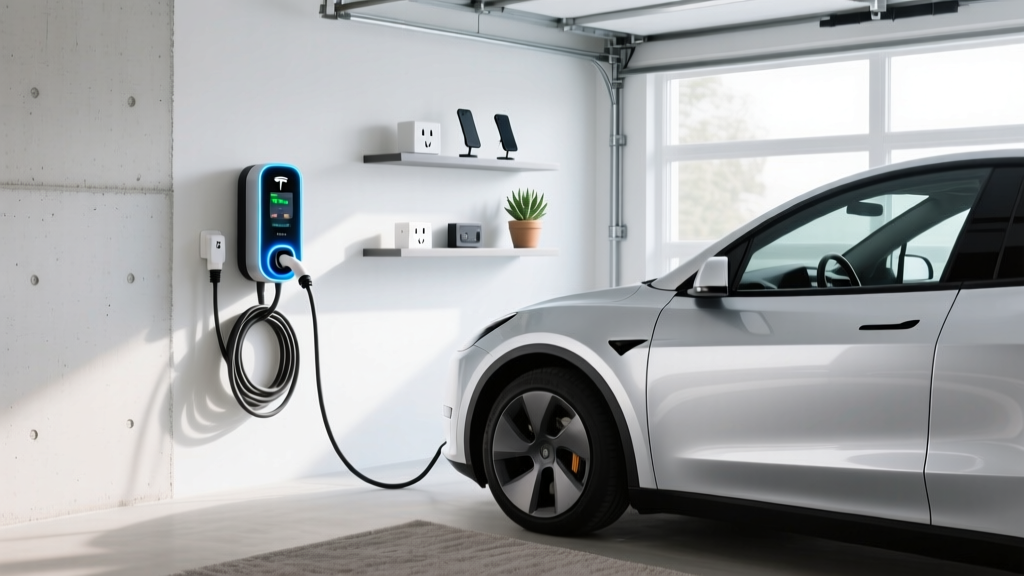
While most Avis renters rely on public charging, those on month-long rentals or considering an EV purchase benefit from understanding home Level 2 installation. Here's what's involved:
| Component | Typical Cost Range | Notes |
|---|---|---|
| Level 2 charger hardware (32A–48A) | $350–$700 | Smart Wi-Fi chargers with app scheduling; see equipment picks below |
| Electrician labor (240V circuit install) | $500–$2,000 | Depends on run length from panel, wall type, and local rates |
| Electrical permit | $50–$200 | Required in most jurisdictions; electrician usually pulls this |
| Panel upgrade (if needed: 100A → 200A) | $1,500–$4,000 | Older homes with 100A service may need an upgrade to support a 40A+ EV circuit alongside existing loads |
| Total (no panel upgrade) | $900–$2,900 | Most homes with 200A service fall in this range |
| Total (with panel upgrade) | $2,400–$6,900 | Panel upgrades are the single biggest variable — get a quote before committing |
Electrical requirements: A typical Level 2 charger requires a dedicated 240V circuit at 40A or 50A (NEMA 14-50 outlet or hardwired). The National Electrical Code (NEC) requires the circuit to be rated at 125% of the charger's continuous draw — so a 40A charger needs a 50A breaker, and a 48A charger needs a 60A breaker. A licensed electrician should perform a load calculation on your panel to confirm capacity before installation.
Safety and code considerations:
- Dedicated circuit — never share the EV charger circuit with other appliances.
- GFCI breaker required by NEC 2023+ for outdoor receptacles; some jurisdictions also require it indoors for EV circuits.
- Outdoor-rated (NEMA 4 or IP65) chargers for garage-exterior or driveway installations.
- Hardwired connections are preferred for 48A+ chargers — NEMA 14-50 receptacles can overheat under sustained high-load use if not installed with commercial-grade components.
For the Alternative Fuels Data Center's home charging guidance, the DOE provides state-specific incentive information and qualified installer locators.
Recommended Home EV Chargers (2026 Equipment Picks)
If you're installing a home charger for an owned EV or a long-term rental, these are the units we recommend based on reliability, features, and value:
ChargePoint Home Flex (Best Overall)
- Power output: Up to 12 kW (50A) on a 240V circuit; configurable down to 16A for lower-capacity panels
- Connector: NACS or J1772 (CCS adapters available)
- Cable length: 23 feet
- Smart features: Wi-Fi, app-based scheduling, energy tracking, Alexa integration, utility demand-response compatible
- Price: ~$599 (hardware only)
WallConnector (Best for Tesla/NACS Ecosystem)
- Power output: Up to 11.5 kW (48A) on a 240V/60A circuit
- Connector: NACS native; J1772 adapter included for non-Tesla EVs
- Cable length: 24 feet
- Smart features: Wi-Fi, over-the-air updates, power-sharing between two units on one circuit, Tesla app integration
- Price: ~$450
Emporia Level 2 EV Charger (Best Budget Smart Charger)
- Power output: Up to 11.5 kW (48A)
- Connector: J1772 (NACS adapter available separately)
- Cable length: 24 feet
- Smart features: Wi-Fi, app scheduling, solar-integration with Emporia Vue energy monitor, time-of-use optimization
- Price: ~$399
Strategies to Avoid the Avis EV Charging Fee Entirely
Based on real-world rental experience and current infrastructure, here's a practical playbook:
- Map chargers near your return location before the trip. Use PlugShare or A Better Routeplanner to identify DCFC stations within 5 miles of the Avis return lot. Airport rental centers at LAX, SFO, DEN, and ATL now have on-site or adjacent fast chargers.
- Plan a 25-minute charge stop on your way to the airport. Arriving at a DCFC with 15–20% SoC and charging to 80% takes roughly 20–30 minutes in most 2024–2026 EVs. That's less time than a sit-down lunch.
- Precondition the battery before fast charging. If your rental EV supports it (Tesla, Hyundai/Kia E-GMP, GM Ultium vehicles), navigate to the charger using the built-in navigation. The car will warm the battery to optimal temperature, enabling faster peak charge rates — especially critical in cold weather where charging speeds can drop 30–50%.
- Use the Avis app to check your specific return policy. Some locations offer a "return as-is" flat fee that may be cheaper than the per-kWh rate if you're only 10–15% below the target SoC.
- Don't rely on Level 1 (120V) charging to top up. At 3–5 miles of range per hour, plugging into a standard hotel outlet overnight adds only 30–50 miles — not enough to meaningfully reduce a recharge fee on a depleted battery.
Frequently Asked Questions
How much does the Avis EV charging fee actually cost?
Avis EV recharge fees range from approximately $0.45/kWh at locations where you self-report a partial charge to $0.79–$1.25/kWh when Avis handles the recharge for you, sometimes with an additional $10–$25 service fee. For a typical 57 kWh deficit (about 200 miles of range), that translates to $25–$71. Always check your rental agreement for the exact rate at your location.
Is it cheaper to charge the rental EV myself or pay the fee?
Almost always cheaper to charge yourself. Public DC fast charging costs $0.35–$0.56/kWh in most U.S. markets in 2026 — significantly less than the Avis premium recharge rate of $0.79–$1.25/kWh. On a 200-mile deficit, self-charging saves $15–$40. The exception: if you're at a remote airport with no nearby chargers and time pressure, the fee may be worth the convenience.
What connector does my Avis rental EV have?
It depends on the model year. Vehicles from 2025+ (Ford, GM, Hyundai, Kia, Rivian, Volvo) typically have the NACS connector, granting access to Tesla Superchargers. Older 2022–2024 models (VW ID.4, older Ioniq 5, older Mach-E) use CCS1. Check your reservation details or ask at the counter. Download PlugShare and filter by your connector type before driving off the lot.
How long does it take to charge a rental EV from 10% to 80%?
On a DC fast charger: 18–35 minutes for most 2024–2026 EVs, depending on battery size and charger power. Vehicles with 800V architecture (Hyundai Ioniq 5, Kia EV6, Porsche Taycan) can do 10–80% in under 20 minutes on a 350 kW charger. Standard 400V vehicles (Ford Mach-E, VW ID.4) typically need 25–40 minutes on a 150 kW station. On Level 2 (240V), expect 4–8 hours for a full charge — practical overnight, not for a quick airport stop.
Does cold weather affect how much I'll need to charge?
Yes, significantly. In temperatures below 32°F, expect 20–35% range loss compared to the EPA sticker, and DC fast charging speeds can drop 30–50% because the battery management system limits charge rate to protect cold cells. If you're renting an EV in winter, plan for more frequent charge stops and always use the vehicle's battery preconditioning feature (navigate to the charger via built-in nav) to warm the pack before plugging in.
Can I use Tesla Superchargers with a non-Tesla Avis rental?
If your rental is a 2025+ model-year Ford, GM, Hyundai, Kia, or Rivian with a native NACS port, yes — you can use Tesla Superchargers directly. If your rental is an older CCS-equipped vehicle, you'll need a NACS-to-CCS adapter (some rental locations provide one; ask at the counter). Tesla's Magic Dock adapter at select Superchargers also enables CCS vehicles to charge without a personal adapter, but availability is limited to specific stations.