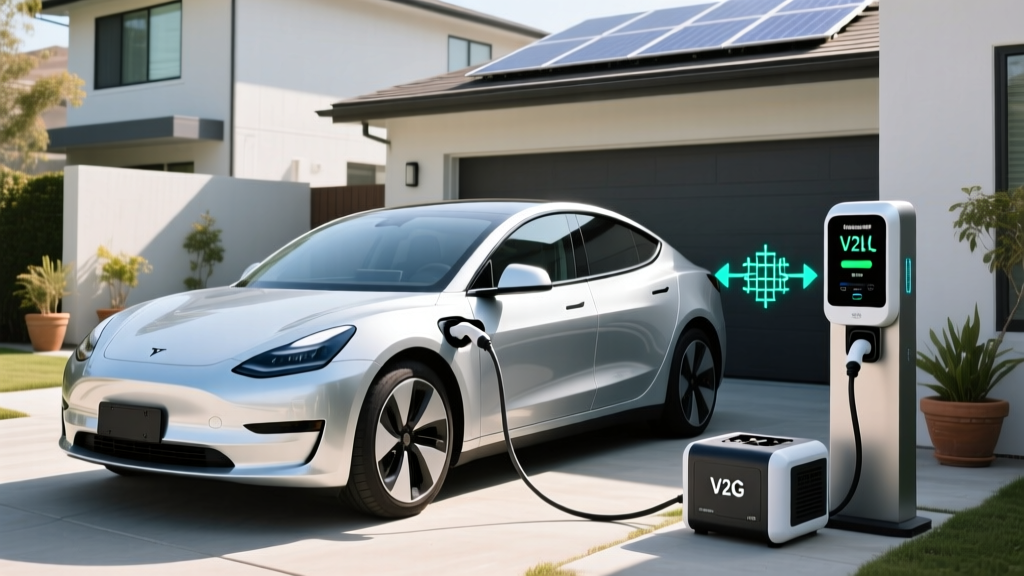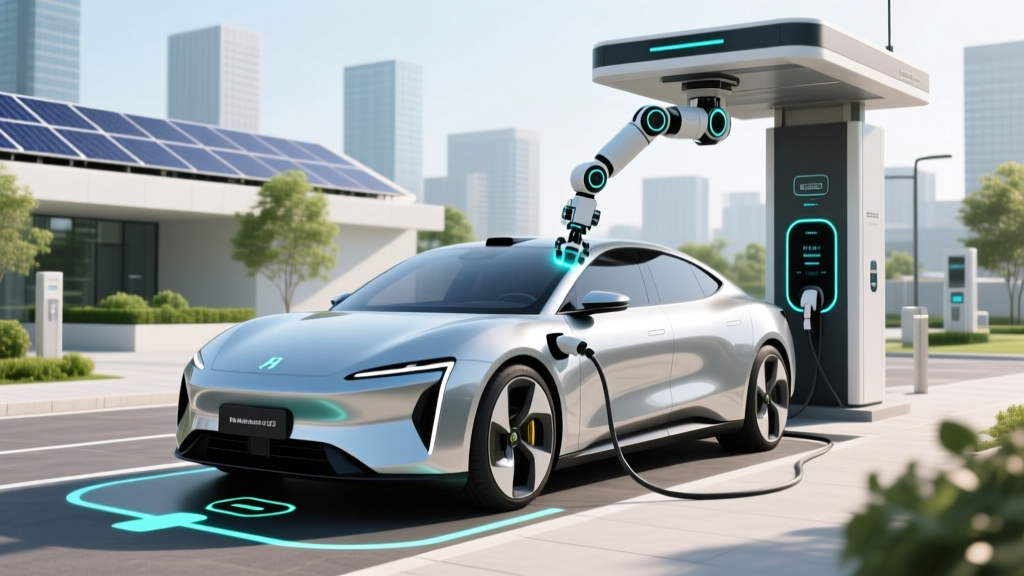
The promise of autonomous EV charging is simple: you park (or your car parks itself), and charging begins without you ever touching a cable. While fully driverless charging is still emerging, the technology stack behind it — wireless inductive pads, robotic plug arms, and automated valet-parking charge stations — is advancing rapidly. Meanwhile, today's EV owners still rely on proven Level 2 and DC fast-charging infrastructure. This guide covers where autonomous charging stands in 2026, what's actually available, and how conventional home and public charging compare on speed, cost, and installation.
What Is Autonomous EV Charging?
Autonomous EV charging refers to any system that initiates and manages an EV charge session without direct human intervention. It spans three main approaches:
- Wireless inductive charging: A ground-mounted pad transfers energy electromagnetically to a receiver coil under the vehicle. No physical plug is needed. Companies like WiTricity and Plugless Power have demonstrated systems delivering 3.6–11 kW for home and fleet use, with efficiency around 90–93%.
- Robotic plug-in arms: A mechanical arm — guided by cameras and proximity sensors — physically inserts a CCS or NACS connector into the vehicle's charge port. Volkswagen demonstrated its robotic charging prototype, and startups like EVAR (Electric Vehicle Autonomous Robotics) are piloting fleet depot versions.
- Automated valet charging: The vehicle self-parks (using Level 4 autonomy in a geo-fenced lot) into a stall equipped with a charge connector or wireless pad. Mercedes-Benz and Bosch have piloted such systems in controlled parking structures.
How Autonomous Charging Compares to Conventional Charging Levels
Before evaluating autonomous systems, it's essential to understand the baseline charging speeds available today. Power is measured in kilowatts (kW), which represents the rate of energy flow, while battery capacity is measured in kilowatt-hours (kWh), the total energy stored. A larger kW number means faster charging, but the battery's kWh capacity determines how far you can drive.
| Level | Voltage | Power (kW) | Miles of Range per Hour | Typical Use |
|---|---|---|---|---|
| Level 1 | 120V AC | 1.2–1.9 kW | 3–5 mi/hr | Overnight home (standard outlet) |
| Level 2 | 240V AC | 3.3–19.2 kW | 12–75 mi/hr | Home wallbox, workplace, public AC |
| DC Fast (Level 3) | 400–800V DC | 50–350 kW | 150–1,200+ mi/hr (peak) | Highway corridor, rapid top-ups |
| Wireless (Autonomous) | N/A (inductive) | 3.6–11 kW | 12–40 mi/hr | Home pad, fleet depot (emerging) |
Wireless autonomous charging currently matches mid-range Level 2 speeds. A vehicle with an 80 kWh battery charging at 7.2 kW wirelessly would gain roughly 25 miles of range per hour — adequate for overnight home charging but not competitive with DC fast charging for road trips.
Real-World Charging Times: 10–80% for Common Battery Sizes
Charging time depends on battery capacity (kWh), the charger's peak power (kW), and the vehicle's charge curve — the rate at which charging speed tapers as the battery fills. Most EVs charge fastest between 10% and 50% state of charge, then progressively slow above 80% to protect battery health.
| Battery Size | Level 2 (11.5 kW) | DC Fast (150 kW peak) | DC Fast (350 kW peak) | Wireless (7.2 kW) |
|---|---|---|---|---|
| 60 kWh (e.g., base EV sedan) | ~3.5 hours | ~22 min | ~15 min | ~5.8 hours |
| 80 kWh (e.g., mid-size SUV) | ~4.8 hours | ~28 min | ~18 min | ~7.8 hours |
| 100 kWh (e.g., full-size truck) | ~6.1 hours | ~35 min | ~22 min | ~9.7 hours |
These figures assume optimal conditions. In practice, cold weather (below 40°F) can add 15–30% to charging times because the battery management system must warm the cells before accepting peak power. Highway driving at sustained 75+ mph also consumes more energy per mile, effectively reducing the range gained per minute of charging.
Home Charger Installation: Costs, Electrical Requirements & Upgrades
Whether you opt for a conventional Level 2 wallbox or an emerging wireless pad, home installation requires a dedicated 240V circuit. Here's what's involved and what it costs.
Electrical Requirements
- Circuit: Dedicated 240V, typically 40A or 50A breaker (supporting continuous draw of 32A or 40A respectively, per NEC 80% rule)
- Wire gauge: 6 AWG copper for 50A circuits; 8 AWG for 40A
- Panel capacity: Most modern 200A panels can accommodate a 40–50A EV circuit. Older 100A panels may require a service upgrade ($1,500–$3,500)
- GFCI protection: Required for outdoor installations per NEC 2023/2026 updates; some chargers have built-in GFCI
- Permit: Most jurisdictions require an electrical permit ($50–$200) with a post-install inspection
| Component | Low Estimate | High Estimate | Notes |
|---|---|---|---|
| Level 2 charger (equipment) | $350 | $750 | Smart Wi-Fi charger, 32–48A, 18–25 ft cable |
| Electrician labor | $400 | $1,800 | Depends on run length from panel to garage |
| Electrical permit | $50 | $200 | Varies by municipality |
| Conduit & wiring materials | $100 | $400 | Longer runs or outdoor routing increase cost |
| Panel upgrade (if needed) | $1,500 | $3,500 | 100A → 200A service upgrade; ~15% of homes need this |
| Total (no panel upgrade) | $900 | $3,150 | Typical install for most modern homes |
| Total (with panel upgrade) | $2,400 | $6,650 | Older homes with 100A service |
The federal Residential Clean Energy Credit (IRS §25D) does not cover EV chargers as of 2026, but the Alternative Fuel Vehicle Refueling Property Credit (§30C) offers up to $1,000 for home charger hardware and installation if you live in an eligible census tract. Check IRS guidance on §30C eligibility before purchasing.
Connector Compatibility: NACS, CCS1 & CHAdeMO
Autonomous charging systems must interface with your vehicle's charge port. The connector landscape in North America has consolidated significantly since Tesla opened its Supercharger network and the North American Charging Standard (NACS) was adopted by most automakers starting in 2025.
| Connector | Brands Using It (2026 Models) | DC Fast Charging Networks | Adapter Availability |
|---|---|---|---|
| NACS (Tesla standard) | Tesla, Ford, GM, Rivian, Volvo, Polestar, Hyundai, Kia, BMW, Mercedes, Subaru, Lucid, Nissan (2026+) | Tesla Supercharger, Electrify America (NACS stalls), EVgo, ChargePoint | CCS-to-NACS adapters available (~$200–$250) |
| CCS1 | Legacy models (pre-2025 VW, some Stellantis, older BMW/Hyundai/Kia) | Electrify America, EVgo, ChargePoint, Ionity (EU) | NACS-to-CCS adapters available (~$200) |
| CHAdeMO | Nissan Leaf (legacy), Mitsubishi Outlander PHEV | Limited; being phased out at new stations | No practical NACS adapter for DC fast charging |
For autonomous robotic charging arms, the system must be calibrated to the specific port geometry of each connector. Most pilot deployments use NACS or CCS1. Wireless inductive charging bypasses connectors entirely, which is its primary advantage for autonomous operation.
Cost to Charge: Home vs. Public vs. Gas
The economics of EV charging remain one of the strongest ownership arguments, particularly for home charging. Electricity prices vary significantly by region and time of use.
| Scenario | Rate ($/kWh) | Vehicle Efficiency (kWh/100 mi) | Cost per Mile |
|---|---|---|---|
| Home off-peak (utility TOU rate) | $0.09–$0.13 | 28–32 kWh | $0.025–$0.042 |
| Home standard rate | $0.14–$0.18 | 28–32 kWh | $0.039–$0.058 |
| Public Level 2 (network pricing) | $0.25–$0.49 | 28–32 kWh | $0.070–$0.157 |
| DC Fast Charging (EA, EVgo, Tesla) | $0.35–$0.65 | 28–32 kWh | $0.098–$0.208 |
| Gasoline (25 MPG combined, $3.40/gal) | — | — | $0.136 |
| Gasoline (30 MPG combined, $3.40/gal) | — | — | $0.113 |
Home off-peak charging delivers per-mile costs roughly 70–80% lower than gasoline. Public DC fast charging, however, can exceed the per-mile cost of an efficient gas car — a critical consideration for apartment dwellers or frequent road trippers who cannot charge at home. According to fueleconomy.gov, the average 2026 EV achieves 3.0–3.5 miles per kWh, making home charging at $0.12/kWh roughly $0.034–$0.040 per mile.
Equipment Recommendations: Level 2 Chargers & Wireless Pads
Below are specific, currently available charging solutions — from proven Level 2 wallboxes to emerging autonomous-ready wireless systems.
Emporia Vue Level 2 Charger
- Power: 48A (11.5 kW on 60A circuit)
- Connector: NACS (J3400), CCS adapter available
- Cable length: 24 ft
- Smart features: Wi-Fi, app scheduling, solar integration, energy monitoring
- Price: ~$400
- Best for: Budget-conscious homeowners wanting max power and energy tracking
ChargePoint Home Flex
- Power: Configurable 16–50A (up to 12 kW)
- Connector: NACS or CCS1 (J1772 adapter included)
- Cable length: 23 ft
- Smart features: Wi-Fi, Alexa/Google integration, flexible amperage dial
- Price: ~$550
- Best for: Homes with varying circuit capacities; adjustable amperage avoids panel upgrade
Wallbox Pulsar Plus
- Power: 40A (9.6 kW on 50A circuit)
- Connector: NACS (2026 model), J1772 for legacy
- Cable length: 25 ft
- Smart features: Wi-Fi + Bluetooth, Power Sharing (two chargers on one circuit), ECO-Smart solar mode
- Price: ~$500
- Best for: Two-EV households sharing a single 60A circuit
Plugless Power L2 Wireless Pad
- Power: 7.2 kW (inductive transfer)
- Connector: None — vehicle-side receiver required
- Cable length: N/A (pad-to-vehicle air gap ~4–6 inches)
- Smart features: Auto-alignment, app monitoring, foreign object detection
- Price: ~$3,500–$4,200 (pad + vehicle receiver kit + install)
- Best for: Autonomous charging pilot; garage setups where plug-in is inconvenient
Where Autonomous EV Charging Stands in 2026
Despite significant R&D progress, autonomous EV charging is not yet a mainstream consumer product. Here's the current landscape:
What's Available Now
- Wireless home charging: Plugless Power and WiTricity offer aftermarket kits for select models (primarily fleet and pilot programs). Vehicle-side receiver installation adds $1,500–$2,500 to the cost.
- Robotic fleet charging: Companies like EVAR and Standard Bots are deploying robotic plug-in arms at commercial fleet depots where vehicles park in predictable, structured environments.
- Auto-park + charge pilots: Mercedes-Benz's Intelligent Park Pilot (Level 4, approved in Germany and select US structures) can self-park in designated garages, but the charge-plug step still requires infrastructure-side automation.
What's Coming (2027–2030)
- Higher-power wireless: SAE J2954 standardization is pushing toward 11–22 kW wireless pads for passenger vehicles, with 500 kW wireless concepts for heavy-duty trucks.
- OEM-integrated receivers: BMW and Mercedes have tested factory-installed wireless receivers, potentially eliminating the aftermarket kit requirement.
- Robotaxi charging depots: Waymo and Zoox are developing Level 4 autonomous charging workflows where robotaxis navigate to depot chargers between rides — a likely first commercial application.
- Wireless charging is ~7–10% less efficient than wired Level 2, meaning more energy (and money) per mile.
- Aftermarket vehicle receivers add weight (~15–25 lbs) and ground clearance concerns.
- Robotic plug-in arms require precise parking alignment (±2 inches) — not yet viable in unstructured public lots.
- No consumer vehicle sold in the US as of 2026 ships with a factory wireless charging receiver as standard equipment.
- Cost remains 4–6× higher than a conventional Level 2 wallbox installation.
Safety, Code & Practical Considerations
Whether installing a conventional wallbox or a wireless pad, electrical safety and code compliance are non-negotiable.
- Dedicated circuit: EV chargers must be on a dedicated breaker — never shared with other appliances. NEC Article 625 governs EV charging equipment.
- GFCI protection: Required for all outdoor EVSE (Electric Vehicle Supply Equipment) installations. Indoor garage installations may also require GFCI depending on local amendments to NEC 2023/2026.
- Outdoor rating: If mounting outside, the charger must carry a NEMA 4 or IP65 rating for weather resistance. All recommended chargers above meet this standard.
- Wireless pad safety: Inductive pads include foreign object detection (FOD) and living object protection (LOP) to shut down if metal debris or a pet enters the charging field.
- Permit and inspection: Skipping the permit risks insurance denial in the event of an electrical fire. Most insurers require permitted, inspected work for EV charger-related claims.
Frequently Asked Questions
How much does it cost to install a home EV charger?
A typical Level 2 home charger installation costs between $900 and $3,150 when no panel upgrade is needed. This includes the charger unit ($350–$750), electrician labor ($400–$1,800), materials ($100–$400), and permit ($50–$200). Homes with older 100A electrical panels may need a service upgrade adding $1,500–$3,500, bringing the total to $2,400–$6,650. Wireless autonomous charging pads cost significantly more — $3,500–$4,200 including the vehicle-side receiver and installation.
How fast will each charging level add range?
Level 1 (120V) adds 3–5 miles per hour. Level 2 (240V, 11.5 kW) adds roughly 35–40 miles per hour for a typical EV. DC fast charging at 150 kW can add 150–250 miles in 15–20 minutes, depending on battery size and charge curve. Wireless autonomous charging at 7.2 kW adds approximately 20–25 miles per hour — comparable to a mid-range Level 2 setup.
Which connector or charger is compatible with my EV?
For 2026 model-year vehicles, the vast majority of new EVs use the NACS (J3400) connector, including Tesla, Ford, GM, Hyundai, Kia, BMW, Rivian, and others. Older EVs (pre-2025) may use CCS1 or CHAdeMO. Check your vehicle's charge port or owner's manual. Adapters are available for cross-compatibility, though CHAdeMO DC fast charging options are shrinking as networks transition to NACS and CCS.
How much does charging cost per mile compared to gas?
Home off-peak charging averages $0.025–$0.042 per mile, compared to $0.113–$0.136 per mile for a gas car getting 25–30 MPG at $3.40/gallon. Public DC fast charging is more expensive at $0.098–$0.208 per mile and can exceed gas costs. The savings are maximized when you charge at home on a time-of-use electricity plan with off-peak rates.
What electrical upgrades might I need?
Most homes with a 200A electrical panel can support a 40–50A dedicated EV circuit without upgrades. If you have a 100A panel (common in homes built before 1990), you'll likely need a panel upgrade to 200A, costing $1,500–$3,500. Some homeowners opt for a lower-amperage charger (16–32A) to avoid the upgrade, accepting slower charging speeds. A licensed electrician can perform a load calculation to determine your panel's available capacity. Wireless charging pads typically require a 40A circuit, similar to a mid-range Level 2 wallbox.
Is autonomous EV charging practical for home use today?
For most homeowners in 2026, a conventional Level 2 wallbox remains the practical choice — it's 4–6× cheaper, charges faster, and is compatible with all EVs without aftermarket modifications. Wireless autonomous charging makes sense primarily for fleet operators, tech-forward early adopters, or situations where physical plug-in is impractical (e.g., tight garage spaces, accessibility needs). Expect consumer-ready autonomous charging to become more viable as OEMs integrate wireless receivers at the factory level in the 2027–2030 timeframe.