Quick Verdict: Is the Autel MaxiCharger Worth It for Home Charging?
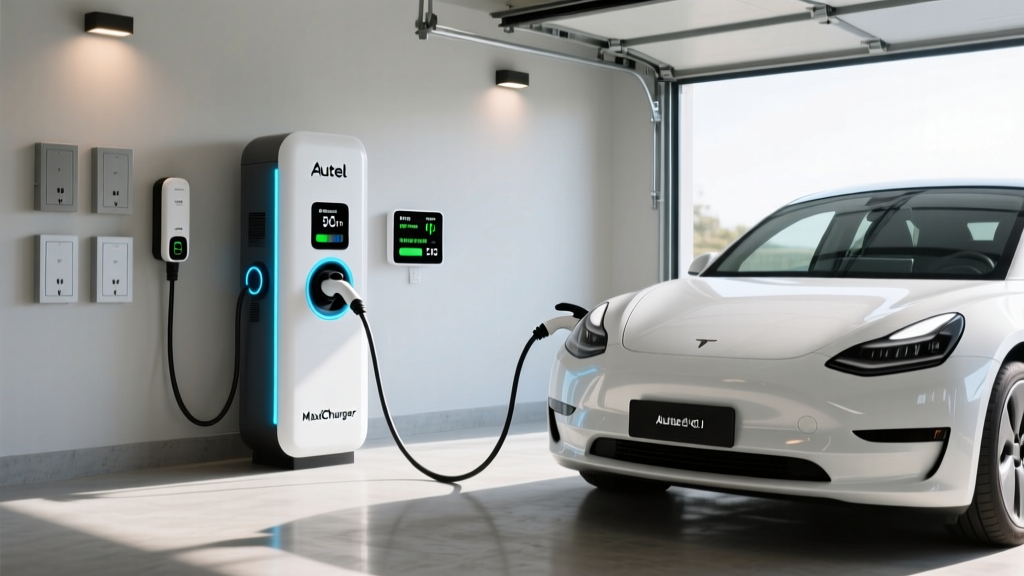
The Autel MaxiCharger AC line has carved out a solid niche in the crowded Level 2 home charging market by offering Wi-Fi-connected smart charging, robust build quality, and competitive pricing against stalwarts like ChargePoint and Emporia. For the 2026 model year, Autel offers the MaxiCharger AC Wallbox in 40A (9.6 kW) and 50A (12 kW) configurations, both available with either a NACS (Tesla-compatible) or J1772 connector. If you're evaluating whether this charger fits your garage and your electrical panel, this guide breaks down every spec, cost, and compatibility question you need answered.
Before we get into the hardware, let's ground the discussion in what Level 2 charging actually delivers and why the distinction between kW (power, or the rate of energy flow) and kWh (energy, or the battery's capacity) matters for your daily routine.
Charging Levels Explained: What Speed Do You Actually Need?
Every EV owner interacts with three tiers of charging. Understanding the kW output and real-world miles added per hour is the single most important factor in choosing home equipment.
| Level | Voltage | Max Power (kW) | Miles of Range Added Per Hour | Typical Use |
|---|---|---|---|---|
| Level 1 | 120V AC | 1.2–1.9 kW | 3–5 miles | Overnight trickle; PHEVs, low-mileage drivers |
| Level 2 | 240V AC | 3.3–19.2 kW | 12–75 miles | Daily home & workplace charging |
| DC Fast Charge | 200–800V DC | 50–350+ kW | 150–1,000+ miles (equivalent) | Road trips; 10–80% in 18–45 minutes |
For context, a 77 kWh battery pack (like the Ford Mustang Mach-E Extended Range) charging on a Level 1 outlet at 1.4 kW would take roughly 55 hours from empty to full — essentially impractical for a BEV. That same pack on a 9.6 kW Level 2 charger like the Autel MaxiCharger 40A recovers about 35–40 miles of range per hour, or a full charge in approximately 8 hours overnight. On a 350 kW DC fast charger, that pack can go from 10% to 80% in about 20–25 minutes, though sustained speeds taper significantly above 80% State of Charge (SoC) due to the battery's charge curve protecting cell longevity.
Autel MaxiCharger Lineup: Specs, Power Output, and Connector Options
Autel's 2026 MaxiCharger AC Wallbox lineup centers on two hardwired models designed for residential and light-commercial use. Here's how they stack up against each other and the competition.
Autel MaxiCharger AC Wallbox 40A
- Power Output: 9.6 kW (240V × 40A)
- Connector: NACS or J1772 (configurable at purchase)
- Cable Length: 24 feet
- Smart Features: Wi-Fi, Bluetooth, Autel Charge app, scheduled charging, energy tracking
- Enclosure Rating: NEMA 4 (indoor/outdoor, weather-resistant)
- Price: ~$399–$449
- Best For: Most EVs with 7.2–9.6 kW onboard chargers; standard 50A circuit homes
Autel MaxiCharger AC Wallbox 50A
- Power Output: 12 kW (240V × 50A)
- Connector: NACS or J1772 (configurable at purchase)
- Cable Length: 24 feet
- Smart Features: Wi-Fi, Bluetooth, Autel Charge app, scheduled charging, energy tracking, load balancing
- Enclosure Rating: NEMA 4 (indoor/outdoor, weather-resistant)
- Price: ~$499–$549
- Best For: EVs with 11.5 kW onboard chargers (e.g., Rivian R1T/R1S, some Tesla configurations); homes with 60A+ available circuit capacity
The 40A model is the pragmatic choice for the majority of EV owners. Vehicles like the Hyundai Ioniq 5 (10.9 kW onboard charger), Chevrolet Equinox EV (11.5 kW), and Tesla Model Y (11.5 kW on NACS) can utilize most or all of what the 50A unit provides, but the 40A unit still delivers a full overnight charge for any battery size currently on the market. The 50A model makes the most sense if you regularly drive 60+ miles daily and want the fastest possible Level 2 recovery, or if you own a vehicle with a large pack (100+ kWh) like the Rivian R1T Dual-Motor (128.9 kWh usable) or the GMC Sierra EV.
Autel also includes a built-in RFID reader for access control (useful if your charger is accessible to neighbors or in a shared garage) and supports OCPP 1.6J for commercial integration. The app allows you to set charging schedules to take advantage of off-peak utility rates — a meaningful cost lever we'll explore below.
Home Installation: Electrical Requirements, Panel Upgrades, and Real Costs
The Autel MaxiCharger is a hardwired unit — it does not plug into a standard outlet. This means a licensed electrician must run a dedicated circuit from your electrical panel to the charger location. Here's what that involves.
Electrical Specifications
- 40A model: Requires a dedicated 50A, 240V circuit (NEC code mandates circuits be rated 125% of continuous load; 40A × 1.25 = 50A breaker)
- 50A model: Requires a dedicated 60A or 70A, 240V circuit (50A × 1.25 = 62.5A → 70A breaker in most jurisdictions)
- Wire gauge: 6 AWG copper for the 50A circuit; 4 AWG copper for the 70A circuit
- Connection: Hardwired junction box (no plug)
Panel Capacity: The Hidden Cost Variable
Most modern homes built after 2000 have a 200A main electrical panel, which typically has enough spare capacity for a 50A or 70A EV circuit. Older homes with 100A or 150A panels may require a panel upgrade — this is the single biggest variable in your installation cost. A panel upgrade from 100A to 200A can add $1,500–$3,000 to the project.
Your electrician will perform a load calculation per NEC Article 220 to determine whether your panel can handle the additional circuit. If your home runs electric heat, an electric oven, and an electric dryer simultaneously, you may be close to capacity already. In some cases, a smart load-management device (like the Emporia Smart Load Center or a Span panel) can dynamically share capacity between your EV charger and other appliances, avoiding a panel upgrade.
| Component | Low Estimate | High Estimate | Notes |
|---|---|---|---|
| Autel MaxiCharger unit (40A or 50A) | $399 | $549 | Depends on amperage and retailer |
| Electrician labor (run circuit, mount unit) | $400 | $1,200 | Varies by run length, wall type, region |
| Materials (wire, conduit, breaker, junction box) | $100 | $350 | Longer runs and 4 AWG wire cost more |
| Electrical permit | $50 | $200 | Required in most jurisdictions |
| Panel upgrade (if needed) | $1,500 | $3,000 | 100A → 200A upgrade; not always required |
| Total (no panel upgrade) | $949 | $2,299 | Most common scenario for 200A-panel homes |
| Total (with panel upgrade) | $2,449 | $5,299 | Older homes with 100A service |
The IRS residential clean energy credit (IRC §25C) covers 30% of home EV charger equipment and installation costs, up to $1,000 per year, through 2032. This applies to the MaxiCharger and the electrician's labor. Note: this is separate from the §30D vehicle tax credit and has its own eligibility rules. Consult a tax professional to confirm your eligibility.
Safety and Code Considerations
- Dedicated circuit: NEC requires the EV charger to be on its own dedicated circuit — it cannot share with other outlets or appliances.
- GFCI protection: The 2026 NEC (Article 625) requires GFCI protection for all EV charging equipment. Hardwired units like the MaxiCharger typically have built-in ground-fault protection, but confirm with your electrician that your installation meets local code.
- Outdoor rating: The MaxiCharger's NEMA 4 rating means it can be installed outdoors and withstand rain, snow, and hose-directed water. If you're mounting it on an exterior wall, no additional enclosure is needed.
- Disconnect: Some local codes require a visible disconnect switch within sight of the charger. Your electrician will advise on this.
Connector Compatibility: NACS, CCS1, CHAdeMO, and Adapter Needs
The North American charging landscape has largely consolidated around NACS (the Tesla-designed connector now adopted by nearly every major automaker) and CCS1 (the previous standard, still found on many 2022–2025 EVs). Here's how the MaxiCharger fits in.
| Connector Type | Brands Using It (2026 Models) | MaxiCharger Config | Adapter Needed? |
|---|---|---|---|
| NACS (Tesla plug) | Tesla (all), Ford, GM, Rivian, Hyundai, Kia, BMW, Mercedes, Volvo, Polestar, Toyota, Subaru | Order NACS version | No |
| J1772 (legacy AC plug) | Older Nissan Leaf, some 2022–2025 models from Stellantis, Mitsubishi | Order J1772 version | No |
| CCS1 (combo DC plug) | 2022–2025 VW ID.4, Hyundai Ioniq 5, Kia EV6 (pre-NACS transition) | Order J1772 version | CCS adapter for DC; J1772 works natively for AC Level 2 |
| CHAdeMO | Nissan Leaf (legacy DC) | Order J1772 version | J1772 works for AC Level 2; CHAdeMO only relevant at DC stations |
For Level 2 home charging, the relevant connector is either NACS or J1772. DC fast charging connectors (CCS1, CHAdeMO) are only used at public fast-charging stations and are irrelevant to your home setup. If you own a 2024–2025 model-year EV with a CCS1 port (like an early Hyundai Ioniq 5 or VW ID.4), you can order the MaxiCharger with a J1772 connector and it will plug directly into your car's AC charging port — no adapter needed for home use.
If you plan to transition to a NACS-equipped vehicle in the future, ordering the NACS version now and using a J1772-to-NACS adapter (~$50–$100) for your current CCS1 car is a forward-looking option. Tesla sells an official adapter, and third-party options from Lectron and A2Z are widely available.
Cost to Charge: Home vs. Public vs. Gas per Mile
The economic case for home charging is compelling, but the numbers vary dramatically depending on where and when you charge.
| Charging Scenario | Avg $/kWh | Cost Per Mile (at 3.0 mi/kWh efficiency) | Equivalent Gas Price (at 25 MPG) |
|---|---|---|---|
| Home — off-peak (utility time-of-use rate) | $0.08–$0.12 | $0.027–$0.040 | $0.67–$1.00/gallon |
| Home — standard residential rate | $0.14–$0.18 | $0.047–$0.060 | $1.17–$1.50/gallon |
| Public Level 2 (ChargePoint, EVgo L2) | $0.25–$0.40 | $0.083–$0.133 | $2.08–$3.33/gallon |
| DC Fast Charge (Electrify America, Tesla Supercharger) | $0.35–$0.55 | $0.117–$0.183 | $2.92–$4.58/gallon |
| Gasoline (national avg, early 2026) | — | $0.124 (at $3.10/gal, 25 MPG) | $3.10/gallon |
At the national average electricity rate of ~$0.16/kWh (per EIA data), charging a 77 kWh battery from 10% to 80% at home costs roughly $8.60 and adds about 215 miles of range. That same distance in a 25 MPG gas car at $3.10/gallon costs $26.66. Over 15,000 miles of annual driving, the home-charging EV saves approximately $1,450 per year in fuel alone.
The MaxiCharger's scheduling feature lets you set charging windows to coincide with your utility's off-peak rate — typically 10 PM to 6 AM — which can cut your charging cost by 30–50% compared to standard rates. This is where a smart charger earns its premium over a "dumb" Level 2 unit.
Charging Time Examples: How Long Does 10–80% Take at Home?
Here's how the Autel MaxiCharger 40A (9.6 kW) and 50A (12 kW) handle common EV battery sizes from 10% to 80% State of Charge:
| Vehicle (2026) | Battery (kWh usable) | Onboard Charger | MaxiCharger 40A (9.6 kW) | MaxiCharger 50A (12 kW) |
|---|---|---|---|---|
| Tesla Model Y Long Range | 75 kWh | 11.5 kW | ~5 hrs 30 min | ~4 hrs 40 min |
| Hyundai Ioniq 5 (Long Range) | 77.4 kWh | 10.9 kW | ~5 hrs 40 min | ~5 hrs 00 min |
| Ford Mustang Mach-E (Ext. Range) | 91 kWh | 10.5 kW | ~6 hrs 40 min | ~5 hrs 55 min |
| Chevrolet Equinox EV | 85 kWh | 11.5 kW | ~6 hrs 10 min | ~5 hrs 10 min |
| Rivian R1T (Dual-Motor, Max Pack) | 128.9 kWh | 11.5 kW | ~9 hrs 25 min | ~7 hrs 50 min |
| Toyota bZ4X | 64 kWh | 7.2 kW | ~4 hrs 40 min | ~4 hrs 40 min (limited by car) |
Notice the Toyota bZ4X row: its 7.2 kW onboard charger limits AC charging speed regardless of how powerful your wallbox is. This is why matching charger output to your vehicle's onboard charger matters — buying the 50A MaxiCharger for a bZ4X would not reduce charge times. Conversely, a Rivian R1T owner benefits measurably from the 50A unit's extra 2.4 kW.
How the Autel MaxiCharger Compares to Competitors
The home Level 2 charger market in 2026 is competitive. Here's how the MaxiCharger stacks up against the three most common alternatives.
ChargePoint Home Flex
- Power: Up to 12 kW (50A), adjustable down to 16A
- Connector: J1772 (NACS adapter sold separately)
- Cable: 23 feet
- Smart Features: Wi-Fi, Alexa, app scheduling, energy reports
- Price: ~$549–$599
- Edge: Adjustable amperage is useful for panel-constrained homes
Emporia Vue EV Charger
- Power: Up to 11.5 kW (48A)
- Connector: J1772 (NACS version available)
- Cable: 24 feet
- Smart Features: Wi-Fi, energy monitoring with whole-home Vue integration
- Price: ~$399–$449
- Edge: Best energy-tracking ecosystem when paired with Emporia Vue panel monitor
Tesla Wall Connector
- Power: Up to 11.5 kW (48A)
- Connector: NACS (J1772 adapter included)
- Cable: 24 feet
- Smart Features: Wi-Fi, power sharing (up to 6 units on one circuit), OTA updates
- Price: ~$425–$475
- Edge: Native NACS, power-sharing for multi-EV households, sleek design
The Autel MaxiCharger's differentiator is its commercial pedigree — Autel is a major diagnostic-tool manufacturer, and the MaxiCharger line carries over industrial-grade components and OCPP compatibility that appeal to fleet operators and tech-savvy homeowners alike. The RFID access control is uncommon at this price point and valuable for shared-space installations. Against the ChargePoint, it's slightly cheaper and offers native NACS without an adapter. Against the Tesla Wall Connector, it matches on cable length and price but lacks Tesla's multi-unit power-sharing feature.
Frequently Asked Questions
How much does it cost to install a home EV charger?
For the Autel MaxiCharger, expect a total installed cost of $949–$2,299 if your home has a 200A panel with available capacity. If you need a panel upgrade from 100A to 200A, the total rises to $2,449–$5,299. The IRS §25C credit covers 30% of equipment and installation, up to $1,000, which can offset $285–$690 of a standard install.
How fast will each charging level add range?
Level 1 (120V) adds 3–5 miles per hour. Level 2 at 9.6 kW (Autel 40A) adds approximately 35–40 miles per hour for an average EV. Level 2 at 12 kW (Autel 50A) adds approximately 44–50 miles per hour. DC fast charging at 150+ kW can add 150–300 miles in 20–30 minutes, depending on the vehicle's charge curve.
Which connector/charger is compatible with my EV?
If you drive a 2025–2026 EV from Tesla, Ford, GM, Hyundai, Kia, Rivian, BMW, Mercedes, or most other brands, your vehicle uses NACS — order the MaxiCharger with the NACS connector. If you drive a 2022–2024 EV with CCS1 (like an early VW ID.4 or Hyundai Ioniq 5), order the J1772 version. For AC Level 2 home charging, NACS and J1772 are the only two connectors in use; CHAdeMO and CCS1 are relevant only for DC public charging.
How much does charging cost per mile vs gas?
At the national average residential electricity rate of ~$0.16/kWh and an EV efficiency of 3.0 miles/kWh, home charging costs roughly $0.053 per mile. A 25 MPG gas car at $3.10/gallon costs $0.124 per mile — more than double. Over 15,000 miles annually, that's a savings of approximately $1,065 per year with home charging.
What electrical upgrades might I need?
The most common upgrade is adding a dedicated 50A or 70A, 240V circuit from your existing panel. If your panel is 200A and has spare breaker slots and load capacity, no upgrade is needed. If your panel is 100A or 150A and already near capacity, a panel upgrade to 200A may be required — adding $1,500–$3,000 to the project. In some cases, a smart load-management device can avoid the upgrade entirely. Have a licensed electrician perform a NEC Article 220 load calculation before purchasing equipment.
Does the Autel MaxiCharger qualify for a tax credit?
The charger itself and its professional installation qualify for the IRS §25C residential clean energy credit — 30% of the cost, capped at $1,000 per year. This is separate from the §30D new-vehicle credit. Eligibility depends on your tax liability and the installation meeting code requirements. Consult a tax professional for your specific situation.
Can I install the Autel MaxiCharger myself?
Technically, a skilled homeowner with electrical experience can perform the wiring, but most jurisdictions require a licensed electrician to pull the permit and perform (or inspect) the work for it to pass code. Hardwired 240V circuits carry significant arc-flash and fire risk if improperly installed. Additionally, DIY installation may void the equipment warranty and disqualify you from the §25C tax credit, which requires the installation to meet all applicable codes. We recommend using a licensed electrician.