If you've spent years behind the wheel of an Audi S5 with its supercharged 3.0L V6 — enjoying that instant torque and refined power delivery — you already understand what electrified performance feels like. The supercharger's lag-free response is exactly what EV motors replicate, only with more immediacy and zero tailpipe emissions. For S5 owners exploring the EV transition in 2026, the biggest question isn't about performance; it's about charging. This guide breaks down exactly what you need to charge an EV at home and on the road, with the same engineering precision you'd expect from Audi's Ingolstadt team.
Why Audi S5 Supercharged V6 Owners Are Uniquely Ready for EVs
The 3.0 TFSI supercharged V6 in the B8/B8.5 generation Audi S5 (2009–2017) produced 333 horsepower and 325 lb-ft of torque available from 2,900 rpm. That mechanical supercharger gave the S5 a linear, responsive character that turbocharged engines often lack. Modern EVs like the 2026 Audi Q8 e-tron (402 hp, 490 lb-ft, EPA range up to 285 miles) or the Audi A6 e-tron (announced for late 2025/2026, estimated 400+ hp, targeting ~370 miles EPA) deliver that same instant-torque personality — amplified.
Where the transition requires new knowledge is fueling. Instead of visiting a gas station for premium 93-octane at $4.50/gallon, you'll be managing kilowatt-hours (kWh), charge rates in kilowatts (kW), and connector standards. Let's decode every variable.
Charging Levels Explained: Speeds, kW Ratings, and Miles Per Hour
The single most important distinction in EV charging: kW (kilowatts) measures power — the rate of energy delivery. kWh (kilowatt-hours) measures energy — the total capacity stored in your battery. Think of kW as the flow rate of a hose and kWh as the size of the bucket. Never confuse them.
| Level | Voltage | Max Power (kW) | Miles of Range Added Per Hour | Best For |
|---|---|---|---|---|
| Level 1 | 120V AC | 1.4–1.9 kW | 3–5 miles | Overnight trickle, PHEVs, emergencies |
| Level 2 | 240V AC | 7.2–19.2 kW | 20–60 miles | Daily home charging, workplace |
| DC Fast Charging | 400–800V DC | 50–350 kW | 150–1,200+ miles (equivalent/hr) | Road trips, rapid top-ups |
For context, an Audi Q8 e-tron with its 114 kWh gross battery (106 kWh usable, NMC chemistry) charging at a 48-amp Level 2 station (11.5 kW) will add roughly 35 miles of range per hour — going from 10% to 80% State of Charge (SoC) in about 7 hours. On a 170 kW DC fast charger, that same 10–80% session takes approximately 31 minutes, thanks to the Q8 e-tron's strong charge curve that sustains near-peak rates up to ~60% SoC before tapering.
Home EV Charger Installation: Electrical Requirements, Costs, and Panel Upgrades
Installing a Level 2 home charger is the single highest-impact upgrade for EV ownership. Here's what's required and what it costs in 2026.
Electrical Requirements
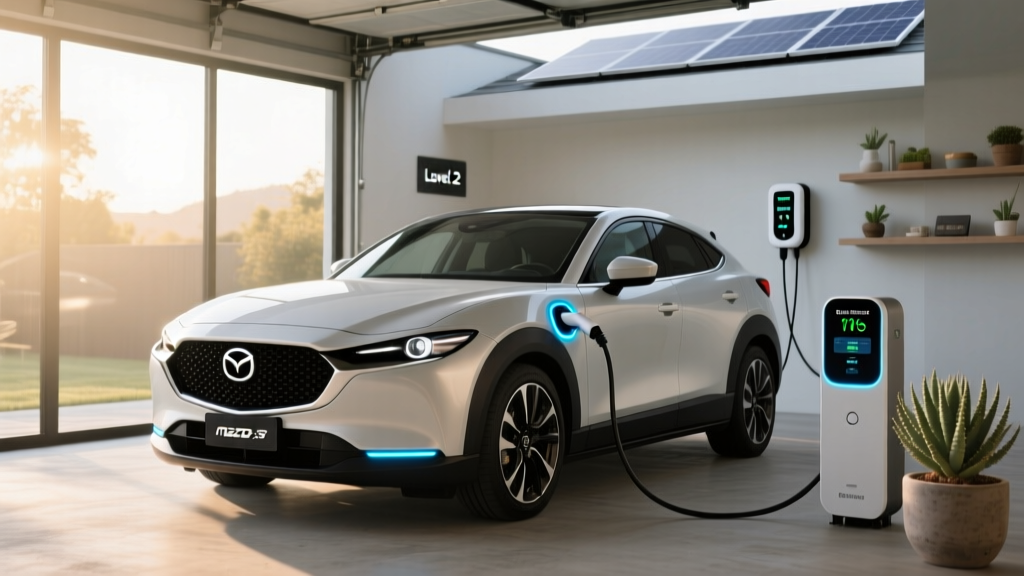
A standard Level 2 home charger requires a dedicated 240V circuit, identical in concept to what powers your electric dryer or oven. Common configurations:
- 40-amp circuit / 32-amp continuous draw: Delivers 7.7 kW at 240V. Sufficient for most daily needs — adds ~25–30 miles per hour.
- 50-amp circuit / 40-amp continuous: Delivers 9.6 kW. Adds ~32–38 miles per hour. The sweet spot for most EV owners.
- 60-amp circuit / 48-amp continuous: Delivers 11.5 kW. Maximizes charging for large-battery EVs like the Q8 e-tron or Rivian R1S.
- 80-amp circuit / 64-amp continuous: Delivers 15.4+ kW. Requires hardwired installation and a robust panel — typically for dual-EV households.
The National Electrical Code (NEC) requires that continuous loads (like EV charging, which runs for 3+ hours) not exceed 80% of the circuit's rated amperage. So a 50-amp breaker supports only 40 amps of continuous charging draw.
Do You Need a Panel Upgrade?
If your home has a 100-amp main service panel (common in homes built before 1990), adding a 50-amp EV circuit will likely require a panel upgrade to 200 amps. A load calculation performed by a licensed electrician will determine whether your existing panel can handle the additional draw alongside HVAC, kitchen appliances, and other circuits.
Panel upgrades add significant cost but also increase your home's overall electrical capacity — valuable for future electrification (heat pumps, solar, V2H bidirectional systems).
| Component | Simple Install (Panel Adjacent) | Standard Install (50–80 ft Run) | Complex Install (Panel Upgrade + Long Run) |
|---|---|---|---|
| Level 2 Charger Equipment | $400–$700 | $400–$700 | $400–$700 |
| Electrician Labor | $300–$600 | $600–$1,500 | $1,500–$3,500 |
| Electrical Panel Upgrade | Not needed | Not needed | $1,500–$3,000 |
| Permit & Inspection | $50–$150 | $50–$250 | $100–$400 |
| Conduit, Wiring, Misc. | $50–$150 | $200–$600 | $400–$1,000 |
| Total Estimated Cost | $800–$1,600 | $1,250–$3,050 | $3,900–$8,600 |
Many utilities offer rebates of $250–$1,000 for Level 2 charger installation, and some states provide additional incentives. Check your local utility's EV program page before scheduling work. The federal Alternative Fuel Vehicle Refueling Property Credit (IRS Form 8911) may cover up to 30% of home charging equipment and installation costs (capped at $1,000), subject to income and census-tract eligibility — consult a tax professional for your specific situation.
Connector Compatibility: NACS, CCS1, and CHAdeMO in 2026
The connector landscape has consolidated significantly. Here's where each standard stands for the 2026 model year:
| Connector | Brands Using It | Notes |
|---|---|---|
| NACS (North American Charging Standard / Tesla) | Tesla, Ford, GM, Rivian, Volvo, Polestar, Mercedes-Benz, BMW (2025+), Audi (2025+), Hyundai, Kia | Now the dominant standard. Access to Tesla Supercharger network. |
| CCS1 (Combined Charging System) | VW ID.4 (remaining stock), Stellantis, some legacy models | Still widely available at Electrify America, EVgo stations. Declining in new vehicles. |
| CHAdeMO | Nissan Leaf (discontinued), Mitsubishi Outlander PHEV | Legacy standard. Stations increasingly rare. |
For Audi specifically: the 2026 Audi Q8 e-tron and upcoming A6 e-tron use the NACS connector natively in North America, granting direct access to Tesla's 17,000+ Supercharger stalls nationwide without an adapter. If you own a 2023–2024 Audi e-tron GT (which shipped with CCS1), Audi provides a CCS-to-NACS adapter — critical for accessing the Supercharger network on road trips.
Level 2 Charger Equipment Recommendations for 2026
Not all Level 2 chargers are equal. Here are top picks based on power output, build quality, smart features, and real-world reliability:
ChargePoint Home Flex (2nd Gen)
- Power: Up to 12 kW (50A) / configurable down to 16A
- Connector: NACS native (CCS adapter available)
- Cable Length: 23 feet
- Smart Features: Wi-Fi, app scheduling, utility demand-response integration, Alexa
- Price: ~$599
- Best For: Most homeowners. Flexible amperage means it works on 20A to 60A circuits.
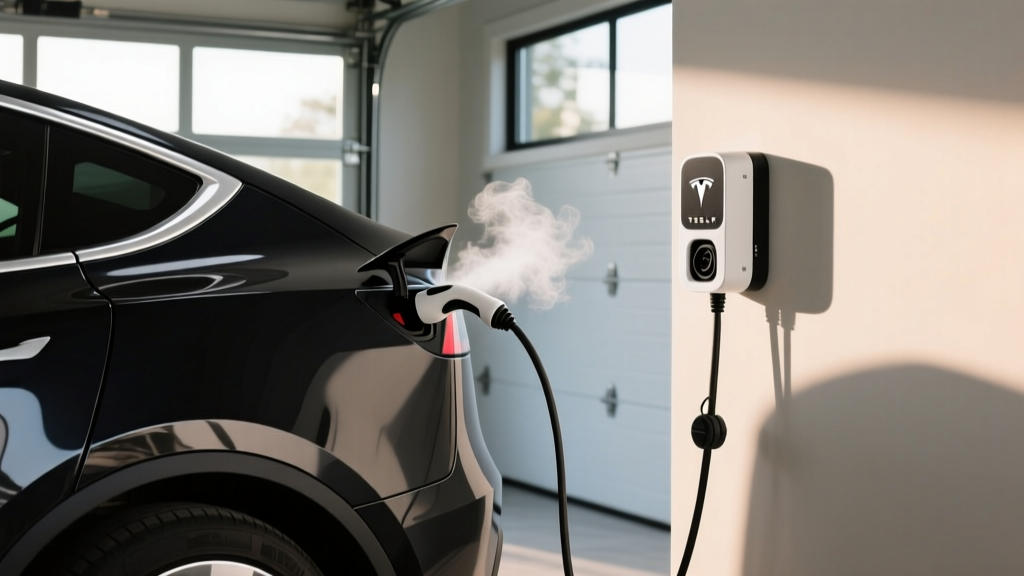
Tesla Wall Connector
- Power: Up to 11.5 kW (48A)
- Connector: NACS native
- Cable Length: 24 feet
- Smart Features: Wi-Fi, OTA updates, power sharing (link multiple units on one circuit), Tesla app
- Price: ~$475
- Best For: Tesla and NACS-equipped Audi owners. Excellent value and reliability.
Emporia Level 2 Smart Charger
- Power: Up to 11.5 kW (48A)
- Connector: NACS (J1772 variant available)
- Cable Length: 24 feet
- Smart Features: Wi-Fi, energy monitoring, solar integration, time-of-use scheduling
- Price: ~$399
- Best For: Budget-conscious buyers wanting smart features. Strong energy-monitoring app.
Grizzl-E Smart
- Power: Up to 10 kW (40A)
- Connector: NACS or J1772
- Cable Length: 24 feet
- Smart Features: OCPP-compatible, app control, adjustable amperage via DIP switches
- Price: ~$449
- Best For: Cold-climate durability. Built in Canada, rated to -40°F, NEMA 4 outdoor rating.
Cost to Charge an EV vs. Fueling the Audi S5 Supercharged V6
The S5's 3.0T V6 averages roughly 20 MPG combined on premium fuel. At $4.50/gallon (2026 national average for premium), that's $0.225 per mile in fuel alone. How does EV charging compare?
| Scenario | Rate | Cost Per Mile | Annual Cost (12,000 mi) |
|---|---|---|---|
| Audi S5 3.0T V6 (20 MPG, $4.50/gal premium) | $4.50/gallon | $0.225 | $2,700 |
| EV — Home Off-Peak (0.30 kWh/mi, $0.13/kWh) | $0.13/kWh | $0.039 | $468 |
| EV — Home Standard Rate (0.30 kWh/mi, $0.18/kWh) | $0.18/kWh | $0.054 | $648 |
| EV — Public Level 2 (0.30 kWh/mi, $0.30/kWh) | $0.30/kWh | $0.090 | $1,080 |
| EV — DC Fast Charging (0.30 kWh/mi, $0.45/kWh) | $0.45/kWh | $0.135 | $1,620 |
Even in the worst-case scenario — relying exclusively on DC fast charging at public rates — an EV costs 40% less per mile than fueling the S5. With home off-peak charging, the savings reach 83%. Over five years and 60,000 miles, home-charging an EV saves approximately $10,000–$11,000 in fuel costs compared to the S5's premium appetite.
Efficiency note: most modern EVs achieve 2.5–3.5 miles per kWh (0.28–0.40 kWh/mile). The Audi Q8 e-tron averages about 2.5 mi/kWh (0.40 kWh/mi) — on the less efficient end due to its size and weight. Sleeker models like the Hyundai Ioniq 6 or Tesla Model 3 achieve 3.5–4.0 mi/kWh, pushing cost per mile even lower.
Charging Time Examples: 10–80% for Common Battery Sizes
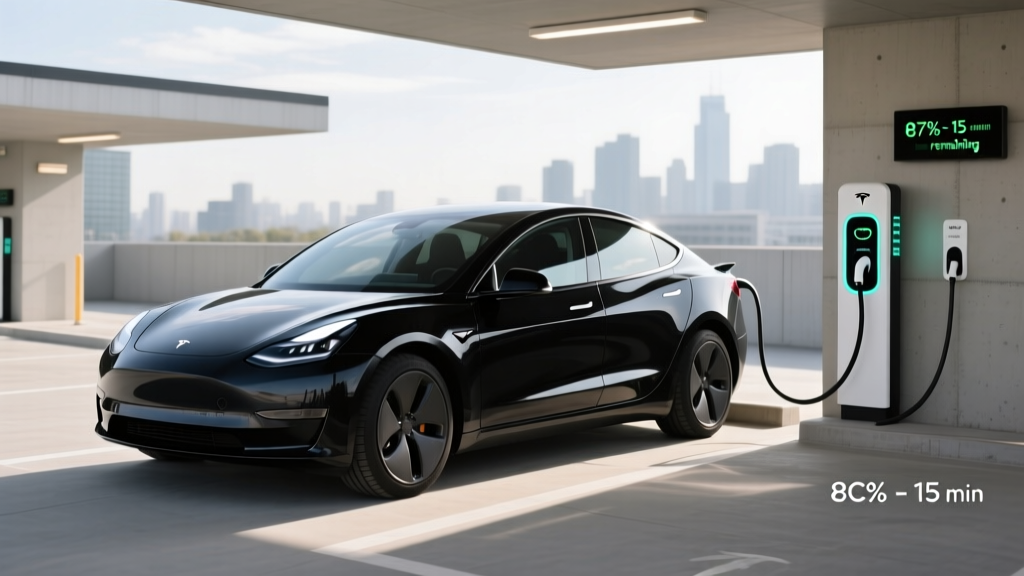
DC fast charging times depend on three factors: the vehicle's maximum charge rate (kW), the station's output, and the battery's charge curve. Most EVs accept peak charge rates only between roughly 10–50% SoC, then taper significantly above 80% to protect battery longevity. Here's why you'll see "10–80%" times quoted rather than 0–100%:
| Vehicle | Battery (kWh usable) | Peak Charge Rate (kW) | 10–80% Time |
|---|---|---|---|
| Audi Q8 e-tron | 106 kWh (NMC) | 170 kW | ~31 minutes |
| Tesla Model 3 Long Range | 75 kWh (NMC) | 250 kW | ~18 minutes |
| Hyundai Ioniq 5 | 77.4 kWh (NMC) | 240 kW (800V) | ~18 minutes |
| Ford F-150 Lightning (Ext. Range) | 131 kWh (NMC) | 150 kW | ~41 minutes |
| BMW iX xDrive50 | 105.2 kWh (NMC) | 200 kW | ~34 minutes |
Preconditioning matters: Most EVs (including Audis) will precondition the battery — warming it to optimal temperature — when you navigate to a DC fast charger. This can reduce 10–80% times by 5–10 minutes in cold weather. Always use the vehicle's built-in navigation to route to a charger, triggering preconditioning automatically.
Safety, Code Compliance, and Installation Best Practices
EV charging involves sustained high-amperage electrical loads. Cutting corners is not an option.
- Dedicated circuit: Your Level 2 charger must have its own dedicated breaker — never shared with other appliances.
- GFCI protection: NEC 2023/2026 requires GFCI (Ground Fault Circuit Interrupter) protection for outdoor EV outlets. Hardwired installations may have different requirements depending on jurisdiction.
- Outdoor rating: If your charger is installed outdoors or in an unenclosed carport, it must carry a NEMA 4 (weatherproof) rating. All chargers listed above meet this standard.
- Permit and inspection: Most municipalities require an electrical permit for a new 240V circuit. The inspection ensures the work meets NEC code — this protects your home insurance coverage in the unlikely event of an electrical fire.
- Use a licensed electrician: DIY 240V work is dangerous and often voids homeowner's insurance. Always hire a licensed, insured electrician. Verify they have EV charger installation experience — the continuous-load nature of EV charging has specific NEC requirements (Article 625) that general electricians sometimes overlook.
- Cable management: Choose a charger with at least 20+ feet of cable to reach your vehicle's charge port regardless of parking orientation. Wall-mount the unit at 42–48 inches from the floor for ergonomic access.
DC Fast Charging on the Road: Networks and Real-World Speeds
For road trips — say, taking your Audi e-tron from Boston to Montreal — DC fast charging is your equivalent of the gas station stop. In 2026, the major networks include:
- Tesla Supercharger (NACS): 17,000+ stalls, 150–350 kW. Now open to NACS-equipped non-Tesla EVs including Audi. Reliability and uptime remain industry-leading.
- Electrify America (CCS1 + NACS): 4,000+ stalls, up to 350 kW. Transitioning to include NACS connectors. Variable reliability.
- EVgo (CCS1 + NACS): 3,500+ stalls, up to 350 kW. Adding NACS. Strong urban presence.
- ChargePoint (CCS1 + NACS): Mixed DC fast locations, typically 50–125 kW.
Real-world charging speeds rarely match the advertised peak. A "350 kW" station may deliver 250 kW to your vehicle due to battery temperature, SoC, and the vehicle's onboard charge-rate limit. The U.S. Department of Energy's EV charging resources provide detailed technical explanations of charge-curve behavior.
Frequently Asked Questions
How much does it cost to install a home EV charger?
A straightforward Level 2 installation (charger near the electrical panel, no panel upgrade) costs $800–$1,600 including equipment, labor, and permits. A standard installation with a 50–80 foot wire run averages $1,250–$3,050. If your home needs a panel upgrade from 100A to 200A service, expect $3,900–$8,600 total. Utility rebates and the federal Alternative Fuel Vehicle Refueling Property Credit can offset $250–$1,000+ of these costs.
How fast will each charging level add range?
Level 1 (120V) adds 3–5 miles of range per hour — adequate only for PHEVs with small batteries or emergency use. Level 2 (240V) adds 20–60 miles per hour depending on amperage — a 48A charger adds ~35 miles/hour, fully replenishing most EVs overnight. DC fast charging adds 150–1,200+ equivalent miles per hour at peak rates, enabling 10–80% sessions in 18–40 minutes depending on the vehicle and station.
Which connector and charger is compatible with my EV?
For 2026, most new EVs sold in North America — including all new Audis — use the NACS connector. Older CCS1-equipped EVs (2022–2024 model years) can use a CCS-to-NACS adapter to access Tesla Superchargers. CHAdeMO is effectively obsolete for new vehicles. When purchasing a home charger, choose one with the connector matching your vehicle, or buy a universal unit with adapters. The Alternative Fuels Data Center maintains a current compatibility guide.
How much does charging cost per mile vs. gas?
Home charging at off-peak rates ($0.13/kWh) costs approximately $0.039 per mile for an average EV — compared to $0.225 per mile for an Audi S5 supercharged V6 on premium fuel. That's an 83% savings. Even exclusive DC fast charging at $0.45/kWh costs $0.135/mile — still 40% less than the S5. Over 12,000 annual miles, home-charging an EV saves roughly $2,000–$2,200 per year versus the S5's fuel costs.
What electrical upgrades might I need?
The most common upgrade is a panel replacement from 100-amp to 200-amp service, required when your existing panel lacks capacity for a 40–60 amp dedicated EV circuit. Homes built after 2000 typically have 200A panels and can accommodate Level 2 charging without upgrades. Your electrician will perform a NEC Article 220 load calculation to determine your panel's available capacity. Other potential upgrades include replacing aluminum wiring, adding a sub-panel in the garage, or upgrading the utility service drop for older homes.
Will my Audi charge as fast on a Supercharger as a Tesla?
Not quite — but close. Tesla Model 3/Y vehicles can accept up to 250 kW and have highly optimized charge curves. The Audi Q8 e-tron peaks at 170 kW with a strong sustained curve, making it competitive. On a 350 kW Supercharger V4 stall, the Q8 e-tron will charge at its 170 kW maximum, achieving 10–80% in ~31 minutes. That's a reasonable restroom-and-coffee stop on a road trip.
Transitioning from an Audi S5 supercharged V6 to an electric vehicle doesn't mean sacrificing the responsive, torque-rich driving experience you love — it means gaining instant acceleration, dramatically lower per-mile costs, and the convenience of "refueling" at home every night. With a properly installed Level 2 charger, a compatible connector, and an understanding of real-world charge times, the EV ownership experience is more seamless than the S5's premium-fuel lifestyle ever was. Get quotes from two licensed electricians, check your utility's EV rebate program, and start charging smarter.