If you've ever searched for an Audi S4 supercharged V6, you already know the appeal: that 3.0-liter TFSI V6, fed by an Eaton TVS supercharger, delivered 333 horsepower and a relentless midrange punch in the B8/B8.5 generation (2009–2017). It remains one of the most visceral sport sedans of its era. But in 2026, with gasoline prices averaging $3.40–$3.90/gallon nationally and home EV charging infrastructure maturing rapidly, the ownership math has shifted dramatically. This guide breaks down exactly what it costs to charge a modern electric sedan at home and on the road — and how that compares to fueling the legendary supercharged S4.
Why the Supercharged S4 Still Matters in the EV Conversation
The B8 Audi S4's supercharged 3.0T V6 (EA837) produced 333 hp and 325 lb-ft of torque, paired with a 7-speed S tronic dual-clutch and quattro AWD. EPA-rated at 18 city / 27 highway / 21 combined MPG on premium fuel, real-world highway driving often yields 23–25 MPG, while aggressive driving drops it to 16–18 MPG. At current premium prices ($4.10–$4.60/gal in many metro areas), that's a meaningful annual fuel bill.
The modern electric sedan equivalents — the 2026 Tesla Model 3 Performance, BMW i4 M50, and Audi's own e-tron GT — deliver comparable or superior acceleration with fundamentally different refueling economics. Understanding charging infrastructure is the key to deciding whether to keep that supercharged V6 humming or transition to electrons.
Charging Levels Explained: Speed, Power, and What You Actually Get
EV charging operates at three distinct levels, each defined by its power delivery in kilowatts (kW). Remember: kW measures power (the rate of energy flow), while kWh measures energy (battery capacity). Think of kW as how wide the hose is, and kWh as the size of the bucket.
| Level | Voltage | Power (kW) | Miles of Range Added per Hour | Typical Use Case |
|---|---|---|---|---|
| Level 1 | 120V AC | 1.0–1.9 kW | 3–5 mi/hr | Overnight top-up, PHEVs, emergencies |
| Level 2 | 240V AC | 3.3–19.2 kW | 12–70 mi/hr | Home daily charging, workplace, public AC |
| DC Fast Charge | 400–800V DC | 50–350 kW | 150–900+ mi/hr (peak) | Road trips, highway corridors, rapid top-up |
A critical reality check: DC fast charging speeds are peak rates, not sustained. Most EVs hit peak kW between 10–30% State of Charge (SoC), then taper significantly above 80% to protect battery health. A vehicle rated for 250 kW peak may average only 120–140 kW over a full 10–80% session.
Home Charger Installation: Electrical Requirements, Costs, and Gotchas
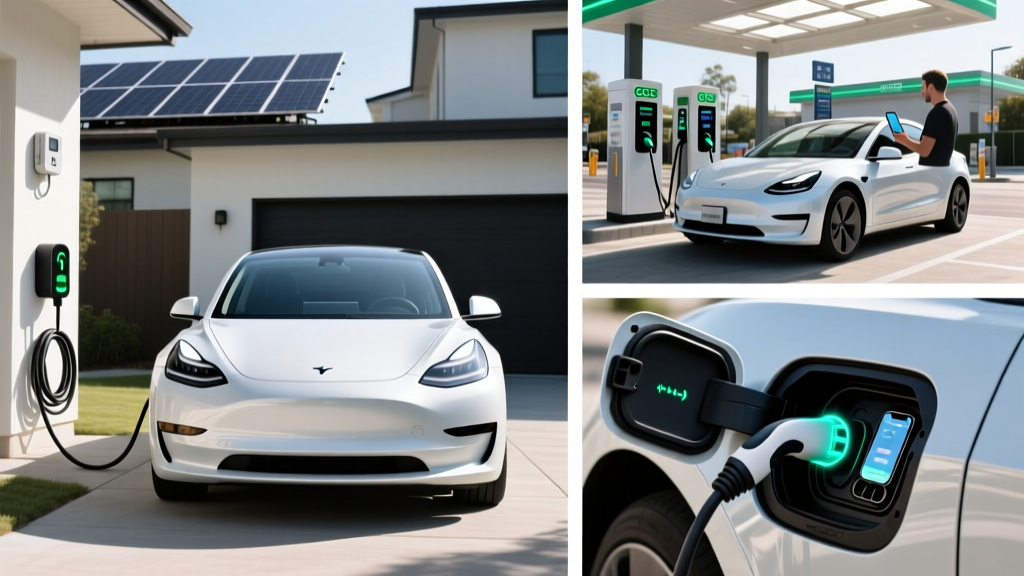
Installing a Level 2 home charger is where most EV owners do 85–95% of their charging. Here's what's actually involved.
Electrical Requirements
A typical home Level 2 installation requires:
- Circuit: Dedicated 240V circuit, 40A–60A breaker (EVSE rated at 32A–48A continuous draw, per NEC 80% rule)
- Wire: 6 AWG copper (for 40–50A) or 4 AWG (for 60A), run through conduit
- Outlet vs. hardwired: NEMA 14-50 receptacle (50A) allows portability; hardwired units support up to 48A–80A and avoid GFCI nuisance trips common with receptacles
- Panel capacity: Your main panel must have sufficient amperage headroom. A 200A panel can typically support a 40–60A EV circuit. Older 100A panels often require an upgrade to 200A.
Panel Upgrade Reality
Homes built before 1990 frequently have 100A or 150A panels already near capacity with HVAC, electric dryers, and ranges. A panel upgrade to 200A–400A costs $1,500–$4,500 depending on your utility's requirements, local labor rates, and whether a new meter base or service drop is needed. This is the single most underestimated cost in home EV charging.
| Item | Low Estimate | High Estimate | Notes |
|---|---|---|---|
| Level 2 EVSE (hardware) | $350 | $750 | 32A–48A smart charger |
| Electrical permit | $50 | $250 | Varies by municipality |
| Electrician labor (short run, <25 ft) | $400 | $900 | Panel adjacent or same-wall install |
| Electrician labor (long run, 25–75 ft) | $800 | $2,000 | Attic/crawlspace routing, conduit |
| Panel upgrade (if needed) | $1,500 | $4,500 | 100A → 200A service upgrade |
| Total (no panel upgrade) | $800 | $3,900 | Most typical installs |
| Total (with panel upgrade) | $2,300 | $8,400 | Older homes |
Connector Compatibility: NACS, CCS, and What Fits What in 2026
The connector landscape has consolidated significantly since 2024. Tesla's North American Charging Standard (NACS) has been adopted by nearly every major automaker for new vehicles sold in 2025–2026. Here's where things stand:
| Connector | Brands Using It (2026 Models) | Public Network Access | Adapter Needed? |
|---|---|---|---|
| NACS (native) | Tesla, Ford, GM, Rivian, Hyundai/Kia (2025+), Volvo, Polestar, Mercedes, BMW (2025+) | Tesla Supercharger + growing NACS networks | None for NACS stations; CCS adapter for legacy stations |
| CCS1 | VW ID.4 (carryover), older Hyundai/Kia, older Ford/GM EVs, Stellantis | Electrify America, EVgo, ChargePoint DC | NACS-to-CCS adapter for Tesla Superchargers |
| CHAdeMO | Nissan Leaf (legacy only, discontinued 2025), Mitsubishi Outlander PHEV | Declining; some EA and independent stations | No practical adapter; network sunset underway |
For Audi owners specifically: The 2026 Audi e-tron GT and Q8 e-tron use CCS1 natively but are compatible with NACS stations via the widely available CCS-to-NACS adapter (approximately $175–$250). Audi has confirmed NACS adoption for 2027+ models.
Charging Cost Per Mile: Electric Sedan vs. Supercharged S4 V6
This is where the math gets compelling. We'll compare a representative modern electric sedan (the 2026 Tesla Model 3 Long Range, EPA 363 miles, 75 kWh usable battery, 4.0 mi/kWh efficiency) against the B8.5 Audi S4 supercharged V6 at 21 MPG combined on premium fuel.
| Scenario | Cost per kWh / Gallon | Cost per Mile (EV) | Cost per Mile (S4 SC V6) | Annual Savings (12,000 mi) |
|---|---|---|---|---|
| Home charging (off-peak utility rate) | $0.13/kWh | $4.30/gal premium | $0.033 | $0.205 | $2,064 |
| Home charging (high-cost state, e.g. CA) | $0.30/kWh | $5.10/gal premium | $0.075 | $0.243 | $2,016 |
| Public Level 2 (workplace/retail) | $0.20/kWh | $0.050 | $0.205 (avg) | $1,860 |
| DC Fast Charging (road trip, EA/Tesla) | $0.40–$0.55/kWh | $0.100–$0.138 | $0.220 (highway) | $984–$1,440 |
The supercharged Audi S4's fuel cost advantage disappears entirely in every scenario. Even exclusive DC fast charging — the most expensive EV refueling method — costs roughly half per mile compared to premium gasoline in the S4. For owners with access to home Level 2 charging at average utility rates, the annual fuel savings of $1,800–$2,100 essentially pays for the home charger installation within the first year.
Charging Times: What to Expect with Common Battery Sizes
Charging time depends on battery capacity (kWh), charger power (kW), and the vehicle's charge curve. Here are real-world benchmarks for popular 2026 EV platforms:
| Vehicle (Battery Size) | Level 2 at 11.5 kW (48A) | DC Fast 10–80% | Peak DC Rate |
|---|---|---|---|
| Tesla Model 3 LR (75 kWh usable) | ~7 hours (0–100%) | ~22 min | 250 kW (V3 Supercharger) |
| Hyundai Ioniq 6 (77.4 kWh, 800V) | ~7.5 hours | ~18 min | 350 kW (EA/compatible 800V station) |
| BMW i4 eDrive40 (81.5 kWh usable) | ~8 hours | ~31 min | 205 kW |
| Audi Q8 e-tron (106 kWh usable) | ~10 hours | ~31 min | 170 kW |
| Ford F-150 Lightning Ext. (131 kWh) | ~13 hours | ~41 min | 150 kW |
For daily driving (30–50 miles), a Level 2 home charger replenishes a typical commute's energy in 1–2 hours overnight. You wake up to a full battery every morning — something no supercharged V6 owner experiences at a gas station.
Recommended Home EV Chargers for 2026
ChargePoint Home Flex (Gen 2)
- Power: Up to 12 kW (50A circuit, 40A continuous) on 240V
- Connector: NACS native (CCS adapter included in box)
- Cable length: 23 ft
- Smart features: Wi-Fi, Alexa/Google Home, scheduled charging, utility demand-response integration, energy tracking via app
- Price: ~$549
- Best for: Most homeowners wanting a reliable, future-proof smart charger
Wall Connector (Tesla, Gen 4)
- Power: Up to 11.5 kW (48A continuous on 60A circuit)
- Connector: NACS native
- Cable length: 24 ft
- Smart features: Wi-Fi, over-the-air updates, Power Sharing (multiple units on one circuit), integrated cable management
- Price: ~$450
- Best for: Tesla owners and households with multiple EVs (Power Sharing)
Grizzl-E Smart
- Power: Up to 10 kW (40A continuous on 50A circuit)
- Connector: J1772 (NACS adapter available) or NACS native (2025+ model)
- Cable length: 24 ft
- Smart features: OCPP-compatible, works with ev.energy and utility apps, adjustable amperage via DIP switches
- Price: ~$399
- Best for: Budget-conscious buyers, outdoor installs (IP67 rated, -40°F to +122°F), Canadian-built durability
Safety, Electrical Code, and Permit Considerations
Home EV charger installations must comply with the National Electrical Code (NEC) Article 625 and your local jurisdiction's amendments. Key requirements:
- Dedicated circuit: Your EVSE must be on its own breaker — no sharing with dryers, ranges, or HVAC.
- GFCI protection: NEC 2023 and later require GFCI protection for all receptacles rated 150V-to-ground or less, 50A or less, used for EV charging. Hardwired installations are exempt from this receptacle-specific GFCI requirement, which is why many electricians now recommend hardwiring.
- Outdoor rating: If mounted outside, the EVSE must carry a NEMA 4 or IP65+ rating. All recommended units above meet this standard.
- Permit and inspection: Virtually all jurisdictions require an electrical permit for a new 240V circuit. The inspection verifies proper wire gauge, breaker sizing, grounding, and GFCI compliance. Typical permit cost: $50–$250. Skipping the permit risks insurance denial in the event of an electrical fire.
- Load calculation: A licensed electrician will perform an NEC Article 220 load calculation to verify your panel can handle the new circuit. If your calculated load exceeds 80% of panel capacity, a panel upgrade is mandatory — not optional.
Federal Tax Credits and Utility Rebates for Home Charging
The Alternative Fuel Vehicle Refueling Property Credit (IRS §30C) provides a 30% credit on home EV charger hardware and installation, capped at $1,000 per year. Eligibility depends on installing the charger in a qualifying census tract (generally non-urban or low-income areas). Check the IRS §30C guidance for tract eligibility.
Additionally, many utilities offer rebates of $250–$750 for installing a smart Level 2 charger and enrolling in a time-of-use (TOU) or demand-response rate plan. Contact your local utility or visit the U.S. DOE Alternative Fuels Data Center for state-specific incentives.
The Ownership Verdict: Supercharged V6 Soul vs. Electric Economics
The Audi S4's supercharged 3.0T V6 will always have a special place in the sport sedan pantheon. The linear torque delivery, the whine of the Eaton supercharger, the quattro launch — these are analog experiences that electric drivetrains replicate in speed but not in character. If you own one, maintain it well; clean examples are appreciating.
But from a pure ownership-cost perspective, the numbers are unambiguous. A modern electric sedan charged at home costs $0.03–$0.08 per mile in energy versus $0.20–$0.25 for the S4 on premium. Over five years and 60,000 miles, that's $8,000–$12,000 in fuel savings alone — before factoring in the S4's higher maintenance costs (timing chain tensioner replacements, carbon buildup cleaning, DSG service, supercharger belt and isolator wear that plague the EA837).
For enthusiasts who want both, the emerging answer is a two-car garage: keep the supercharged S4 for weekends and canyon roads, and add an EV daily driver with a home Level 2 charger. The charger pays for itself in the first year of diverted commuting miles.
Frequently Asked Questions
How much does it cost to install a home EV charger?
A typical Level 2 home charger installation costs $800–$3,900 if your electrical panel has sufficient capacity. This includes the charger hardware ($350–$750), electrician labor ($400–$2,000), and permit ($50–$250). If a panel upgrade from 100A to 200A is required, add $1,500–$4,500, bringing the total to $2,300–$8,400.
How fast will each charging level add range?
Level 1 (120V) adds 3–5 miles of range per hour. Level 2 (240V, 40–48A) adds 25–40 miles per hour for most sedans. DC fast charging adds 150–900+ miles per hour at peak, but real-world 10–80% sessions take 18–41 minutes depending on the vehicle's peak kW rating and charge curve taper.
Which connector is compatible with my EV?
In 2026, most new EVs use NACS (Tesla, Ford, GM, Hyundai/Kia, Rivian, Volvo, BMW). VW and legacy models still use CCS1. Audi's 2026 models use CCS1 with NACS adapter compatibility. CHAdeMO is effectively discontinued. Check your vehicle's charge port or consult fueleconomy.gov for your specific model.
How much does charging cost per mile vs. gas?
Home charging at average U.S. electricity rates ($0.13–$0.17/kWh) costs $0.03–$0.05 per mile for an efficient EV sedan. The Audi S4 supercharged V6 at 21 MPG combined on premium ($4.30/gal) costs roughly $0.20 per mile — 4 to 6 times more per mile driven.
What electrical upgrades might I need?
The most common upgrade is a panel capacity increase from 100A to 200A ($1,500–$4,500). You may also need a new dedicated 240V circuit with 6 AWG or 4 AWG copper wire, a NEMA 14-50 receptacle or hardwired connection, and a GFCI breaker if using a receptacle. A licensed electrician's load calculation determines exactly what's required.
Can I charge an EV on a standard 120V outlet?
Yes, but slowly. Level 1 charging at 120V delivers 1.0–1.9 kW, adding only 3–5 miles of range per hour. This works for plug-in hybrids with small batteries (10–18 kWh) or for EV owners who drive fewer than 30 miles daily and can charge for 10–12 hours overnight. For most EV owners, Level 2 is the practical minimum.