From Supercharged V6 to Silent Kilowatts: Your Charging Transition Guide
If you've spent years enjoying the whine of a supercharged 3.0L V6 in an Audi Q7 — whether that's the 2014–2018 TFSI or the later 55 TFSI mild-hybrid — you already know what 329 horsepower and instant torque feel like. What you might not know is that a modern electric SUV can deliver that same rush without a single drop of premium fuel, and the "refueling" happens in your garage while you sleep.
The jump from a supercharged Audi Q7 to a battery-electric vehicle (BEV) isn't just about swapping powertrains. It's about rethinking how and where you add energy. This guide breaks down every charging tier, the real cost of installing a home Level 2 station, connector compatibility, and what you'll actually pay per mile compared to filling that Q7's 22.5-gallon tank with 91-octane.
Charging Levels Explained: How Fast Will Each Tier Add Range?
Every EV sold in the United States supports three charging tiers. The speed difference between them is enormous — understanding this is the single most important thing a former gas-car owner can learn.
| Level | Voltage / Amperage | Power (kW) | Miles of Range Added per Hour | Best For |
|---|---|---|---|---|
| Level 1 | 120V / 12A | ~1.4 kW | 3–5 mi/hr | Overnight top-ups, PHEVs, emergencies |
| Level 2 | 240V / 32–48A | 7.7–11.5 kW | 25–44 mi/hr | Daily home charging, primary method for most owners |
| DC Fast Charge | 400–800V DC | 50–350 kW | 150–1,200+ mi/hr (peak) | Road trips, rapid top-ups away from home |
Let's make this concrete. The 2026 Audi Q8 e-tron (Audi's flagship electric SUV and the spiritual EV successor to the Q7) carries a 114 kWh gross battery pack (106 kWh usable). Here's what charging looks like across levels:
- Level 1 (120V): Adds roughly 4 miles per hour. A full 10–80% charge would take over 100 hours — impractical as a primary method but fine for plug-in hybrids with smaller batteries.
- Level 2 (240V, 48A / 11.5 kW): Adds roughly 33 miles per hour. That same 10–80% session takes about 6.5 hours — perfect for overnight charging.
- DC Fast Charge (170 kW peak): The Q8 e-tron peaks at 170 kW on a compatible CCS1 station. A 10–80% session takes approximately 31 minutes under ideal thermal conditions, though real-world sessions often run 35–40 minutes due to charge-curve taper above 80%.
Home Level 2 Charger Installation: Electrical Requirements, Costs & Panel Upgrades
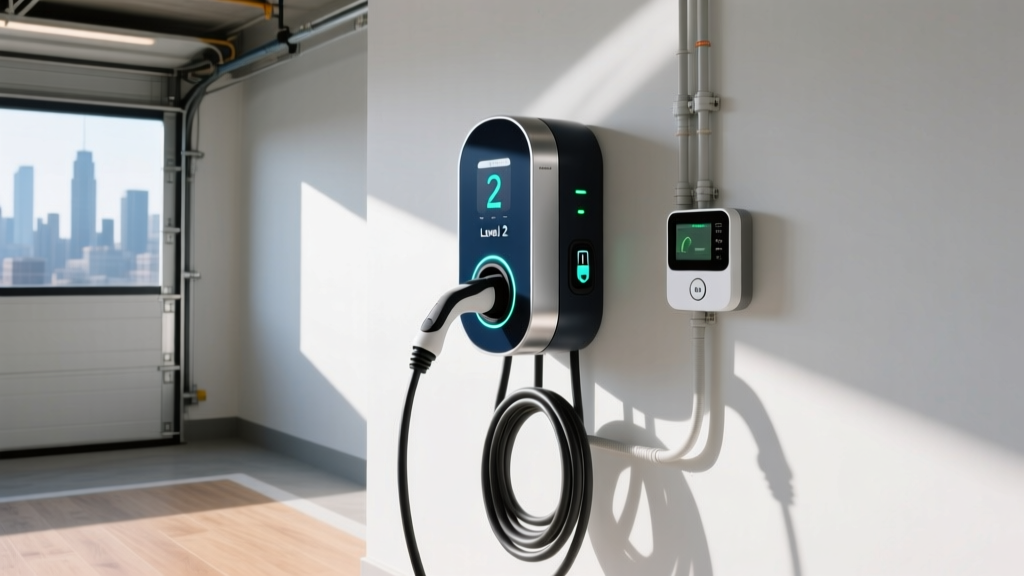
This is where most former gas-car owners have the most questions. Installing a home Level 2 charger is essentially adding a high-draw appliance circuit — similar to an electric dryer or oven — but with EV-specific code requirements.
Electrical Requirements for a 48-Amp Level 2 Charger
A 48-amp continuous-draw charger (the most common high-power home unit) requires a 60-amp dedicated circuit on a 240V split-phase supply. The National Electrical Code (NEC Article 625) mandates that continuous loads cannot exceed 80% of a circuit's rated capacity, hence 48A on a 60A breaker.
- Voltage: 240V (two-pole breaker, same as your dryer)
- Amperage: 60A breaker for a 48A charger; 50A breaker for a 40A charger
- Wire gauge: 6 AWG copper (THHN in conduit) or 4 AWG aluminum for longer runs
- Circuit type: Dedicated — no sharing with other outlets or appliances
- GFCI protection: Required by NEC 2020+ for outdoor receptacles; many hardwired EV chargers have built-in ground-fault protection, which may eliminate the need for a GFCI breaker (check with your electrician and local AHJ)
- Outdoor rating: If mounted outside, the charger must carry a NEMA 4 or NEMA 4X weatherproof rating
Do You Need a Panel Upgrade?
This is the variable that can double your installation cost. Here's a quick diagnostic:
- 200A main panel with existing headroom: Most homes built after 2000 have a 200A service. If your panel has spare breaker slots and your calculated load (existing appliances + 60A EV circuit) stays under 80% of 200A (160A continuous), you're clear for a straightforward install.
- 100A or 150A panel, or panel near capacity: Adding 60A to an already-loaded 100A panel will likely require a service upgrade to 200A, which costs $1,500–$3,500 depending on your utility's requirements and trenching distance.
- Smart-panel or load-management workaround: Some chargers (like the Emporia V2 with load management) can dynamically throttle charging amperage to stay within your panel's capacity, potentially avoiding a full upgrade.
Installation Cost Breakdown
| Component | Typical Cost Range | Notes |
|---|---|---|
| Level 2 Charger (hardware) | $400–$750 | Varies by brand, power output, cable length, smart features |
| Electrician labor (standard install) | $500–$1,500 | Depends on run length from panel to garage, wall type, conduit |
| Electrical permit | $50–$250 | Varies by municipality; some jurisdictions waive for EV installs |
| Panel upgrade (if needed) | $1,500–$3,500 | 100A → 200A service upgrade; may require utility coordination |
| Additional conduit/wiring (long runs) | $200–$800 | Detached garages or chargers far from the panel |
| Total (no panel upgrade) | $950–$2,500 | Most common scenario for newer homes |
| Total (with panel upgrade) | $2,450–$6,000 | Older homes with 100A service |
According to the U.S. Department of Energy, the national average for a basic home Level 2 installation (no panel upgrade, short wire run) is approximately $1,200–$2,000 all-in.
Connector Compatibility: NACS, CCS1, and CHAdeMO for Your Next EV
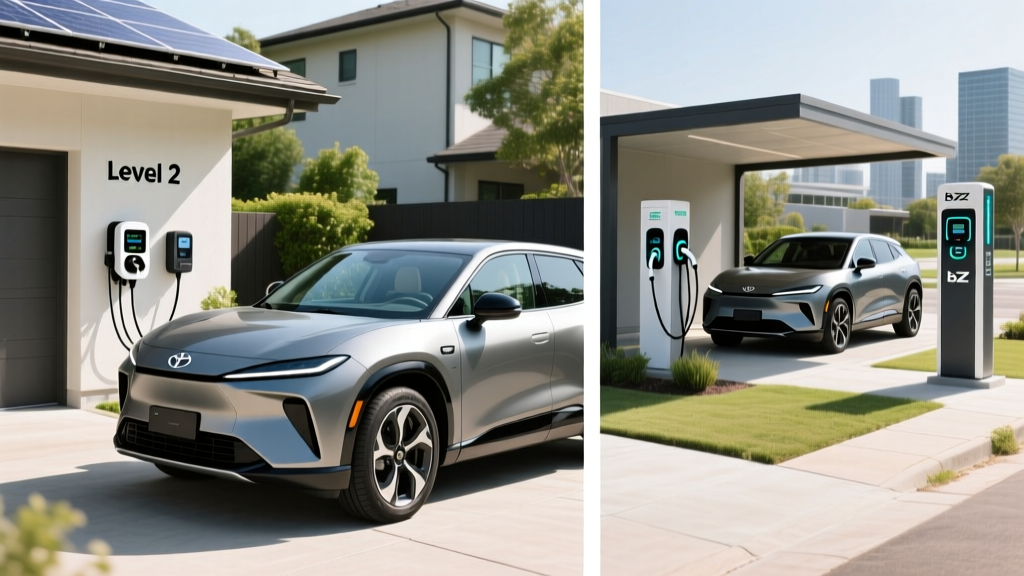
If you're coming from a supercharged Q7, you haven't had to think about fuel nozzles in years — they all fit. EV connectors are more fragmented, but the landscape is consolidating rapidly as of 2026.
| Connector | Used By | Home Level 2 | DC Fast Charge | 2026 Status |
|---|---|---|---|---|
| NACS (Tesla / SAE J3400) | Tesla (all), Ford, GM, Rivian, Volvo, Polestar, Hyundai/Kia (2025+), most new 2026 models | Yes | Yes (Tesla Supercharger network + growing third-party) | Becoming the North American standard |
| CCS1 (Combined Charging System) | Audi (e-tron/Q8 e-tron), BMW, VW, Mercedes-Benz, Stellantis, legacy 2020–2024 models | Yes (J1772 for AC) | Yes (Electrify America, EVgo, Ionity) | Still widely available; being phased in favor of NACS on new models |
| CHAdeMO | Nissan Leaf (legacy), Mitsubishi Outlander PHEV | No (J1772 adapter needed) | Yes (declining availability) | Effectively discontinued for new vehicles |
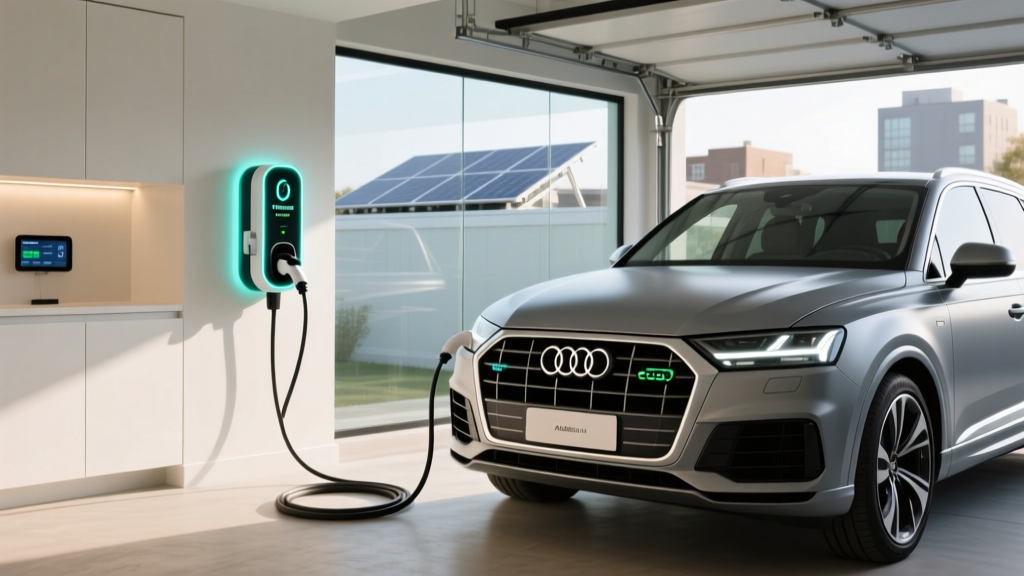
If you're buying a 2026 Audi Q8 e-tron: It uses a CCS1 port for DC fast charging and a J1772 inlet for Level 2 AC charging. You can use a CCS-to-NACS adapter (sold by Audi and third parties like Lectron) to access Tesla Superchargers that have been opened to non-Tesla vehicles via the Magic Dock or NACS adapter program.
If you're buying a 2026 Ford F-150 Lightning, GM Silverado EV, or new Hyundai Ioniq 5: These now ship with native NACS ports, giving direct access to the Tesla Supercharger network — currently the most reliable DC fast-charging network in North America with over 25,000 stalls.
For your home Level 2 charger: You have a choice. Buy a J1772-connector charger (universal for all non-Tesla EVs; Teslas include a J1772 adapter in the glovebox) or a NACS-connector charger (native for Tesla and new NACS-equipped vehicles; J1772 EVs need an adapter). Most non-Tesla EV owners in 2026 still opt for J1772 home chargers for broadest compatibility.
Cost to Charge vs. Gas: What You'll Actually Spend Per Mile
This is where leaving a supercharged Q7 behind pays real dividends. The 2017 Audi Q7 3.0T Supercharged gets an EPA-rated 19 city / 25 highway / 21 combined MPG. At $4.20/gallon for premium (required), that's roughly $0.20 per mile in fuel alone.
| Charging Scenario | Cost per kWh | Efficiency (kWh/mi) | Cost per Mile | Savings vs. Q7 3.0T |
|---|---|---|---|---|
| Home Level 2 (off-peak utility rate) | $0.11 | 0.38 (Q8 e-tron) | $0.042 | 79% cheaper |
| Home Level 2 (standard rate, no TOU) | $0.16 | 0.38 | $0.061 | 70% cheaper |
| Public Level 2 (ChargePoint, Blink) | $0.25–$0.39 | 0.38 | $0.095–$0.148 | 26–53% cheaper |
| DC Fast Charge (Electrify America) | $0.36–$0.48 | 0.38 | $0.137–$0.182 | 9–32% cheaper |
| Tesla Supercharger (V3/V4) | $0.28–$0.36 | 0.38 | $0.106–$0.137 | 32–47% cheaper |
At 12,000 miles per year, a Q8 e-tron owner charging primarily at home on off-peak rates would spend roughly $504/year on electricity for driving. That same mileage in a supercharged Q7 at $4.20/gallon premium costs about $2,400/year in fuel. That's nearly $1,900 in annual fuel savings before factoring in the Q7's more frequent oil changes, supercharger-belt service, and transmission fluid.
For real-world utility rates in your area, check the U.S. Energy Information Administration's state-by-state electricity price data.
Charging Time Examples: How Long Does a Full Session Take?
Here's a practical look at 10–80% charging times for common EV battery sizes at each level. These assume optimal battery preconditioning and ambient temperatures above 50°F.
| Vehicle (Battery Size) | Level 1 (1.4 kW) | Level 2 — 32A (7.7 kW) | Level 2 — 48A (11.5 kW) | DC Fast (Peak kW) |
|---|---|---|---|---|
| 2026 Audi Q8 e-tron (106 kWh usable) | ~106 hrs | ~9.6 hrs | ~6.5 hrs | ~31 min (170 kW peak) |
| 2026 Tesla Model Y LR (75 kWh usable) | ~75 hrs | ~6.8 hrs | ~4.6 hrs | ~25 min (250 kW peak) |
| 2026 Hyundai Ioniq 5 (77.4 kWh usable) | ~77 hrs | ~7.0 hrs | ~4.7 hrs | ~18 min (350 kW peak, 800V) |
| 2026 Ford F-150 Lightning Ext. (131 kWh usable) | ~131 hrs | ~11.9 hrs | ~8.0 hrs | ~41 min (150 kW peak) |
| 2026 Toyota RAV4 PHEV (18.1 kWh usable) | ~9 hrs | ~2.3 hrs (16A) | ~2.3 hrs (limited by 3.3 kW onboard) | N/A (no DC fast) |
Notice that the RAV4 PHEV's onboard charger limits Level 2 speed to 3.3 kW regardless of how powerful your home station is. This is why knowing your vehicle's onboard charger capacity matters as much as knowing your EVSE's output.
Level 2 Home Charger Equipment Recommendations
After testing dozens of home EVSEs across multiple households and electrical configurations, here are our top picks for a former Q7 owner transitioning to electric. All recommendations below are based on 2026 pricing and availability.
Best Overall: ChargePoint Home Flex (2nd Gen)
- Power Output: Up to 11.5 kW (48A) on a 60A circuit; configurable down to 16A for smaller circuits
- Connector: J1772 (NACS version also available)
- Cable Length: 23 feet
- Smart Features: Wi-Fi, app scheduling, utility TOU integration, Alexa/Google Home, energy tracking
- Price: ~$549
- Why we recommend it: The amperage-dip-switch configurability means it works on circuits from 20A to 60A — future-proof if you move or upgrade your panel. UL-listed, NEMA 4 outdoor-rated, and compatible with most utility demand-response programs.
Best Value: Emporia V2 Level 2 Charger
- Power Output: Up to 11.5 kW (48A)
- Connector: J1772 (NACS adapter available)
- Cable Length: 24 feet
- Smart Features: Wi-Fi, detailed energy monitoring, solar-integration mode, load management (can throttle to avoid panel overload), real-time cost tracking
- Price: ~$399
- Why we recommend it: The load-management feature is a potential panel-upgrade saver — it can communicate with an Emporia Vue energy monitor to dynamically adjust charging amperage based on your home's real-time load. Best-in-class energy data.
Best for Tesla / NACS Owners: Tesla Wall Connector
- Power Output: Up to 11.5 kW (48A)
- Connector: Native NACS (no adapter needed for Tesla, Ford, GM, Rivian, and 2025+ Hyundai/Kia NACS vehicles)
- Cable Length: 24 feet
- Smart Features: Wi-Fi, over-the-air updates, power-sharing (link two units on one circuit), integrated cable management
- Price: ~$450
- Why we recommend it: If your next vehicle has a NACS port, this is the cleanest setup — no adapter needed. The power-sharing feature is excellent for two-EV households on a single 60A circuit.
Best for Cold Climates: Grizzl-E Smart
- Power Output: Up to 9.6 kW (40A) on a 50A circuit
- Connector: J1772 (NACS version available)
- Cable Length: 24 feet
- Smart Features: Wi-Fi, app control, OCPP-compatible (works with utility programs), extreme cold-rated to -40°F
- Price: ~$499
- Why we recommend it: Built in Canada and tested to -40°F. The thick, cold-flex cable stays pliable in deep winter — something thinner cables can't match. Slightly lower max amperage (40A vs 48A) but still adds ~29 miles per hour, sufficient for overnight charging of even large packs.
Safety, Code, and Permit Considerations
EV charging installations are governed by NEC Article 625 (Electric Vehicle Charging System Equipment) and your local Authority Having Jurisdiction (AHJ). Key requirements:
- Dedicated circuit: Your EV charger must be on its own breaker — no shared outlets, lights, or appliances on the same circuit.
- Hardwired vs. plug-in: Chargers above 40A (9.6 kW+) are typically hardwired, which eliminates the need for a 240V receptacle and provides a cleaner, more reliable connection. Plug-in units (NEMA 14-50) are convenient for portability but require a properly torqued receptacle — loose 14-50 outlets are a known fire risk.
- GFCI protection: NEC 2020 and later require GFCI for outdoor receptacles. Hardwired chargers with internal ground-fault detection may satisfy this requirement without a GFCI breaker (which can nuisance-trip on some EVSEs). Confirm with your electrician.
- Permit and inspection: Most jurisdictions require an electrical permit for a new 240V circuit. The inspection ensures proper wire gauge, breaker sizing, grounding, and torque. Budget $50–$250 for the permit and schedule the inspection before your utility will approve any EV-rate plan.
- Utility EV rate plans: Many utilities offer time-of-use (TOU) plans with off-peak rates as low as $0.06–$0.09/kWh for overnight charging. Enrolling typically requires proof of EV ownership and a dedicated meter or smart charger that can verify charging times.
Frequently Asked Questions
How much does it cost to install a home EV charger?
A typical Level 2 home charger installation costs between $950 and $2,500 when no panel upgrade is needed. This includes the charger hardware ($400–$750), electrician labor ($500–$1,500), and permit fees ($50–$250). If your home has an older 100A electrical panel that needs upgrading to 200A, add $1,500–$3,500 to the total.
How fast will each charging level add range?
Level 1 (120V) adds 3–5 miles of range per hour. Level 2 (240V, 48A) adds 25–44 miles per hour depending on vehicle efficiency. DC fast charging adds 150–1,200+ miles per hour at peak rate, but sessions are typically measured in minutes (10–80% in 18–41 minutes depending on the vehicle and charger). The actual speed depends on both the charger's kW output and your vehicle's onboard charger capacity and charge-curve profile.
Which connector/charger is compatible with my EV?
For 2026 models: Tesla, Ford, GM, Rivian, Volvo, Polestar, and new Hyundai/Kia models use NACS. Audi (Q8 e-tron), BMW, VW, and Mercedes-Benz still use CCS1. For home Level 2 charging, all non-Tesla EVs accept J1772 connectors; Teslas include a J1772 adapter. For DC fast charging, check whether your vehicle has NACS or CCS1 and plan your road-trip charging network accordingly. Adapters (CCS-to-NACS) are available for cross-compatibility.
How much does charging cost per mile vs gas?
Home charging on off-peak rates costs approximately $0.04–$0.06 per mile for a mid-size electric SUV — roughly 70–80% less than a supercharged Audi Q7's fuel cost of ~$0.20/mile on premium gasoline. Public DC fast charging is more expensive ($0.11–$0.18/mile) but still typically cheaper than premium fuel. Your exact savings depend on local electricity rates, driving efficiency, and how much of your charging happens at home.
What electrical upgrades might I need?
The most common upgrade is a panel service increase from 100A to 200A, needed in older homes where the existing panel lacks capacity for a 60A EV circuit. You may also need additional conduit runs for detached garages, a new grounding rod, or a sub-panel installation. Some homeowners can avoid a full panel upgrade by using a smart charger with load-management capability that dynamically reduces charging amperage when other appliances are running. Always have a licensed electrician perform a load calculation before committing to equipment.
Is there a tax credit for home charger installation?
The federal Alternative Fuel Vehicle Refueling Property Credit (IRS Form 8911) offers up to 30% of the cost of home EV charging equipment and installation, capped at $1,000. However, eligibility depends on whether you live in a qualifying census tract (typically rural or low-income areas) as defined by current IRS guidance. Check with a tax professional to confirm eligibility for your specific address.