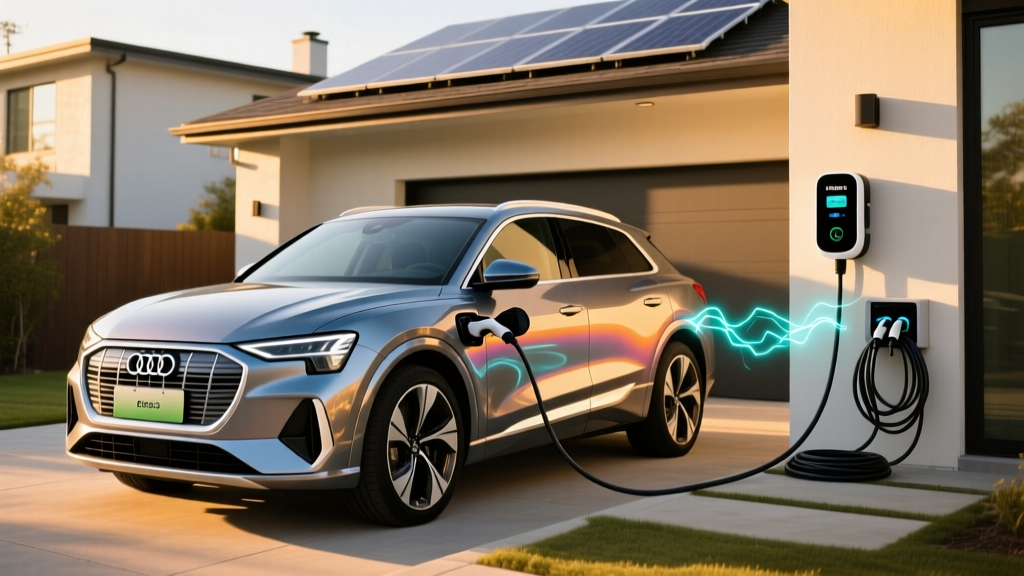
The 2025 Audi Q6 e-tron arrives on the Premium Platform Electric (PPE) architecture co-developed with Porsche, bringing an EPA-estimated 321 miles of range (Ultra trim, RWD) and a peak DC fast-charge rate of 270 kW. But that impressive sticker range and blistering charge speed are only as useful as the charging infrastructure behind them. Whether you're evaluating the Q6 e-tron or have already taken delivery, matching your home electrical system and daily driving habits to the right charging equipment is the single biggest factor in long-term ownership satisfaction.
This guide walks through every charging scenario for the Q6 e-tron — from Level 1 trickle charging on a standard outlet to 270 kW DC fast charging on a road trip — with exact numbers, real-world range expectations, and the home installation costs you'll actually face in 2025–2026.
Audi Q6 e-tron Range & Battery Specs at a Glance
| Spec | Q6 e-tron Ultra (RWD) | Q6 e-tron quattro (AWD) |
|---|---|---|
| EPA Range | 321 miles | 308 miles |
| Usable Battery | 94.9 kWh (NMC) | 94.9 kWh (NMC) |
| Gross Battery | 100 kWh | 100 kWh |
| Peak DC Fast Charge | 270 kW | 270 kW |
| 10–80% DC Fast Charge | ~21 minutes | ~21 minutes |
| Max AC Level 2 Rate | 11.5 kW (48A) | 11.5 kW (48A) |
| Connector (2025 MY) | CCS1 (NACS adapter available) | CCS1 (NACS adapter available) |
| 0–60 mph | 5.2 seconds | 4.6 seconds |
| Horsepower | 335 hp | 456 hp |
| Battery/Powertrain Warranty | 8 yr / 100,000 mi | 8 yr / 100,000 mi |
| Base MSRP | $65,095 | $67,095 |
Charging Levels Explained: Speeds, Times & Range Added
Understanding the difference between kW (kilowatts — the rate of power delivery) and kWh (kilowatt-hours — the total energy stored in your battery) is essential. Think of kW as how fast water flows from a hose, and kWh as the size of the bucket. The Q6 e-tron's 94.9 kWh usable battery is the bucket; your charger's kW rating determines how fast it fills.
| Level | Voltage / Power | kW Delivered | Miles of Range Added per Hour | Full Charge Time (0–100%) |
|---|---|---|---|---|
| Level 1 (120V outlet) | 120V / 12A | ~1.4 kW | ~4–5 mi/hr | ~68 hours |
| Level 2 (240V, 40A circuit) | 240V / 40A | ~9.6 kW | ~30–33 mi/hr | ~10 hours |
| Level 2 (240V, 48A circuit) | 240V / 48A | ~11.5 kW | ~36–39 mi/hr | ~8.5 hours |
| Level 2 (240V, 60A circuit) | 240V / 60A | ~11.5 kW (car-limited) | ~36–39 mi/hr | ~8.5 hours |
| DC Fast Charge (150 kW station) | 400–800V DC | Up to 150 kW | ~300–500 mi/hr* | 10–80% in ~30 min |
| DC Fast Charge (270 kW+ station) | 800V DC | Up to 270 kW peak | ~600–800 mi/hr* | 10–80% in ~21 min |
*Miles-per-hour figures at DC fast chargers are peak rates; actual throughput tapers significantly above 80% State of Charge (SoC) due to battery management system (BMS) protections. The Q6 e-tron's PPE platform sustains high charge rates longer than most competitors, holding above 200 kW until roughly 55% SoC before tapering.
How Much Does It Cost to Install a Home EV Charger?
Home Level 2 charging is where the Q6 e-tron will spend most of its charging life. A properly installed 240V Level 2 station adds 30–39 miles of range per hour — enough to fully replenish the 94.9 kWh battery overnight. But the total installed cost varies enormously depending on your home's electrical panel, the distance from panel to charger location, and local permitting requirements.
| Cost Component | Basic Install (Panel Adjacent) | Standard Install (50–80 ft run) | Complex Install (Panel Upgrade + Long Run) |
|---|---|---|---|
| Level 2 Charger (hardware) | $400–$700 | $400–$700 | $400–$700 |
| Electrician labor | $500–$800 | $800–$1,500 | $1,500–$3,000 |
| Electrical permit | $50–$150 | $50–$200 | $100–$300 |
| Panel upgrade (if needed) | $0 | $0 | $1,500–$3,500 |
| Conduit, wiring, misc. | $100–$200 | $200–$500 | $300–$800 |
| Total Installed Cost | $1,050–$1,850 | $1,450–$2,900 | $3,800–$8,300 |
What Electrical Upgrades Might I Need?
The Q6 e-tron's onboard charger accepts up to 11.5 kW (48 amps). To deliver this, you need a dedicated 60-amp circuit (EVSE rated for 48A continuous draw requires a circuit rated at 125% of continuous load per NEC Article 625). Here's what determines whether your home is ready:
- Panel capacity: A 200-amp service panel is standard in most homes built after 2000 and typically supports a 60A EV circuit. Homes with 100A or 150A panels — common in pre-1990 construction — may need a service upgrade to 200A or a smart load-management device like the Span smart panel or Enel X JuiceBox with load sharing.
- Available breaker slots: You need two adjacent slots for a 240V double-pole breaker. If your panel is full, a sub-panel or tandem breaker reconfiguration adds $200–$600.
- Wire run distance: Longer runs from panel to charger require thicker-gauge wire (e.g., #4 AWG copper for 60A up to 80 feet; #2 AWG beyond that), increasing material cost by $3–$8 per foot.
- Panel upgrade: Upgrading from 100A to 200A service typically costs $1,500–$3,500 including utility coordination, new meter base, and permit. This is the single largest variable in home charger installation.
Which Connector Is Compatible with the Audi Q6 e-tron?
The 2025 Audi Q6 e-tron ships with a CCS1 (Combined Charging System) port for both AC Level 2 and DC fast charging. However, Audi has confirmed that a factory NACS adapter (the Tesla connector standard) will be available, granting access to Tesla's Supercharger network — the most extensive and reliable DC fast-charging network in North America with over 25,000 stalls.
| Connector Type | Q6 e-tron Compatibility | Network Access | Adapter Required? |
|---|---|---|---|
| CCS1 | Native (built-in) | Electrify America, EVgo, ChargePoint, Ionity (EU) | No |
| NACS (Tesla) | Via OEM adapter | Tesla Supercharger network (25,000+ stalls) | Yes — Audi OEM NACS adapter (~$200–$250) |
| CHAdeMO | Not compatible | Limited legacy network | N/A — no viable adapter |
| J1772 (AC only) | Native (CCS1 includes J1772) | Public Level 2 stations | No |
Practical recommendation: Order the NACS adapter at purchase or through your Audi dealer. Access to Tesla Superchargers dramatically expands road-trip charging options, especially in rural corridors where Electrify America coverage remains sparse. For home charging, any J1772 Level 2 EVSE will plug directly into the Q6 e-tron's CCS port — no adapter needed.
Level 2 Home Charger Recommendations for the Q6 e-tron
Because the Q6 e-tron's onboard charger maxes at 11.5 kW (48A), installing a 48A-rated EVSE on a 60A circuit extracts the full AC charging capability. A 40A EVSE on a 50A circuit is a lower-cost alternative that still delivers ~9.6 kW — sufficient to fully charge overnight.
Emporia Vue Level 2 EVSE — Best Value
- Power Output: 48A / 11.5 kW (240V)
- Connector: J1772 (NACS version available)
- Cable Length: 24 ft
- Smart Features: Wi-Fi, app scheduling, solar integration, energy monitoring via Emporia Vue panel monitor
- Price: ~$399
- Best For: Budget-conscious buyers who want full 48A output and energy tracking
ChargePoint Home Flex — Best for Flexibility
- Power Output: Adjustable 16A–50A / up to 12 kW (240V)
- Connector: J1772 (NACS version available)
- Cable Length: 23 ft
- Smart Features: Wi-Fi, Alexa integration, amperage dial to match circuit, ChargePoint network access
- Price: ~$549–$649
- Best For: Homes with varying panel capacities — adjust amperage without swapping hardware
Wallbox Pulsar Plus — Best Compact Option
- Power Output: 48A / 11.5 kW (240V)
- Connector: J1772
- Cable Length: 25 ft
- Smart Features: Wi-Fi + Bluetooth, app scheduling, Power Sharing (daisy-chain two units on one circuit), Eco-Smart solar mode
- Price: ~$599
- Best For: Garages with limited wall space or dual-EV households
How Much Does Charging Cost per Mile vs. Gasoline?
The Q6 e-tron's efficiency is rated at approximately 3.0–3.2 kWh per mile (roughly 100 MPGe combined, per fueleconomy.gov). Your actual per-mile cost depends entirely on your electricity rate, which varies by charging scenario:
| Charging Scenario | Rate ($/kWh) | Cost to Add 200 Miles | Cost per Mile | Gas Equivalent (25 MPG @ $3.40/gal) |
|---|---|---|---|---|
| Home — off-peak (utility TOU rate) | $0.09–$0.13 | $5.40–$7.80 | $0.027–$0.039 | $27.20 ($0.136/mi) |
| Home — standard residential rate | $0.14–$0.18 | $8.40–$10.80 | $0.042–$0.054 | $27.20 ($0.136/mi) |
| Public Level 2 (ChargePoint, etc.) | $0.25–$0.40 | $15.00–$24.00 | $0.075–$0.120 | $27.20 ($0.136/mi) |
| DC Fast Charge (Electrify America) | $0.40–$0.56 | $24.00–$33.60 | $0.120–$0.168 | $27.20 ($0.136/mi) |
| Tesla Supercharger (via NACS adapter) | $0.28–$0.40 | $16.80–$24.00 | $0.084–$0.120 | $27.20 ($0.136/mi) |
The bottom line: Home charging at off-peak rates saves roughly $0.10 per mile compared to a comparable gasoline SUV — approximately $1,200–$1,500 annually at 12,000 miles/year. However, exclusive reliance on DC fast charging at $0.48+/kWh can push per-mile costs to parity with or above gasoline. Home charging access is the economic linchpin of EV ownership.
Safety, Code & Permitting Requirements
EV charger installations must comply with the National Electrical Code (NEC) Article 625 and local amendments. Key requirements:
- Dedicated circuit: Your Level 2 EVSE must be on its own dedicated double-pole breaker — it cannot share a circuit with other loads.
- Circuit sizing: Continuous loads (EV charging runs 3+ hours) require the circuit to be rated at 125% of the charger's maximum draw. A 48A charger requires a 60A breaker and #4 AWG copper wire (or #2 aluminum).
- GFCI protection: NEC 2020 and later requires GFCI protection for all 125V–250V receptacles used for EV charging in garages and outdoors. Hardwired EVSE installations may be exempt in some jurisdictions — check with your AHJ (Authority Having Jurisdiction).
- Outdoor rating: If installing outdoors, the EVSE must carry a NEMA 4 or NEMA 4X rating for weather resistance. All three chargers recommended above carry outdoor-rated enclosures.
- Permit and inspection: Most jurisdictions require an electrical permit ($50–$300) and a post-installation inspection. Skipping this step risks insurance claim denials and code violations discovered at home sale. Always pull the permit.
DC Fast Charging on the Road: What to Expect
The Q6 e-tron's 800-volt PPE architecture enables its headline 270 kW peak DC fast-charge rate, but real-world charging involves a charge curve — the battery management system (BMS) gradually reduces power intake as State of Charge increases to protect battery health.
Here's what a typical DC fast-charge session looks like at a 350 kW Electrify America station:
- 10–30% SoC: Peaks near 270 kW — fastest segment of the curve
- 30–55% SoC: Sustains 200–250 kW — still very fast
- 55–80% SoC: Tapers to 120–150 kW — significant slowdown
- 80–100% SoC: Drops below 50 kW — best avoided on road trips
Practical road-trip strategy: Plan to charge from 10% to 80% (~21 minutes at a 270 kW+ station) and drive on. Charging from 80% to 100% at a DC fast charger can take as long as the 10–80% session due to taper. Use the 80–100% top-up only at home on Level 2, where the slow rate doesn't matter and you wake up to a full battery.
For optimal fast-charge speeds, use the Q6 e-tron's built-in route preconditioning: when you navigate to a DC fast-charger in the MMI system, the car preheats or precools the battery to the ideal temperature window, ensuring you hit peak kW from the moment you plug in.
Frequently Asked Questions
How much does it cost to install a home EV charger for the Audi Q6 e-tron?
A basic install with a short wire run and an adequate 200A panel costs $1,050–$1,850 including equipment, electrician labor, and permit. A standard install with a 50–80 foot wire run typically falls between $1,450–$2,900. If your home needs a panel upgrade from 100A to 200A service, total costs can reach $3,800–$8,300. Always get 2–3 licensed electrician quotes and verify they pull the required permit.
How fast will each charging level add range to the Q6 e-tron?
Level 1 (120V) adds roughly 4–5 miles per hour — impractical for daily use but useful in emergencies. Level 2 (240V, 48A) adds 36–39 miles per hour, fully recharging the 94.9 kWh battery in about 8.5 hours overnight. DC fast charging at 270 kW adds range at 600–800+ miles per hour at peak, but tapers significantly — the practical metric is 10–80% in approximately 21 minutes at a compatible station.
Which connector and charger are compatible with my Q6 e-tron?
The Q6 e-tron uses a CCS1 connector natively, compatible with all Electrify America, EVgo, and ChargePoint DC fast chargers. Audi offers an OEM NACS adapter (~$200–$250) for Tesla Supercharger access. For home Level 2 charging, any J1772 EVSE plugs directly into the CCS port — no adapter needed. CHAdeMO is not compatible and has no viable adapter path.
How much does charging the Q6 e-tron cost per mile compared to gas?
At home off-peak rates ($0.09–$0.13/kWh), the Q6 e-tron costs $0.03–$0.04 per mile — roughly 75% cheaper than a 25 MPG gasoline SUV at $3.40/gallon ($0.14/mi). At standard residential rates ($0.14–$0.18/kWh), it costs $0.04–$0.05/mi. Public DC fast charging ($0.40–$0.56/kWh) pushes costs to $0.12–$0.17/mi, approaching or exceeding gasoline parity. Home charging is where the savings live.
What electrical upgrades might my home need for a Level 2 charger?
The Q6 e-tron's 48A onboard charger requires a dedicated 60A, 240V circuit. Homes with a 200A electrical panel and available breaker slots typically need no upgrade beyond the new circuit. Homes with 100A or 150A panels may require a $1,500–$3,500 service upgrade. If your panel is full, a sub-panel adds $200–$600. Smart load-management devices can sometimes avoid a panel upgrade by dynamically sharing capacity between the EVSE and other heavy loads. A licensed electrician can assess your panel during a site visit — most offer free estimates.
Does the Audi Q6 e-tron qualify for the federal EV tax credit?
Under current IRS §30D rules, the Q6 e-tron's eligibility for the up-to-$7,500 federal clean vehicle credit depends on battery component and critical mineral sourcing requirements that change annually. The Q6 e-tron's MSRP ($65,095+) falls under the $80,000 SUV cap. Buyer income limits apply ($300,000 joint / $150,000 single for new vehicles). Point-of-sale transfer is available if eligible. Verify current-year eligibility on the IRS website or with a tax professional before relying on the credit in your purchase decision.