The 2026 Audi Q4 e-tron is one of the most accessible luxury electric SUVs on the market, but understanding how to extract its full potential requires more than reading the window sticker. Whether you already own one or are shopping for a new EV, the real question isn't just the EPA estimate — it's how the Audi Q4 e-tron range holds up in daily driving, how fast you can replenish the battery at home or on the road, and what the true per-mile cost looks like compared to a gas-powered compact SUV.
This guide walks through the Q4 e-tron's battery specs, charging infrastructure requirements, home installation realities, and equipment recommendations so you can plan your ownership experience with hard numbers, not guesswork.
2026 Audi Q4 e-tron Battery, Range, and Efficiency Specs
Before plugging in, you need to know what you're filling. The 2026 Audi Q4 e-tron uses an 82 kWh battery pack (77 kWh usable) based on NMC (nickel-manganese-cobalt) lithium-ion chemistry. This is the same MEB-platform pack shared with the Volkswagen ID.4, but Audi's thermal management tuning and drivetrain calibration yield slightly different efficiency results.
| Spec | Q4 45 e-tron (RWD) | Q4 55 e-tron quattro (AWD) |
|---|---|---|
| Battery (usable) | 77 kWh NMC | 77 kWh NMC |
| EPA Range | 265 miles | 242 miles |
| Combined MPGe | 105 MPGe | 95 MPGe |
| Efficiency | 32 kWh/100 mi | 35 kWh/100 mi |
| Horsepower | 282 hp | 340 hp |
| 0-60 mph | 7.4 sec | 5.0 sec |
| Max DC Fast Charge | 175 kW (peak) | 175 kW (peak) |
| 10-80% DC Time | ~28 min | ~28 min |
| Onboard Charger (L2) | 11 kW (48A) | 11 kW (48A) |
| Base MSRP | $50,995 | $58,295 |
| Battery Warranty | 8 yr / 100,000 mi (≥70% capacity) | 8 yr / 100,000 mi (≥70% capacity) |
Source: EPA / fueleconomy.gov
The EPA rates the RWD Q4 45 e-tron at 265 miles, but real-world results vary. In mixed suburban-highway driving at 70°F, expect 235–255 miles. Sustained highway speeds above 75 mph can drop that to 210–230 miles. In freezing temperatures (below 32°F), plan for 185–210 miles — the Q4 e-tron's heat pump (standard on 2026 models) mitigates some cold-weather loss compared to resistive heating, but battery chemistry inherently loses efficiency in the cold. Preconditioning the battery while plugged in helps recover some of that range and improves DC fast-charge speeds.
Charging Levels Explained: How Fast Does Each Add Range?
EV charging operates across three tiers, and the difference between them is measured in kilowatts (kW), which represents the rate of power delivery — not to be confused with kilowatt-hours (kWh), which measures total energy stored in the battery. Think of kW as the width of the hose and kWh as the size of the tank you're filling.
| Level | Power Source | Max kW | Miles Added / Hour | Use Case |
|---|---|---|---|---|
| Level 1 | 120V household outlet | 1.4 kW | ~4 mi/hr | Emergency top-off, overnight trickle |
| Level 2 | 240V dedicated circuit | 11.5 kW (Q4 e-tron max) | ~36 mi/hr | Daily home / workplace charging |
| DC Fast Charge | 400V+ public station | 175 kW peak | ~190 mi in 30 min (peak) | Road trips, rapid replenishment |
Level 1 charging is only practical for plug-in hybrids with small batteries. For the Q4 e-tron's 77 kWh usable pack, a full Level 1 charge from empty would take over 55 hours — essentially useless as a primary strategy.
Level 2 is the backbone of daily EV ownership. The Q4 e-tron's onboard charger accepts up to 11 kW (48 amps at 240V). A full charge from 10% to 100% at this rate takes roughly 7.5 hours — ideal for overnight replenishment. Most owners plug in each evening and wake up to a full battery.
DC Fast Charging bypasses the onboard charger entirely, sending DC current straight to the battery. The Q4 e-tron peaks at 175 kW, but — and this is critical — peak rate is not sustained rate. The charge curve tapers significantly above 80% State of Charge (SoC) to protect battery health. A 10–80% session takes approximately 28 minutes at a capable 175+ kW station, but 80–100% can add another 20+ minutes. Plan road-trip stops around the 10–80% window for optimal time efficiency.
Home Charger Installation: Electrical Requirements and Costs
Installing a Level 2 home charger is the single biggest ownership advantage for EV drivers, but costs vary widely depending on your home's electrical panel, the distance from panel to charger location, and local permitting requirements.
Electrical Requirements
The Q4 e-tron's 11 kW onboard charger can accept up to 48 amps. To deliver that, you need a 240V, 60-amp dedicated circuit (EV chargers are considered continuous loads under NEC code, so the circuit must be rated at 125% of the charger's max draw — 48A × 1.25 = 60A). If you opt for a 40-amp charger, a 50-amp circuit suffices.
Panel upgrade consideration: Most modern homes with 200-amp electrical panels can accommodate a 60-amp EV circuit without issue. However, older homes with 100-amp panels or panels already near capacity (electric range, dryer, HVAC) may require a panel upgrade to 200 amps. This is a significant added cost — typically $1,500–$3,500 — and should be assessed by a licensed electrician before you commit to equipment.
| Component | Simple Install (near panel) | Complex Install (far run / upgrade) |
|---|---|---|
| Level 2 Charger (hardware) | $400–$700 | $500–$800 |
| Electrician labor | $300–$600 | $800–$2,000 |
| Electrical permit | $50–$150 | $50–$200 |
| Conduit/wiring materials | $50–$150 | $200–$600 |
| Panel upgrade (if needed) | N/A | $1,500–$3,500 |
| Total Estimated Range | $800–$1,600 | $3,050–$7,100 |
A simple install — panel in the garage, charger mounted on the adjacent wall, short conduit run — typically lands in the $800–$1,600 range. A complex install with a 60-foot wire run through finished walls, a sub-panel addition, or a full service upgrade can push past $5,000. Always get at least two quotes from licensed electricians and verify they have EV charger installation experience.
Safety and Code Considerations
- Dedicated circuit: NEC Article 625 requires EV charging equipment to be on its own dedicated circuit — it cannot share with other appliances.
- GFCI protection: Outdoor installations and garage outlets require GFCI (Ground Fault Circuit Interrupter) protection. Hardwired chargers typically have GFCI built in; plug-in units require a GFCI breaker.
- NEMA 14-50 vs. hardwired: A NEMA 14-50 outlet gives you flexibility to unplug and take the charger with you, but some jurisdictions now require hardwired connections for 60-amp circuits. Check local code.
- Outdoor rating: If your charger is mounted outside, ensure it carries a NEMA 4 or IP65 rating for weather resistance.
- Permit and inspection: Most municipalities require an electrical permit and post-installation inspection. Skipping this can void homeowner's insurance coverage for electrical fires.
Connector Compatibility: NACS, CCS, and the Audi Q4 e-tron
The 2026 Audi Q4 e-tron ships from the factory with a CCS1 (Combined Charging System) port for both Level 2 AC and DC fast charging. However, Audi has confirmed that 2026 model-year vehicles will include a NACS adapter in the box, granting access to Tesla's Supercharger network — which, as of 2026, has over 30,000 stalls across North America.
| Connector | AC Level 2 | DC Fast Charge | Major Networks | Q4 e-tron Status |
|---|---|---|---|---|
| CCS1 | Yes (J1772 + DC pins) | Yes | Electrify America, EVgo, ChargePoint | Native port |
| NACS (Tesla) | Yes | Yes | Tesla Supercharger | Via included adapter |
| CHAdeMO | No | Yes (legacy) | Declining; some EVgo stations | Not compatible |
Practical implication: With the CCS1 native port and the NACS adapter, the 2026 Q4 e-tron can access virtually every major public charging network in North America. CHAdeMO is effectively dead for new vehicles — you won't encounter it unless you're driving an older Nissan LEAF or Mitsubishi Outlander PHEV.
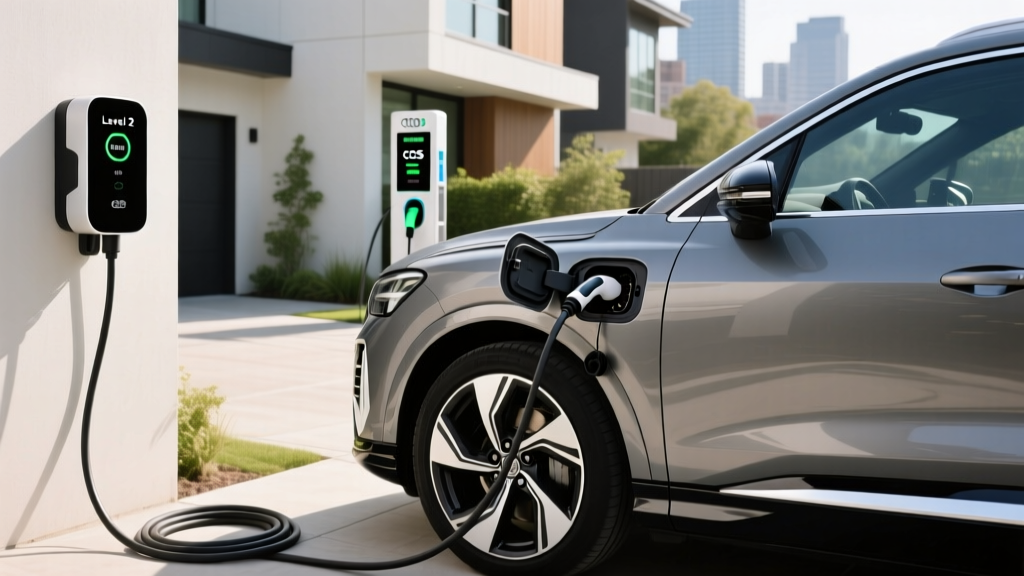
For Level 2 home charging, any J1772-connector charger will plug directly into the Q4 e-tron's CCS port (the CCS port's upper section is the standard J1772 AC connector). No adapter needed for home charging.
Cost to Charge: Per-Mile Economics vs. Gasoline
One of the strongest arguments for the Q4 e-tron is its operating cost. Here's how the per-mile fuel cost compares to a similarly sized gas SUV averaging 26 MPG combined (e.g., Audi Q5 45 TFSI).
| Charging Scenario | Rate | Q4 e-tron Cost/Mile | Gas SUV Cost/Mile ($3.50/gal) |
|---|---|---|---|
| Home (off-peak utility rate) | $0.09/kWh | $0.029 | $0.135 |
| Home (national avg residential) | $0.16/kWh | $0.051 | $0.135 |
| Public Level 2 (network) | $0.30/kWh | $0.096 | $0.135 |
| DC Fast Charge (EA/EVgo) | $0.48/kWh | $0.154 | $0.135 |
At home on off-peak rates, the Q4 e-tron costs roughly $0.03 per mile — about 78% less than the gas equivalent. Even at the national average residential rate of ~$0.16/kWh, you're still saving nearly two-thirds on fuel. Public DC fast charging is the one scenario where costs approach or slightly exceed gasoline, which is why road-trippers should plan stops strategically and take advantage of networks like Electrify America's subscription plans (which lower per-kWh rates for frequent users).
Annual fuel cost estimate: Driving 12,000 miles per year with 80% home charging at $0.13/kWh and 20% public DC charging at $0.45/kWh, your annual electricity cost is approximately $610. The equivalent gas SUV at 26 MPG with $3.50/gallon fuel would cost roughly $1,615. That's over $1,000 in annual fuel savings.
Recommended Home Level 2 Chargers for the Q4 e-tron
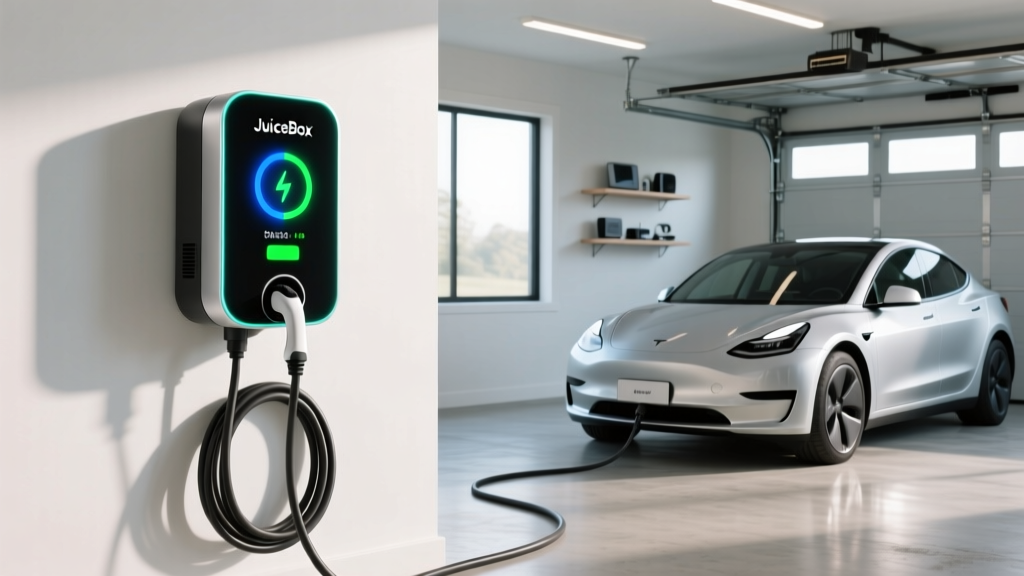
Since the Q4 e-tron can accept up to 11 kW (48A), pairing it with a capable 48-amp charger ensures you're not leaving charging speed on the table. Here are three proven options as of 2026:
Power: Up to 12 kW (50A), adjustable
Connector: J1772 (25-ft cable)
Smart features: Wi-Fi, app scheduling, Alexa integration, utility demand-response compatible
Price: ~$699
Best for: Flexible amperage settings, ideal if your panel can't support a full 60A circuit
Power: Up to 11.5 kW (48A)
Connector: J1772 (24-ft cable)
Smart features: Real-time energy monitoring, solar integration, app control, load management
Price: ~$399
Best for: Budget-conscious buyers who want energy monitoring and solar pairing
Power: Up to 10 kW (40A)
Connector: J1772 (24-ft cable)
Smart features: OCPP-compatible, app scheduling, adjustable amperage, IP65 outdoor rated
Price: ~$549
Best for: Outdoor installations in harsh climates; Canadian-built, extremely durable
Editor's note: The ChargePoint Home Flex at 50A is the top pick for Q4 e-tron owners who want to maximize the vehicle's 11 kW onboard charger capability. If your electrical panel has limited headroom, the Home Flex's dip-switch amperage adjustment (down to 16A) lets you match the charger to your available circuit capacity without buying a different unit.
Public Charging Network Tips for Q4 e-tron Owners
The Q4 e-tron's 175 kW DC fast-charge capability puts it in the mid-tier for charging speed — adequate for road trips, but not class-leading. Here's how to make the most of it:
- Precondition the battery: When you set a DC fast charger as your navigation destination in the Q4 e-tron's MMI system, the car automatically warms the battery to optimal temperature. This can shave 5–8 minutes off a 10–80% session, especially in cool weather.
- Target 150+ kW stations: Electrify America's 150 kW and 350 kW stalls, and Tesla Superchargers (via NACS adapter, V3 stalls at 250 kW), will let the Q4 e-tron hit its peak rate. Older 50 kW CHAdeMO stations will bottleneck you severely.
- Charge to 80%, then move on: The charge curve drops sharply past 80% SoC. A 10–80% session takes ~28 minutes; pushing to 100% adds another 20+ minutes for just ~40 miles of range. On road trips, it's faster to make two 10–80% stops than one 10–100% stop.
- Use PlugShare or A Better Routeplanner: These apps show real-time station status, user-reported reliability, and whether a stall is currently in use — critical for trip planning in areas with sparse infrastructure.
Federal Tax Credit and Incentives for Home Charging
Under current IRS rules, the Alternative Fuel Vehicle Refueling Property Credit (IRC §30C) provides a tax credit of up to $1,000 (30% of equipment and installation costs, capped at $1,000) for home EV charger installation. This credit applies to both the charger hardware and the electrician labor.
Key restrictions:
- The charger must be installed at your primary residence.
- The property must be located in an eligible census tract (qualified low-income or rural communities, as defined by the IRS). Many suburban and urban tracts do not qualify — check the IRS eligibility tool before purchasing.
- The credit is non-refundable — it reduces your tax liability but won't generate a refund if you owe less than the credit amount.
- The Q4 e-tron itself may qualify for the separate §30D New Clean Vehicle Credit (up to $7,500), subject to MSRP caps, buyer income limits, and battery-sourcing requirements. Verify current eligibility on irs.gov or through your dealer's point-of-sale transfer process.
Frequently Asked Questions
How much does it cost to install a home EV charger for the Audi Q4 e-tron?
A straightforward Level 2 installation with a nearby 240V panel typically costs $800–$1,600 including equipment, electrician labor, permit, and materials. Complex installations with long wire runs or a required panel upgrade can reach $3,000–$7,100. The §30C federal tax credit can offset up to $1,000 of this cost if your property is in an eligible census tract.
How fast will each charging level add range to my Q4 e-tron?
Level 1 (120V) adds about 4 miles of range per hour — impractical for daily use. Level 2 (240V, 48A) adds roughly 36 miles per hour, enough for a full overnight charge. DC fast charging at 175 kW can add approximately 190 miles in 30 minutes under peak conditions, though real-world speeds depend on battery temperature, state of charge, and station capability.
Which connector is compatible with the 2026 Audi Q4 e-tron?
The Q4 e-tron uses a native CCS1 port for all AC and DC charging. The 2026 model includes a NACS adapter for Tesla Supercharger access. Any J1772-connector Level 2 charger (which is the industry standard) will plug directly into the upper section of the CCS port. CHAdeMO is not compatible.
How much does charging the Q4 e-tron cost per mile compared to gas?
At a national average residential rate of $0.16/kWh, the Q4 e-tron costs about $0.05 per mile. A comparable 26 MPG gas SUV at $3.50/gallon costs $0.135 per mile. Home charging saves roughly 60–78% on fuel costs. Public DC fast charging at $0.48/kWh is slightly more expensive than gasoline at $0.154 per mile.
What electrical upgrades might I need for a home charger?
If your home has a 200-amp electrical panel with available capacity, you likely need only a dedicated 60-amp circuit and a short conduit run. Homes with 100-amp panels or panels near maximum load may require a service upgrade to 200 amps ($1,500–$3,500). A licensed electrician can perform a load calculation to determine whether an upgrade is necessary before you purchase any equipment.