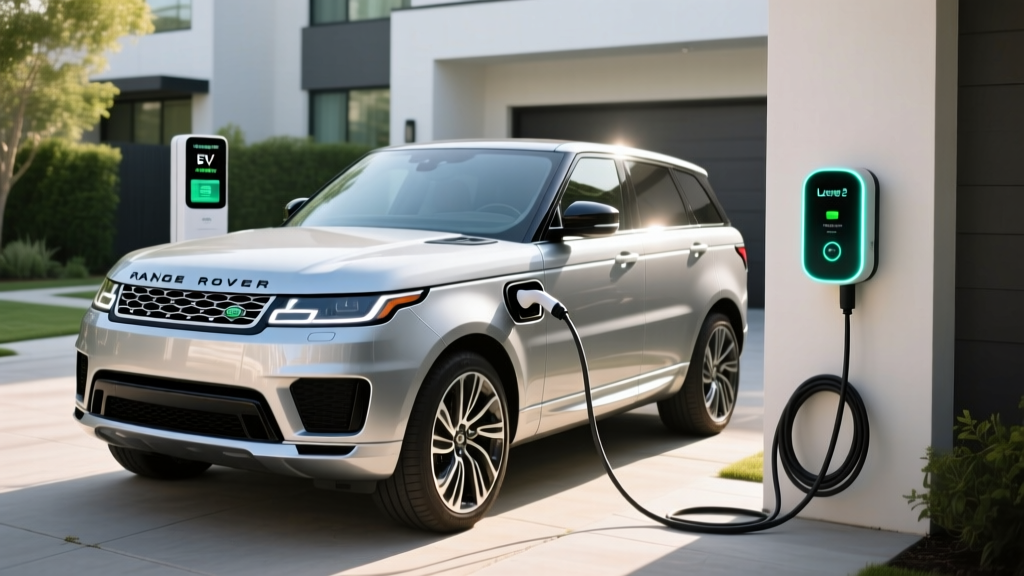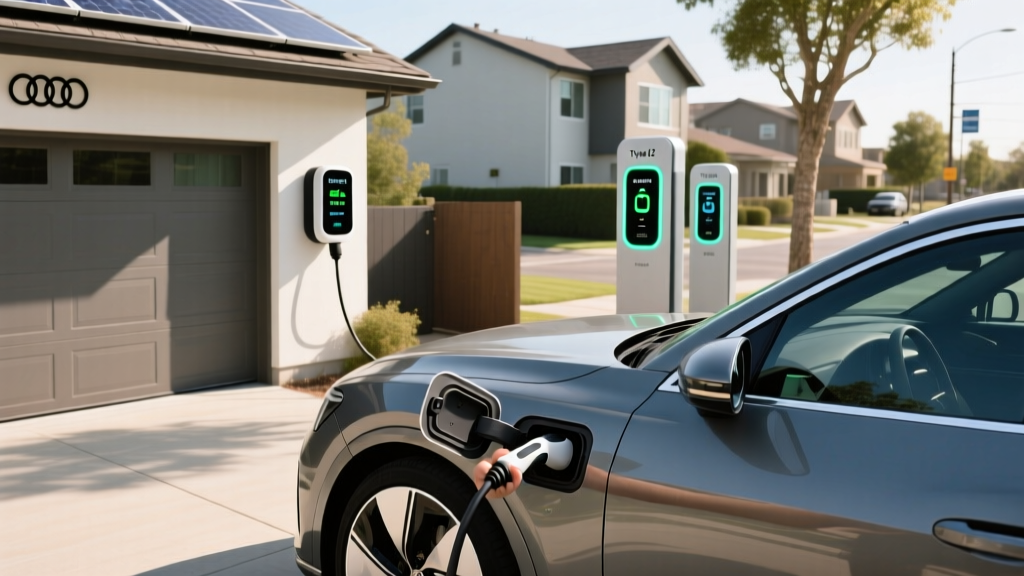
If you've researched the Audi e-tron lineup — or searched for an "Audi supercharged car" expecting blistering electric performance — you've likely landed here wondering how to actually keep one of these EVs fed with electrons. Audi's current electric portfolio (Q8 e-tron, Q4 e-tron, and the incoming Q6 e-tron) relies entirely on plug-in charging, and the experience varies wildly depending on whether you're at home, at a mall, or on a road trip.
This guide covers exactly what Audi EV owners need to know about charging infrastructure in 2026: home Level 2 installation costs, public DC fast-charging realities, connector compatibility (including Audi's transition to NACS), and what you'll actually pay per mile compared to gas.
Understanding Charging Levels: What Each Adds to Your Audi
Before buying equipment or booking an electrician, you need clarity on the three charging tiers. The distinction between kW (power — how fast energy flows) and kWh (energy — what your battery stores) matters everywhere below. An Audi Q8 e-tron has a ~106 kWh usable battery; a Q4 e-tron has ~77 kWh usable. Charge power (kW) determines how quickly you fill that capacity (kWh).
| Level | Voltage / Amps | Power (kW) | Miles Added/Hour | Typical Use |
|---|---|---|---|---|
| Level 1 | 120V / 12A | ~1.4 kW | 3–5 mi/hr | Emergency / overnight trickle |
| Level 2 (Home) | 240V / 32–48A | 7.7–11.5 kW | 22–35 mi/hr | Daily home charging |
| DC Fast Charge | 400–800V DC | 50–270 kW | 150–500+ mi/hr | Road trips, quick top-ups |
Real-world note: Level 1 on a Q8 e-tron is essentially impractical — recovering a full battery would take over 70 hours. Level 2 is where 90%+ of Audi EV charging happens for daily drivers.
Home Level 2 Installation: Electrical Requirements and Real Costs
A Level 2 home charger requires a dedicated 240V circuit, similar to what an electric dryer or oven uses. Most Audi EVs accept up to 11.5 kW on Level 2 (48 amps), though you can install a 40A circuit and charge at 9.6 kW with no issues — you'll just add range slightly slower.
Electrical Requirements
- Circuit amperage: 40A minimum (requires 50A breaker per NEC 125% rule); 60A breaker for full 48A charging
- Voltage: 240V single-phase (standard US residential split-phase)
- Wire gauge: 6 AWG copper for 50A; 4 AWG for 60A runs
- Panel capacity: Your main service panel must have spare capacity — typically 200A service is adequate, but older 100A panels often need upgrading
Panel Upgrade Reality
Homes built before the 1990s frequently have 100A or 150A panels. Adding a 50–60A EV circuit may push you past safe capacity, especially if you also run electric heat, a dryer, and an electric range. A panel upgrade to 200A typically costs $1,500–$3,500 before the charger install. Some homeowners opt for a load-management smart charger (like the Emporia V2 with load-sensing CT clamps) to avoid a panel upgrade — these dynamically reduce charge rate when household demand spikes.
Installation Cost Breakdown
| Component | Cost Range | Notes |
|---|---|---|
| Level 2 Charger (Equipment) | $300 – $700 | Hardwired or NEMA 14-50 plug |
| Electrician Labor | $500 – $2,000 | Depends on panel-to-garage distance |
| Permit & Inspection | $50 – $300 | Varies by municipality |
| Panel Upgrade (if needed) | $1,500 – $3,500 | Only if existing panel lacks capacity |
| Total (no panel upgrade) | $850 – $3,000 | Typical for most modern homes |
| Total (with panel upgrade) | $2,350 – $6,500 | Older homes with 100A service |
The IRS Residential Clean Energy Credit (§25D) covers 30% of home EV charger equipment and installation costs (up to $1,000) for qualifying installations through 2032. This applies to the charger hardware and electrician labor, but check income and eligibility rules with a tax professional.
Connector Compatibility: CCS1, NACS, and Audi's Transition
Audi's connector situation in 2026 requires attention. Here's what fits what:
| Audi Model | Built-in Connector | Tesla Supercharger Access | Adapter Needed? |
|---|---|---|---|
| Q8 e-tron (2024–2025) | CCS1 | Yes (with adapter) | CCS-to-NACS adapter (~$200) |
| Q4 e-tron (2024–2025) | CCS1 | Yes (with adapter) | CCS-to-NACS adapter (~$200) |
| Q6 e-tron (2025+) | NACS (native) | Yes (native) | None for Tesla; NACS-to-CCS for non-Tesla DCFC |
| e-tron GT (2022–2025) | CCS1 | Yes (with adapter) | CCS-to-NACS adapter (~$200) |
Key detail: Starting with the 2025 Q6 e-tron, Audi adopted the North American Charging Standard (NACS) port natively. If you own a 2024 or earlier CCS1-equipped Audi, a CCS-to-NACS adapter from Tesla or Lectron unlocks the Supercharger network — which, according to fueleconomy.gov and real-world testing, remains the most reliable public DC fast-charging network in the US.
CHAdeMO is effectively dead for new vehicles in North America — no current Audi uses it, and you can safely ignore it unless you drive a legacy Nissan Leaf.
DC Fast Charging: How Fast Does an Audi Actually Charge?
Marketing claims about "peak kW" are misleading because no EV sustains its maximum charge rate for the entire session. Charging follows a curve: fast at low state of charge (SoC), tapering significantly above 80%. Here's what real sessions look like:
| Audi Model | Battery (usable kWh) | Peak DC Rate (kW) | 10–80% Time | 800V Architecture? |
|---|---|---|---|---|
| Q8 e-tron (2024–2025) | 106 kWh (NMC) | 170 kW | ~31 min | No (400V) |
| Q4 e-tron (2024–2025) | 77 kWh (NMC) | 175 kW | ~28 min | No (400V) |
| Q6 e-tron (2025+) | 94 kWh (NMC) | 270 kW | ~21 min | Yes (800V) |
| e-tron GT (2024–2025) | 85 kWh (NMC) | 270 kW | ~22 min | Yes (800V) |
The Q6 e-tron's 800-volt architecture (shared with the Porsche Macan Electric) allows it to sustain higher charge rates longer, which is why its 10–80% time beats the larger Q8 e-tron despite similar peak numbers. This is the real-world advantage of 800V — not just peak kW, but sustained kW across the charge curve.
Preconditioning matters: All current Audi EVs can precondition the battery for faster DC charging when you navigate to a charger via the MMI system. In cold weather (below 40°F), a cold battery may accept only 50–80 kW until it warms up — preconditioning can cut your charge time nearly in half.
Cost Per Mile: Charging vs. Gasoline
One of the strongest arguments for an Audi EV over an equivalent gas-powered Q7 or Q5 is operating cost. Here's a realistic breakdown:
| Scenario | Cost per kWh | Efficiency (kWh/100mi) | Cost per Mile |
|---|---|---|---|
| Home (off-peak utility rate) | $0.09 – $0.14 | 30–35 (Q4 e-tron) | $0.03 – $0.05 |
| Home (standard rate) | $0.15 – $0.22 | 30–35 | $0.05 – $0.08 |
| Public Level 2 (ChargePoint, etc.) | $0.25 – $0.49 | 30–35 | $0.08 – $0.17 |
| DC Fast (Electrify America / EVgo) | $0.35 – $0.55 | 30–35 | $0.11 – $0.19 |
| Tesla Supercharger (with adapter) | $0.25 – $0.38 | 30–35 | $0.08 – $0.13 |
| Gas equivalent (Audi Q5, 25 MPG, $3.50/gal) | — | — | $0.14 |
At home on off-peak rates, a Q4 e-tron costs roughly $0.04/mile to fuel — about one-quarter the cost of a gas Q5. Even exclusive DC fast charging at $0.48/kWh averages ~$0.16/mile, which is still comparable to or cheaper than premium gasoline in a turbocharged Audi SUV.
According to EPA data on fueleconomy.gov, the 2025 Q4 e-tron achieves 84 MPGe combined (roughly 32 kWh/100mi), while the Q8 e-tron sits at 78–83 MPGe depending on trim. These are solid figures for luxury-class EVs, though efficiency trails lighter vehicles like the Hyundai Ioniq 5.
Recommended Home Chargers for Audi EVs
Not all Level 2 chargers are equal. Below are tested picks that pair well with Audi's charging architecture:
ChargePoint Home Flex
- Power: Up to 12 kW (50A), adjustable down to 16A
- Connector: J1772 (CCS1 vehicles plug directly; NACS vehicles need adapter)
- Cable length: 23 ft
- Smart features: Wi-Fi, scheduling, Alexa integration, energy tracking
- Price: ~$550–$650
- Best for: CCS1-equipped Audis (2024 and earlier models)
Emporia V2 Smart EV Charger
- Power: Up to 11.5 kW (48A)
- Connector: J1772 (standard)
- Cable length: 24 ft
- Smart features: Load management (avoids panel upgrades), solar integration, real-time energy monitoring
- Price: ~$350–$400
- Best for: Homes with tight panel capacity or solar panels
Wall Connector (Tesla, Gen 3 with J1772 adapter)
- Power: Up to 11.5 kW (48A)
- Connector: NACS native (J1772 adapter included for CCS Audis)
- Cable length: 24 ft
- Smart features: Wi-Fi, over-the-air updates, power sharing between two units
- Price: ~$420–$475
- Best for: NACS-native Audis (Q6 e-tron) or mixed Tesla/Audi households
Hardwired vs. plug: Hardwired chargers (no plug, direct-wired into a junction box) allow up to 48A/11.5 kW and don't require a GFCI breaker (which can add $100–$200 to your electrical bill). Plug-in units using a NEMA 14-50 outlet max at 40A/9.6 kW but offer portability if you move.
Safety, Code, and Installation Best Practices
A 240V EV circuit is serious electrical work. Key safety and code points:
- Dedicated circuit: Your EV charger must have its own breaker — never share a circuit with a dryer, welder, or other high-draw appliance.
- GFCI protection: NEC 2020 and later requires GFCI breakers for plug-in (receptacle) EV circuits in garages. Hardwired installations are exempt. GFCI breakers cost $100–$200 more than standard breakers.
- Outdoor rating: If your charger is mounted outside (carport, driveway), it must be rated NEMA 4 or NEMA 4X for weather resistance. All three chargers above carry outdoor ratings.
- Permit and inspection: Nearly all US jurisdictions require a permit for a new 240V circuit. Skipping this can void homeowner's insurance coverage in the event of a fire. Budget $50–$300 for the permit plus a final inspection visit.
- Licensed electrician: This is not a DIY project unless you're a qualified electrician. Improper 240V work causes fires and electrocution risk. Use a licensed, insured professional and get the permit.
Frequently Asked Questions
How much does it cost to install a home EV charger for my Audi?
Expect $850–$3,000 for a straightforward Level 2 installation (charger + electrician + permit) in a home with adequate panel capacity. If your panel needs upgrading from 100A to 200A, add $1,500–$3,500. The 30% federal Residential Clean Energy Credit (§25D) can offset up to $1,000 of equipment and installation costs through 2032.
How fast will each charging level add range to my Audi e-tron?
Level 1 (120V) adds roughly 3–5 miles per hour — impractical for daily use. Level 2 (240V, 48A) adds 22–35 miles per hour, easily replenishing a day's driving overnight. DC fast charging adds 150–500+ miles per hour at peak rates, with 10–80% sessions taking 21–31 minutes depending on model.
Which connector does my Audi use, and can I charge at Tesla Superchargers?
2024 and earlier Audi EVs use CCS1. The 2025+ Q6 e-tron uses NACS natively. All CCS1 Audis can access Tesla Superchargers using a CCS-to-NACS adapter (~$200). At home, CCS1 Audis use a standard J1772 connector; NACS Audis need a J1772-to-NACS adapter for non-Tesla Level 2 chargers.
How much does charging an Audi EV cost per mile compared to gas?
Home charging at typical utility rates costs $0.03–$0.08 per mile — roughly one-quarter to one-half the cost of premium gasoline in an equivalent Audi Q5 or Q7. Even public DC fast charging at $0.48/kWh averages around $0.16/mile, comparable to gas. Off-peak home charging delivers the best economics.
What electrical upgrades might my home need for a Level 2 charger?
Homes with 200A service and a modern panel typically need no upgrades — just a new dedicated 50A or 60A breaker and wiring run. Homes with 100A or 150A panels, especially those with electric heat, dryers, and ranges, may need a panel upgrade ($1,500–$3,500) or a load-management smart charger to avoid overloading the service.
Does cold weather affect my Audi's charging speed?
Yes. Below 40°F, a cold battery may accept only 50–80 kW at a DC fast charger until it warms up. Always use the MMI navigation to route to your charger — this triggers battery preconditioning, which can cut cold-weather charge times nearly in half. Expect 20–30% range reduction in sustained sub-freezing driving.
Whether you're plugging in a Q4 e-tron for the daily commute or road-tripping a Q6 e-tron across state lines, understanding your charging options — and investing in a proper home Level 2 setup — transforms EV ownership from an experiment into a genuine upgrade over gasoline. Get the electrical work done right, choose the correct connector for your model year, and your Audi will spend most of its time on the road, not at a charger.