The Audi e-tron GT is one of the most compelling luxury electric grand tourers on the road, but its real-world usability hinges on how you charge it. With a large 93.4 kWh (83.7 kWh usable) battery pack and an EPA-estimated range of up to 246 miles (Performance trim, 2025/2026 model year), the e-tron GT demands a thoughtful charging strategy — whether you're topping up at home or relying on public DC fast chargers for road trips.
This guide breaks down exactly how fast each charging level replenishes the e-tron GT's battery, what a home Level 2 installation actually costs, which connectors you need, and how the per-mile economics stack up against a comparable gas-powered Audi. Every figure below is grounded in EPA data, Audi specifications, and real-world charging behavior.
Audi e-tron GT Range: EPA Numbers vs. Real-World Expectations
Before sizing your charger, you need to understand the energy demand. The 2026 Audi e-tron GT lineup includes the standard GT, GT quattro, and GT Performance. Battery capacity is identical across trims: a 93.4 kWh gross (83.7 kWh net usable) lithium-ion NMC pack operating on an 800-volt architecture.
- EPA est. range (GT Performance): 246 miles
- EPA est. range (GT quattro): 242 miles
- Real-world highway (70 mph, mild weather): ~210–225 miles
- Real-world cold weather (below 32°F): ~175–200 miles
- Efficiency: 82 MPGe combined (GT Performance, per fueleconomy.gov)
The 800V architecture is the e-tron GT's secret weapon for charging speed, but range is highly sensitive to driving style. Aggressive acceleration and sustained highway speeds above 75 mph will push consumption toward 3.0–3.2 miles/kWh, cutting practical range closer to 190 miles on the low end.
Charging Levels Explained: How Fast Will Each Add Range?
Electric vehicle charging is categorized into three levels. The critical distinction: kW (kilowatts) measures power — the rate of energy delivery, while kWh (kilowatt-hours) measures energy — the total amount stored in the battery. Think of kW as the speed of water flowing through a hose and kWh as the size of the bucket you're filling.
| Level | Voltage / Phase | Max Power (kW) | Miles of Range Added per Hour | Typical Use Case |
|---|---|---|---|---|
| Level 1 (120V) | 120V / 1-phase | 1.2–1.4 kW | ~3–4 miles/hr | Emergency / overnight trickle |
| Level 2 (240V) | 240V / 1-phase | 7.2–19.2 kW | ~20–55 miles/hr | Home daily charging |
| DC Fast Charge | 400–800V DC | 50–350 kW | ~150–650 miles/hr (peak) | Road trips, rapid top-ups |
For the e-tron GT specifically:
- Level 1 (120V, 12A): Adds roughly 3–4 miles of range per hour. A full charge from 10% to 100% would take approximately 70+ hours. Impractical for daily use with this battery size.
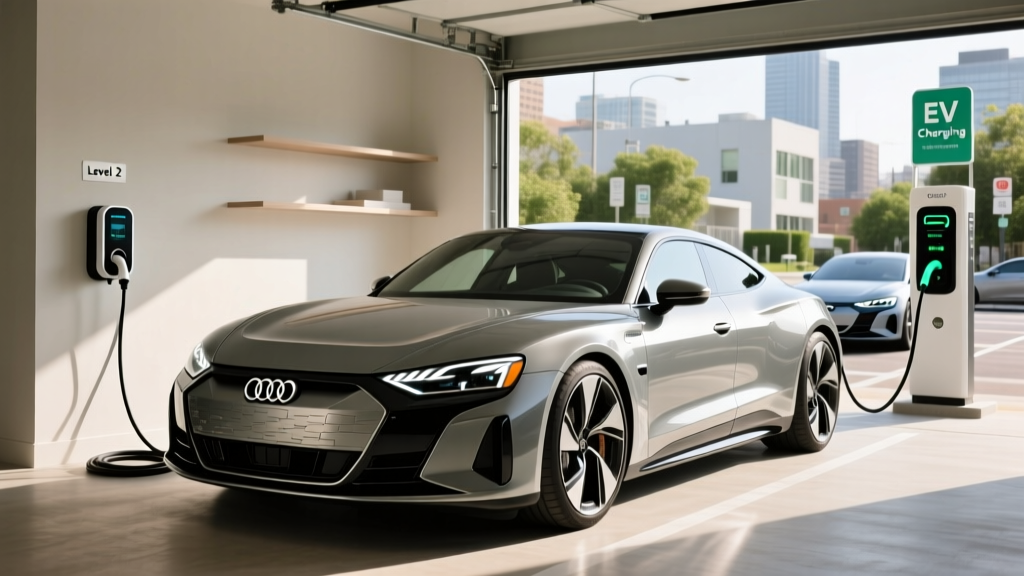
- Level 2 (240V, 48A / 11.5 kW): The e-tron GT's onboard charger accepts up to 11 kW (single-phase) or 22 kW (optional dual-phase in some markets). In the US on a standard 48A/240V circuit, expect ~30 miles of range per hour. A 10–100% charge takes roughly 8–9 hours — ideal for overnight charging.
- DC Fast Charging (800V architecture): The e-tron GT peaks at 270 kW on a compatible 350 kW charger. Thanks to the 800V platform, it sustains high charge rates longer than 400V competitors.
Audi e-tron GT DC Fast Charging: 10–80% Times and the Charge Curve
Audi quotes a 10–80% DC fast-charge time of approximately 22.5 minutes on a 270+ kW charger. But peak kW is not sustained kW — understanding the charge curve is essential for realistic trip planning.
Here's what actually happens at a 350 kW Electrify America or Ionity station:
- 10–30% SoC: The pack ramps quickly to ~270 kW peak. This is where the 800V architecture shines.
- 30–60% SoC: Sustained rate averages around 180–220 kW. Still very fast, but tapering begins.
- 60–80% SoC: Charge rate drops to ~100–130 kW as the battery management system protects cell health.
- Above 80% SoC: Sharp taper to ~50 kW or less. Charging from 80–100% on DC fast can add another 20+ minutes — avoid this on road trips unless necessary.
On a 150 kW DC fast charger (more common at older stations), expect 10–80% in roughly 32–38 minutes. On a 50 kW CHAdeMO or CCS station, plan for 70–90 minutes for the same window.
Home Level 2 Installation: Electrical Requirements and Cost Breakdown
The e-tron GT's 83.7 kWh usable battery is large enough that a quality Level 2 home charger is essentially mandatory. Level 1 charging would require multiple days for a full replenishment.
Electrical Requirements
- Circuit: Dedicated 60A breaker (for a 48A continuous charger) or 50A breaker (for a 40A charger)
- Voltage: 240V single-phase, NEMA 14-50 receptacle or hardwired connection
- Wire gauge: 6 AWG copper for 48A; 8 AWG for 40A (NEC Article 625 requires conductors rated at 125% of continuous load)
- Panel capacity: Your main service panel must have sufficient spare capacity — typically at least 200A total service for a modern home with an EV charger. A load calculation per NEC Article 220 is required.
Panel Upgrade Reality
Homes with 100A or 150A service — common in builds before 2000 — often require a panel upgrade to 200A before adding a 48A EV circuit. This is the single biggest variable in installation cost. A panel upgrade from 100A to 200A typically runs $1,500–$3,500 depending on local utility requirements, meter upgrades, and conduit runs.
| Component | Low Estimate | High Estimate | Notes |
|---|---|---|---|
| Level 2 Charger (hardware) | $400 | $750 | 40A–48A smart charger, NEMA 14-50 or hardwired |
| Electrician labor (standard install) | $600 | $1,500 | Run from panel to garage/carport, ~20–40 ft |
| Permit and inspection | $100 | $350 | Varies by municipality |
| Panel upgrade (if needed) | $1,500 | $3,500 | 100A → 200A service upgrade |
| Total (no panel upgrade) | $1,100 | $2,600 | Typical for homes with 200A service |
| Total (with panel upgrade) | $2,600 | $6,100 | Older homes needing service upgrade |
Always hire a licensed electrician who will pull a permit. Unpermitted EV charger installations can void homeowner's insurance and create fire risk. The National Electrical Code (NEC Article 625) governs EV charging equipment specifically.
Connector Compatibility: CCS, NACS, and the Adapter Landscape
The Audi e-tron GT sold in North America through the 2025 model year uses the CCS1 (Combined Charging System) connector for both Level 2 AC and DC fast charging. Beginning with 2025–2026 model years, Audi has announced a transition to the NACS (North American Charging Standard / Tesla connector) across its EV lineup.
| Connector | Used By | e-tron GT Compatibility | Adapter Needed? |
|---|---|---|---|
| CCS1 | Audi, VW, BMW, GM, Ford (pre-2025), Hyundai, Kia | Native on 2022–2025 e-tron GT | No — native port |
| NACS (Tesla) | Tesla, Ford (2025+), GM (2025+), Rivian, Volvo, Audi (2026+) | Expected native on 2026+ models | CCS-to-NACS adapter for 2022–2025 models |
| CHAdeMO | Nissan Leaf (legacy) | Not compatible | No adapter available |
| J1772 (AC only) | All EVs for Level 2 AC | Native (CCS includes J1772 pins) | No — built into CCS port |
For 2022–2025 e-tron GT owners wanting Tesla Supercharger access: Tesla sells a CCS-to-NACS adapter (approximately $200–$250) that enables access to V3 Superchargers (up to 250 kW). However, charge speed may be limited by the adapter's throughput and the Supercharger's protocol negotiation. Audi also offers its own approved adapter in some markets. Confirm compatibility with your specific model year before purchasing.
Cost to Charge the e-tron GT: Home vs. Public vs. Gas Comparison
The e-tron GT's efficiency of roughly 82 MPGe combined translates to approximately 3.0 miles per kWh (or ~33 kWh per 100 miles). Using this figure, we can model real charging costs.
| Scenario | Rate ($/kWh) | Cost for 10–80% (70 kWh) | Cost per Mile |
|---|---|---|---|
| Home (off-peak utility rate) | $0.10–$0.14 | $7.00–$9.80 | $0.033–$0.047 |
| Home (average US residential) | $0.16–$0.17 | $11.20–$11.90 | $0.053–$0.057 |
| Public Level 2 (ChargePoint, EVgo) | $0.25–$0.39 | $17.50–$27.30 | $0.083–$0.130 |
| DC Fast (Electrify America, EA Pass) | $0.36–$0.48 | $25.20–$33.60 | $0.120–$0.160 |
| Tesla Supercharger (where accessible) | $0.28–$0.36 | $19.60–$25.20 | $0.093–$0.120 |
Gas comparison: A comparable Audi RS7 (16 MPG combined, premium fuel at $4.20/gallon) costs approximately $0.263 per mile in fuel alone. Even at public DC fast-charging rates, the e-tron GT costs roughly 40–60% less per mile. At home off-peak rates, the savings exceed 80%.
For a driver covering 12,000 miles annually:
- Home charging (off-peak): ~$480/year
- Public DC fast (majority): ~$1,680/year
- Audi RS7 gas equivalent: ~$3,150/year
Recommended Home Chargers for the Audi e-tron GT
Given the e-tron GT's 11 kW AC charge acceptance (single-phase US), a 48A Level 2 charger is the sweet spot — it delivers the full 11.5 kW the car can accept while staying within a standard 60A circuit.
ChargePoint Home Flex
- Power output: Up to 12 kW (50A adjustable, NEMA 14-50) or 11.5 kW (48A hardwired)
- Connector: J1772 (CCS compatible for AC)
- Cable length: 23 ft
- Smart features: Wi-Fi, app scheduling, Alexa, load sharing
- Price: ~$549–$599
- Best for: Flexible amperage adjustment if your panel is tight on capacity
Wallbox Pulsar Plus (48A)
- Power output: 11.5 kW (48A, hardwired 240V)
- Connector: J1772
- Cable length: 25 ft
- Smart features: Wi-Fi/Bluetooth, app control, Power Sharing for dual-charger setups
- Price: ~$449–$499
- Best for: Compact form factor, budget-friendly with full smart features
Emporia Level 2 EV Charger
- Power output: 11.5 kW (48A hardwired) or 10 kW (40A NEMA 14-50)
- Connector: J1772
- Cable length: 24 ft
- Smart features: Wi-Fi, energy monitoring, integrates with Emporia Vue home energy panel
- Price: ~$349–$399
- Best for: Best value; ideal if you already use Emporia energy monitoring
Audi Genuine e-tron Charger (ChargePoint)
- Power output: 9.6 kW (40A, NEMA 14-50)
- Connector: J1772
- Cable length: 18 ft
- Smart features: App integration with myAudi, scheduling, LED status indicator
- Price: ~$525–$600 (often included or discounted at purchase)
- Best for: Brand purists wanting OEM integration; note the lower 40A/9.6 kW output
Editor's pick: The ChargePoint Home Flex offers the best balance of adjustable amperage, build quality, and app reliability for the e-tron GT. If your electrical panel has limited headroom, you can dial the Flex down to 40A or 32A without swapping hardware — a feature competitors lack.
Safety, Code, and Installation Best Practices
EV charging is a continuous high-draw load — your installation must meet specific safety standards to protect your home and vehicle.
- Dedicated circuit: NEC Article 625.40 requires EV charging equipment to be on a dedicated branch circuit. Do not share the circuit with other appliances.
- GFCI protection: NEC 2020 (625.54) mandates GFCI protection for all receptacles used for EV charging. Hardwired installations are exempt from this requirement but may be required by local amendments.
- Outdoor rating: If your charger is mounted outdoors or in an unenclosed carport, ensure it carries a NEMA 4 or IP65 weather rating. All chargers listed above meet outdoor installation standards.
- Cable management: Use a wall-mounted cable organizer to prevent tripping hazards and cord damage. Never run a charging cable across a driveway where vehicles will drive over it.
- Surge protection: Consider a whole-home surge protector or a dedicated SPD (Surge Protective Device) at the charger circuit, especially in regions with frequent lightning.
- Utility incentives: Many utilities offer rebates of $250–$500 for Level 2 charger installation and time-of-use (TOU) rate plans that reduce off-peak electricity costs to $0.06–$0.10/kWh. Check with your local provider before installation.
Frequently Asked Questions
How much does it cost to install a home EV charger for the Audi e-tron GT?
A standard Level 2 installation (48A hardwired or NEMA 14-50) runs $1,100–$2,600 including equipment, electrician labor, and permits — assuming your home already has a 200A electrical panel. If a panel upgrade from 100A to 200A is needed, add $1,500–$3,500, bringing the total to $2,600–$6,100. Always get a load calculation from your electrician before assuming your panel has capacity.
How fast will each charging level add range to the e-tron GT?
Level 1 (120V) adds roughly 3–4 miles per hour — essentially unusable for this 83.7 kWh battery. Level 2 (240V, 48A) adds approximately 30 miles per hour, fully recharging overnight in 8–9 hours. DC fast charging at a 270+ kW station adds the equivalent of 150+ miles in 15 minutes during peak charge rates (10–40% SoC), tapering significantly above 60%.
Which connector is compatible with my Audi e-tron GT?
Model years 2022–2025 use the CCS1 connector natively. Model year 2026+ is expected to adopt NACS natively, aligning with the broader industry shift. For 2022–2025 owners wanting Tesla Supercharger access, a CCS-to-NACS adapter (~$200–$250) is available. All Level 2 AC charging uses the J1772 standard, which is integrated into the CCS1 port.
How much does charging the e-tron GT cost per mile vs. gas?
At home off-peak rates ($0.10–$0.14/kWh), the e-tron GT costs approximately $0.03–$0.05 per mile. At public DC fast chargers ($0.36–$0.48/kWh), it costs $0.12–$0.16 per mile. A comparable gas-powered Audi RS7 at 16 MPG combined and $4.20/gallon premium costs about $0.26 per mile. Home charging saves 80%+ vs. gas; even public DC fast charging saves 40–55%.
What electrical upgrades might I need for a home charger?
The most common upgrade is a panel capacity increase. Homes with 100A or 150A main service often need an upgrade to 200A to safely add a 48A EV circuit alongside existing loads (HVAC, electric range, dryer). Your electrician will perform a NEC Article 220 load calculation. Other potential upgrades include replacing an outdated fuse box with a breaker panel, upgrading the utility meter, or running new conduit from the panel to the charger location.
Does the Audi e-tron GT support vehicle-to-home (V2H) or bidirectional charging?
As of the 2026 model year, the e-tron GT does not support V2H or V2L (vehicle-to-load) bidirectional charging. This feature is currently available on select competitors like the Ford F-150 Lightning and Hyundai Ioniq 5. Audi has indicated bidirectional capability is under development for future platforms but has not confirmed a timeline.
Is the Audi e-tron GT eligible for the federal EV tax credit?
The §30D federal tax credit eligibility depends on MSRP caps, buyer income limits, and battery component/critical mineral sourcing requirements per IRS guidelines. The e-tron GT's MSRP (starting ~$106,000+) exceeds the $55,000 sedan cap for the new-vehicle credit, making it ineligible for the $7,500 new-vehicle credit. However, it may qualify under the used-EV credit (§25E) if purchased pre-owned at or below $25,000 — though current e-tron GT resale values make this unlikely. Always consult a tax professional and verify current-year rules.
Battery Warranty and Long-Term Charging Health
Audi covers the e-tron GT's high-voltage battery with an 8-year / 100,000-mile warranty guaranteeing at least 70% capacity retention. Real-world data from the 800V platform (shared with the Porsche Taycan) suggests degradation of approximately 5–8% over the first 100,000 miles for drivers who primarily use Level 2 home charging and limit DC fast charging to road trips.
To maximize long-term battery health:
- Set your daily charge limit to 80–85% and only charge to 100% before long trips.
- Avoid leaving the car at 100% SoC for extended periods, especially in hot weather.
- Use the e-tron GT's built-in preconditioning feature when navigating to a DC fast charger — this warms or cools the pack to optimal temperature, improving charge speed and reducing cell stress.
- Minimize repeated DC fast charging in extreme heat; the thermal management system is robust, but sustained high-C-rate charging at high ambient temperatures accelerates degradation.
The e-tron GT's 800V architecture and active thermal management give it a meaningful longevity edge over passively cooled packs. Owners who follow the 80% daily / 100% road-trip discipline typically see less than 1% annual degradation in temperate climates.