What Does It Mean to Get an Audi Supercharged?
When EV owners search for "Audi supercharged," they're usually asking about maximum DC fast-charging speed — how quickly an Audi e-tron, Q6 e-tron, or e-tron GT can replenish its battery at a high-power public charger. Unlike Tesla's branded "Supercharger" network, Audi relies on the Electrify America network (a VW Group subsidiary) and other third-party DC fast-charging providers. But the physics are the same: push high-voltage direct current into the pack as fast as the battery management system (BMS) will allow.
For the 2026 model year, Audi's EV lineup spans several architectures with different peak charge rates:
- Q6 e-tron / Q6 e-tron Sportback (PPE platform): up to 270 kW peak DC fast charging, 10–80% in approximately 21 minutes
- A6 e-tron (PPE platform): up to 270 kW, 10–80% in ~21 minutes
- e-tron GT / RS e-tron GT (J1 platform, 800V): up to 270 kW, 10–80% in ~22 minutes
- Q8 e-tron / Q8 Sportback e-tron: up to 170 kW, 10–80% in ~31 minutes
These are peak rates. Real-world charging follows a curve: the car pulls maximum power at low state of charge (SoC), then tapers as the battery fills to protect cell health. Expect to sustain peak kW only through roughly 30–50% SoC, with a gradual decline above that. This is why manufacturers quote 10–80% times rather than 0–100%.
Charging Levels Explained: How Fast Will Each Level Add Range?
Understanding the three charging levels is essential before you invest in equipment or plan road trips. Here's the critical distinction: kW (kilowatts) measures power — the rate of energy delivery, like water pressure from a hose. kWh (kilowatt-hours) measures energy — the total amount stored in your battery, like gallons in a tank. A 100 kWh battery charged at 10 kW takes roughly 10 hours from empty; at 270 kW, the math is more complex due to taper, but the first 50% fills dramatically faster.
| Level | Voltage / Amperage | Power (kW) | Miles of Range Per Hour | Best For |
|---|---|---|---|---|
| Level 1 (120V) | 120V / 12A | ~1.4 kW | 3–5 mi/hr | Emergency top-ups, PHEVs |
| Level 2 (240V) | 240V / 32–48A | 7.7–11.5 kW | 20–35 mi/hr | Daily home charging |
| DC Fast Charging | 400–800V DC | 50–350 kW | 150–400+ mi/hr (at peak) | Road trips, rapid top-ups |
For a 2026 Q6 e-tron with its 100 kWh (usable ~94.9 kWh) battery and EPA-estimated range of approximately 310 miles, here's what typical sessions look like:
- Level 1 (120V, 1.4 kW): 0–100% in ~68 hours. Essentially useless for a large BEV — adds roughly 40 miles overnight.
- Level 2 (240V, 48A / 11.5 kW): 0–100% in ~8.5 hours. Ideal for overnight charging — wake up to a full battery every morning.
- DC Fast (270 kW peak): 10–80% in ~21 minutes, adding roughly 200 miles of range in that window.
Home Level 2 Installation: Electrical Requirements and Costs
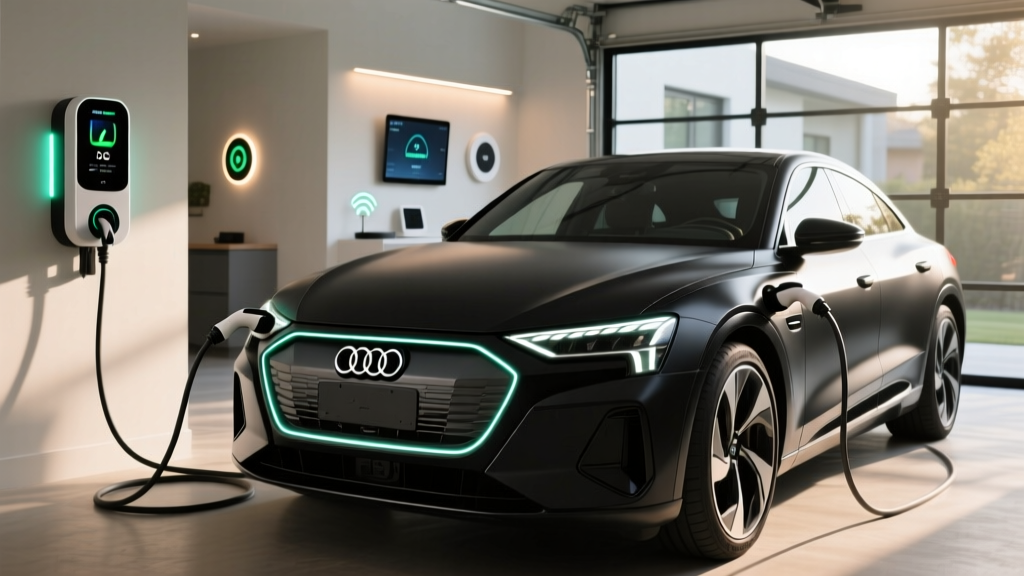
Most Audi EV owners will want a Level 2 home charger. The Q6 e-tron and A6 e-tron (PPE platform) feature an onboard charger rated at 11.5 kW (48A), meaning you can fully utilize a 48-amp hardwired Level 2 unit. The Q8 e-tron accepts up to 9.6 kW (40A).
Electrical Requirements
A 48A Level 2 charger requires a 60-amp dedicated circuit (the National Electrical Code requires circuits to be rated at 125% of continuous load — 48A × 1.25 = 60A). This means:
- 240V / 60A breaker in your main panel
- 6 AWG copper wire (or 4 AWG aluminum) for runs up to ~100 feet
- Spare panel capacity: Your electrical panel must have two adjacent open slots and sufficient total amperage headroom. A 200A panel with 160A+ of existing load may need an upgrade to accommodate a 60A EV circuit.
Do You Need a Panel Upgrade?
Homes built before 2000 often have 100A or 150A service. Adding a 60A EV circuit to an already-loaded 100A panel frequently triggers a panel upgrade to 200A, which is the single largest variable in installation cost. Signs you may need an upgrade:
- Your panel is 100A or 150A service
- You already run electric heat, electric dryer, electric range, and A/C
- Your panel is a Federal Pacific or Zinsco (known safety hazards requiring replacement regardless)
- Your electrician's load calculation exceeds 80% of panel capacity with the EV circuit added
| Component | Simple Install (panel nearby, no upgrade) | Complex Install (long wire run, panel upgrade) |
|---|---|---|
| Level 2 Charger Equipment | $400–$700 | $500–$750 |
| Electrician Labor | $400–$800 | $1,200–$2,500 |
| Electrical Permit | $50–$150 | $50–$200 |
| Panel Upgrade (if needed) | $0 | $1,500–$3,500 |
| Wire & Conduit Materials | $100–$250 | $300–$800 |
| Total Estimated Cost | $950–$1,900 | $3,550–$7,750 |
Connector Compatibility: NACS, CCS1, and Audi's 2026 Transition
The connector landscape has shifted dramatically. As of the 2026 model year, Audi has transitioned its North American EV lineup to the NACS (North American Charging Standard) connector — the same plug used by Tesla. This means new Audis can charge natively at Tesla Superchargers (now open to non-Tesla vehicles) as well as Electrify America and other networks that have added NACS cables.
| Connector Type | 2025 and Earlier Audi EVs | 2026+ Audi EVs (Q6 e-tron, A6 e-tron) |
|---|---|---|
| NACS (Tesla-style) | Requires CCS-to-NACS adapter | Native — no adapter needed |
| CCS1 (Combo) | Native port | Requires NACS-to-CCS adapter for older stations |
| CHAdeMO | Not compatible (adapter exists but limited DC support) | Not compatible |
If you own a 2024 or 2025 Q8 e-tron or e-tron GT with a CCS1 port, you'll need a CCS-to-NACS adapter (approximately $150–$250 from Tesla or third-party brands) to access Tesla Superchargers. Audi has offered complimentary adapters to some early buyers — check with your dealer.
If you're buying a 2026 Q6 e-tron or A6 e-tron, the native NACS port means you can plug directly into any Tesla Supercharger or NACS-equipped Electrify America station without an adapter. However, some older CCS-only public chargers may require you to carry a NACS-to-CCS adapter for backward compatibility.
Cost to Charge: Home vs. Public vs. Gas Comparison
One of the strongest ownership arguments for an Audi EV is per-mile fuel cost. But the savings depend entirely on where you charge. A driver who charges 90% at home on off-peak rates and 10% on DC fast chargers will see dramatically different economics than someone who relies entirely on public charging.
| Charging Scenario | Rate ($/kWh) | Efficiency (kWh/100 mi) | Cost Per Mile |
|---|---|---|---|
| Home Level 2 — Off-Peak TOU | $0.08–$0.12 | 33 kWh | $0.026–$0.040 |
| Home Level 2 — Standard Rate | $0.14–$0.18 | 33 kWh | $0.046–$0.059 |
| Public Level 2 (workplace, mall) | $0.20–$0.30 | 33 kWh | $0.066–$0.099 |
| DC Fast — Electrify America | $0.35–$0.55 | 33 kWh | $0.116–$0.182 |
| Gasoline — BMW X5 xDrive40 (25 MPG combined) | $3.40/gal | 4 gal/100 mi | $0.136 |
At a national average electricity rate of ~$0.16/kWh (EIA data) and the Q6 e-tron's efficiency of roughly 33 kWh/100 miles, home charging costs about $0.053/mile — roughly 60% less than the gasoline baseline at $3.40/gallon. Over 15,000 annual miles, that's approximately $1,245 in savings per year on fuel alone when charging primarily at home.
The calculus flips if you rely heavily on DC fast charging at $0.45+/kWh. At those rates, you're paying $0.15–$0.18/mile — more than the gas car. This is why home charging access is the single most important factor in EV ownership economics.
Recommended Home Level 2 Chargers for Audi EVs
Not all Level 2 chargers are equal. For a 2026 Audi with an 11.5 kW onboard charger, you want a unit that can deliver the full 48A to minimize overnight charge time. Here are proven options:
ChargePoint Home Flex
- Power: Up to 11.5 kW (48A), adjustable down to 16A
- Connector: NACS (2025+ models) or J1772 with adapter
- Cable Length: 23 feet
- Smart Features: Wi-Fi, app scheduling, Alexa, energy tracking
- Price: ~$550–$650
- Best For: Flexible amperage if your panel can't support 60A
Wallbox Pulsar Plus
- Power: Up to 11.5 kW (48A)
- Connector: NACS or J1772 variants available
- Cable Length: 25 feet
- Smart Features: Wi-Fi + Bluetooth, app control, power sharing for dual installs
- Price: ~$500–$600
- Best For: Compact size, dual-charger garage setups
Tesla Wall Connector (NACS)
- Power: Up to 11.5 kW (48A)
- Connector: NACS native
- Cable Length: 24 feet
- Smart Features: Wi-Fi updates, load sharing, access control
- Price: ~$420–$475
- Best For: 2026 Audi NACS owners wanting the lowest-cost quality unit
Emporia Vue Level 2
- Power: Up to 11.5 kW (48A)
- Connector: NACS or J1772
- Cable Length: 24 feet
- Smart Features: Whole-home energy monitoring integration, solar-aware scheduling
- Price: ~$400–$500
- Best For: Solar-panel owners wanting integrated energy management
All four units are UL-listed (or ETL-listed to UL standards), which is non-negotiable for safety and insurance compliance. Avoid unbranded chargers from online marketplaces that lack independent safety certification.
Safety, Code, and Installation Best Practices
Level 2 charging pulls sustained high current for hours — this is the most demanding continuous load in most homes. Cutting corners creates fire risk. Here's what proper installation requires:
- Dedicated circuit: Your EV charger must have its own breaker — never shared with other appliances. A 48A charger requires a 60A breaker.
- GFCI protection: The 2023 NEC (National Electrical Code) requires GFCI protection for all EV charging outlets. Hardwired units (no plug) typically have GFCI built into the charger itself. If you install a NEMA 14-50 receptacle, your electrician must add a GFCI breaker (~$50–$80 extra).
- Outdoor rating: If your charger is mounted outside or in an exposed carport, it must carry a NEMA 4 (weatherproof) rating. All four recommended chargers above meet this standard.
- Hardwired vs. plug: Hardwired installations are generally preferred for 48A units — they eliminate the receptacle as a failure point, avoid the NEC GFCI-breaker requirement, and allow the full 48A continuous draw. A NEMA 14-50 receptacle limits you to 40A continuous (the NEC 80% rule for plug-in loads).
- Wire sizing: 6 AWG copper for 60A circuits. Your electrician will calculate voltage drop for runs over 100 feet and may upsize to 4 AWG.
Frequently Asked Questions
How much does it cost to install a home EV charger for my Audi?
A straightforward Level 2 installation (panel has capacity, charger mounts near the panel) typically costs $950–$1,900 including equipment, labor, wire, and permit. If your home needs a 200A panel upgrade, total costs can reach $3,500–$7,750. Get three quotes from licensed electricians and verify they have EV-charging installation experience.
Can I use a Tesla Supercharger with my Audi?
Yes. If you have a 2026 Audi with a native NACS port (Q6 e-tron, A6 e-tron), you can plug directly into any open Tesla Supercharger. If you have a 2024–2025 Audi with a CCS1 port, you'll need a CCS-to-NACS adapter ($150–$250). Tesla's Supercharger network is the largest and most reliable DC fast-charging network in North America, with over 30,000 stalls.
How fast will each charging level add range to my Audi Q6 e-tron?
Level 1 (120V) adds roughly 3–5 miles per hour — impractical for a 100 kWh battery. Level 2 (240V, 48A) adds 30–35 miles per hour, fully recharging overnight in ~8.5 hours. DC fast charging at 270 kW peak adds up to ~190 miles in 21 minutes (10–80% SoC), though actual speed depends on battery temperature and state of charge.
Is it cheaper to charge at home or use public DC fast chargers?
Home charging is dramatically cheaper. At the national average rate of ~$0.16/kWh, home charging costs roughly $0.05/mile. Public DC fast chargers at $0.35–$0.55/kWh cost $0.12–$0.18/mile — often more expensive than gasoline. For maximum savings, charge 85–90% of your miles at home and reserve DC fast charging for road trips.
What electrical upgrades might I need for a Level 2 charger?
The most common upgrade is a panel upgrade from 100A to 200A service ($1,500–$3,500) if your existing panel lacks capacity for a 60A dedicated circuit. You may also need: two adjacent open breaker slots, a new ground rod (if your system isn't up to current code), or a meter-main combo upgrade if your utility requires it. A licensed electrician will perform a NEC Article 220 load calculation to determine exactly what your home needs.
Does the federal tax credit cover home charger installation?
The IRS Residential Clean Energy Credit (IRC §25C) previously offered a 30% credit (up to $1,000) for home EV charger equipment and installation. However, this credit has undergone changes — verify current-year eligibility on irs.gov or with a tax professional. Some utilities and states offer separate rebates for Level 2 charger installation; check your local utility's EV programs. The EPA's fueleconomy.gov site also links to state incentive databases.