What You Need to Know About Audi e-tron GT Range and Charging
The Audi e-tron GT is a luxury electric grand tourer that pairs striking design with serious performance credentials. But owning one — or considering one — means understanding exactly how far it will go on a charge, how fast it replenishes, and what it takes to set up proper home charging. This guide covers the Audi e-tron GT range in real-world terms, the charging infrastructure you need, and the exact costs involved in getting a Level 2 charger installed in your garage.
We will break down the difference between kilowatts (kW), which measure charging power, and kilowatt-hours (kWh), which measure battery energy capacity. Getting this distinction right is the single most important piece of EV literacy for any e-tron GT owner or buyer.
The standard e-tron GT (84 kWh usable battery, NMC chemistry) carries an EPA-estimated range of approximately 238 miles. The RS e-tron GT, with its higher-output dual-motor setup, rates around 232 miles EPA. In real-world highway driving at 70+ mph, expect 200–215 miles. In cold weather (below 32°F), range can drop 20–30%, meaning a winter road trip might yield 165–185 miles before needing a charge. Plan accordingly.
Audi e-tron GT: Key Specs at a Glance
| Specification | e-tron GT quattro | RS e-tron GT |
|---|---|---|
| Usable Battery Capacity | 84 kWh (NMC) | 84 kWh (NMC) |
| EPA Range | ~238 mi | ~232 mi |
| Real-World Highway Range | ~200–215 mi | ~195–210 mi |
| Max DC Fast Charge Rate | 270 kW peak | 270 kW peak |
| 10–80% DC Fast Charge | ~22 min | ~22 min |
| Level 2 AC Charge Rate | 9.6 kW (onboard charger) | 9.6 kW (onboard charger) |
| Level 2 Full Charge Time (0–100%) | ~9.5 hours | ~9.5 hours |
| Horsepower | 522 hp (boost) | 637 hp (boost) |
| 0–60 mph | 3.9 sec | 3.1 sec |
| Connector (US Models) | CCS1 (J1772 + DC pins) | CCS1 (J1772 + DC pins) |
| Starting MSRP (2025 MY) | ~$106,500 | ~$147,800 |
| Battery/Powertrain Warranty | 8 yr / 100,000 mi | 8 yr / 100,000 mi |
Source: fueleconomy.gov and Audi USA specifications. Real-world range estimates based on aggregated owner data and independent testing. MSRP reflects base pricing before destination; verify current model-year pricing with your dealer.
Charging Levels Explained: How Fast Will Each Add Range?
Understanding charging levels is critical to planning your e-tron GT ownership experience. Here is the breakdown:
| Charging Level | Power (kW) | Voltage / Amperage | Miles of Range Added per Hour | Best Use Case |
|---|---|---|---|---|
| Level 1 (Standard Outlet) | 1.2–1.4 kW | 120V / 12A | ~3–4 mi/hr | Emergency top-ups, overnight trickle |
| Level 2 (Home / Workplace) | 7.2–11.5 kW | 240V / 30–48A | ~22–35 mi/hr | Daily home charging, workplace charging |
| DC Fast Charging | 50–350 kW | 400–800V DC | ~150–600+ mi/hr (peak) | Road trips, rapid replenishment |
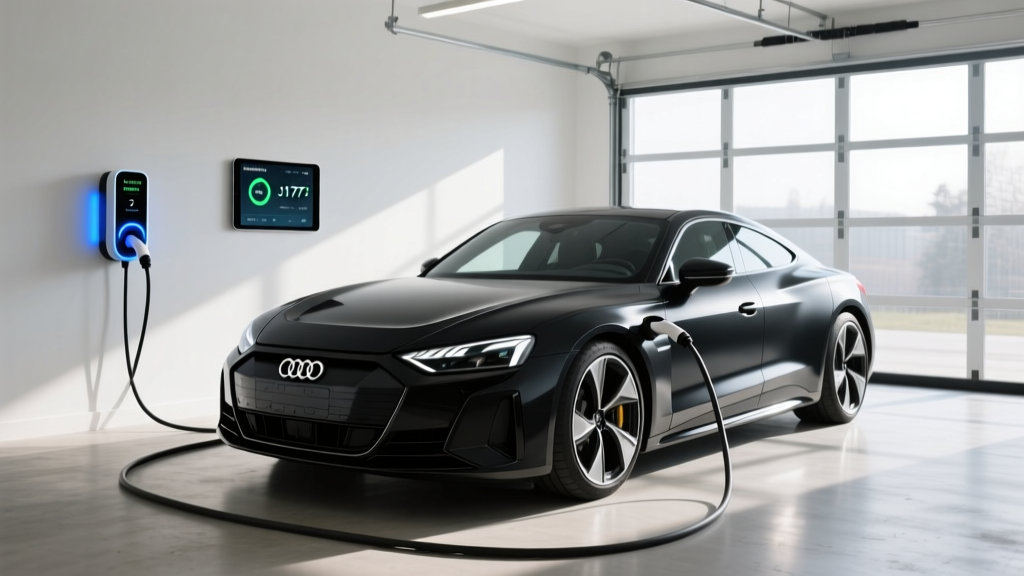
For the e-tron GT specifically: Level 1 charging is impractical for daily use — it would take over 60 hours to fill the 84 kWh battery from empty. Level 2 at 9.6 kW (the e-tron GT's onboard charger limit) adds roughly 29 miles of range per hour, fully replenishing the battery in about 9.5 hours — ideal for overnight charging. DC fast charging at the car's 270 kW peak can add approximately 185 miles of range in just 15 minutes under optimal conditions, though the charge curve tapers significantly above 80% state of charge.
Charge curve reality: The e-tron GT's 800-volt architecture enables that impressive 270 kW peak, but it only sustains peak power roughly between 10–55% SoC. From 55–80%, the rate gradually tapers to around 100–130 kW. From 80–100%, it drops further to under 50 kW. This is why the industry standard metric is 10–80% time (~22 minutes) rather than a full 0–100% charge.
Home Charger Installation: Requirements, Costs, and Panel Upgrades
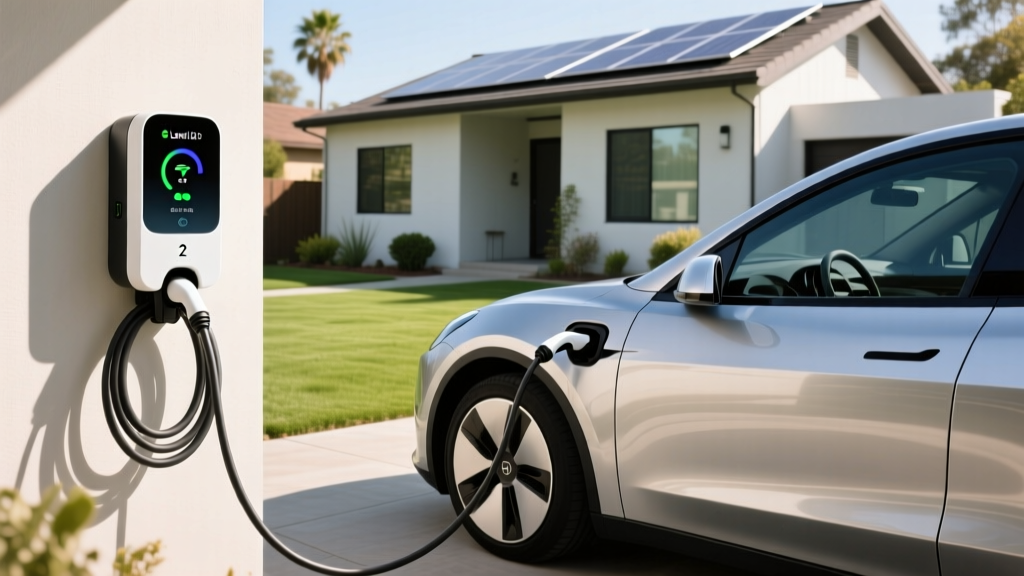
Installing a Level 2 home charger is the single best investment for e-tron GT ownership. Here is exactly what is involved:
Electrical Requirements
For a Level 2 charger delivering the e-tron GT's maximum 9.6 kW AC charge rate, you need:
- Circuit: Dedicated 50-amp, 240-volt circuit (a 48A continuous charger requires a 60A breaker per NEC 80% rule)
- Wire: 6 AWG copper (THHN in conduit or NM-B depending on run)
- Outlet option: NEMA 14-50 receptacle (allows charger portability) OR hardwired connection (required for some higher-amperage units and often preferred by inspectors)
- GFCI: NEC 2020 and later require GFCI protection for outdoor receptacles; hardwired indoor installations may be exempt depending on jurisdiction
Do You Need a Panel Upgrade?
This is the make-or-break cost question. Most modern homes with a 200-amp electrical panel can accommodate a 50A EV circuit without an upgrade — provided you are not already near panel capacity with existing loads (electric range, dryer, HVAC, etc.). A licensed electrician will perform a load calculation per NEC Article 220 to determine available headroom.
If your home has a 100-amp panel, or if the load calculation shows insufficient capacity, you may need a panel upgrade to 200A. This adds $1,500–$3,500 to the project. Some homeowners opt for a smart load management device (such as the Emporia VUE with smart breaker or a Span panel) as a panel-upgrade alternative, which dynamically limits charger draw when other loads are high.
Installation Cost Breakdown
| Cost Component | Low-End Estimate | High-End Estimate | Notes |
|---|---|---|---|
| Level 2 Charger (Equipment) | $350 | $750 | Varies by brand, power output, smart features |
| Electrician Labor | $500 | $2,000 | Depends on run length, conduit needs, wall type |
| Electrical Permit | $50 | $250 | Varies by municipality; required in most jurisdictions |
| Panel Upgrade (if needed) | $1,500 | $3,500 | 100A to 200A upgrade; not always required |
| Total (No Panel Upgrade) | $900 | $3,000 | Typical scenario for modern homes |
| Total (With Panel Upgrade) | $2,400 | $6,500 | Older homes or high-load situations |
Federal incentive note: The residential clean energy credit (IRS §25D) previously covered 30% of home charger equipment and installation costs up to $1,000. Check current-year IRS guidance for availability, as this credit has undergone legislative changes. Some utilities also offer rebates of $250–$500 for Level 2 charger installation — contact your local provider.
Connector Compatibility: CCS1, NACS, and Adapter Options
The Audi e-tron GT sold in the US comes equipped with a CCS1 (Combined Charging System) port, which combines the J1772 AC connector with two DC fast-charging pins below it. This is the legacy standard used by most non-Tesla EVs.
| Connector Type | Compatibility with e-tron GT | Network Availability | Adapter Needed? |
|---|---|---|---|
| CCS1 | Native — built-in | Electrify America, EVgo, ChargePoint, Ionity (EU) | No |
| NACS (Tesla) | Requires adapter | Tesla Supercharger network (17,000+ stalls in US) | Yes — CCS-to-NACS adapter (~$200–$250) |
| CHAdeMO | Not compatible | Largely discontinued in US | N/A — no practical adapter exists |
| J1772 (AC only) | Native — top portion of CCS port | All public Level 2 stations | No |
The NACS question: As of 2025, Audi has not announced a native NACS port for the e-tron GT. However, a CCS-to-NACS adapter (such as those from Lectron or A2Z) allows access to Tesla Superchargers that have been opened to non-Tesla vehicles. Note that some older Supercharger stalls may not support CCS adapters — check the Tesla app for station compatibility. Peak charge speeds through an adapter may be limited to 150–200 kW depending on the stall and adapter rating, which is below the e-tron GT's native 270 kW capability.
Cost to Charge: Per-Mile Economics vs. Gasoline
One of the strongest ownership arguments for the e-tron GT is fuel-cost savings — but only if you charge smartly. Here is how the math works:
| Charging Scenario | Rate ($/kWh) | Cost for Full 84 kWh Charge | Cost per Mile (at 238 mi EPA) | Equivalent Gas Price (at 25 MPG) |
|---|---|---|---|---|
| Home Off-Peak (utility TOU rate) | $0.08–$0.12 | $6.72–$10.08 | $0.03–$0.04 | $0.75–$1.00/gal |
| Home Standard Rate (national avg) | $0.16 | $13.44 | $0.06 | $1.41/gal |
| Public Level 2 (ChargePoint, etc.) | $0.25–$0.40 | $21.00–$33.60 | $0.09–$0.14 | $2.20–$3.55/gal |
| DC Fast Charging (Electrify America) | $0.40–$0.56 | $33.60–$47.04 | $0.14–$0.20 | $3.55–$4.95/gal |
Gas comparison baseline: A comparable luxury performance sedan getting 22 MPG combined on premium fuel ($4.20/gal national average for premium in 2025) costs approximately $0.19 per mile. The e-tron GT charged at home off-peak costs roughly $0.03–$0.04 per mile — an 80%+ savings. Even DC fast charging on road trips generally undercuts premium gasoline on a per-mile basis.
The e-tron GT's efficiency: At approximately 82 MPGe combined (per EPA data), the e-tron GT consumes roughly 41 kWh per 100 miles. This is moderate for a luxury performance EV — the Porsche Taycan (its platform sibling) rates similarly, while a Tesla Model S achieves around 120 MPGe. Efficiency matters directly to your per-mile cost.
Recommended Home Chargers for the Audi e-tron GT
The e-tron GT's onboard charger maxes out at 9.6 kW (40 amps at 240V), so you do not need a 48A or 80A charger to get full speed. A quality 40A or 48A unit gives you headroom and future-proofing. Here are three proven options:
ChargePoint Home Flex (NEMA 14-50 or Hardwired)
- Power Output: Up to 12 kW / 50A (adjustable down to 16A)
- Connector: J1772 (plugs directly into e-tron GT CCS port)
- Cable Length: 23 feet
- Smart Features: Wi-Fi, app scheduling, Alexa integration, utility TOU optimization, energy tracking
- Outdoor Rating: NEMA 4 (weather-resistant)
- Price: ~$550–$650
- Why for e-tron GT: Amperage flexibility means it works on a 50A or 60A circuit; scheduling lets you charge during off-peak TOU windows automatically.
Emporia Level 2 EV Charger
- Power Output: Up to 11.5 kW / 48A
- Connector: J1772
- Cable Length: 24 feet
- Smart Features: Wi-Fi, app control, solar integration (pairs with Emporia VUE energy monitor), load management
- Outdoor Rating: NEMA 4
- Price: ~$350–$400
- Why for e-tron GT: Best value in smart chargers; the solar-aware charging feature is ideal if you have rooftop panels. Load management can avoid a panel upgrade.
Grizzl-E Smart (United Chargers)
- Power Output: Up to 10 kW / 40A
- Connector: J1772
- Cable Length: 24 feet
- Smart Features: Wi-Fi, OCPP compatibility, app scheduling, energy monitoring
- Outdoor Rating: NEMA 4 (IP65)
- Price: ~$450–$550
- Why for e-tron GT: Canadian-built, extremely robust in cold climates. 40A matches the e-tron GT's 9.6 kW onboard limit precisely. No wasted capacity.
Important note on charger amperage: You can install a 48A charger on a 60A dedicated circuit, but the e-tron GT will only draw 40A (9.6 kW) regardless. The extra circuit capacity simply provides future-proofing for your next EV, which may have a larger onboard charger.
Safety, Electrical Code, and Installation Best Practices
EV charging places a sustained high-amperage load on your home's electrical system — unlike a dryer or oven, which cycles on and off, an EV charger can draw maximum current for 8+ continuous hours. This makes code compliance and safety non-negotiable:
- Dedicated circuit: Your Level 2 charger must be on its own dedicated breaker — never shared with other appliances.
- NEC 80% rule: Continuous loads (defined as 3+ hours) cannot exceed 80% of the breaker rating. A 40A charger requires a 50A breaker; a 48A charger requires a 60A breaker.
- GFCI protection: Required for outdoor receptacles under NEC 2020+. Hardwired indoor installations are typically exempt, but local codes vary — confirm with your inspector.
- Outdoor-rated equipment: If your charger is mounted outside (garage exterior, carport, driveway), it must carry a NEMA 4 or IP65+ rating. The charger, cable, and connector must all be rated for wet locations.
- Permit and inspection: Most jurisdictions require an electrical permit for a new 240V circuit. The inspection ensures proper wire gauge, breaker sizing, grounding, and GFCI compliance. Do not skip this — it protects your home and is required for insurance claims related to electrical fires.
- Cable management: Use a cable organizer or retractor to keep the charging cable off the ground, preventing trip hazards, abrasion, and water exposure.
Always hire a licensed electrician experienced with EV charger installations. Ask for references and confirm they perform a load calculation before recommending a panel upgrade — some contractors default to upselling panel work that is not actually required.
Frequently Asked Questions
How much does it cost to install a home EV charger for the Audi e-tron GT?
For a typical installation without a panel upgrade, expect $900–$3,000 total (charger + electrician + permit). If your home needs a panel upgrade from 100A to 200A, add $1,500–$3,500, bringing the total to $2,400–$6,500. The wide range reflects differences in wire run length, conduit requirements, local labor rates, and whether you choose a hardwired or receptacle installation.
How fast will each charging level add range to the e-tron GT?
Level 1 (120V): approximately 3–4 miles per hour — not practical for daily use. Level 2 (240V at 40A): approximately 29 miles per hour, fully recharging the 84 kWh battery in about 9.5 hours. DC fast charging (up to 270 kW): approximately 185 miles in 15 minutes at peak rate, with the 10–80% charge completing in roughly 22 minutes.
Which connector and charger is compatible with my Audi e-tron GT?
The e-tron GT uses a CCS1 connector (J1772 for AC, plus two DC pins). Any J1772 Level 2 charger works natively. For DC fast charging, use CCS1 stations (Electrify America, EVgo, ChargePoint DC). You can access Tesla Superchargers with a CCS-to-NACS adapter (~$200–$250), though at potentially reduced peak charge speeds.
How much does charging the e-tron GT cost per mile compared to gas?
Charging at home on off-peak utility rates costs roughly $0.03–$0.04 per mile — about 80% less than a comparable premium-gasoline performance sedan at $0.19/mile. Even public DC fast charging at $0.48/kWh averages about $0.17/mile, still cheaper than premium gas. The e-tron GT's 82 MPGe combined efficiency means it uses about 41 kWh per 100 miles.
What electrical upgrades might I need for a Level 2 charger?
The most common upgrade is a panel replacement from 100A to 200A service ($1,500–$3,500) if your existing panel lacks capacity for a new 50A or 60A circuit. Alternatives include a smart load management device that dynamically caps charger draw, or installing a lower-amperage charger (e.g., 32A / 7.7 kW) that requires only a 40A breaker. A licensed electrician's load calculation will determine which path is necessary.
Does the Audi e-tron GT qualify for the federal EV tax credit?
The e-tron GT's eligibility under IRS §30D depends on current-year rules regarding battery component sourcing, critical mineral requirements, MSRP caps ($55,000 for sedans — the e-tron GT exceeds this), and buyer income limits. As of the most recent guidance, the e-tron GT's MSRP exceeds the sedan cap, making it ineligible for the new-vehicle credit. Always verify current eligibility with a tax professional and the IRS Clean Vehicle provisions before purchasing.
Can I use a Tesla Supercharger with the Audi e-tron GT?
Yes, with a CCS-to-NACS adapter. Tesla has opened portions of its Supercharger network to non-Tesla CCS vehicles. Purchase a reputable adapter (Lectron, A2Z, or similar) rated for at least 200A DC. Expect peak charge speeds of 150–200 kW through the adapter — below the e-tron GT's native 270 kW capability but still practical for road-trip charging. Check the Tesla app to confirm which Supercharger stalls support non-Tesla vehicles in your area.