The 2022 Audi e-tron GT is one of the most capable electric grand tourers ever built, pairing a stunning design with an 800-volt architecture that enables some of the fastest DC charging in the industry. But to actually realize the car's potential — both its EPA-rated range and its blistering charge speeds — you need the right charging infrastructure at home and a clear understanding of how public networks interact with its CCS1 connector.
This guide breaks down the real-world range you can expect from the 2022 e-tron GT, the home electrical upgrades you may need, exact installation costs, equipment picks, and how much you'll spend per mile compared to a gas equivalent. Whether you currently own an e-tron GT or are evaluating one on the used market, the numbers below will help you budget accurately.
2022 Audi e-tron GT: Range, Battery, and Efficiency Specs
Before planning your charging setup, you need to know exactly what you're filling. The 2022 e-tron GT uses a 93.4 kWh gross battery pack (approximately 85 kWh usable) with NMC (nickel-manganese-cobalt) chemistry. Its 800-volt electrical architecture is shared with the Porsche Taycan and is central to both its performance and charging capability.
| Specification | e-tron GT quattro | RS e-tron GT |
|---|---|---|
| EPA Range | 238 miles | 232 miles |
| Battery (gross / usable) | 93.4 kWh / ~85 kWh | 93.4 kWh / ~85 kWh |
| Chemistry | NMC | NMC |
| Horsepower | 469 hp (522 hp launch) | 590 hp (637 hp launch) |
| 0-60 mph | 3.9 seconds | 3.1 seconds |
| MPGe (combined) | 82 MPGe | 79 MPGe |
| Efficiency | 41 kWh/100 mi | 43 kWh/100 mi |
| Max DC Charge Rate | 270 kW | 270 kW |
| 10-80% DC Fast Charge | ~23 minutes | ~23 minutes |
| Onboard AC Charger | 9.6 kW (optional 19.2 kW) | 9.6 kW (optional 19.2 kW) |
Charging Levels Explained: How Fast Will Each Add Range?
Understanding the difference between kW (kilowatts — a measure of power, or how fast energy flows) and kWh (kilowatt-hours — a measure of energy, or how much the battery holds) is essential. Think of kW as the width of a hose and kWh as the size of the bucket. A wider hose fills the bucket faster.
The e-tron GT's 85 kWh usable battery is a large bucket. Here's how each charging level fills it:
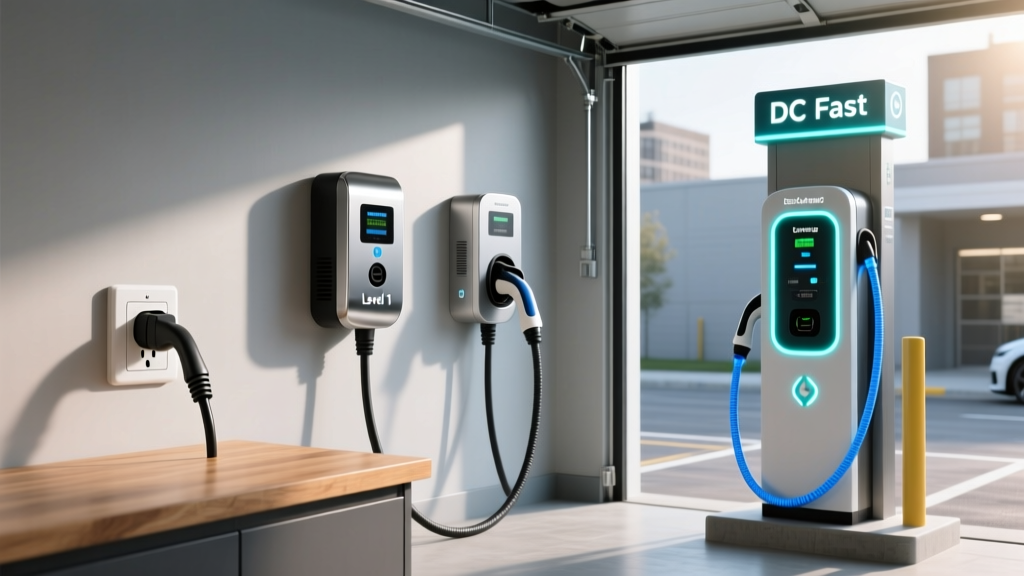
| Charging Level | Power (kW) | Voltage / Amperage | Miles of Range Added per Hour | 0-100% Time (Approx.) |
|---|---|---|---|---|
| Level 1 (Standard Outlet) | 1.2 - 1.4 kW | 120V / 12A | ~3-4 miles | 60+ hours |
| Level 2 (Home / Public AC) | 7.2 - 9.6 kW | 240V / 32-40A | ~22-30 miles | 9-11 hours |
| Level 2 (Optional 19.2 kW onboard) | Up to 19.2 kW | 240V / 80A | ~50-58 miles | ~5 hours |
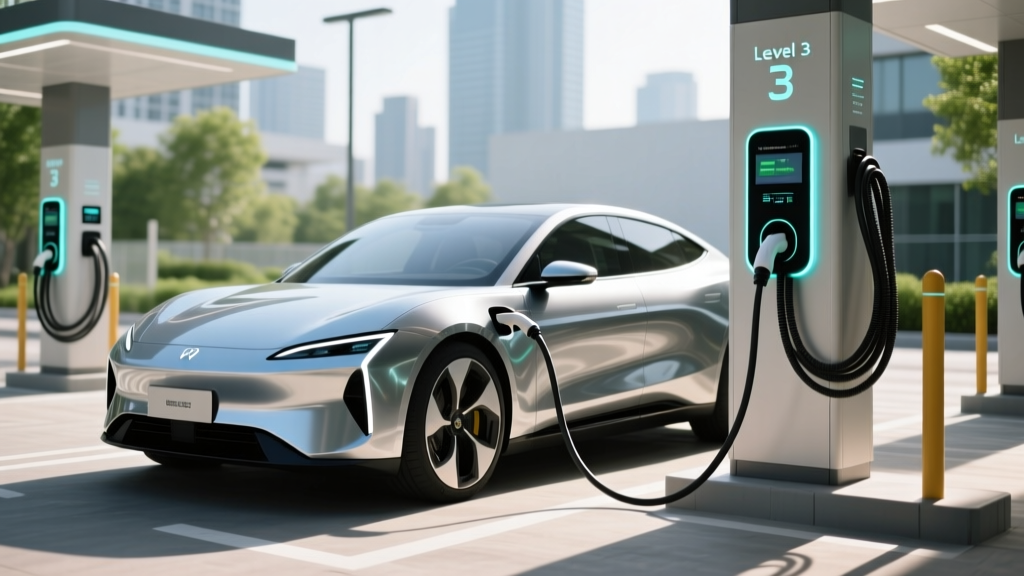
| DC Fast Charging (CCS1) | Up to 270 kW peak | 800V DC | ~180 miles in 10 min (peak) | 10-80% in ~23 min |
Important charging-curve reality: The e-tron GT's 270 kW peak charge rate is not sustained across the entire session. Thanks to its 800V architecture, it holds above 150 kW from roughly 10% to about 55% state of charge, then tapers progressively. From 80% to 100%, charging slows dramatically to protect the NMC cells. For daily use, charging to 80% is recommended for battery longevity; reserve 100% fills for road trips.
Home Charger Installation: Electrical Requirements and Costs
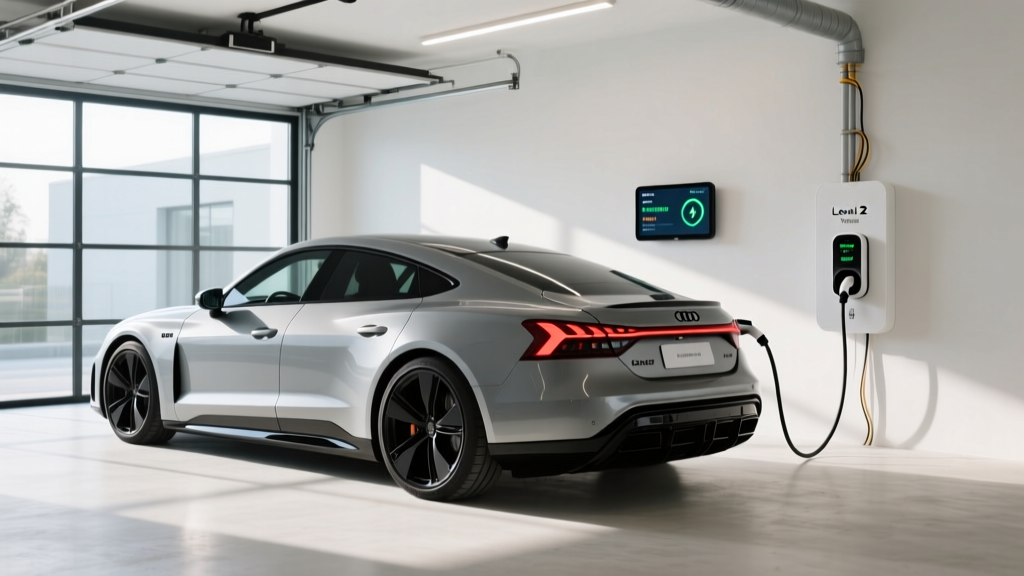
Most e-tron GT owners will install a Level 2 home charger on a dedicated 240-volt circuit. The standard onboard AC charger accepts up to 9.6 kW, which requires a 240V / 40A circuit (using a 50A breaker, since continuous loads must be derated to 80% of breaker capacity per NEC code). If your e-tron GT was optioned with the 19.2 kW onboard charger, you'll need a 240V / 80A circuit with a 100A breaker — a significantly more demanding electrical requirement.
What Electrical Upgrades Might You Need?
Before installing any Level 2 charger, a licensed electrician should evaluate your home's electrical panel. Here are common scenarios:
- Adequate panel capacity (200A service, spare breaker slots): The electrician runs a new 240V line from the panel to your garage or parking spot. This is the best-case scenario.
- Panel at or near capacity: If your home has a 100A or 150A panel with limited spare capacity, adding a 40A or 50A circuit may require a panel upgrade to 200A service. This is common in homes built before 2000 and adds $1,500-$3,000 to the project.
- Smart panel or load-management solution: Some homes can avoid a full panel upgrade by installing a smart load-management device (e.g., Span smart panel or a Load-Splitter device) that dynamically shares capacity between the EV charger and other household loads. Cost: $500-$1,500 additional.
- Detached garage or long conduit runs: If your parking spot is far from the electrical panel (100+ feet), wire costs increase significantly. Expect $5-$12 per linear foot for conduit and wire, potentially adding $500-$1,500.
Installation Cost Breakdown
| Component | Basic Install (Near Panel) | Complex Install (Far Run / Panel Upgrade) |
|---|---|---|
| Level 2 Charger Equipment (9.6 kW) | $400 - $750 | $400 - $750 |
| Electrician Labor | $300 - $800 | $800 - $2,500 |
| Materials (Wire, Conduit, Breaker) | $100 - $300 | $400 - $1,200 |
| Permit Fee | $50 - $200 | $50 - $200 |
| Panel Upgrade (if needed) | $0 | $1,500 - $3,000 |
| Total Estimated Cost | $850 - $2,050 | $3,150 - $7,650 |
Connector Compatibility: CCS1, NACS, and Adapter Realities
The 2022 Audi e-tron GT uses a CCS1 (Combined Charging System) connector for both AC Level 2 and DC fast charging in North America. This was the standard for virtually all non-Tesla EVs sold in the US through 2024.
However, the North American charging landscape has shifted significantly. Tesla opened its Supercharger network to non-Tesla vehicles via the NACS (North American Charging Standard) connector, and most major automakers — including Audi — have committed to adopting NACS on future models. For your 2022 e-tron GT, here's what this means:
| Connector Type | Native Compatibility | Adapter Required? | Network Access |
|---|---|---|---|
| CCS1 | Yes (native) | No | Electrify America, EVgo, ChargePoint DC, Ionity (EU) |
| NACS (Tesla) | No | Yes — CCS-to-NACS adapter | Tesla Supercharger (V3/V4 stalls with Magic Dock or adapter) |
| CHAdeMO | No | Not practical | Largely deprecated in the US |
| J1772 (AC Level 1/2) | Yes (CCS includes J1772) | No | All public Level 2 stations |
Adapter guidance: As of 2026, Audi offers an official CCS-to-NACS adapter for e-tron GT owners, and reputable third-party adapters (such as those from Lectron or A2Z) are also available in the $150-$250 range. With an adapter, you can access Tesla Supercharger V3 stalls (250 kW) and V4 stalls. Note that the e-tron GT's 800V architecture can accept up to 270 kW, so a 250 kW Supercharger will not bottleneck it significantly. However, some older Supercharger stalls are limited to 150 kW — check the station details in your EV's navigation or the Tesla app.
Recommended Level 2 Home Chargers for the e-tron GT
Since the standard 2022 e-tron GT onboard charger maxes out at 9.6 kW on AC, a 40A or 48A Level 2 charger is the sweet spot. Buying a higher-output charger (e.g., 80A) only makes sense if your car has the optional 19.2 kW onboard charger. Here are specific picks:
ChargePoint Home Flex
- Power: Up to 12 kW (50A), configurable down to 16A
- Connector: CCS1 (J1772+CCS combo)
- Cable Length: 23 feet
- Smart Features: Wi-Fi, app scheduling, Alexa integration, energy tracking
- Price: ~$549
- Best For: Flexible amperage for homes with limited panel capacity
Emporia Vue Level 2 Charger
- Power: Up to 11.5 kW (48A)
- Connector: CCS1 (J1772+CCS combo)
- Cable Length: 24 feet
- Smart Features: Wi-Fi, app control, solar integration, energy monitoring
- Price: ~$399
- Best For: Budget-conscious buyers with solar panels
Tesla Wall Connector (with CCS adapter)
- Power: Up to 11.5 kW (48A)
- Connector: NACS (requires CCS adapter for e-tron GT)
- Cable Length: 24 feet
- Smart Features: Wi-Fi, OTA updates, power sharing between units
- Price: ~$475 (charger) + ~$180 (adapter)
- Best For: Multi-EV households with both Tesla and CCS vehicles
Grizzl-E Smart
- Power: Up to 10 kW (40A)
- Connector: CCS1 (J1772+CCS combo)
- Cable Length: 24 feet
- Smart Features: OCPP-compatible, works with multiple apps
- Price: ~$449
- Best For: Outdoor installations (rated to -40°F, IP67)
Safety checklist for any home charger: Ensure the unit is UL-listed or ETL-certified. For outdoor installations, verify an IP65 or higher weather rating. Use a dedicated circuit — never share the EV charger circuit with other appliances. Hardwired installations are preferred over plug-in (NEMA 14-50) for reliability and to avoid the GFCI nuisance-tripping issues that some breakers exhibit with EV loads.
Cost to Charge: e-tron GT Per-Mile vs. Gas Equivalent
The e-tron GT consumes approximately 41 kWh per 100 miles (e-tron GT quattro). To calculate your cost per mile, you need your electricity rate in $/kWh. Here are common scenarios:
| Charging Scenario | Rate ($/kWh) | Cost per 100 Miles | Cost per Mile |
|---|---|---|---|
| Home (national avg residential) | $0.16 | $6.56 | $0.066 |
| Home (off-peak utility rate) | $0.09 | $3.69 | $0.037 |
| Home (high-cost state, e.g., CA) | $0.30 | $12.30 | $0.123 |
| Public Level 2 (e.g., ChargePoint) | $0.25 - $0.35 | $10.25 - $14.35 | $0.10 - $0.14 |
| DC Fast (Electrify America) | $0.40 - $0.56 | $16.40 - $22.96 | $0.16 - $0.23 |
Gas comparison: A comparable gas-powered luxury sport sedan — say, the Audi RS7 — averages about 17 MPG combined. At $3.60/gallon, that's $21.18 per 100 miles, or $0.21 per mile. Even at California's high residential electricity rates, the e-tron GT costs roughly half as much per mile to fuel as its gas equivalent when charging at home. The savings narrow when relying exclusively on DC fast charging, which is why home charging access is the single biggest factor in EV ownership economics.
Charging Time Examples: What to Expect
Here are real-world charging time estimates for the e-tron GT's ~85 kWh usable battery across common scenarios:
- Overnight home charge (Level 2, 9.6 kW, 20% to 100%): Approximately 7-8 hours. Plug in at 10 PM, wake up to a full battery by 6 AM. This is the ideal daily routine.
- DC fast charge road trip stop (270 kW, 10% to 80%): Approximately 22-23 minutes at a compatible Electrify America 350 kW stall. The e-tron GT's 800V architecture keeps charge rates high through the mid-range, making it one of the fastest-charging EVs available.
- DC fast charge at a 150 kW stall (10% to 80%): Approximately 35-40 minutes. The car can accept the full 150 kW through most of the curve, but obviously can't reach its 270 kW peak.
- Level 1 emergency top-up (1.4 kW, 10% to 30%): Approximately 12-14 hours for just 17 kWh (~40 miles of range). Level 1 is only practical as an emergency trickle, not a daily strategy for a car with this battery size.
Preconditioning tip: The e-tron GT will precondition its battery for faster DC charging when you navigate to a charging station using the built-in navigation system. This warms the battery to the optimal temperature for maximum charge acceptance. Without preconditioning — especially in cold weather — your initial charge rate may be significantly lower than the 270 kW peak. Always route through the car's nav when heading to a DC fast charger.
Frequently Asked Questions
How much does it cost to install a home EV charger for the e-tron GT?
A basic Level 2 installation near your electrical panel typically costs $850-$2,050 including equipment, labor, and permits. If your home needs a panel upgrade or a long wire run, costs can reach $3,150-$7,650. Always get at least two quotes from licensed electricians and verify they pull a permit.
Can I use a Tesla Supercharger with my 2022 e-tron GT?
Yes, with a CCS-to-NACS adapter ($150-$250). Audi and Tesla have expanded Supercharger access to CCS-equipped vehicles. You'll need the adapter and should verify the specific Supercharger stall supports non-Tesla vehicles via the Tesla app before driving there.
Is the 2022 e-tron GT eligible for the federal EV tax credit?
The e-tron GT was eligible for the §30D federal tax credit when purchased new, but current-year rules under IRS guidelines have strict battery-sourcing and critical-mineral requirements that may limit eligibility. For used e-tron GT purchases, the used clean vehicle credit (up to $4,000 or 30% of sale price, whichever is less) may apply if the vehicle is under $25,000 and you meet income caps ($75,000 single / $150,000 joint). Consult a tax professional for your specific situation.
Should I charge my e-tron GT to 100% every day?
No. NMC batteries like the one in the e-tron GT last longest when kept between 20% and 80% state of charge for daily use. Audi's MMI system lets you set a charge limit — use 80% for daily driving and reserve 100% for road trips. The battery warranty covers 8 years / 100,000 miles with a capacity retention threshold of 70%, per Audi USA.
What happens if my home only has a 100A electrical panel?
A 100A panel is often insufficient for a 40A EV charger circuit, especially if your home also uses electric heating, an electric oven, and an electric dryer. Your electrician will perform a load calculation. Options include upgrading to 200A service ($1,500-$3,000), installing a smart load-management device, or using a lower-amperage charger (e.g., 16A / 3.8 kW) that adds range more slowly but doesn't overload the panel.
How does cold weather affect charging speed?
In temperatures below freezing, a cold-soaked battery may initially accept DC fast charging at only 50-80 kW until it warms up. Using the e-tron GT's navigation to route to a charger triggers battery preconditioning, which mitigates this effect. Expect 10-80% charge times to increase by 5-10 minutes in winter conditions even with preconditioning.