Quick Verdict: The Audi A6 e-tron's Charging Profile
The 2025 Audi A6 e-tron (sold as the A6 Sportback e-tron and A6 Avant e-tron on the PPE platform) represents Audi's most capable charging architecture to date. With a peak DC fast-charge rate of 270 kW and an 800-volt electrical system, the A6 e-tron can recover from 10% to 80% state of charge in approximately 21 minutes under ideal conditions. But peak numbers don't tell the full story — sustained charging curves, home electrical readiness, and connector compatibility determine your actual ownership experience.
This guide breaks down every charging scenario A6 e-tron owners and prospective buyers need to plan for: home Level 2 installation, public DC fast charging, connector standards, and the real cost per mile compared to gasoline.
Understanding Charging Levels: What Speeds Actually Mean
Before installing equipment or planning road trips, the distinction between kW (kilowatts — the rate of power delivery) and kWh (kilowatt-hours — the total energy stored in your battery) must be clear. Think of kW as the width of a hose and kWh as the size of the bucket. Your A6 e-tron's battery holds approximately 100 kWh of energy; how fast you fill it depends on the kW rating of your charger.
| Level | Voltage | Max Power (kW) | Miles of Range Added per Hour | Typical Use Case |
|---|---|---|---|---|
| Level 1 | 120V AC | 1.0–1.4 kW | 3–5 mi/hr | Emergency/overnight trickle |
| Level 2 | 240V AC | 7.2–19.2 kW | 22–65 mi/hr | Home daily charging |
| DC Fast Charge | 400–800V DC | 50–350 kW | 150–650 mi/hr (peak) | Road trips, public stations |
The A6 e-tron's onboard charger accepts up to 11 kW on Level 2 AC power (three-phase in Europe; in the US, expect approximately 9.6 kW on a 40A single-phase circuit, or up to 11.5 kW on a 48A circuit). On DC fast chargers, the 800V architecture enables the 270 kW peak — but sustained rate matters more than peak.
The Charging Curve Reality
No EV sustains its peak charge rate for the entire session. The A6 e-tron will hold close to 270 kW from roughly 10% to 30% state of charge, then taper progressively. From 30–60%, expect approximately 180–220 kW. Above 80%, the rate drops sharply to protect battery health — often below 50 kW. This is why manufacturers quote 10–80% times rather than 0–100%: the final 20% can take as long as the first 70%.
Home Level 2 Installation: Requirements, Costs, and Gotchas
For daily driving, a home Level 2 charger is essential. The A6 e-tron's 100 kWh battery means Level 1 charging (adding ~4 miles per hour) would require over 25 hours for a full charge — impractical for anyone driving more than 30 miles daily.
Electrical Requirements
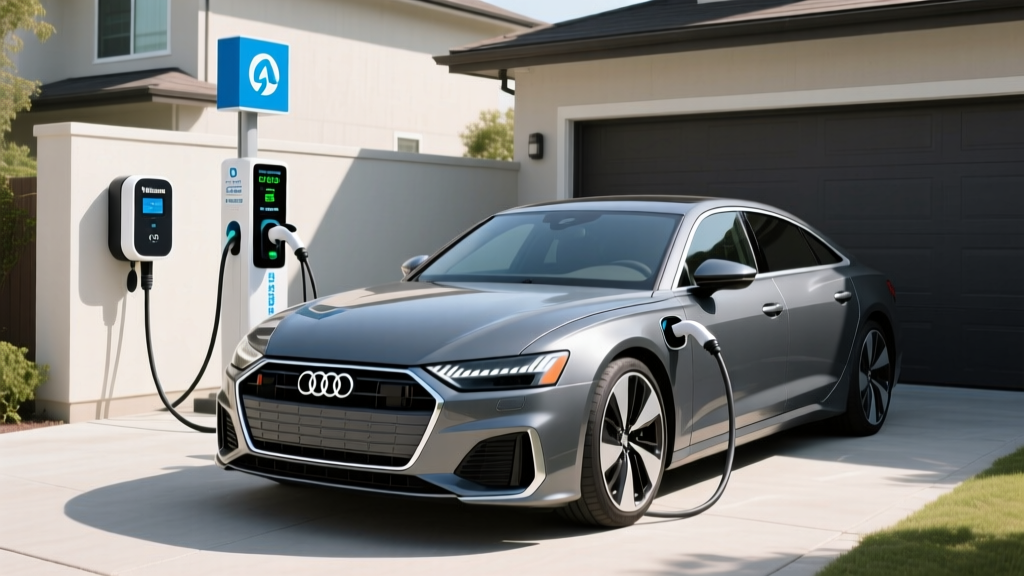
To maximize the A6 e-tron's 11.5 kW AC acceptance rate, you need a 240V circuit rated at 48 amps, which requires a 60A breaker (electrical code requires circuits to be loaded to no more than 80% of breaker capacity). A 40A circuit on a 50A breaker delivers 9.6 kW — still adequate for overnight replenishment of 200+ miles.
Panel Capacity and Upgrade Considerations
Most modern homes with 200A electrical service can accommodate a 48A EV circuit without a panel upgrade. However, older homes with 100A service, or homes already running multiple high-draw appliances (electric range, dryer, HVAC), may need a service panel upgrade to 200A or 400A. This is the single largest variable in installation cost.
Some jurisdictions now allow automated load management devices (such as the Emporia Smart Load Management system) that let you add an EV circuit without a panel upgrade by dynamically throttling charger draw when other appliances are active. Ask your electrician about this option.
| Component | Low Estimate | High Estimate | Notes |
|---|---|---|---|
| Level 2 Charger (hardware) | $400 | $750 | 48A smart charger |
| Electrician labor (standard install) | $500 | $1,500 | Run from panel to garage/carport |
| Electrical permit | $50 | $250 | Varies by municipality |
| Panel upgrade (if needed) | $1,500 | $4,000 | 100A → 200A service |
| Conduit/wiring (long runs) | $200 | $800 | If panel is far from charge point |
| Total (no panel upgrade) | $950 | $2,500 | Typical scenario |
| Total (with panel upgrade) | $2,450 | $6,550 | Older homes |
Safety and Code Requirements
Your installation must comply with NEC Article 625 (National Electrical Code for EV charging). Key requirements include:
- Dedicated circuit: The EV charger must have its own breaker — no shared circuits with other appliances.
- GFCI protection: Required for all outdoor receptacles and recommended (sometimes mandated) for indoor garage installations.
- NEMA 14-50 receptacle vs. hardwired: A hardwired charger avoids the GFCI breaker nuisance-trip issues that plague some NEMA 14-50 installations and allows full 48A draw. A 14-50 outlet limits you to 40A continuous (9.6 kW) but offers portability.
- Outdoor rating: If your charge point is exterior, the charger must carry a NEMA 4 or IP65 weather-resistance rating.
Connector Compatibility: NACS, CCS, and the Adapter Question
The Audi A6 e-tron launched in the US market with a CCS1 (Combined Charging System) connector for DC fast charging and a J1772 inlet for Level 2 AC. However, the industry-wide shift toward Tesla's NACS (North American Charging Standard) — now adopted by Ford, GM, Rivian, Volvo, BMW, and others — creates a compatibility landscape A6 e-tron buyers must navigate.
| Connector | Used By | A6 e-tron Compatible? | Adapter Needed? |
|---|---|---|---|
| CCS1 | Audi, VW, Hyundai, Kia, BMW (legacy) | Yes — native | No |
| NACS (Tesla) | Tesla, Ford, GM, Rivian, Volvo, BMW (2025+) | With adapter | Yes — CCS-to-NACS adapter (~$150–$250) |
| CHAdeMO | Nissan Leaf (legacy) | No | Not available; network is sunsetting |
| J1772 (AC only) | All EVs (Level 2) | Yes — native | No |
Practical recommendation: Purchase a CCS-to-NACS adapter (such as the Lectron or A2Z adapter rated for 250A DC) to access Tesla Supercharger V3 and V4 stalls. As of 2025–2026, Electrify America, EVgo, and ChargePoint still operate CCS-native stations, but Tesla's Supercharger network remains the most reliable public charging infrastructure in the US. An adapter ensures you're never stranded without options.
Public DC Fast Charging: Networks, Speeds, and Costs
On a road trip, the A6 e-tron's 270 kW peak rate means you should target 350 kW-capable chargers to maximize charging speed. Charging on a 150 kW stall will bottleneck the A6 e-tron — you'll still charge, but the 10–80% time stretches to approximately 35–40 minutes.
Charging Time Examples (A6 e-tron, ~100 kWh battery)
- 350 kW charger (ideal conditions): 10–80% in ~21 minutes
- 150 kW charger: 10–80% in ~38 minutes
- 50 kW CHAdeMO/CCS charger: 10–80% in ~90 minutes
- Home Level 2 at 11.5 kW: 10–80% in ~6 hours
- Level 1 at 1.2 kW: 10–80% in ~58 hours (emergency only)
Major networks and their typical pricing:
- Electrify America: $0.48–$0.64/kWh (varies by state and membership tier)
- EVgo: $0.43–$0.56/kWh (lower with EVgo Plus subscription)
- Tesla Supercharger (with adapter): $0.25–$0.40/kWh (varies by location and time of day)
- ChargePoint: $0.35–$0.55/kWh (set by individual site hosts)
Cost Per Mile: EV Charging vs. Gasoline
The A6 e-tron achieves an EPA-rated efficiency of approximately 3.0–3.3 kWh per mile (roughly 105–112 MPGe combined). Here's how that translates to real cost:
| Scenario | Cost per kWh | Cost per Mile | Annual Cost (12,000 mi) |
|---|---|---|---|
| Home charging (off-peak utility rate) | $0.12 | $0.038 | $456 |
| Home charging (average US rate) | $0.17 | $0.054 | $648 |
| Public DC fast (average) | $0.48 | $0.152 | $1,824 |
| Gasoline equivalent (30 MPG, $3.40/gal) | — | $0.113 | $1,356 |
| Gasoline equivalent (25 MPG, $3.40/gal) | — | $0.136 | $1,632 |
Home charging delivers dramatic savings — roughly $0.04–0.05 per mile versus $0.11–0.14 for a comparable gasoline sedan. However, exclusive reliance on public DC fast charging erases the cost advantage. This is why home Level 2 access is the single most important factor in EV economics.
Recommended Home Level 2 Chargers for the A6 e-tron
ChargePoint Home Flex
- Power output: Up to 12 kW (50A) — adjustable down to match your circuit
- Connector: J1772 (CCS-compatible for AC charging)
- Cable length: 23 feet
- Smart features: Wi-Fi, app scheduling, utility demand-response integration, Alexa
- Price: ~$550–$650
- Best for: Owners wanting utility integration and flexible amperage settings
Emporia Vue EV Charger
- Power output: Up to 11.5 kW (48A)
- Connector: J1772
- Cable length: 24 feet
- Smart features: Integrated energy monitoring, solar-aware charging, load management
- Price: ~$400–$500
- Best for: Budget-conscious buyers, solar-panel owners, panel-upgrade avoidance
Grizzl-E Smart
- Power output: Up to 10 kW (40A)
- Connector: J1772
- Cable length: 24 feet
- Smart features: OCPP protocol, app control, adjustable amperage
- Price: ~$450–$550
- Best for: Cold-climate durability (rated to -40°F), Canadian-built quality
Wallbox Pulsar Plus
- Power output: Up to 11.5 kW (48A)
- Connector: J1772
- Cable length: 25 feet
- Smart features: Wi-Fi + Bluetooth, Power Sharing (daisy-chain two units), compact form factor
- Price: ~$500–$600
- Best for: Two-EV households, tight garage spaces
All four chargers are ENERGY STAR certified and eligible for the federal Alternative Fuel Vehicle Refueling Property Credit (30% of hardware + installation cost, up to $1,000 for residential — see IRS guidelines for eligibility based on census-tract requirements).
Federal Incentives for Home Charger Installation
Under the current §30C Alternative Fuel Vehicle Refueling Property Credit, homeowners in eligible census tracts can claim 30% of the combined cost of charger hardware and installation, capped at $1,000. This credit applies to equipment placed in service during the current tax year. Eligibility depends on whether your home is located in a qualifying low-income or non-urban census tract — use the IRS eligibility tool or consult a tax professional to confirm.
Additionally, many utilities offer rebates of $250–$500 for installing a smart Level 2 charger, and some provide discounted time-of-use (TOU) electricity rates that further reduce per-mile charging costs.
Audi A6 e-tron Charging FAQ
How much does it cost to install a home EV charger for the A6 e-tron?
Expect $950–$2,500 for a standard installation with a 48A Level 2 charger if your electrical panel has sufficient capacity. If a panel upgrade from 100A to 200A is required, total cost rises to $2,450–$6,550. Always get at least two quotes from licensed electricians.
How fast will each charging level add range to the A6 e-tron?
Level 1 (120V): approximately 3–5 miles per hour. Level 2 (240V, 48A): approximately 35–38 miles per hour. DC fast charging at 270 kW peak: up to 200+ miles in 10 minutes during the initial phase of the charge curve.
Which connector does the A6 e-tron use?
The US-market A6 e-tron uses CCS1 for DC fast charging and J1772 for Level 2 AC. To access Tesla Superchargers, you'll need a CCS-to-NACS adapter ($150–$250). CHAdeMO is not compatible and is being phased out across the US.
How much does charging cost per mile vs. gas?
At home on average US electricity rates ($0.17/kWh), the A6 e-tron costs approximately $0.054 per mile. A comparable gasoline sedan at 28 MPG with gas at $3.40/gallon costs $0.121 per mile — more than double. Public DC fast charging at $0.48/kWh pushes the EV cost to $0.152/mile, exceeding gasoline.
What electrical upgrades might I need?
Homes with 200A service typically need no panel upgrade. Homes with 100A service, or those with significant existing electrical loads, may require a panel upgrade ($1,500–$4,000). Automated load management devices can sometimes avoid this cost by dynamically limiting charger draw.
Should I precondition the battery before DC fast charging?
Yes. The A6 e-tron's navigation system will automatically begin battery preconditioning when you route to a DC fast charger. Preconditioning warms the battery to optimal temperature, enabling the full 270 kW peak rate. Without it — especially in cold weather — your peak charge rate may be limited to 100–150 kW for the first several minutes.
Can I use a Tesla Supercharger with the A6 e-tron?
Yes, with a CCS-to-NACS adapter. Tesla has opened its Supercharger network to non-Tesla EVs with CCS connectors via adapter. Confirm your adapter is rated for the full amperage of Supercharger V3/V4 stalls (up to 615A for V4) to avoid charge-rate bottlenecks.