Are Tesla Chargers Free? The Quick Answer
No — Tesla Superchargers are not free for the vast majority of owners in 2026. The days of unlimited free Supercharging as a promotional perk are essentially over, limited to legacy Model S and Model X vehicles purchased before 2017 with transferable free-credit status. For every current-production Tesla (Model 3, Model Y, Cybertruck, refreshed Model S/X), you pay per kilowatt-hour (kWh) or per minute at Supercharger stations. Destination Chargers at hotels and businesses may be complimentary, but they deliver Level 2 speeds — not the DC fast charging you rely on for road trips.
This guide breaks down exactly what you will pay to charge a Tesla (or any EV using the North American Charging Standard connector) at home, at public Level 2 stations, and at DC fast chargers — with real $/kWh figures, cost-per-mile math, and the full picture on home charger installation.
Understanding Charging Levels: Speed, Power, and What They Cost
Before comparing costs, you need to understand the three charging tiers and how fast each adds range. Note the critical distinction: kW (kilowatts) measures power — how fast energy flows into your battery. kWh (kilowatt-hours) measures energy — the total capacity of your battery, like gallons in a fuel tank. You are billed in kWh, not kW.
| Level | Voltage | Power (kW) | Miles of Range Added Per Hour | Typical Use Case | 10–80% Time (75 kWh Battery) |
|---|---|---|---|---|---|
| Level 1 | 120V AC | 1.0–1.4 kW | 3–5 mi/hr | Overnight trickle, PHEVs, emergencies | ~52+ hours |
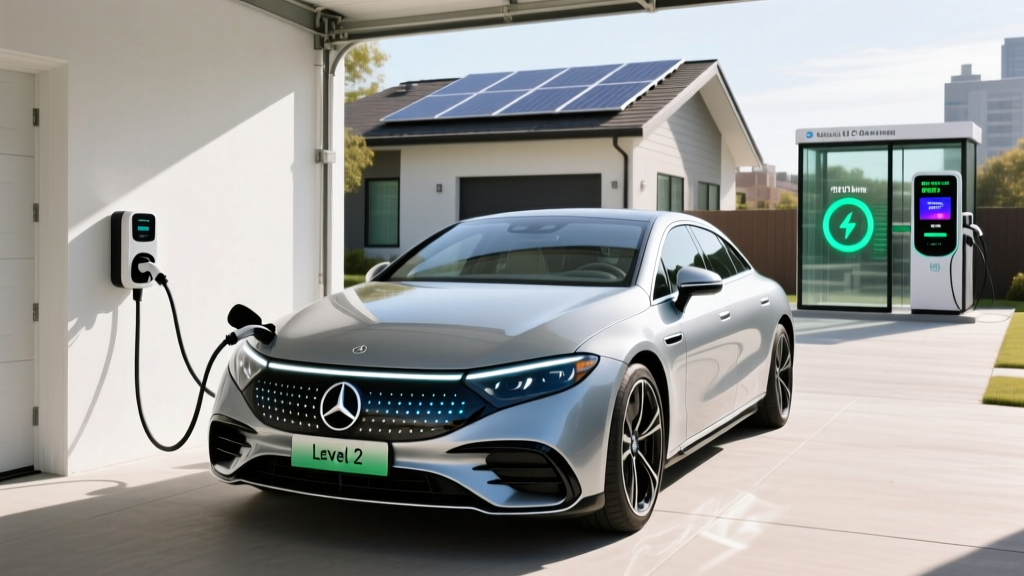
| Level 2 (Home/Public) | 240V AC | 7.2–19.2 kW | 25–75 mi/hr | Daily home charging, workplace, hotels | 3.5–7 hours |
| DC Fast Charging | 400V–800V DC | 50–350 kW | 150–1,000+ mi/hr (peak) | Road trips, highway corridors | 15–35 minutes |
A Tesla Model Y Long Range with a ~75 kWh usable battery charging on a 240V/48A Level 2 circuit (11.5 kW) will add roughly 44 miles of range per hour and reach a full charge overnight in about 7 hours. On a V3 Supercharger (peak 250 kW), that same battery can go from 10% to 80% in roughly 25–28 minutes, though the charge curve tapers significantly above 60% — you will not sustain 250 kW for the entire session.
Tesla Supercharger Pricing: What You Actually Pay in 2026
Tesla Supercharger rates vary by station, time of day, and region. As of early 2026, typical Supercharger pricing in the United States falls in these ranges:
- Off-peak hours: $0.25–$0.35 per kWh
- Peak hours: $0.35–$0.50 per kWh
- Idle fees: $0.50–$1.00 per minute if you remain plugged in after reaching your charge limit
Some urban Supercharger locations in California and the Northeast regularly hit $0.48–$0.52/kWh during peak afternoon hours. Tesla's in-app pricing shows the exact rate before you navigate to a station, and time-of-use pricing is now standard at most metropolitan locations.
For a Tesla Model 3 Long Range (EPA 341 miles, ~75 kWh usable battery), a 10–80% session adds about 52.5 kWh. At $0.35/kWh, that session costs roughly $18.38 for approximately 239 miles of range — about $0.077 per mile.
What About Free Tesla Charging?
Free Tesla Supercharging still exists in three narrow scenarios:
- Legacy vehicles: Model S and Model X purchased before January 2017 with transferable unlimited free Supercharging credits attached to the VIN.
- Promotional referrals: Tesla occasionally offers limited free Supercharging miles (typically 1,000–5,000 miles) through referral programs or end-of-quarter promotions.
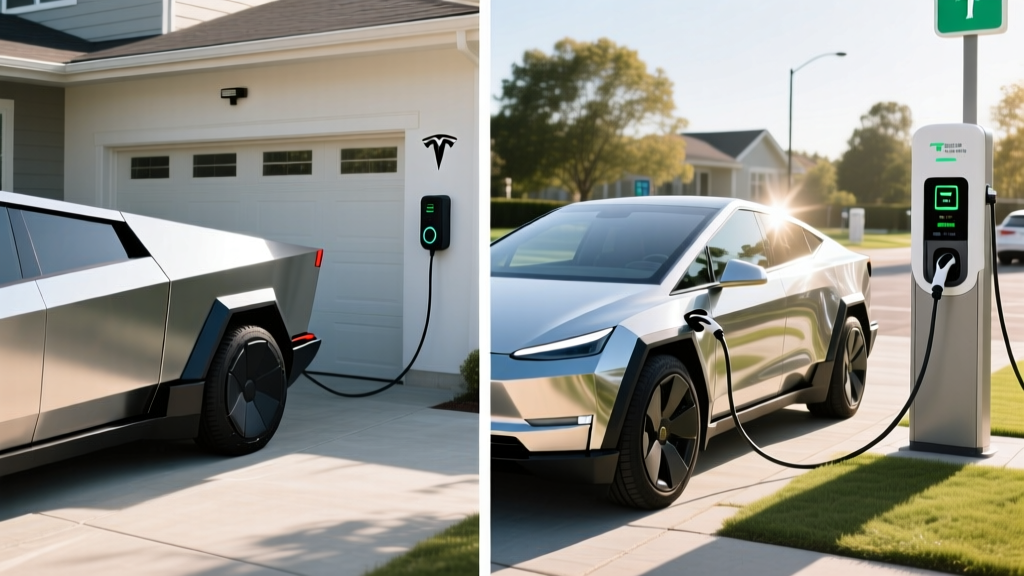
- Tesla Destination Chargers: Hotels, restaurants, and shopping centers with Tesla Wall Connectors often offer free Level 2 charging as a customer amenity — but at 11.5–22 kW, these add 44–75 miles per hour, not highway-ready fast charging.
For a new Tesla buyer in 2026, budget for paid Supercharging as your road-trip fuel cost.
Home Charging Installation: Electrical Requirements and Real Costs
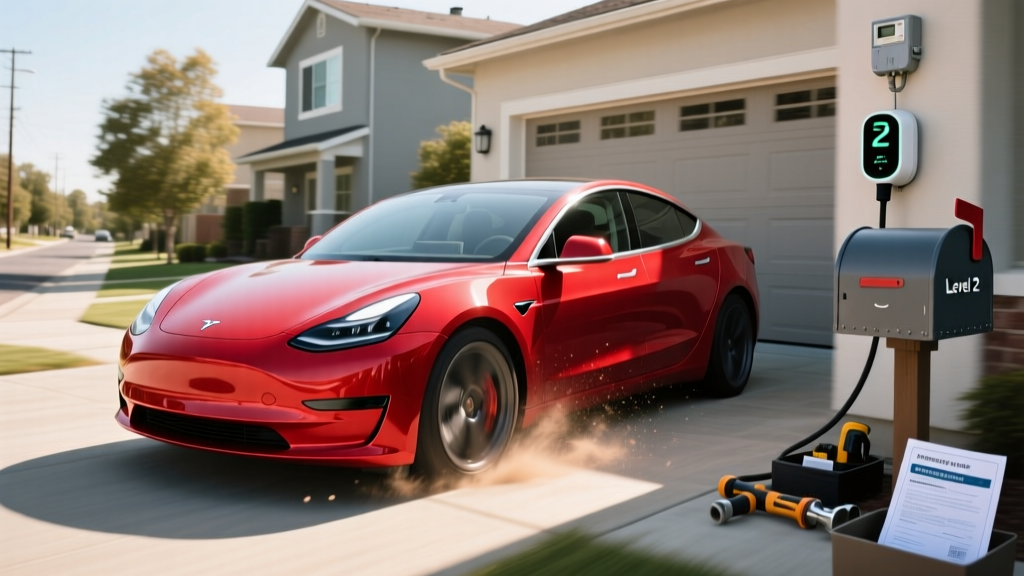
The most economical way to charge any EV — Tesla or otherwise — is at home on a Level 2 circuit. Here is what a proper installation requires and what it actually costs.
Electrical Requirements for Level 2 Home Charging
A standard Level 2 home charger operates on a 240V dedicated circuit, the same voltage as your electric dryer or oven. The most common configurations:
- 240V / 40A circuit (NEMA 14-50 outlet): Delivers up to 9.6 kW (32A continuous draw, per NEC 80% rule). Adds ~37 miles/hr to a Model Y.
- 240V / 48A circuit (hardwired): Delivers up to 11.5 kW. Adds ~44 miles/hr. This is the Tesla Wall Connector's maximum on a 60A breaker.
- 240V / 80A circuit (hardwired): Delivers up to 19.2 kW for high-amperage chargers. Requires a 100A breaker and heavier-gauge wire — overkill for most homes but useful if you have two EVs sharing a load-management system.
The National Electrical Code (NEC) requires that continuous loads (like EV charging, which runs 3+ hours) not exceed 80% of the circuit breaker rating. A 50A breaker supports 40A continuous; a 60A breaker supports 48A continuous.
⚡ Panel Upgrade Reality Check
If your home has a 100A main electrical panel — common in homes built before 1990 — adding a 40A or 60A EV circuit may exceed your panel's capacity, especially if you also run electric heat, a dryer, and an oven. A licensed electrician will perform a load calculation per NEC Article 220. If you need a panel upgrade to 200A, expect to add $1,500–$3,500 to your project. This is the single biggest surprise cost in EV home charging — get a load calc before buying equipment.
Home Charger Installation Cost Breakdown
| Component | Budget Install | Standard Install | Complex Install (Panel Upgrade) |
|---|---|---|---|
| Level 2 Charger (Equipment) | $300–$450 | $400–$600 | $400–$650 |
| Electrician Labor (2–6 hrs) | $300–$600 | $500–$1,200 | $800–$2,000 |
| Electrical Permit | $50–$100 | $75–$200 | $100–$300 |
| Panel Upgrade (if needed) | — | — | $1,500–$3,500 |
| Conduit, Wire, Misc. Materials | $50–$150 | $100–$400 | $200–$800 |
| Total Estimated Cost | $700–$1,300 | $1,075–$2,400 | $3,000–$7,250 |
Costs vary dramatically based on the distance from your panel to the charger location, whether conduit must run through finished walls or along an exterior, and local labor rates. A garage install with the panel on the same wall is the budget scenario. A charger on the far side of the house from a panel in the basement is the complex scenario.
The federal Alternative Fuel Vehicle Refueling Property Credit (IRS Form 8911) may cover up to 30% of home charging equipment and installation costs (capped at $1,000), subject to census-tract eligibility. Check irs.gov for current-year rules and whether your address qualifies.
Connector Compatibility: NACS, CCS, and Adapters
The connector landscape has shifted decisively toward the North American Charging Standard (NACS), which Tesla opened to other automakers in late 2022. As of 2026, Ford, GM, Rivian, Volvo, Polestar, Mercedes-Benz, and others have adopted NACS as their native charge port, with access to Tesla's Supercharger network.
| Connector | Native Brands | Adapter Required For | Network Access |
|---|---|---|---|
| NACS (Tesla) | Tesla, Ford, GM, Rivian, Volvo, Polestar, Mercedes, Honda (2026+) | CCS vehicles using NACS-to-CCS adapter ($150–$250) | Tesla Supercharger, Electrify America (select), ChargePoint |
| CCS1 | Hyundai, Kia, BMW, VW, Stellantis (legacy) | Tesla Supercharger access via CCS-to-NACS adapter | Electrify America, EVgo, ChargePoint, Ionity (EU) |
| CHAdeMO | Nissan Leaf (legacy only — no new 2026 models) | Limited adapter options; network shrinking | Declining; some EVgo stations |
If you own a non-Tesla EV with a CCS port, Tesla sells a CCS-to-NACS adapter (~$200) that grants access to Supercharger stalls. Conversely, Tesla owners traveling to non-Tesla DC fast chargers will find that most new Electrify America and EVgo stations now include NACS cables natively, reducing the need for adapters.
Cost to Charge Per Mile: EV vs Gas in 2026
The economics of EV charging depend heavily on where and when you charge. Here is a realistic comparison using a Tesla Model Y Long Range (EPA 320 miles, ~75 kWh usable, ~3.9 mi/kWh efficiency) versus a comparable gas SUV at 28 MPG combined.
| Charging/Fueling Scenario | Rate | Cost Per Mile | Annual Cost (12,000 mi) |
|---|---|---|---|
| Home Level 2 — Off-Peak Utility Rate | $0.10/kWh | $0.026 | $307 |
| Home Level 2 — Average US Residential | $0.17/kWh | $0.044 | $523 |
| Home Level 2 — High-Cost State (CA, HI) | $0.30/kWh | $0.077 | $923 |
| Tesla Supercharger (Off-Peak) | $0.30/kWh | $0.077 | $923 |
| Tesla Supercharger (Peak) | $0.48/kWh | $0.123 | $1,477 |
| Non-Tesla DC Fast (EA, EVgo) | $0.45/kWh | $0.115 | $1,385 |
| Gas SUV (28 MPG, $3.45/gal) | $3.45/gal | $0.123 | $1,479 |
The takeaway: home charging at off-peak utility rates is 75–80% cheaper per mile than gasoline. Even at peak Supercharger rates, a Tesla Model Y costs roughly the same per mile as a 28 MPG gas SUV. The savings advantage of EV ownership is overwhelmingly tied to access to affordable home or workplace Level 2 charging.
If your utility offers time-of-use (TOU) rates, scheduling charging between 11 PM and 6 AM can drop your effective rate to $0.06–$0.12/kWh — making the cost per mile under $0.03. Check with your utility provider for EV-specific rate plans; many now offer them.
Recommended Home Level 2 Chargers for 2026
These chargers represent the best options across price, reliability, and feature sets based on sustained real-world use. All support NACS natively or via included adapter.
Tesla Wall Connector (Gen 4)
- Power Output: Up to 11.5 kW (48A on 60A breaker) / 240V
- Connector: NACS native
- Cable Length: 24 ft
- Smart Features: Wi-Fi, OTA updates, Power Sharing (daisy-chain two units on one circuit), scheduled charging, energy tracking via Tesla app
- Price: ~$475
- Best For: Tesla owners who want seamless integration, load sharing for two-EV garages
ChargePoint Home Flex (2nd Gen)
- Power Output: Up to 12 kW (50A adjustable, 80A breaker) / 240V
- Connector: NACS native (2025+ models); J1772 for older stock
- Cable Length: 23 ft
- Smart Features: Wi-Fi, Alexa/Google Home integration, amperage adjustment in app (set to match your circuit), detailed session history, utility demand-response compatible
- Price: ~$550–$650
- Best For: Multi-EV households, non-Tesla EVs, renters who may move the unit
Emporia Level 2 EV Charger
- Power Output: Up to 11.5 kW (48A) / 240V
- Connector: NACS or J1772 (select at purchase)
- Cable Length: 24 ft
- Smart Features: Wi-Fi, integration with Emporia Vue energy monitor, solar-aware charging (charge only when solar produces excess), scheduling
- Price: ~$350–$400
- Best For: Budget-conscious buyers, homes with solar panels, energy-monitoring enthusiasts
Grizzl-E Smart (United Chargers)
- Power Output: Up to 10 kW (40A) / 240V
- Connector: NACS or J1772
- Cable Length: 24 ft
- Smart Features: OCPP-compatible, works with multiple apps, adjustable amperage
- Price: ~$450
- Best For: Extreme cold climates (rated to -40°F), outdoor installs, ruggedness priority
Safety, Code, and Permit Requirements
EV charging is a high-draw, continuous electrical load. Cutting corners here creates fire risk and insurance liability. Here is what proper installation requires:
- Dedicated circuit: Your Level 2 charger must have its own breaker — no sharing with other appliances.
- GFCI protection: The 2020 NEC (and all subsequent editions adopted by most states by 2026) requires GFCI protection for all 240V EV charging outlets. Hardwired installations may use a GFCI breaker or rely on the charger's built-in ground-fault protection (confirm with your electrician and AHJ).
- Outdoor rating: If your charger is installed outside (driveway, carport), the unit must carry a NEMA 4 or IP56+ weather rating. All four chargers listed above meet this standard.
- Permit and inspection: Virtually every jurisdiction in the US requires an electrical permit for a new 240V circuit. The permit fee typically runs $50–$200, and a city/county inspector will verify the work. Skipping the permit can void your homeowner's insurance coverage for electrical fires.
- Wire gauge: 6 AWG copper for 40A circuits; 4 AWG copper for 48A circuits. Your electrician will size wire based on run length and ambient temperature per NEC Table 310.16.
Hire a licensed electrician — not a handyman — for this work. Look for installers certified through programs like the Electrical Training Alliance or your utility's approved contractor list. Many utilities offer rebates of $200–$500 for permitted Level 2 installations using approved equipment.
Frequently Asked Questions
How much does it cost to install a home EV charger?
A standard Level 2 home charger installation costs $1,075–$2,400 for most homes with a 200A panel and a garage location. If your home needs a panel upgrade from 100A to 200A, total costs can reach $3,000–$7,250. The equipment itself runs $350–$650; the rest is labor, wire, conduit, and permits.
How fast will each charging level add range?
Level 1 (120V) adds 3–5 miles per hour — fine for plug-in hybrids with small batteries. Level 2 (240V) adds 25–75 miles per hour depending on amperage and your vehicle's onboard charger. DC fast charging adds 150–1,000+ miles per hour at peak, though the charge curve tapers above 60–80% state of charge, so real-world sessions are 15–35 minutes for a 10–80% fill.
Which connector and charger is compatible with my EV?
If you drive a 2025+ Tesla, Ford, GM, Rivian, Volvo, or Polestar, your vehicle uses NACS natively and can use Tesla Superchargers directly. If you drive a Hyundai, Kia, BMW, or VW with CCS1, you need a CCS-to-NACS adapter (~$200) for Supercharger access. CHAdeMO (Nissan Leaf) is a legacy standard with shrinking infrastructure. For home charging, match the charger's connector to your vehicle's port — or use an adapter.
How much does charging cost per mile compared to gas?
Home charging at average US residential rates ($0.17/kWh) costs about $0.044 per mile in a Tesla Model Y — roughly one-third the cost of a 28 MPG gas SUV at $3.45/gallon ($0.123/mile). Even at peak Supercharger rates ($0.48/kWh), EV charging costs about the same per mile as gasoline. The savings come from home and workplace charging, not public fast charging.
What electrical upgrades might I need?
The most common upgrade is a panel capacity increase from 100A to 200A, needed in older homes that lack headroom for a 40–60A continuous EV load on top of existing appliances. A licensed electrician performs a load calculation per NEC Article 220. Other potential upgrades include adding a sub-panel closer to the garage, upgrading service from the utility (rare but possible in very old homes), or installing a smart load-management device (like the Emporia Smart Load Center) that dynamically reduces charger amperage when other appliances draw power — avoiding a panel upgrade entirely in some cases.
Are Tesla Destination Chargers free?
Often yes — but not always. Tesla Destination Chargers at hotels, restaurants, and retail locations are typically offered as a complimentary amenity for customers. However, some venues have begun implementing paid charging or time limits. Always check the listing in your Tesla's navigation or the Tesla app, which shows whether a Destination Charger is free or metered before you arrive. These are Level 2 chargers (7.2–22 kW), so plan for multi-hour stays, not quick top-ups.