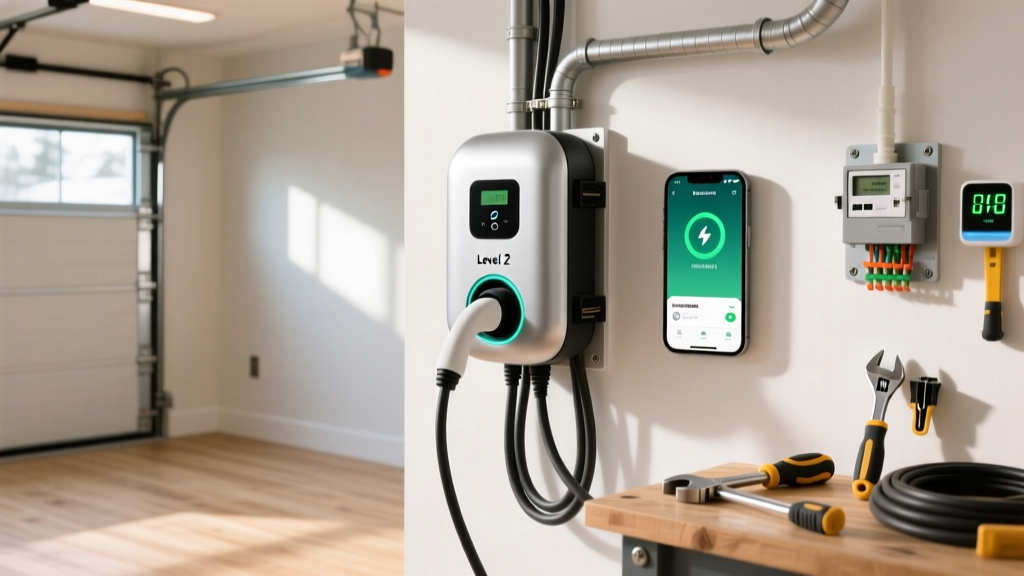
If you've driven past a shopping center with EV chargers and noticed a "Free Charging" sign, you're not alone in wondering: are EV charging stations free? The short answer is sometimes — but increasingly rarely. While a handful of workplaces, hotels, and retail locations still offer complimentary electrons, the vast majority of public charging in 2026 operates on a pay-per-kWh or pay-per-minute model, and home charging carries its own upfront equipment and installation costs.
This guide walks through every layer of what charging actually costs — from the free Level 1 cord in your trunk to $0.48/kWh DC fast-charging stalls on the interstate — and helps you calculate what you'll really spend per mile compared to a gas car.
Where You Can Still Find Free EV Charging (and Where You Can't)
Free charging hasn't disappeared entirely. You'll still find it in specific niches:
- Workplace chargers: Many employers offer free Level 2 (typically 7–19 kW) charging as an employee perk, though some have moved to subsidized rates ($0.05–$0.10/kWh) to manage demand.
- Hotels and resorts: Destination chargers at hotels often remain free for overnight guests — a strong incentive for EV-driving travelers.
- Retail and grocery stores: A shrinking number of stores (Costco, some Target locations) still offer limited free sessions, usually capped at 1–2 hours on Level 2.
- Municipal chargers: A few cities subsidize public Level 2 stations, though many have transitioned to paid models as EV adoption grows.
For DC fast charging along highways — the stations you rely on for road trips — free access is virtually nonexistent in 2026. Networks like Electrify America, EVgo, and Tesla Superchargers charge between $0.25 and $0.55 per kWh depending on location, time of day, and whether you hold a membership. Tesla's Supercharger network averages around $0.30–$0.35/kWh nationally, while Electrify America's standard rate sits near $0.43–$0.48/kWh for non-members.
Charging Levels Explained: Speed, Power, and Range Added Per Hour
Before calculating cost, you need to understand the three charging levels and how much range each delivers. Note: kW (kilowatts) measures the rate of power delivery — like water pressure from a hose — while kWh (kilowatt-hours) measures total energy delivered, like gallons in a bucket. Your battery capacity is measured in kWh; charger output is measured in kW.
| Level | Voltage | Power (kW) | Miles of Range Added Per Hour | Typical Use Case |
|---|---|---|---|---|
| Level 1 | 120V AC | 1.2–1.9 kW | 3–5 miles | Overnight trickle; emergency top-ups |
| Level 2 | 240V AC | 7.2–19.2 kW | 20–60 miles | Daily home charging; workplace; destinations |
| DC Fast Charge | 400–800V DC | 50–350 kW | 150–1,000+ miles (per hour equivalent) | Road trips; highway corridors; rapid top-ups |
Real-world context matters here. A Level 2 home charger delivering 11.5 kW (48A on a 60A circuit) will fully recharge a 75 kWh battery (like a Tesla Model Y Long Range) from 10% to 80% in roughly 4.5–5 hours — perfect for overnight charging. A 350 kW DC fast charger can push that same battery from 10% to 80% in approximately 18–25 minutes, though sustained peak power tapers significantly above 80% state of charge to protect battery health.
Home EV Charger Installation: Electrical Requirements and Real Costs
The single biggest cost variable in home charging isn't electricity — it's installation. Here's what you're working with for a typical Level 2 setup:
Electrical Requirements
A standard home Level 2 charger requires a 240-volt dedicated circuit, the same voltage as an electric dryer or oven. Most EV owners install a 40-amp or 48-amp charger, which requires a 50-amp or 60-amp circuit respectively (the National Electrical Code requires circuits rated at 125% of continuous load).
Key considerations:
- Panel capacity: Your main electrical panel must have enough spare capacity (amperage) and physical breaker slots. A 200-amp panel with open slots is usually sufficient. Older homes with 100-amp panels often need a panel upgrade to 200 amps, which adds $1,500–$3,500 to the project.
- Dedicated circuit: The charger must be on its own breaker — no sharing with other appliances.
- GFCI protection: NEC 2020 and later requires GFCI (Ground Fault Circuit Interrupter) protection for EV charging outlets, adding $30–$80 in breaker cost.
- Outdoor rating: If your charger is outdoors, the unit and outlet must carry a NEMA 4 or NEMA 4X weatherproof rating.
- Permit: Nearly all jurisdictions require an electrical permit ($50–$200) and a post-installation inspection.
Installation Cost Breakdown
| Component | Low End | High End | Notes |
|---|---|---|---|
| Level 2 Charger (Equipment) | $300 | $750 | 40A–48A hardwired or NEMA 14-50 plug |
| Electrician Labor | $400 | $1,800 | Depends on run length, wall type, conduit |
| Electrical Permit | $50 | $200 | Varies by municipality |
| Panel Upgrade (if needed) | $1,500 | $3,500 | 100A → 200A; not always required |
| Total (no panel upgrade) | $750 | $2,750 | Most homes with 200A panel |
| Total (with panel upgrade) | $2,250 | $6,250 | Older homes with 100A service |
Always hire a licensed electrician and pull a permit — unpermitted EV charger installs can void home insurance and create fire risk. If your utility offers a time-of-use (TOU) rate plan, the electrician can also install a smart panel or load-management device to coordinate charging with off-peak hours.
For more detail on electrical code requirements, consult the National Fire Protection Association's NEC guidelines.
Connector Compatibility: NACS, CCS1, and CHAdeMO in 2026
The connector landscape has consolidated significantly. Tesla's North American Charging Standard (NACS) has been adopted by nearly every major automaker starting with 2025 model-year vehicles. Here's where things stand:
| Connector | Brands Using It (2026 Models) | Notes |
|---|---|---|
| NACS (Tesla) | Tesla, Ford, GM, Rivian, Hyundai, Kia, BMW, Mercedes, Volvo, Polestar, Nissan, Subaru, Lucid, Fisker | Now the dominant standard; accesses Tesla Supercharger network |
| CCS1 (Combo) | VW (some carryover), Stellantis/Jeep (some models), older models from transitioned brands | Legacy standard; adapters available for NACS vehicles |
| CHAdeMO | Nissan Leaf (discontinued), Mitsubishi Outlander PHEV (older) | Effectively deprecated in the US; very few new stations |
Adapter reality: If you own a CCS1-equipped EV from 2023 or earlier (say, a Hyundai Ioniq 5 from 2023), you can purchase a CCS-to-NACS adapter (~$200–$250) to access Tesla Superchargers. Tesla sells an official adapter, and third-party options from brands like Lectron are also available. Conversely, NACS-native vehicles can use a NACS-to-CCS adapter at Electrify America or EVgo stations that still have CCS connectors.
For home Level 2 charging, all vehicles use the J1772 connector (or a J1772-to-NACS adapter for Tesla/NACS vehicles). Every Level 2 home charger sold in the US includes a J1772 plug or a native NACS plug with an adapter in the box.
How Much Does EV Charging Really Cost? Per-kWh and Per-Mile Breakdown
This is the question that determines whether an EV actually saves you money. The answer depends heavily on where and when you charge.
| Scenario | Rate ($/kWh) | Vehicle Efficiency (kWh/mi) | Cost Per Mile |
|---|---|---|---|
| Home, off-peak utility rate | $0.08–$0.14 | 0.28 (e.g., Tesla Model Y) | $0.022–$0.039 |
| Home, standard residential rate | $0.14–$0.20 | 0.28 | $0.039–$0.056 |
| Home, high-cost state (CA, HI, MA) | $0.25–$0.40 | 0.28 | $0.070–$0.112 |
| Public Level 2 (parking garage, retail) | $0.20–$0.35 | 0.28 | $0.056–$0.098 |
| DC Fast Charge ( Electrify America, non-member) | $0.43–$0.55 | 0.28 | $0.120–$0.154 |
| Tesla Supercharger (average) | $0.30–$0.38 | 0.28 | $0.084–$0.106 |
Cost Per Mile vs. Gas
For comparison, a gas car averaging 28 MPG at $3.40/gallon costs approximately $0.121 per mile. A fuel-thirsty truck at 18 MPG costs $0.189 per mile.
The takeaway: home charging is dramatically cheaper than gas — typically 60–80% less per mile on off-peak rates. DC fast charging on road trips approaches or slightly exceeds gas-car fuel costs, but since most EV owners do 85–95% of their charging at home, the blended annual cost strongly favors electric.
According to the U.S. Department of Energy's fueleconomy.gov, the national average electricity rate for EV charging translates to an equivalent gasoline price of roughly $1.20–$1.50 per gallon for efficient EVs — though your local rate will vary.
Charging Time Examples: How Long Does a Real Charge Take?
Charge times depend on battery size, charger power, and the vehicle's charge curve (the rate at which it can accept power at different states of charge). Here are real-world estimates for common battery sizes:
60 kWh Battery (e.g., Chevrolet Equinox EV, base Tesla Model 3 RWD)
- Level 1 (1.4 kW): 0–100% in ~43 hours
- Level 2 (11.5 kW): 10–80% in ~3.5 hours
- DC Fast (150 kW peak): 10–80% in ~22 minutes
82 kWh Battery (e.g., Ford Mustang Mach-E Extended Range, VW ID.4 Pro S)
- Level 1 (1.4 kW): 0–100% in ~59 hours
- Level 2 (11.5 kW): 10–80% in ~5 hours
- DC Fast (170 kW peak): 10–80% in ~28 minutes
100 kWh Battery (e.g., GMC Sierra EV, Lucid Air Grand Touring)
- Level 1 (1.4 kW): 0–100% in ~71 hours
- Level 2 (11.5 kW): 10–80% in ~6 hours
- DC Fast (350 kW peak, 800V architecture): 10–80% in ~18–22 minutes
Charge curve reality check: Peak kW ratings are just that — peak. No vehicle sustains maximum charge rate from 10% to 80%. Most EVs hit peak power between 10–30% state of charge, then taper progressively. A vehicle advertising "250 kW peak" may average only 130–160 kW across a full 10–80% session. This is why 10–80% time is the more honest metric than peak kW.
Recommended Home EV Chargers for 2026
After testing and tracking reliability data across dozens of Level 2 units, these are the chargers we recommend for most EV owners:
ChargePoint Home Flex
- Power Output: Up to 12 kW (50A) — configurable down to 16A for lower-capacity panels
- Connector: J1772 (NACS adapter included or available)
- Cable Length: 23 feet
- Smart Features: Wi-Fi connected, Alexa/Google Home integration, scheduling, energy tracking via app
- Price: ~$550–$650
- Best For: Most homeowners; flexible amperage accommodates older panels
Wallbox Pulsar Plus
- Power Output: Up to 11.5 kW (48A)
- Connector: J1772 (NACS version available for 2025+ models)
- Cable Length: 25 feet
- Smart Features: Wi-Fi + Bluetooth, load balancing (share circuit with other appliances), Power Sharing for dual-charger setups
- Price: ~$450–$550
- Best For: Tight budgets; dual-EV households; panels near capacity
Tesla Wall Connector
- Power Output: Up to 11.5 kW (48A)
- Connector: Native NACS (J1772 adapter available separately, ~$100)
- Cable Length: 24 feet
- Smart Features: Wi-Fi, over-the-air updates, power sharing with other Wall Connectors, Tesla app integration
- Price: ~$475
- Best For: Tesla and NACS-vehicle owners who want native plug compatibility
Emporia Vue EV Charger
- Power Output: Up to 11.5 kW (48A)
- Connector: J1772
- Cable Length: 24 feet
- Smart Features: Deep energy monitoring (pairs with Emporia Vue home energy monitor), solar integration, TOU scheduling
- Price: ~$400–$500
- Best For: Solar-panel owners; data-driven households wanting whole-home energy visibility
All four units are UL-listed (critical for safety and insurance), support both hardwired and NEMA 14-50 plug installation, and carry at least a 3-year warranty. Hardwired installation is generally preferred for outdoor mounts — it eliminates the outlet as a potential failure point and may not require GFCI at the breaker (the charger has internal ground-fault protection).
Safety, Code, and Smart Charging Tips
Beyond the permit and inspection, keep these safety and efficiency practices in mind:
- Never use an extension cord with a Level 2 charger. If the cable doesn't reach, move the charger or have an electrician install a closer outlet.
- Check your utility's TOU rates. Many utilities offer off-peak plans where electricity drops to $0.06–$0.10/kWh between 10 PM and 6 AM. Scheduling your charger to run during these hours can cut your charging cost in half.
- Precondition your battery before DC fast charging. Most EVs do this automatically when you navigate to a charger, warming the battery to optimal temperature for faster charge acceptance — especially critical in cold weather where charge speeds can drop 30–50%.
- Don't routinely charge to 100%. For NMC chemistry batteries (most EVs), keeping daily charge between 20–80% extends long-term battery health. LFP batteries (Tesla Model 3 RWD, some BYD models) tolerate and even benefit from regular 100% charges.
- Monitor your State of Health (SoH). Most EVs display battery degradation in the settings menu. Federal warranty mandates require manufacturers to cover batteries that drop below 70% capacity within 8 years or 100,000 miles — check your specific vehicle warranty documentation.
Frequently Asked Questions
Are EV charging stations free at Walmart or Target?
Most Walmart and Target EV chargers are now operated by third-party networks (Electrify America at Walmart, ChargePoint or EVgo at Target) and charge standard pay-per-kWh rates. A small number of locations still offer limited free Level 2 sessions, but these are shrinking as networks monetize growing demand. Always check the charger's screen or network app before plugging in.
How much does it cost to install a home EV charger?
Expect to pay $750–$2,750 for a standard Level 2 installation in a home with a 200-amp panel. If your home has an older 100-amp panel that needs upgrading, total costs can reach $2,250–$6,250. This includes the charger unit ($300–$750), electrician labor ($400–$1,800), and permit ($50–$200).
How fast will each charging level add range?
Level 1 (120V) adds 3–5 miles per hour. Level 2 (240V) adds 20–60 miles per hour depending on amperage. DC fast charging adds the equivalent of 150–1,000+ miles per hour, though you'll typically charge for 15–30 minutes rather than a full hour.
Which connector or charger is compatible with my EV?
For 2025 and newer models from Tesla, Ford, GM, Hyundai, Kia, BMW, Rivian, and most others, your vehicle uses the NACS connector. Older EVs (pre-2025, non-Tesla) likely use CCS1. All home Level 2 chargers use a J1772 plug, which connects directly to CCS vehicles or via a small adapter to NACS vehicles. CHAdeMO is effectively discontinued for new vehicles.
How much does charging cost per mile vs gas?
Home charging on off-peak rates costs approximately $0.025–$0.04 per mile for an efficient EV. Public DC fast charging costs $0.10–$0.15 per mile. A comparable gas car at 28 MPG and $3.40/gallon costs about $0.12 per mile. Most EV owners save 50–75% on fuel costs annually by charging primarily at home.
What electrical upgrades might I need for a home charger?
The most common upgrade is a panel replacement from 100 amps to 200 amps ($1,500–$3,500). You may also need a new dedicated 50A or 60A breaker, conduit runs from the panel to the garage or exterior wall, and a GFCI breaker if using a plug-in (NEMA 14-50) installation. Your electrician will assess panel capacity during a site visit — most offer this evaluation for free or a small trip charge.
The bottom line: free EV charging still exists in pockets, but building a reliable, low-cost charging strategy means investing in a home Level 2 setup and taking advantage of off-peak utility rates. The upfront installation cost pays for itself within 1–3 years for most drivers through fuel savings alone.