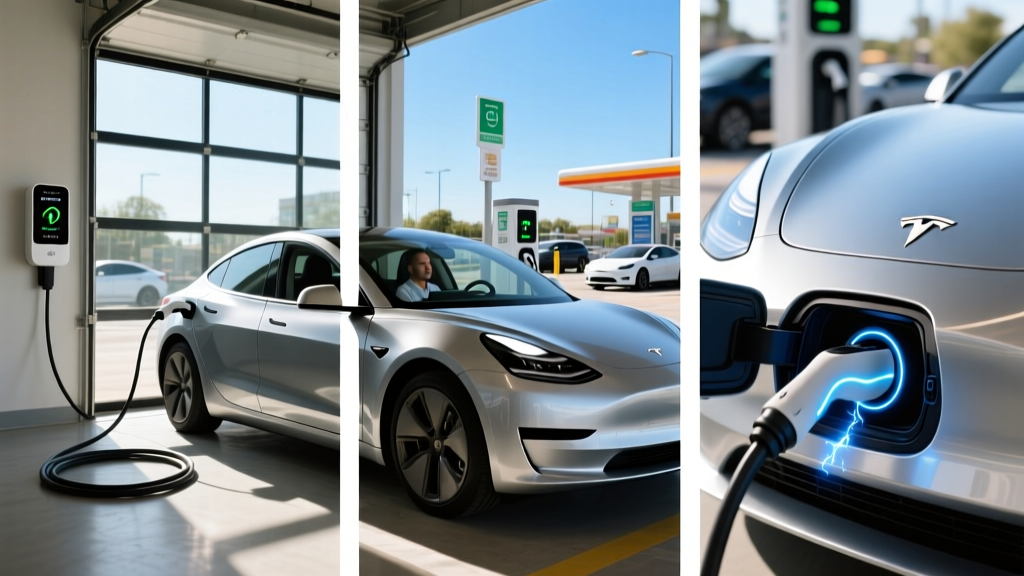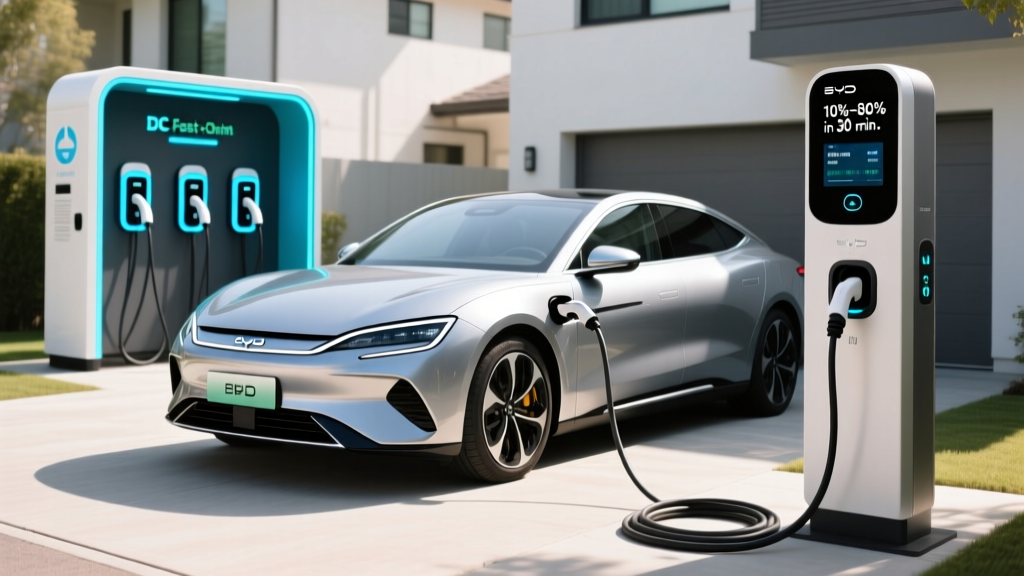
If you've pulled into a shopping center and spotted an EV charger with no price on the screen, you've probably asked: are electric charging stations free? The short answer is no — most public chargers in 2026 require payment, though a shrinking number of complimentary stations still exist at workplaces, dealerships, and promotional locations. The longer answer is that "free" depends entirely on where you plug in, how fast you need electrons, and whether your utility offers off-peak rates that make home charging nearly invisible on your monthly bill.
This guide breaks down every charging scenario an EV owner actually faces — from the 120-volt outlet in your garage to a 350 kW DC fast charger on a road trip — with exact costs, speeds, equipment picks, and the electrical work your home might need.
Are Public Electric Charging Stations Ever Free?
Yes, but the pool is getting smaller. In 2026, free public charging mostly shows up in three places:
- Workplace chargers subsidized by employers as an employee perk (Level 2, typically 7–19 kW).
- Dealer and brand loyalty networks — for example, Volkswagen's Electrify America complimentary period for new ID.4 buyers has historically offered 2–3 years of free DC fast charging, though terms vary by model year.
- Destination chargers at hotels, malls, and municipal lots that absorb electricity costs to attract foot traffic.
Outside those niches, expect to pay. Public networks like Electrify America, EVgo, and ChargePoint price by the kWh (the unit of energy your battery stores) or, in states where per-kWh billing is restricted, by the minute. Typical public Level 2 rates in 2026 run $0.20–$0.49/kWh, while DC fast charging averages $0.35–$0.65/kWh — and can spike above $0.75/kWh at highway travel plazas during peak demand.
The cheapest "public" charging is almost always the charging you do at home on a utility off-peak plan, where rates can dip to $0.06–$0.12/kWh overnight.
Charging Levels Explained: Speed, Cost, and Range Added
Before comparing costs, you need the three charging levels straight. EV charging is measured in kW (kilowatts — the rate of power delivery), while your battery stores energy in kWh (kilowatt-hours). Think of kW as the width of the hose and kWh as the size of the bucket.
| Level | Voltage | Power (kW) | Miles of Range per Hour | Typical Use Case |
|---|---|---|---|---|
| Level 1 | 120V AC | 1.0–1.9 kW | 3–5 mi/hr | Overnight top-off, PHEVs, low-mileage drivers |
| Level 2 | 240V AC | 7.2–19.2 kW | 25–75 mi/hr | Home daily charging, workplaces, destinations |
| DC Fast | 400–900V DC | 50–350 kW | 180–1,200+ mi/hr (peak) | Road trips, rapid top-ups, fleet depots |
Real-world charging time examples (10–80% State of Charge, which is the practical fast-charging window to protect battery health):
- Tesla Model Y (75 kWh usable, NMC): ~25 min on a 250 kW V3 Supercharger; ~8 hr on an 11.5 kW home Level 2.
- Hyundai Ioniq 5 (77.4 kWh usable, NMC, 800V architecture): ~18 min on a 350 kW Electrify America stall; ~7 hr on an 11 kW home Level 2.
- Ford F-150 Lightning Extended Range (131 kWh usable, NMC): ~41 min on a 150 kW DC fast charger; ~13 hr on an 11.5 kW Level 2.
Remember that the advertised peak kW is a ceiling, not an average. Most EVs taper charging speed sharply above 80% SoC to protect the cells — which is why the 10–80% metric is what actually matters for road-trip planning.
How Much Does It Cost to Charge an EV Per Mile vs. Gas?
This is where the math gets compelling for EV skeptics. Using a 2026 average new-vehicle efficiency of ~3.0 mi/kWh (roughly 110 MPGe combined) and a gas baseline of 28 MPG combined at $3.40/gallon, here's how cost-per-mile shakes out across scenarios:
| Scenario | Rate | Cost per Mile | Savings vs. Gas |
|---|---|---|---|
| Home off-peak (utility TOU plan) | $0.09/kWh | $0.030 | 75% cheaper |
| Home standard residential | $0.16/kWh | $0.053 | 56% cheaper |
| Public Level 2 (network) | $0.32/kWh | $0.107 | 11% cheaper |
| DC fast charger (highway) | $0.52/kWh | $0.173 | 43% more expensive |
| Gasoline car (28 MPG) | $3.40/gal | $0.121 | Baseline |
The takeaway: home charging is the economic engine of EV ownership. Drivers who rely exclusively on DC fast charging can actually pay more per mile than a comparable gas car. That's why the question "are electric charging stations free" matters less than "can I charge at home reliably."
For authoritative efficiency figures by model, the EPA's fueleconomy.gov remains the gold standard — search any EV to see its official kWh/100mi and MPGe ratings.
How Much Does a Home EV Charger Installation Cost?
A Level 2 home charger install in 2026 typically lands between $600 and $2,800 total, but that range widens dramatically depending on your home's electrical panel. Here's the realistic breakdown:
| Line Item | Typical Range | Notes |
|---|---|---|
| Level 2 EVSE hardware (smart charger) | $350–$750 | 40A–48A Wi-Fi-enabled units |
| Electrician labor (run 240V circuit) | $300–$1,200 | Depends on run length, drywall work, attic/crawlspace access |
| Permit & inspection | $50–$250 | Required in most jurisdictions; varies by municipality |
| Electrical panel upgrade (if needed) | $1,500–$3,500 | Older 100A panels often need upgrade to 200A |
| Total — simple install (panel OK) | $700–$1,800 | Most newer homes with 200A service |
| Total — with panel upgrade | $2,500–$4,500+ | Common in pre-1990 homes |
What Electrical Upgrades Might You Need?
A 48-amp Level 2 charger requires a dedicated 60-amp, 240-volt circuit (the National Electrical Code requires circuits to be rated at 125% of continuous load). If your panel has spare slots and adequate amperage headroom, the install is straightforward. If not, you may need:
- Panel upgrade from 100A to 200A service — common in older homes running electric dryers, ranges, and HVAC on a tight budget.
- Load-management device (e.g., Emporia or Tesla Wall Connector with power-sharing) that throttles the charger when other heavy loads kick on — a cheaper alternative to a full panel swap.
- Subpanel installation if the charger is in a detached garage far from the main service.
Always hire a licensed electrician and pull a permit. Unpermitted EVSE work can void homeowner's insurance claims and create fire risk. For detailed code guidance, see NFPA 70 (NEC Article 625).
Connector Compatibility: NACS, CCS1, and CHAdeMO in 2026
The North American charging connector landscape consolidated heavily after Tesla opened its Supercharger network and the industry adopted the North American Charging Standard (NACS). Here's where each connector stands for 2026 model-year vehicles:
| Connector | Brands Using It (Native) | Adapter Needed For |
|---|---|---|
| NACS (Tesla standard) | Tesla, Ford, GM, Rivian, Volvo, Polestar, Mercedes, Nissan (new models) | CCS1 stations (with adapter) |
| CCS1 | Hyundai, Kia, Volkswagen, BMW, Stellantis (legacy 2024–25 models) | Tesla Superchargers (with Magic Dock or adapter) |
| CHAdeMO | Nissan Leaf (legacy only — discontinued in new models) | Effectively orphaned; limited new stations |
If you're buying a new EV in 2026, NACS is the safest long-term bet for DC fast charging access, since the vast majority of new public DC infrastructure is being built with NACS connectors. CCS1 owners are not stranded — Electrify America and others have committed to adding NACS cables alongside CCS1 — but the network center of gravity has shifted.
For Level 2 home charging, all non-Tesla EVs use the J1772 connector; Teslas include a J1772 adapter in the glovebox.
Best Home Level 2 Chargers for 2026: Equipment Picks
These are the chargers we'd actually install in our own garages, based on sustained power output, cable quality, smart features, and long-term reliability:
ChargePoint Home Flex
- Power output: Up to 12 kW (50A) on a 60A circuit; configurable down to 16A for weaker panels
- Connector: J1772 (NACS version available)
- Cable length: 23 ft
- Smart features: Wi-Fi, app scheduling, utility TOU integration, Alexa
- Price: ~$599
- Best for: Flexible amperage — ideal if your panel can't spare a full 60A
Emporia Vue EV Charger
- Power output: Up to 11.5 kW (48A) on a 60A circuit
- Connector: J1772
- Cable length: 24 ft
- Smart features: Wi-Fi, solar integration, whole-home energy monitoring pairing, load management
- Price: ~$399
- Best for: Budget-conscious buyers with solar panels or Emporia Vue energy monitors
Tesla Wall Connector (Gen 4)
- Power output: Up to 11.5 kW (48A) on a 60A circuit
- Connector: NACS native (J1772 adapter available)
- Cable length: 24 ft
- Smart features: Wi-Fi, OTA updates, power-sharing with up to 6 units, Tesla app integration
- Price: ~$450
- Best for: Tesla and NACS-equipped Ford/GM/Rivian owners who want a clean native plug
Grizzl-E Smart
- Power output: Up to 10 kW (40A) on a 50A circuit
- Connector: J1772
- Cable length: 24 ft
- Smart features: OCPP-compatible, adjustable amperage, extreme cold rating (-40°C)
- Price: ~$499
- Best for: Cold-climate and outdoor installs; built in Canada
Safety, Code, and Installation Best Practices
Home EV charging is extremely safe when installed correctly, but the electrical loads involved (continuous 40–48A draws for hours) are among the heaviest a residential circuit sees. Non-negotiables:
- Dedicated circuit: The EVSE must have its own breaker — never shared with a dryer, welder, or other appliance.
- GFCI protection: NEC 2023 and later require ground-fault protection on EVSE circuits, especially outdoors. Modern smart chargers include integrated GFCI.
- Outdoor rating: If your charger mounts outside or in an unsealed garage, verify a NEMA 4 (weatherproof) rating on both the unit and the receptacle.
- Hardwired vs. plug-in: Hardwired installs (no 14-50 or 6-50 receptacle) are preferred for 48A+ units — they eliminate a common failure point and often skip the NEC's GFCI breaker requirement since the EVSE itself provides protection.
- Cable management: Use a holster or reel to keep the cable off the floor; dragging a 240V cable across concrete accelerates insulation wear.
Frequently Asked Questions
Are electric charging stations free at Walmart, Target, or grocery stores?
Increasingly, no. Most large retailers have transitioned to paid networks (typically Electrify America or ChargePoint) that bill $0.25–$0.49/kWh. A handful of locations still offer complimentary Level 2 charging as a customer amenity, but don't count on it — check PlugShare or your car's navigation app before assuming a free top-up.
Can I charge my EV from a regular 120V household outlet?
Yes, on Level 1. Expect 1.0–1.9 kW and roughly 3–5 miles of range per hour of charging. That's enough for PHEV owners (who typically need 25–40 miles overnight) and BEV drivers who travel under 30 miles daily. For anything more, Level 2 is the practical baseline.
Does the federal tax credit cover home charger installation?
The IRS §30C Alternative Fuel Vehicle Refueling Property Credit covers 30% of home charger hardware and installation costs, up to $1,000 — but only if you live in an eligible census tract (typically lower-income or non-urban areas). Check the IRS eligibility tool or consult a tax professional; rules tightened significantly for 2024–2026.
Is DC fast charging bad for my EV battery?
Occasional DC fast charging is fine; exclusive reliance on it accelerates degradation modestly. Modern battery thermal management (especially liquid-cooled packs with preconditioning) has narrowed the gap. Most manufacturers warranty 70% capacity retention at 8 years/100,000 miles regardless of charging mix. For daily driving, Level 2 at home remains the healthiest routine.
How do I find free or cheap EV charging near me?
Apps like PlugShare, A Better Routeplanner, and your vehicle's native navigation show real-time pricing. Filter for "free" or "level 2" and cross-reference with your utility's time-of-use schedule to charge at home during off-peak windows — typically 11 p.m. to 6 a.m. — where rates can be one-third of peak pricing.
The Bottom Line: Free Is Rare, but Cheap Is Easy
Most electric charging stations in 2026 are not free — and the truly free ones are dwindling. But the framing of the question misses the point. EV ownership economics are built around cheap, predictable home charging, not hunting for complimentary public stalls. At $0.09/kWh off-peak, a 75 kWh battery fills for under $7 and delivers 200+ real-world miles — a fraction of what a gas car spends on the same distance.
Invest the $1,000–$2,000 in a proper Level 2 home install, enroll in your utility's EV time-of-use rate, and the "are charging stations free" question stops mattering. Your garage becomes the cheapest fuel station you'll ever own.